I Presume?

I Presume?

D. E. Larsen, DVM

The auditorium class quieted down as the professor took the stage. This was an entirely new experience for me. This class filled the auditorium, maybe 500 students.

The professor was a large man, and he looked like he could have been a linebacker in his college days. Not fat, just tall and well built, and very muscular.

He picked up a piece of chalk and, in a giant cursive script, he wrote ‘I presume?’ on the board. Then he returned to the podium.

“For those who don’t know me and have not figured it out yet, my name is Doctor Livingstone.”

The Fall of 1964 found me searching for some spark of inspiration to get my education back on track. I had been admitted to Colorado State University, and I was determined to pursue admission to veterinary school. 

Just how I ended up in Doctor Livingstone’s botany class was a bit of a mystery to me, even at the time. It was a science course and could have been in the pre-veterinary requirements at the time. Or possibly, an astute advisor recognized that Doctor Livingstone could be helpful for this farm boy.

Doctor Livingstone’s lectures were as intriguing as was his initial introduction. I always preferred to sit in the back of the class, and I initially picked a seat near the back and closest to the exit, and I had a full view of the auditorium. When Doctor Livingstone was speaking, he held the full attention of the entire class.

This class of hundreds was broken down into smaller groups of about thirty students for the laboratory portions of the course. Graduate students conducted the lab classes, but seeing Doctor Livingstone dropping into the lab was not unusual.

This system had pluses and minuses. For one thing, it allowed for a personal relationship with the graduate student. But with that relationship, I would learn that the lab class had an assigned row of seats to use and that attendance would be taken. That wasn’t too bad, but I lost my perch in the back of the auditorium.

In one of our Thursday afternoon lab classes, Doctor Livingstone stood behind our small group as we were discussing the microscope slide we were working on that day. As was typical for me, I stumbled over a few scientific words.

Doctor Livingstone corrected my attempts at pronunciation and helped the four of us complete the exercise. Then I noticed he went and talked with the graduate student and checked the grade book.

As the class was cleaning up and I put my books into my pack, Doctor Livingstone came over and sat beside me.

“Mr. Larsen, you’re a pretty good student, at least in this class,” Doctor Livingstone said. “Do you always have trouble with these long words?”

“I just have to hear the word a few times before I can get all the syllables to come out right,” I said.

“I will give you a couple of tips that helped me a lot when I was your age,” Doctor Livingstone said. “I had a lot of problems also. Maybe I am a bit dyslexic, I don’t know, but I just had problems with the big words. It doesn’t matter what you call it in your mind. You just need to learn to spell it correctly. And then, when you do have to pronounce it, you should do so with utter self-confidence. You will find, if you do that confidently, after a short time, everyone around you will be using your pronunciation.”

It was sometime later before I wondered what it was that prompted the doctor to spend those few minutes with me. But it was advice that I follow to this day, and there are still words that I stumble over.

My stay at Colorado State in 1964 was brief. My classroom performance was less than stellar. This was primarily due to the lack of maturity to apply myself to necessary classes that did not interest me. The fact that Colorado sold three-point-two beer to eighteen-year-olds could have had some influence on my school work.

I experienced the best in professors in Doctor Livingstone. And I watched the worst professor in my educational experience in my History of Western Civilization class, but that is a different story. Friday night dinner with my roommates was always five hamburgers, purchased for a dollar, something new to me. My PE class was swimming, and it took several weeks for me to adjust to the altitude. I spent way too much money that term, but it was fun. And then there was a brief encounter with a wild preacher’s daughter. All life lessons, some better than others.

It took me seven years before I returned to Colorado State University. I was admitted to the College of Veterinary Medicine in the Fall of 1971.

There are lessons to be learned here, and they don’t involve the preacher’s daughter. I have always been concerned about all the advanced placement available for students coming out of high school today. It is hard to argue against because of the high cost of higher education today. But suppose you are placed above some classes. In that case, you may lose the opportunity for a great professor, like Doctor Livingstone, to influence the rest of your life. And perseverance pays off. Not everyone is made to fit the mold educators plan out for kids, some of us have to find our own way.

One Large Wart 

D. E. Larsen, DVM

“Doc, I have a heifer that is going to fair at the end of the summer,” Bruce said as he leaned on the front counter. “They tell me that they won’t let her into the fair with a wart.”

“That’s right, Bruce,” I said. “Warts are caused by a virus, and it is considered a contagious disease. They will send her home.”

“Is there anything that we can do to get rid of it?” Bruce asked.

“There is a vaccine,” I said. “It works, but I always try to crush a few off at the same time I give the vaccine. I guess I probably have more confidence in the crush than in the vaccine. But that is just my impression. I don’t have any data, one way or the other.”

“What do you mean by crushing a few off?” Bruce asked.

“If there are a few small ones, I just crush them off with a needle nose pliers,” I said. “Not very surgical, but it works. You see, the virus that causes warts is intercellular. So it never gets exposed to the blood supply to allow the animal to develop an immunity. By crushing the base of the wart, you expose that virus to the blood supply.”

“What if the wart is too big for doing that crush thing?” Bruce asked.

“Just what size of a wart are we talking about?” I asked. “Maybe I should be getting a look at this wart if you want to take this heifer to the fair.”

“It is about the size of a large orange,” Bruce said. “Well, it might be the size of a large grapefruit. It just hangs on her neck, just below her jaw.”

“Are there any smaller ones around it?” I asked.

“I haven’t really looked at it close, Doc,” Bruce said. “The daughter came home in tears from the last 4-H meeting, and I had never heard about it before.”

“I would suggest I look at this wart. The sooner, the better,” I said. “I would also suggest your daughter come up with another animal to be on standby, just in case we don’t get rid of this wart before fair time.”

“We have her tied outside the barn now,” Bruce said. “Sara is teaching her to lead, and they tell us that keeping her tied for a few days helps in the process. You could come by anytime.”

“When is your daughter home?” I asked. “I like to have the kids around when I work on their 4-H animals, and they need to learn as much about the health care of their animals as they can.”

“She is home any afternoon,” Bruce said. “Are you thinking about coming today?”

“Yes, I have some time, and it will take some time to get rid of a large wart,” I said.

“So, what happens to the wart?” Bruce asked. “I mean, does it just fall off?”

“Pretty much, it just falls off,” I said. “When the animal develops some immunity, the normal tissue under the wart sort of cuts the blood supply to the wart, and it just falls off. Sometimes after a few weeks, you can just pull them off. There is no bleeding at the point, and the spot heals pretty fast. Sometimes, it might be more of a process on large warts. And it might take more time.”

“How large do they get?” Bruce asked.

“I have seen some pretty large warts,” I said. “One Holstein cow had a wart, or a mass of warts, that was on and around her udder. There was more wart than there was udder. I have seen some animals with masses of warts on their necks. So they can get pretty large.”

“Okay, I will tell Sara to watch for you,” Bruce said.

***

Sara was out with her heifer by the side of the barn with I pulled into the driveway. Sara looked like she was twelve or thirteen, and she was a petite girl with long dark hair that hung over her shoulders.

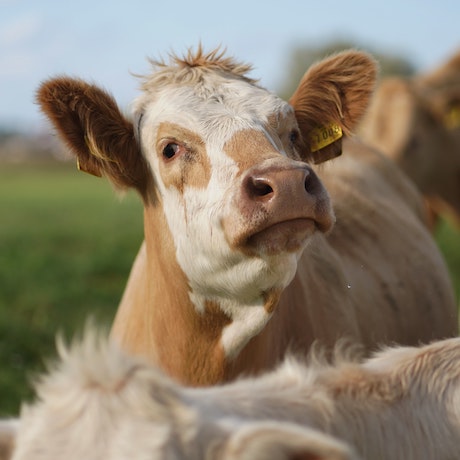
“This is Bessie,” Sara said. “She is a Shorthorn

I petted Bessie and stepped back to look at this wart hanging from the ventral midline of her upper neck. Bruce was pretty accurate when he said it was the size of a grapefruit. The good thing, it was hanging from a relatively narrow stalk of tissue. The first thing that came to mind was that it could be cut off without too much trouble.

“That’s a pretty large wart,” I said. “How long has it been there?”

“It has been there several months,” Sara said. “It has been growing slowly, but there are some smaller ones now, sort of around it.”

I felt the wart and tugged on it a bit. Sometimes an animal will already have developed some natural immunity, and these warts will just pop off. No such luck with this one. I ran my hand over the skin around the wart. There were a half dozen small warts present. They were about the size of a pea and would be just the right size to crush.

“I think we can get this thing to fall off before fair,” I said. “But one thing you should think about, Sara, is if it does fall off in time, you should have another heifer ready to go in Bessie’s place.”

“That’s what dad said,” Sara said. “I don’t want to do that. If Bessie can’t go, I won’t go.”

“Okay, I can understand that. But you are putting a lot of pressure on me to make sure I get the job done,” I said. “So let me explain what I am going to do. First, I am going to give her a vaccine. And we will give her a booster to that vaccine in three weeks. I am also going to crush these small warts off of her neck. That won’t hurt too much, but it will make them bleed. I don’t want you to clean up that blood until tomorrow. Tomorrow you can shampoo the blood out of her hair coat and comb it if necessary. If it bleeds when you do that tomorrow, just let that happen, and don’t clean up the new blood until the next day. It is important that the blood supply is exposed to where I crush those small warts.”

With the explanation out of the way, I gave Bessie a subcutaneous injection of wart vaccine behind her elbow where any lump would be unnoticed. Then, I crushed each of the small warts surrounding the large wart with my needle-nose pliers. Bessie shook her head a little when I crushed the warts, but that was her only reaction. She was dripping blood from the area when I was finished.

“I will be back in three weeks,” I said. “If we are lucky, this big wart might be ready to fall off by then. If not, I will give Bessie another dose of vaccine, and we will wait another few weeks.”

“What is it going to look like when it falls off?” Sara asked. “I mean, is she going to have a big scar?”

“I think it will heal up and have hair covering any scar by fair,” I said.

***

Three weeks passed in no time. Bruce was out with Sara this time when I arrived.

“Doc, I think this thing is just about ready to fall off,” Bruce said.

“That’s a good thing,” I said. “Let me get a look at it.”

All the small warts were gone. This large wart was half detached, and it would probably be ready to fall off by next week. Pulling it off now would cause some bleeding, and we had plenty of time to resolve things before the fair.

“I am confident that this big wart will fall off in the next week or so,” I said. “All the little ones are gone. I am going to give Bessie another dose of vaccine, and I will stop by next week sometime and check her.”

“That crack around the side of that thing looks a little nasty,” Bruce said. “What if the flies start bothering it?”

“You can use some fly spray around it, and you can put some ointment on it,” I said.

“I have some gentian violet. Will that work?” Bruce asked.

“It will work, and it will make one hell of a mess out of her,” I said. “That stuff is terrible to work with, and she will still have a purple neck when fair rolls around. Let me give you a little bit of ointment to use. You won’t need much.”

***

Nobody was around when I stopped by the next week, but Bessie was still tied at the corner of the barn. The wart was gone, and the spot looked like it was healing well. Bessie would be ready for the fair. 

Photo by Julissa Helmuth from Pexels.

Dystocia is a Sow

 D. E. Larsen, DVM

The sun was rapidly sinking behind the hills on the western side of the valley when I finally pulled into George’s barnyard. It had been a long trip to Lacomb. I didn’t like to travel this far for a call because it took more time than I could get an adequate fee to cover my time behind the wheel.

But George had a good client, and I had been up here on several scheduled trips. Tonight George had a sow in labor. I am sure that George would be less confident in my abilities if he knew that I had never seen a sow in labor before.

Swine medicine was almost a specialty in veterinary medicine anymore. If you wanted to be a swine veterinarian, you had to go to school in Kanas or Missouri. At Colorado State, I had argued to get a pig cadaver in freshman anatomy class. In clinics, I could count the number of pigs we treated on the fingers of one hand.

“George, what’s up with your sow?” I asked as I got out of the truck.

George was younger than me, but he must have been married longer. He had a whole gaggle of kids with him, all girls. The youngest one was probably the age of our oldest.

“She has been in labor for a couple of hours,” George said. “She has been straining hard, and nothing has happened. I think she is starting to get worn out.”

“She looks like a big sow,” I said. “I assume that she has delivered a litter or two before.”

“Doc, this is my best sow,” George said. “I get two litters a year out of her, and she has never had a problem in the past.”

“I guess I better get a look at her,” I said.

Sows generally have large litters. If there was a problem, delivery of the entire litter could take several hours. The uterus of the sow was long, stretching well into the abdomen. There was no way that a piglet at the far end of the uterus could be reached without surgery.

I scrubbed the sow’s rear end. She was lying on her left side and didn’t move with the prep. I pulled on an OB sleeve and lubed it up well.

I ran my left hand into her vagina. The vagina was also long, and there was little room for my hand to maneuver. Finally, I bumped into a piglet at the pelvic brim. This was a large piglet, and he seemed to be hung up. His nose was down, like a foal in a poll position.

They make a special forceps for retrieving piglets. Of course, with only a few pigs in my practice, I didn’t have such a forceps. I did have a head snare that I used on lambs. Hopefully, that would work.

I grabbed the snare from my truck and went to work, trying to get hold of the piglet.

“I think this is an abnormal piglet,” I said as I struggled. “It is large and seems to be hung up with his nose.”

“Are you going to be able to get him out?” George asked.

I never answered the question. I was working hard to slip the snare over the piglet’s head. Finally, I had it on the head, and I could feel it move as I pulled on the snare with my right hand.

I carried a handful of lube into the birth canal to provide lubrication. Then with slow, steady traction on the snare, the piglet flopped out on the ground.

What a sight! This guy was not alive. That was probably due to being the plug that was pushed on for two hours. This piglet was twice the size of a normal piglet, and his snout looked like an elephant’s trunk.

“Wow! No wonder she was having problems,” George said as he looked at the abnormal piglet.

George and I were engrossed with this piglet when one of the older girls tapped me on the shoulder. When I looked up, she just pointed at the sow. 

This old sow had been waiting to get the plug out of the way. In the couple of minutes since I had pulled this large piglet, she had three babies pushed out on the ground and another one coming.

By the time we got those four cleaned up, she had three more out behind her. She was spitting out a piglet every three or four minutes.

“I think my job here is done after I give her an injection of antibiotics,” I said. “So unless you want me to stay and watch, I will get on my way home. I am late for dinner already.”

“She is an old pro at this stuff,” George said. “I have some Combiotic that I can give her if that is good enough. How much do you think I should give her?”

“That pig was hung up in there for quite some time,” I said. “With most deliveries, I don’t use anything, but I would give her twenty ccs daily for the next three days.”

“Well, I can get it into her now with no problem,” George said. “But tomorrow might be a struggle, and the third dose, I think you are probably dreaming.”

“You’re probably right, George,” I said. “A good dose tonight might be all that is really needed. Maybe a dose tomorrow, but don’t get hurt trying to give it to her.”

It was dark when I started home. It had been an interesting call. As it would turn out, this would be the only sow that I did a vaginal delivery of piglets. I did do a C-section on an old sow some years later. Swine practice was never a significant portion of my practice in Sweet Home.

Photo by Annie Spratt on Unsplash