D. E. Larsen, DVM
Sandy leaned against the exam door jam, she knew I would not welcome her message. Bob and I were looking at a dog with a serious skin infection that we had just kept for a skin biopsy.
“Elaine called, she is looking at that mare in labor and needs some help,” Sandy said.”She is out on Mountain Home Drive, on the Brownsville side, the owner is George, Robert’s brother. He really wanted you when he called in the first place. Elaine said the head was stuck in a poll position, whatever that means.”
I looked at Bob.
“Don’t look at me,” Bob said. “I have seen a mare in labor, let alone one with problems.”
Difficult birth, dystocia, in a mare was rare. I had been in practice several years before I had a call to assist a mare in labor. At a meeting once, during my time in Enumclaw, I had asked one of the horse doctors how they handle dystocia cases in the mare.
“I give one of you guys a call,” He had responded. “You cow doctors are the OB experts. I maybe see a problem in the mare once every four or five years.”
“Okay, Bob, you get this biopsy done, I will run out and help Elaine,” I said.
Bob and Elaine had graduated a year ago, and had just joined me in Sweet Home. I had be excited, because it not only gave me some help, but Elaine was doing all the horse work.
I double checked my truck, and started out to Liberty. Mountain Home Drive ran from Liberty, over the hill to Brownsville. I didn’t hurry, when Elaine had received the call, the mare had been in labor since last night. A few minutes was not going to make any difference at thiis point.
Elaine was waiting at her truck when I pulled up to the barn.
“I haven’t been able to accomplish anything,” Elaine said. “Every time I try to manipulate the head, the mare bares down, and I can’t move a thing.”
“You have to be careful,” I said. “I hear stories of broken arms if you get your arm past the brim of the pelvis when the mare strains. Let’s go get a look at what’s going on.”
“She has been in labor since sometime last night,” Elaine said. “She is getting pretty tired,” Elaine said.
“I assume the foal must be dead,” I said.
“I’m not sure,” Elaine said. “All I can feel is the top of his head and his ears. How would make that determination?”
“Well, if there is a posterior presentation, you stick your finger in the rectum and feel any contraction,” I said. “In an anterior presentation, you use the mouth, or an eye.”
“You can’t reach the mouth, maybe we can reach an eye,” Elaine said. “Let me try.”
The mare was lying on her side and straining every couple of minutes. She looked exhausted, not even lifting her head as Elaine did one my scrub on her vulva.
Elaine pulled on an OB sleeve and ran her arm into the mare. This induced a strong contraction as she moved her hand along the side of foal’s head to find an eye.
“No reaction there,” Elaine said. “I guess that is pretty conclusive that the little guy is dead.”
“Why would he be dead?” George asked.
“Several things go on in a long labor like this,” I said. “One just the stress of the contraction with the foal in an abnormal postion is enough to kill the foal after severall hours. But often, after three or four hours of labor, we see the placenta separate from the uterus.”
I scrubbed my left arm and reached into the mare to evaluate the status of the position. I usually worked bare arm in OB cases as it afforded better feel.
Elaine was correct, the top of the foal head was tightly pushed into the pelvic canal. I pushed on head, just to see if I could repel it back into the uterus. The mare stained, and I could not budge the foals head.
“So, if I push any harder on the head, there is a good chance it will rupture the uterus,” I said to anyone listening. “Then we have a dead mare.”
“The only other option is to load her up and take her over to the vet school,” Elaine said.
“She isn’t going anywhere,” George said. “I worrying about how I am going to pay you two, I can’t afford going over there.”
“We are not going to be doing a C-section here,” I said. “There other option is a fetotomy. All we have to do is remove the head.”
“They say to never do a fetotomy in a mare,” Elaine said. “There is too much risk of some major injury to the birth canal.”
“I guess it is a good thing I never knew what ‘they’ said,” I said. “I did one in Brownsville a couple years ago on a mare with the exact same presentation. I don’t think there is any other option open to us. We either do a fetotomy, or we euthanize the mare.”
“I’m with you, Doc,” George said. “If things don’t work out, at least we tried.”
“They don’t even teach fetotomies in school anymore,” Elaine said. “I’m excited to see this.”
“Yes, it is almost a dying art. I don’t talk with very many veterinarians who do them on a regular basis. I was tought in school to use a fetotomy rather than a C-section any time the calf is dead. The hardest part with this one will be threading the OB wire around the neck,” I said as I measured off a length of OB wire with my arms. “Twelve feet should be enough.”
I tied the OB wire to the wire threader, a curved heavy gauge stainless steel rod with a loop on both ends.
“If I can pass the behind the angle of the jaw and retrieve it from the other side, the battle is won,” I said.
Working with limited space and trying to be a gentle aa possible so I would induce a contraction from the mare, I managed to push the threader through to the other side of the neck. I grabbed it from the other side and pulled the wire through.
“Where are you going to make the cut,” Elaine asked.
“The best option will be to do a right angle cut through the neck,” I replied. “That will allow me to pull the head out and to use my hand to cover the exposed neck bone so the birth canal is protected. Once the head is off, things will happen fast. She will push out what’s left of the foal with one or two contractions.”
I threaded the two ends of the OB wire through the double-barreled fetotome and attached the handles to the wire.
“George, I’m going to let you do the sawing,” I said. “It’s an easy job. When I give the word, you just start with slow, long strokes. Sort of lean back and put a little weight on wire. You will feel when the wire saw breaks through the skin. At that point, you can quicken the pace a little. It won’t take long, these fetal bones are soft.”
I put my arm back in the mare and slipped the wire over the ears of the foal. Then I glanced and Elaine and told her what I was doing.
“So, I got the wire of the top of the head.” I said. “When I position the end of the fetotome along side of the neck, the wire will slide into position as soon as George starts sawing. And George, if I say stop, you stop instantly. It only takes one stroke to severe a finger.”
“Now you have me worried, Doc,” George said.
Once I had the fetotome in position, I motioned to George. “Okay, nice long, slow strokes.”
George acted like he had done this many times before. He felt when he was through the skin and quickened his pace, leaning back to weight to the wire. He was through the neck in four of five more strokes.
I pulled the fetotome out with my right hand and grabbed the ears on the foal’s head. With a firm tug, I pulled the head free and tossed it on the ground behind me. I covered the the neck bones with my left hand and gave just a slight pull on one of the legs with my right hand.
The mare strained, and the foal moved a bit. Then with one big contraction, the foal almost shot out. The placenta followed. I checked to make sure that it was all there and finally stood up and stretched a little.
“That looked awful easy,” Elaine said.
“Now we just need to give this gal some oxytocin to contract the uterus and some antibiotics. I also like to put about five grams of tetracycline powder in her uterus,” I said.
“Why do that?” Elaine asked. “It will just be discharged in short order.”
“I know, but I will sleep better tonight,” I said. “For one thing, it will give you a chance to check her uterus for any injury and to make sure there is not a twin in there.”
“It’s pretty unlikely of there being a twin,” Elain said.
“You should always check, there are more than one story about that,” I said. “I’ll let you finish here, and I’ll run back to the office just to make sure Bob doesn’t need any help.”
George came out to the truck while I was washing up.
“Thanks for coming, Doc,” George said. “I feel better with you here.”
“We got a little lucky today, George,” I said. “But the mare should come along fine now. Keep a close eye on her and call if you have any questions.”
The mare recovered well and was looking good when Elaine stopped by to check on her the following day.
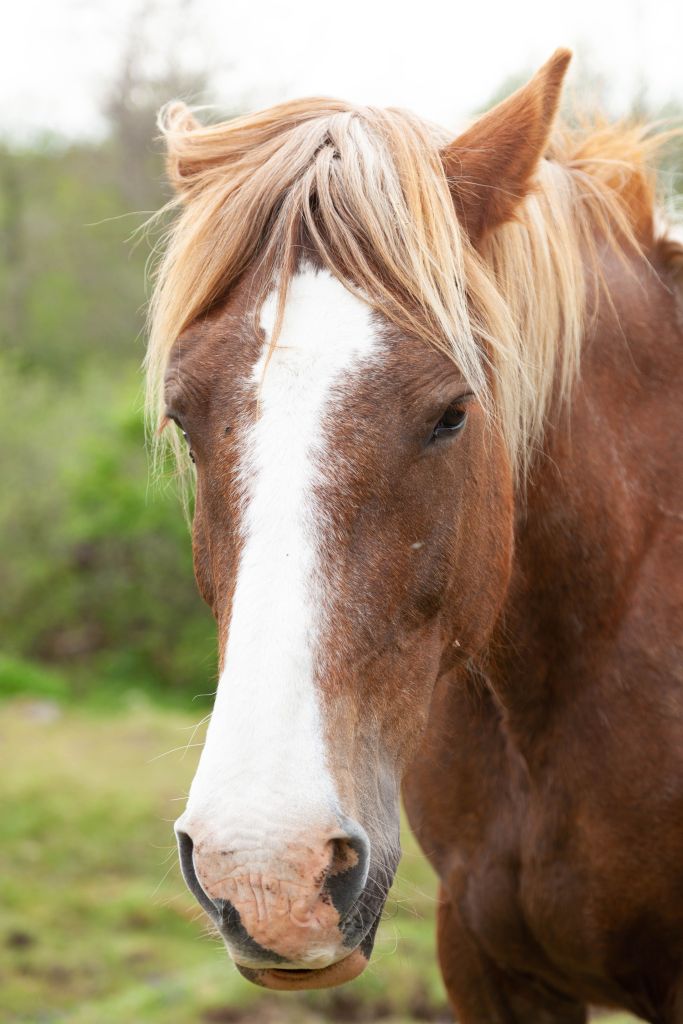
Photo Credit: Philippe Serrand on Pexels.


Thank you, Dr. Larsen, for the fascinating story and another example of your superior expertise expertise!
Joanna
LikeLiked by 1 person
That is a well written, instructional story, Doc. It is interesting that equine vets tended to call cow doctors for equine dystocia problems, but that makes sense. You would be the OB experts. Many of the techniques you used to perform are probably a dying art now, but still relevant, have their place where time and money are in short supply, and should not be forgotten.
LikeLiked by 1 person