D. E. Larsen, DVM
By the time I entered the exam room, Callie was already unhappy. She was actually a nice cat; she just didn’t like the clinic. When Ruth got all her vitals, she was disgusted by the invasion of her privacy.
She perched herself in the middle of the exam table and glared at me, just daring me to be the next one to touch me.
Rebecca attempted to soothe Callie, but Callie raised her paw as a warning for Rebecca not to touch her.
“She’s just a little upset right now, Doctor Larsen,” Rebecca said. “She doesn’t like leaving the house, and the thermometer thing really gets on the fight.”
“She doesn’t like leaving the house because she usually comes to the clinic,” I said. “But I know Callie, and she is basically good. She just doesn’t like to have anything to do with me.”
“I don’t think it is you, Doc,” Rebecca said. “She just doesn’t like her routine disrupted.”
“You are just here for Callie’s annual exam and vaccines, I see,” I said. “But Callie looks a little unkept to me this year if I remember correctly. Has she been feeling okay?”
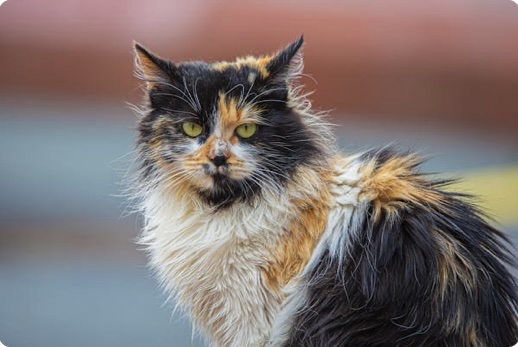
“She is doing pretty well, I think,” Rebecca said. “Now that you mention it, she is a bit thinner this year. Ruth said she had lost a couple of pounds. And unkept; maybe I just haven’t noticed since I see her every day. I guess we just attributed it to her getting older. But looking at her now, she has seemed to have lost that slick hair coat.”
I reached my hand out to pet Callie on the back, avoiding her head for now. She instantly swirled and hissed. And swatted me on my wrist, drawing blood.
Cat scratches could be serious, but bite wounds from a cat are much more serious. Cat bites account for the largest number of State Industrial Accident claims in the veterinary field. And a cat is the only animal to put me in the hospital from a bite wound on my hand.
“Callie, you and I are going to have to come to terms with each other if we are going to do an exam,” I said.
Then, with a distracting motion with my left hand, I grabbed Callie by the nape of her neck with my right hand. Even old cats are usually easily controlled with such a grip. I always felt it to be a learned response from when they were moved about by their mothers.
Once I had a hold of Callie, I could calm her enough for a thorough exam. After listening to her chest and abdomen with a stethoscope, I briefly peeked into her mouth. Then, I switched hands on my grip on her neck and palpated her abdomen with my right hand.
Her anterior abdomen was not normal. I finished palpating the rest of the abdomen and then returned to her anterior abdomen. I switched hands again and palpated with my left hand. I had been trained to use my left hand for rectal palpations, and I could almost see with my left fingertips. I could feel a mass projection from the lever. It was not painful, but it had a very irregular surface. It was the size of a large lemon.
I released my grip on Callie’s neck, and she settled on the exam table. I patted her head and thought I could hear a slight purr. She was calm, feeling that her torture was over. Rebecca could tell that I had spent much longer on the exam than was normal.
“What did you find, Doc?” Rebecca asked.
“Callie has a mass in her anterior abdomen,” I said. “It is probably a liver tumor. It is not painful, but based on Callie’s weight loss and rough hair coat, it is causing her some problems. We need some x-rays and blood work to better define things.”
“Doc, you know we love Callie,” Rebecca said. “But things are slow right now in Gavin’s construction business. And Doc, I am four months pregnant. There is no way we can spend much money on Callie right now.”
Rebecca and Gavin had been good clients for over five years. I would have no problem carrying an account for them. I knew that Rebecca had managed their finances carefully and that they were not going to overextend themselves.
“I could carry an account for you guys with no problem,” I said.
“Doc, it’s not that we couldn’t come up with the money or that we couldn’t make payments; it’s that we just can’t put ourselves in a position of uncertainty at this time,” Rebecca said. “Are there any lessor options available?”
“We need to talk frankly right now,” I said. “Rebecca, I don’t have any success stories to tell you about liver tumors in my hands. It’s almost a death sentence. And from what I can tell, that is probably the case for you and I.”
“Are you saying we should put her to sleep?” Rebecca asked.
“The only shortcut we could make would be to go right to surgery with no diagnostics,” I said. “I would do that for you if you understand that if there is nothing I can do, we put Callie to sleep instead of recovering her from the surgery. That way, we give Callie a chance. If things go well, she wakes up and gets a new lease on life. How much time we buy for her depends on what kind of tumor she has.”
“That sounds like a good plan,” Rebecca said. “At least I will feel like we did the best we could, one way or the other.”
“There will be several bridges to cross,” I said. “The first one will be for Callie to survive the surgery. Then, we will have to wait to see if the liver still works. And finally, her survival will depend on the malignancy of the tumor and what kind of metastasis are present.”
“I guess we better schedule it as soon as possible,” Rebecca said.
***
Callie seemed much more at ease with the clinic when Rebecca brought her in for surgery early the following week. The girls took her back and started the prep routine while I spoke with Rebecca.
“I just want to make sure you understand what is going to happen today,” I said.
“Yes, Gavin and I discussed it again last night,” Rebecca said. “We have the utmost confidence in you, Dr. Larsen. And we trust your judgment. If there is a chance your hands can save Callie, that would be great. But if it is not to be, we are prepared for that also. Will you give me a call when surgery is over?”
“Yes, I will call as soon as we are done,” I said. “If it looks like I can’t do anything, I will call before we euthanize Callie. But I don’t plan to wake her up. I just want to make sure that is clear.”
“We wouldn’t want to put her through any more than what is necessary,” Rebecca said. “I guess I need to sign that little form in case you need it.”
Rebecca signed all the papers and went back to say goodbye to Callie one last time.
“I will be waiting for your call, Doc,” Rebecca said with tears in her eyes. “I am guessing that the longer I have to wait for a call, the better the chances are for Callie.”
“That’s right, Rebecca,” I said. “A lot of times, if things are bad, the decision is made shortly after the initial incision. Maybe I’ll have Sandy give you an early call for a progress report. That way, you won’t be completely in the dark.”
Once Rebecca left, we took Callie right into surgery. Once she was under anesthesia, we clipped her entire abdomen. We extended the clipped area to include some of her rib cage.
“Why do you want such a large area clipped?” Ruth asked.
“Hopefully, this will be a four or five-inch incision, starting at her rib cage and extending toward her umbilicus,” I said. “But we really don’t know what we will find when opening her up, so if we need to go longer, we will be ready.”
When Callie was all prepped and draped, I took a deep breath and made a four-inch skin incision. Then, I extended the incision through the abdominal wall through the linea alba. Once the abdomen was opened, I removed the falciform ligament to provide more room and visibility.
I placed retractors on each end of the incision and carefully reached into the abdomen with my left hand. The mass almost jumped into my hand. I moved some intestines out of the way and pulled the mass up to the incision.
This was an ugly mass. I worked it through the incision. The only good thing I could see was it was on a thin stalk of liver tissue extending from the left lateral liver lobe. That meant I could remove it. But looking at it, I don’t know how much time this would buy Callie.
This tumor was made of a mass of nodules. Each nodule was a centimeter in diameter, and the color was a pale red. There was a distinct demarcation between the tumor and normal liver tissue on the stalk. This stalk of liver tissue was almost an inch wide and less than a centimeter thick.
“Are you going to be able to remove that thing?” Ruth asked.
“That’s the good thing,” I said. “This looks like a snap to remove. The problem will be if this is malignant. It has likely already metastasized. We might not be buying much time for Callie. But we are here, and this is coming out. Time will tell us the rest of the story.”
“I will have Sandy give Rebecca a call and tell her the tumor is removable and we are going ahead with the surgery,” Ruth said.
“Yes, that is all we can say right now,” I said.
I placed six overlapping mattresses across the stalk to the liver tissue connecting the mass. When I tied these, crushing through the liver tissue, they ligated all the vessels and biliary tree going to the tumor. Then I incised through the stalk on the mass side of the ligatures. There was no bleeding. I sat the tumor on the tray and released the stalk of tissue back into the abdomen.
I carefully explored the rest of the liver and the anterior abdomen for a few minutes. I could find no other tumors and no evidence of metastasis. I had done all I could do.
I did a three-layer closure with Maxon, and we moved Callie to the recovery kennel. Then I went to my office to call Rebecca.
“Surgery went well and things were the best we could hope for,” I said as soon as Rebecca answered the phone. “The good thing is this tumor was on a small stalk of liver tissue and it was easy to remove. The bad thing is it is one ugly mass of tissue.”
“Do you think Callie is going to be okay?” Rebecca asked.
“She is doing well right now and recovering well,” I said. “I think she will better with the mass out of her belly, but as to what kind of survival time we have bought her, only time will tell. We could know a little more if we send this tumor over to the diagnostic lab and find out what it is and how malignant it might be.”
“If we spend the money to know a little more, does that allow us to do anything to change the outcome?” Rebecca asked.
“No, Rebecca, we have done all there is to do,” I said. “At this point in time, there is nothing left to do. All it will do is allow us to put a name on this tumor. What is going to happen will happen, and all the money in the world will not change the outcome.”
“I think we can live without putting a name on that tumor,” Rebecca said. “We will just take things as they come and love every day we have, Callie.”
Callie went home at the end of the day. She looked like she was feeling well and purred loudly when she saw Rebecca.
***
When Rebecca was in for suture removal two weeks later, Callie had already gained a pound.
“We are so pleased, Doctor Larsen,” Rebecca said. “Callie feels so much better since her surgery. She is eating better and almost plays a kitten at times.”
“Her attitude hasn’t changed much,” I said as we wrestled Callie to remove her sutures.
“I am a little embarrassed. You would think Callie would love it here now,” Rebecca said.
“Our patients seldom give us any credit,” I said.
***
Nearly five years later, Rebecca and her daughter dropped by the clinic.
“We just want to let you know that Callie died at home last night,” Rebecca said. “We are so happy to have had her for all these years. They were really good years for her. And most of all, Brigit got to grow up with Callie sitting on her lap every morning.”
“Thanks for letting us know,” Sandy said. “Pets give us so much of themselves. It is just sad that their lives are so short.”
“You guys and Dr. Larsen gave her almost five extra years,” Rebecca said. “And we can’t thank you enough.”
Photo Credit: Irfan Rahat on Pexels