D. E. Larsen, DVM
I am unsure of the year, but I think it was 1954. I do remember an early spring and a bumper crop of kittens in the barn. We were living at Broadbent, and we milked a small herd of dairy cows.
One of my jobs was taking care of the barn cats. They got pretty much all the milk they could drink, and a few cups of dry food. The rest of their ration came from the mice in the haymow.
My self imposed responsibility was to keep track of all the new kittens in the barn. Some of the mother cats were pretty good at hiding their litters and it would take considerable detective work to find all of them.
That year we had twenty-seven kittens born to six mother cats. The largest litter was eight kittens, and the smallest litter (and the last one found) was three. With six mother cats and just about an equal number of young tom cats, how were we going the handle twenty-seven more cats in the barn.
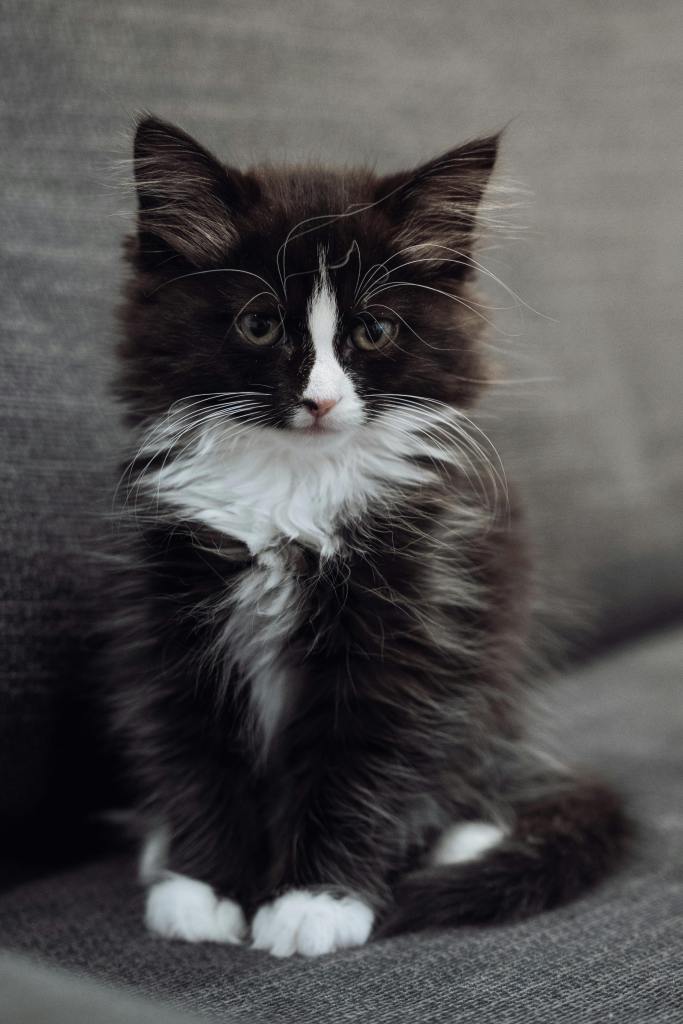
When I found the last litter of three kittens, they were a little older than the rest and the mother cat had kept them well hidden. The little black and white kitten was wild and hissed and scratched when I tried to touch him.
He quickly became my favorite, and with four white feet, I named him socks. After playing with him at every milking, he tamed down quickly. But it was obvious who ruled the litter.
The looming population boom continued to worry me. Finally, I had to discuss things with Dad.
“What are we going to do with all these kittens?” I asked.
“Don’t worry about it,” Dad said. “Nature takes of things most of the time.”
That didn’t mean much to me at the time. What did nature have to do with a bunch of kittens.
Everything went along fine for another week. Socks even seemed to look forward to my visit to their little nest that I would pass when I carried the grain rations to the cows who were being milked. I would stop and pet the kittens when I had a free minute.
Then one afternoon, the nest was empty. The mother cat never came to the milk bowl for the evening meal. I searched the barn and the haymow everywhere. The litter was just gone.
At the dinner table that evening, Mom could see that I was upset.
“What is the matter, David?” Mom asked.
“That last litter that I found is gone, the one with that black and white kitten that I named Socks,” I replied. “I’ve looked everywhere. I can’t find them and the mother cat didn’t come to the milk bowl tonight.”
“It is probably okay,” Mom said. “Mother cats often take their kittens out to teach them to hunt. She will be back in a couple of weeks.”
That seemed reasonable, but I continued to search the deep recesses ins the barn every evening. When Saturday came, I climbed the hill behind the barn, hoping find the litter. But just as Dad had said, it was a waste of time.
And then the nature thing happened! When I got to the barn after school on Monday. I had some time to look for hiding spots again. When I came across the large litter of eight kittens, four of them were dead. The others were nearly moving. They looked like they would be dead by morning. The mother can was distressed. I removed the dead kittens and showed them to Dad.
“Throw them out in the manure pile,” Dad said. “For them to die that quickly, it is probably Distemper. We will be lucky if any of them live.”
Over the next couple of days, more kittens found the grave in the manure pile. By Thursday evening, every single kitten in the barn was dead.
“That’s what I was talking about,” Dad said. “When there are too many kittens, the ole distemper virus comes along, and not too many survive.”
“None survived,” I said. “Not a single one.”
“Well, maybe your favorite kitten, who is out hunting, maybe they got lucky,” Dad said. “Maybe his mother knew the barn was not safe with so many kittens.”
That was an interesting thought, did she take the kittens out teach them to hunt, or did she know that the epidemic was coming?
It was almost a full two weeks later when I noticed Socks’ mother at the milk bowl following the evening milking. I ran down to their old nesting area, and sure enough, there were three healthy kittens waiting for attention.
Those three kittens were the sole survivors of the distemper epidemic. Was it just the luck of timing the hunt or did the mother know it was coming?
Socks grew into a large tomcat. It didn’t take long and he was the dominant cat in the barn. All the other cats would move out of his way when he approached the milk bowl or food dish.
In the spring of 1958, we moved back to Catching Creek. To a larger farm, an older barn and bigger herd of dairy cows. The cats all moved with us, and everyone stuck around. The familiar milk bowl was a strong drawing card.
This old barn had a lot of old chopped hay in the haymow. Rather the emptying it out, we just stacked the baled hay on this thin layer of chopped hay. The chopped hay was alive with mice.
On lazy afternoons, I would take Socks to the haymow and use a pitchfork to scatter the chopped hay. Mice would run in very direction. Socks would catch three of four at a time. One under each paw and one in his mouth.
One one of those afternoons, both me and socks laid in the hay after a mouse catching session. Without thinking about the consequences, I wiggled finger under the chopped. Socks, who was almost asleep, immediately pounced on the finger.
I learned what the mouse have felt like as his claws secured my finger. It took a moment to calm Socks and extract my bruised and scratched finger from his grip. We didn’t do that again.
Barn cats didn’t have the luxury of veterinary care in those days. And tom cats were not known to be long lived. Socks maintained is position at the top of higher archery for quite a few years. You could tell that he was getting older because he stated to have more battle wounds. The younger tomcats were starting to replace the old man.
It was the spring of 1967. I was in the Army in South Korea at the time when I got the letter from Mom that Socks had died. I was thirteen, a very good lifespan for a tomcat in the 1960s. When I started practicing in 1975, I never saw a male cat over fifteen, and those older males were all neutered.
I never heard of Socks’ final resting place, but my guess is it was the manure pile. He finally joined all those other kittens from 1954.
Photo Credit: apertur 2.8 on Pexels


What a great story! Barn cats were fun!
LikeLiked by 1 person
Wonderful! My parents adopted a barn kitten. She was small and flea infested. She never became “tame” and retained a grudge against my mother for bathing and defleaing her. She would sit on my father’s lap but he had to remain stock still or she’d attack! As for petting her – never! They named her Abigail but we all called her Crabby Abby….
LikeLiked by 1 person
That was a lot of kittens! I can picture you as a youngster ferreting them all out and keeping track of them. That was one smart mother cat who took her kittens offsite for a while when the round of distemper started. I remember the alternate function of those old time farm manure piles from the story of Gus.
LikeLiked by 1 person