Fort Devens 

D. E. Larsen, DVM

The late flight into Boston was nearly empty. With three Army guys and one businessman, the stewardesses ran out of anything to do. We ended up in the back of the plane playing cards. One of the girls would run up and check on the other lone passenger every half hour.

I stopped at the ticket counter on my way out to see if they had a suggestion on how I could get to Fort Devens.

“You’re not going to get there at this hour unless you hire a cab,” the clerk said. “It would be cheaper to rent a hotel room and catch the bus in the morning.”

I caught the last shuttle leaving the airport for a downtown hotel. I was a little flush with money, and travel pay was far more than the standby ticket. Plus, I was able to work a few days when I was on leave at home. It worked out pretty good to be home over Thanksgiving. I would be in school at Fort Devens for nearly a year.

The bus ride from Boston to Fort Devens was about thirty miles. Most of the leaves were off the trees, and it looked like I missed the fall colors.

I caught a cab to the Fort when I got off the bus.

“What company are you going to?” the cabby asked.

I looked at my orders.

“It says ASA Training Company C,” I said.

“There has been a bunch of you guys heading up there,” the cabby said. “I hear that the schools are really backed up.”

When the cabby dropped me off in front of the company building, I looked for a moment, sort of getting my bearings.

The company building was a six-story brick building, and troops were milling around aimlessly. I took a deep breath, shouldered my duffle bag, and headed for the front doors.

The orderly room was packed, and chaos reined. I worked through the crowd and handed my orders to the CQ. He wrote my name on a list and handed me my orders back.

“You hang on to those for now,” the CQ said. “I think they will be sending a bunch of you guys down to the second battalion this afternoon. You can grab a bunk on the fifth floor, west side bay, if you want. It is a little crowded, but you might be able to rest a bit. But keep your ears open. We will announce the guys’ names on the transfer list as soon as it is confirmed.”

I carried my heavy duffle bag up the five flights of stairs and opened the door to the West bay. I stood looking at a big mess. Who’s Army allowed men to live like this? The bunks were not made, clothes hung from everywhere, and guys were sleeping in all states of dress and undress. I scanned the room and saw an empty bunk against the far wall.

“Did you just come in?” a red-haired kid asked.

“Yes, I just got off the bus from Boston,” I said.

“This place is a mess,” the kid said. “They are telling us that we might be waiting for six months for school.”

“I am surprised by the disorder of this bay,” I said. “Doesn’t anyone check on things?”

“I’m not sure this company has a commanding officer,” the kid said. “There is nothing for anybody to do. Everyone just lies around all day.”

“The CQ said they were going to send a bunch of us down to the second battalion,” I said. “Do you know anything about that?”

“That doesn’t surprise me,” the kid said. “We are running out of room fast. I think yours is the last empty bunk in this bay. And people just keep coming.”

I unbuttoned my jacket and loosened my tie. There was little use in organizing anything if I was going to be sent elsewhere in a short time.

The intercom honked a couple of times.

“Listen up, this is the list of names of those going to Company D in the second battalion. There will be a couple of trucks here before noon. This list will be posted in the orderly room. If you miss the trucks, you will have to walk.”

Then a long list of names followed, my name was near the end of the list.

“Well, there is no reason for me to mess up this bunk,” I said. “I guess I will head downstairs and wait for the truck.”

“Wait up,” the kid said. “My name was on that list also. I’ll go downstairs with you.

“My name is Dave Larsen. What’s your name?” I asked.

“Marsden, Marsden Burger,” Marsden said.

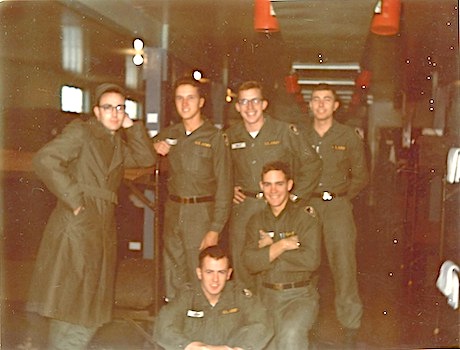
The truck ride to the second battalion was short. We were greeted by First Sergeant Scagliotti. He was a short, round Italian with a broad smile. I thought he was old. He was in his early forties.

“You guys stash your gear in the orderly room or the day room. We will meet in the day room after you guys get lunch. We will assign quarters at that time. The mess hall is Con-4, located just across the field,” Sergeant Scagliotti said as he pointed to the giant mess hall.

The day room was full of chairs set up for the meeting. A few guys were playing pool, but that all stopped with Sergeant Scag entered the room.

“So this the deal, the schools are all backed up with this build-up for Vietnam,” Sergeant Scagliotti said. “You guys will be waiting for three to six months before you get into a class. To keep you busy, we have formed this duty company. Most of you will be on KP every day. To make up for that, once you’re in school, you won’t have to pull KP. That is an Army promise. I have been in the Army a long time, and I will tell you that Army promises always come with a hitch. Take that for what it is worth.”

There were more than a few moans from the crowd of troops. We were recruited to be elite troops, and now we were going to be working in a kitchen for six months.

“Now I need eight guys to work for me,” Sergeant Scag said. “Six guys to be permanent CQs and two mail clerks. You need to be able to type, and you won’t be able to go home for Christmas. The CQs will work twenty-four hours on duty and forty-eight hours off. The mail clerks will work eight to five days and Saturday morning.”

I had always heard the cautions about volunteering in the Army, but this sounded better than six months of KP, and I had no plans to go home for Christmas. I raised my hand. I also gave quiet thanks to Miss Duke for teaching me to type in high school, despite my reluctance.

“Okay, the barracks assignments are on the board downstairs,” Sarge said. “Supply should have bedding on all the bunks. You guys can get settled and plan on a long weekend off. Our duty assignments will start on Monday, and your trick assignments and squad leaders will be set up by then. Just stay out of trouble; I prefer you not to go to Boston this weekend. Anywhere locally is fine. And all you guys who raised your hands, you stay here.”

The room cleared out pretty fast. There was a lot of grumbling as the guys filtered by, and Sarge never seemed to notice.

“You guys will be working for me,” Sarge said. “You can wear fatigues when on duty, but I want you to look sharp. You ask for extra starch when you turn in your laundry. I will pair you up, and you will share a squad room. You won’t be in the open bay. But you aren’t going to get the weekend off. Larsen and Drake, you guys will take the first shift starting in the morning. We will get the rest of you lined out pretty soon, but Larsen and Drake had better get moved into your squad room and get some sleep. The twenty-four-hour shift will get a little long until you get used to it.”

And so it began. My stay at Company D (Dog Company) with Sergeant Scagliotti turned out to be only four months. Still, it was four months with the best mentor that the Army could provide. 

Sergeant Scagliotti will be the topic of the next post.
Moose’s Escape

D. E. Larsen, DVM

Office hours on Saturday mornings were always the same in the summer. If the sun shined, half the appointment never showed up. But you could be sure that the last appointment would make it.

“Everyone is headed to the lake this morning,” I said. “The last four appointments have been no-shows. We have one more at eleven-thirty, why don’t you call them to make sure they are coming. Maybe even get them in a little early if that is possible.”

“That would be nice. The kids wanted to see that movie this afternoon,” Sandy said.

Sandy called, and yes, the gal was still coming, and she could come now. So maybe we could be done early enough to catch the matinee with the kids.

It wasn’t long before Sally dragged a reluctant Moose through the clinic’s front door.

I knew Moose from several previous appointments, and his name fits him well.

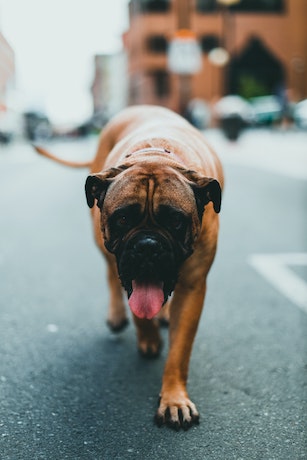
Moose was a Mastiff and a large one at that. Couple that with a generous layer of fat. Moose was one of my larger patients.

“He looks a little reluctant to see me this morning,” I said as Sally stopped to catch her breath.

“I have been so mad at this dog this morning,” Sally said. “Our neighbor’s dog is in heat, and this dog has been out of his mind.”

“It’s been known that some males will do crazy things when a female is in heat,” I said.

“Yes, Doctor, I am well acquainted with the antics of the male of a species,” Sally said. “But this dog managed to climb up on our wood pile and jump over the fence into the neighbor’s yard. Now I have a limping dog and neighbor who is not too happy that his Lab might be having half mastiff puppies.”

“I assume we are checking Moose’s limp,” I said.

“Yes, that was a six-foot fence he jumped over,” Sally said. “This old tub of lard must have been thinking he was still a puppy.”

“I think that is a common male trait also,” Sandy said, looking at me with a wry smile.

“We are trying to get done this morning so we can catch the matinee with the kids,” I said. “Let me get a look a this limp. Can you have him walk a few steps for me?”

Sally tugged on Moose’s lead rope, but he wasn’t going to move. She coaxed him and pulled again.

“Nope, he’s not moving,” Sally said.

“Try turning around and taking a few steps toward the door,” I said.

Moose almost jumped when Sally headed for the front door. He had a pretty significant limp on his right front leg.

“That was a pretty big jump for this guy,” I said. “He is limping pretty good. The fact that he is bearing weight probably means no fracture, but a ligament injury is sure possible.”

I knelt down and started looking over Moose’s leg.

“Tell me when it hurts,” I said. “Moose looked away, trying to avoid eye contact with his tormentor.

I grabbed his forearm and pulled his leg forward as hard as I could, checking the shoulder. Then I flexed his elbow and rotated his forearm this way and that. Moose made no response to any of that. I went over his foot, palpating each of his toes. Still no response. Then I came to his carpus. I flexed his wrist, and he flinched. I bent it again, and Moose growled.

“That doesn’t sound like Moose,” Sally said.

“He is just saying don’t do that again,” I said.

“What do you think, Doctor?” Sally asked.

“I think he got lucky,” I said. “His leg looks okay. He probably just has a sprained wrist. I will need to get some x-rays to make sure there isn’t a fracture, and also I will need to get a stress view or two to check for ligament tears. But if the x-rays look okay, I think a wrap and a splint for a week or two will be all Moose needs.”

“Can you do that this morning?” Sally asked.

“Yes, I think so,” I said. “I will have to sedate him briefly for the x-rays, and it will take a while to wake up enough to go home. Why don’t we plan to leave him? I will get the x-rays, do a wrap with a splint, and then call you when we get out of the movie.”

“That will be fine,” Sally said. “You think he is going to be okay.”

“If I don’t find anything on the x-rays, he will heal with his foot in a splint for a week or two,” I said. “Of course, you will have to convince him to ignore his neighbor during that time.”

“How are we going to do that?” Sally asked. “After this morning, I don’t think my neighbor will be very talkative.”

“Finding a kennel might be a good idea,” I said. “That will remove the immediate problem and probably allow this sprain the heal better with some rest and relaxation.”

Sally left Moose, and Moose, deciding that he was stuck, became more cooperative.

After sedating him, I could check his carpus joint with some aggressive palpation. I was convinced there were no ligament tears. The x-rays looked fine. I placed a padded wrap on his foot that went halfway up his foreleg and taped a metal spoon splint on the outside of the wrap.

We moved Moose back to one of the runs in the kennel room, and by the time I had him situated, he was already waking up.

“You do fill up this run,” I said to Moose as he looked around at his surroundings.

Moose was on his feet in no time. It took him a few minutes to put some weight on his wrapped foot, but when he did, it didn’t seem to bother him.

“Do we have enough time to send Moose home now?” I asked Sandy.

“We are going to have to hurry if we are going to make the movie,” Sandy said. “Let’s just come over after the movie and send him home then.”

We rushed home, gathered the kids, and went to the afternoon movie at the Rio Theater.

I sneezed when we came out of the dark theater into the bright sunlight.

“You always sneeze like that in the sun,” Sandy said.

“Any change in light intensity causes me to sneeze,” I said. “It must be some mixup between my olfactory and optic nerves. I don’t see it in very many other people. Colonel Paris in the Army, and my nephew David Larsen, are the only ones I have ever noticed it being a problem.”

The kids piled in the car, all smiles.

“We better go send Moose home,” Sandy said.

“How long is that going to take?” Brenda asked with a fading smile.

“It won’t take long,” Sandy said. “He is ready to go. We just need to call his owner and wait for her to come to pick him up.”

It only took a moment to drive the two blocks to the clinic. I got out of the car, followed by the kids, and sandy was helping Derek out of the car.

I opened the door and stepped into a puddle of water.

“There’s water on the floor,” I said. “You guys wait here until I find where all this water is coming from.”

There wasn’t a lot of water on the floor, but it shouldn’t have been there. I checked the sink in the pharmacy, the bathroom, and the surgical scrub sink. There was no problem in the front of the clinic.

When I opened the door to the back of the clinic, I could hear water rushing, and the room was cold. The floor drain in the treatment room had a whirlpool, as the water was draining as fast as possible.

I opened the kennel room door. It was freezing like an air conditioner was stuck on low, and there was quite a site to greet my eyes. The hose faucet was running full bore. The floor drains were draining water as fast as they could, but that was not fast enough. The lone cat in his kennel was in the back corner, curled up, trying to stay warm.

And Moose was standing on his hind legs, pressed against the far wall, shivering. The gate to Moose’s run was on the floor. Obviously, knocked off its hinges by Moose.

I turned off the water faucet, and the drains quickly caught up with their job. I motioned Moose to come, and he almost knocked me over, getting out of the room.

“What the hell did you do?” I asked Moose as I took out to the recovery kennel in the front of the kennel. Then I went out to talk with Sandy.

“We need to run home and get the shop vac so I can start drying this floor out,” I said. “Moose knocked the gate of his run off the hinges and somehow turned on the water faucet full blast. Water is everywhere, more in the back, but some out front. It’s no real problem, everything is up off the floor, and the floor is concrete. The drains in the back are catching up with their job since I turned off the faucet.”

“Do we get to go home?” Brenda asked.

“Yes, I will take you kids home,” I said. “Then I will have to dry the floor enough to send Moose home. I will probably have to change his wrap. I am sure that he has it soaked.”

When I returned with the shop vac, most of the water had made it to the floor drains. Moose had warmed up enough that he was no longer shivering, and the cat in the kennel room was still looking around like he had just witnessed a circus. Moose knew he had done wrong. He would not look me in the eye. I left him in the recovery kennel while I changed his wrap and reapplied the splint.

Then I gathered every towel I could find and started mopping up the residual water in the front of the clinic. It was warm enough that the floor actually dried out pretty fast. I ran the shop vac in the back of the clinic, where there was a little more residual water. It would be dry by morning.

Finally, I could give Sally a call.

“I thought something must be wrong,” Sally said. “I expected your call earlier.”

“Well, it seems Moose took exception to his accommodations,” I said. “He knocked the run gate off its hinges and, somehow, turned on the faucet in the kennel room. I have been drying this place out for the last couple of hours.”

“Is Moose okay?” Sally asked.

“Oh, he is fine,” I said. “I had to change his wrap because it was soaked, and he is a little embarrassed about the mess he left for me, but he is fine. The cat back in the kennel room still hasn’t processed the entire event yet.”

Moose went and healed up with no problem. The clinic was completely dry by Monday morning, and I removed the handle from the kennel room faucet, just in case we had to keep Moose again. The run gate was more challenging, but I could fix the hinges so the gate could not be removed by a fractious dog.

Photo by Jonathan Copper on Pexels.

KATA Alumni, From the Archives

D. E. Larsen, DVM

“Doctor Larsen, I visited my therapist today, and she told me to find what motivates me and run with it,” Vicki said. “She said, ‘if that happens to be cats, then do cats.’ I am going to start a cat rescue, and I am wondering if I can get some support from you.”

“That sounds like a big project, and there is a definite need around here,” I said. “The County gives no help for cats, and the Humane Society is not much better. Cats definitely are relegated to the back seat.”

“Well, we are going change things,” Vicki said. “Doris is on board with me. We will start small, but we have big plans.”

“I would guess you are going to have to define your operations pretty well, or you are going to be overrun with demand. But I will give you all the support that I can afford. I don’t have real deep pockets, you know.”

Following the initial brief conversation, Vicki and Doris embarked on their project. They had lessons to learn along the way, sometimes they were hard lessons, and as I predicted, the job soon became more than two people could handle.

They started working with colonies of feral cats. Sweet Home had more than enough of those colonies. The life of a wild cat was difficult and short. 

Their goal was to capture, neuter and release. Once captured, they would test for feline leukemia and then vaccinate the negative cats for rabies and feline distemper. The cats would receive a broad spectrum dewormer and then have a trip to a low-cost surgery at the humane society in Salem. There they would be spayed or neutered, as determined by their plumbing.

Once treated and rendered sterile, they would be released back into the colony. With a distemper vaccine onboard, the cat’s survival was greatly enhanced. Distemper is one of nature’s mechanisms to control the population of the cat colonies. In young cats, it is a highly fatal disease. The colonies would experience periodic epidemics where the virus would eliminate a significant portion of the kittens. The feline distemper portion of the vaccine given to the captured cats is one of the best vaccines science has produced. With vaccination and periodic natural exposures to the virus, cats remained solidly immune. The average age of the colony indeed doubled.

The first significant attempt to provide primarily free neuter and spay surgeries locally were undertaken with the aid of the Feral Cat Coalition. The FCC operated a mobile truck set up with three surgery tables and a prep table. Caregivers could bring feral cats in for surgery and vaccinations done by volunteer veterinarians. There was no fee for the procedure. Although, a donation was expected.

My first experience volunteering for the day was when they had the truck at the Holley Grange. I found the day exhausting and the environment in the surgery room hot and lacking adequate ventilation. But we accomplished close to a hundred surgeries. I am sure that some of the cats were less than feral.

After that experience, the Kitty Angel Team took off like wildfire. They grew in numbers of volunteers helping them. The number of cats that they helped, actually saved, also increased. 

They arranged for periodic visits of the Feral Cat Coalition surgery truck. When that wasn’t enough, they would transport cats to low-cost clinics and the humane society for spays and neuters. They held adoption clinics in Petco’s in Albany and Corvallis. And with their tax-free organization status, they expanded their all-volunteer, no-kill cat and kitten rescue to serve the entire mid-Willamette Valley. Their name also extended to the Kitty Angel Team Adoption, KATA.

They were obviously the only choice for Sandy and me when we were tasked with finding kittens for our two California granddaughters, Addison and Olivia. We gave Vickie a call.

“Vickie, we are looking for a couple of kittens for Dee’s girls,” I said.

“You’re in luck,” Vickie said. “Doris has a bunch at her place that are just about ready to go. I would guess that we could release a couple of them early to your care. I will call Doris and tell her you are coming if you would like. Do you know where she lives?”

“Yes, we have been by her place often,” I said. “And it would be great if you could give her a call, that way I don’t have to know her phone number. I know you two try to protect your privacy as much as possible.

We can get up there this afternoon. We are not going to California until the end of the week. But we can hold the kittens at the clinic until we leave. That way, we can make sure they have all their shots and deworming.”

Doris was waiting for us when we pulled into her driveway.

“I have these kittens in the old chicken coop,” Doris said. “This spring has been pretty productive. We have almost twenty kittens in there. I have a few more isolated, just for that mild upper respiratory stuff they get sometimes.”

We followed Doris into the chicken coop, and we were immediately swarmed with kittens. I think they were expecting to be fed. There were all kinds and colors. They all looked to be six to eight weeks old, and I could only spot a couple with a bit of discharge in the corner of their eyes.

“We keep the younger ones with our foster caregivers,” Doris said. “Then, when they are about six weeks old, we move them in here, so they are a little better socialized to the ways of being a kitten.”

“Picking two out of twenty might be a little difficult,” I said.

I had no more than spoke those words when two kittens launched themselves onto my pant legs and started to climb up. They were a couple of tabby kittens, and they looked so much alike that they must have been littermates. 

“It looks like these two made a choice for me,” I said.

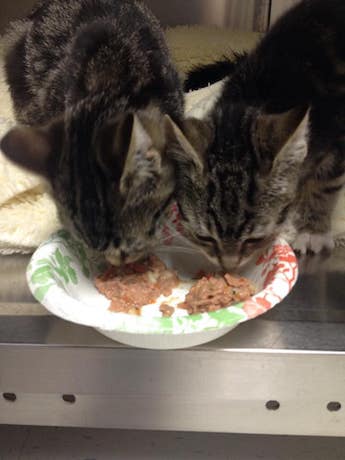
We gathered the two kittens up and made a generous donation to KATA. The kittens shared a kennel at the clinic. It was a couple of days before our trip, and they seemed to enjoy being away from the crowd.

***

The trip to South San Francisco proved to be uneventful. The kittens, in their carrier, had no issue with traveling. We stopped for a visit with cousins at Fortuna. We stayed in a motel, but the kittens stayed with the cousins. They were almost adopted by Lorrene and Jim. We could have easily left them there.

We picked up Addison and Olivia from school on our arrival at Dee’s. To say they were excited to see the new kittens would be a colossal understatement. 

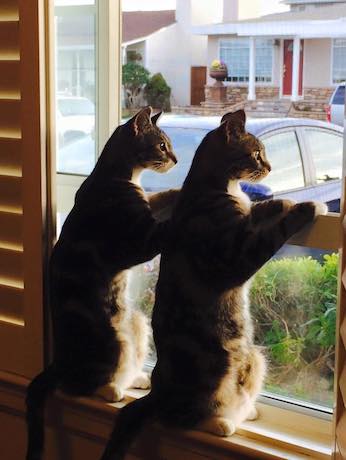
It did not take long for Wishbone and Crystal to become fixtures in the family. They have individual personalities, but they also remain very close to each other in their daily routines.

And most of all, they remain a living testament to the great work done by Vicki and Doris and their cadre of volunteers.

Photo by DeLaine Larsen, PhD