There will probably not be blog post for a few days. I have been bouncing between ERs.
Bicycle Mishap for Tucker, From the Archives

D. E. Larsen, DVM
June and her two boys, Joe and Josh, were waiting impatiently in the reception with what looked like a rather painful Tucker.
Tucker was about a three-year-old Springer Spaniel who was usually bouncing off the walls in the clinic. Today he was standing, hunched up and reluctant to move. Something must be terribly wrong.
Dixie had them in the exam room, but Tucker was so painful that he was still on the floor.
“What’s up with Tucker?” I asked when I entered the room.
“Joe ran over him with his bicycle a couple of hours ago,” June said as Joe held up his elbow to show me a road rash he had sustained. “He seemed okay when it happened but then started getting painful. Just a little painful at first, but then it started getting worse. He doesn’t want to move now.”
I squatted down to look at Tucker, and he snarled as I reached out to touch him.
“I think I had better fashion a little muzzle for him,” I said. “He is so painful he doesn’t want to be touched.”
“He won’t bite,” June said.
“Under normal circumstances, that may be true,” I said. “But when a dog is painful, he will bite, I assure you. So just to be safe, I am going to tie his mouth with a loop of gauze.”
I took about three feet of roll gauze and made a loop in the middle with one throw. I placed the loop over Tucker’s muzzle and pulled it tight with the throw on top of his muzzle. Then I crossed the gauze under his muzzle and tied the ends behind his head.
Then leaving Tucker on the floor, I carefully started to run my hands over him to find the source of his pain. Tucker snarled at my very touch.
Tucker showed no response as my hands started at his nose and moved over his head and down his neck. There was no pain in his front legs or chest. I stood up and moved behind Tucker to carefully palpate his back and hips. He tensed and growled when I started to palpate his hind legs, but that growl stopped when I reached his knees and lower legs. I carefully pushed on his abdomen, no pain was detected. I moved back to his hind legs, and the growl started again. I lifted his rear up to look closer, and there it was.
Tucker’s right testicle was almost twice the size of his left testicle. I reached to touch the swollen testicle, and Tucker sort of exploded. Without the muzzle, I would have been bitten. Tucker maintained contact with my left arm with his muzzled mouth, just to make sure I wouldn’t try to touch that again.
“Well, it looks like I found it,” I said. “Tucker must have gotten a testicle ran over.”
“I am shocked,” June said. “I have never seen him act like that before.”
“Don’t hold it against him,” I said. “When these guys are really painful, that is their only defense.”
“What do we need to do with him,” June asked.
“I need to get him under anesthesia and figure out what happened to that testicle,” I said. “My guess is that it is going have to be removed. I just need to make sure there is not a hernia involved.”
“It looks like that is our only choice,” June said. “Can you do that right away?”
“I have a couple of things to do first, but we will give him some pain stuff while he waits for surgery,” I said. “The best thing would be to take both of those things while we are doing this. It really wouldn’t add anything to the surgery bill and would make a better dog out of him.”
“I will ask Jerry, but we have talked about neutering Tucker before, and Jerry is pretty dead set against it,” June said. “Sort of a guy thing, I guess.”
“Okay, but just between you and I, Tucker’s life will be much happier if he is neutered,” I said. “He won’t be worrying about that little chippy down the street. Or fighting with the big dog down there with her.”
“I know,” June said. “But I’m afraid there is no changing Jerry’s mind.”
“Okay, I will plan to only remove the injured testicle unless I hear from you,” I said. “We will be getting to surgery in an hour or so. Is that enough time for you to talk with Jerry?”
“I think so,” June said. “But if you don’t hear from me, just remove the injured testicle.
I gave Tucker a dose of Innovar for pain and put him in a kennel while we finished things up so we could get him into surgery.
June called the clinic just before we started into surgery with Tucker to confirm that Jerry did not want to remove both testicles unless necessary.
“You could tell him a little white lie,” Dixie said with a smile. She knew I would not do that.
“I have to be able to live with myself,” I said. “Telling little lies makes that hard to do, and it leads to bigger lies. Pretty soon, you can’t remember what you said to whom.”
We prepped Tucker, and I made a mid-line incision in front of the scrotum. Then, pushing the injured testicle into the incision, I incised the soft tissues over the testicle and pushed the testicle out of the incision.
The problem was immediately apparent. There was a full two twists in the cord of the testicle, a testicular torsion. There was no saving this testicle. The bicycle wheel must have spun this testicle as it ran over it.
At this point, I opened the tunic covering the testicle. I completed a standard orchiectomy, removing the injured testicle and closing the incision.
We recovered Tucker from anesthesia, and we had the old Tucker back, bouncing around the kennel. He was ready to go home.
I called June to give her the news.
“June, Tucker can go home anytime this afternoon,” I said. “He had a complete torsion of his right testicle. The bicycle wheel must have spun it around a couple of times. There was no saving the testicle, but Tucker is wide awake and bouncing around like the old Tucker we know.”
When Tucker was picked up, he was jumping up and licking at the faces of both Joe and Josh, showing no remorse for the accident, if he was even aware of it at all.
Photo by John Debrey on Unsplash
Fort Devens
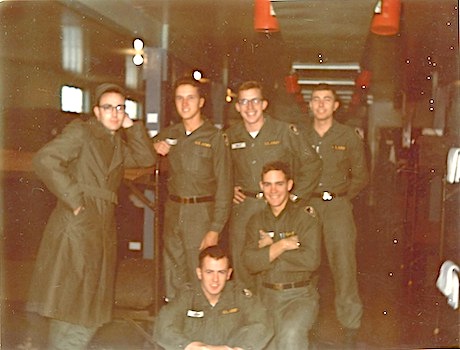
D. E. Larsen, DVM
The late flight into Boston was nearly empty. With three Army guys and one businessman, the stewardesses ran out of anything to do. We ended up in the back of the plane playing cards. One of the girls would run up and check on the other lone passenger every half hour.
I stopped at the ticket counter on my way out to see if they had a suggestion on how I could get to Fort Devens.
“You’re not going to get there at this hour unless you hire a cab,” the clerk said. “It would be cheaper to rent a hotel room and catch the bus in the morning.”
I caught the last shuttle leaving the airport for a downtown hotel. I was a little flush with money, and travel pay was far more than the standby ticket. Plus, I was able to work a few days when I was on leave at home. It worked out pretty good to be home over Thanksgiving. I would be in school at Fort Devens for nearly a year.
The bus ride from Boston to Fort Devens was about thirty miles. Most of the leaves were off the trees, and it looked like I missed the fall colors.
I caught a cab to the Fort when I got off the bus.
“What company are you going to?” the cabby asked.
I looked at my orders.
“It says ASA Training Company C,” I said.
“There has been a bunch of you guys heading up there,” the cabby said. “I hear that the schools are really backed up.”
When the cabby dropped me off in front of the company building, I looked for a moment, sort of getting my bearings.
The company building was a six-story brick building, and troops were milling around aimlessly. I took a deep breath, shouldered my duffle bag, and headed for the front doors.
The orderly room was packed, and chaos reined. I worked through the crowd and handed my orders to the CQ. He wrote my name on a list and handed me my orders back.
“You hang on to those for now,” the CQ said. “I think they will be sending a bunch of you guys down to the second battalion this afternoon. You can grab a bunk on the fifth floor, west side bay, if you want. It is a little crowded, but you might be able to rest a bit. But keep your ears open. We will announce the guys’ names on the transfer list as soon as it is confirmed.”
I carried my heavy duffle bag up the five flights of stairs and opened the door to the West bay. I stood looking at a big mess. Who’s Army allowed men to live like this? The bunks were not made, clothes hung from everywhere, and guys were sleeping in all states of dress and undress. I scanned the room and saw an empty bunk against the far wall.
“Did you just come in?” a red-haired kid asked.
“Yes, I just got off the bus from Boston,” I said.
“This place is a mess,” the kid said. “They are telling us that we might be waiting for six months for school.”
“I am surprised by the disorder of this bay,” I said. “Doesn’t anyone check on things?”
“I’m not sure this company has a commanding officer,” the kid said. “There is nothing for anybody to do. Everyone just lies around all day.”
“The CQ said they were going to send a bunch of us down to the second battalion,” I said. “Do you know anything about that?”
“That doesn’t surprise me,” the kid said. “We are running out of room fast. I think yours is the last empty bunk in this bay. And people just keep coming.”
I unbuttoned my jacket and loosened my tie. There was little use in organizing anything if I was going to be sent elsewhere in a short time.
The intercom honked a couple of times.
“Listen up, this is the list of names of those going to Company D in the second battalion. There will be a couple of trucks here before noon. This list will be posted in the orderly room. If you miss the trucks, you will have to walk.”
Then a long list of names followed, my name was near the end of the list.
“Well, there is no reason for me to mess up this bunk,” I said. “I guess I will head downstairs and wait for the truck.”
“Wait up,” the kid said. “My name was on that list also. I’ll go downstairs with you.
“My name is Dave Larsen. What’s your name?” I asked.
“Marsden, Marsden Burger,” Marsden said.
The truck ride to the second battalion was short. We were greeted by First Sergeant Scagliotti. He was a short, round Italian with a broad smile. I thought he was old. He was in his early forties.
“You guys stash your gear in the orderly room or the day room. We will meet in the day room after you guys get lunch. We will assign quarters at that time. The mess hall is Con-4, located just across the field,” Sergeant Scagliotti said as he pointed to the giant mess hall.
The day room was full of chairs set up for the meeting. A few guys were playing pool, but that all stopped with Sergeant Scag entered the room.
“So this the deal, the schools are all backed up with this build-up for Vietnam,” Sergeant Scagliotti said. “You guys will be waiting for three to six months before you get into a class. To keep you busy, we have formed this duty company. Most of you will be on KP every day. To make up for that, once you’re in school, you won’t have to pull KP. That is an Army promise. I have been in the Army a long time, and I will tell you that Army promises always come with a hitch. Take that for what it is worth.”
There were more than a few moans from the crowd of troops. We were recruited to be elite troops, and now we were going to be working in a kitchen for six months.
“Now I need eight guys to work for me,” Sergeant Scag said. “Six guys to be permanent CQs and two mail clerks. You need to be able to type, and you won’t be able to go home for Christmas. The CQs will work twenty-four hours on duty and forty-eight hours off. The mail clerks will work eight to five days and Saturday morning.”
I had always heard the cautions about volunteering in the Army, but this sounded better than six months of KP, and I had no plans to go home for Christmas. I raised my hand. I also gave quiet thanks to Miss Duke for teaching me to type in high school, despite my reluctance.
“Okay, the barracks assignments are on the board downstairs,” Sarge said. “Supply should have bedding on all the bunks. You guys can get settled and plan on a long weekend off. Our duty assignments will start on Monday, and your trick assignments and squad leaders will be set up by then. Just stay out of trouble; I prefer you not to go to Boston this weekend. Anywhere locally is fine. And all you guys who raised your hands, you stay here.”
The room cleared out pretty fast. There was a lot of grumbling as the guys filtered by, and Sarge never seemed to notice.
“You guys will be working for me,” Sarge said. “You can wear fatigues when on duty, but I want you to look sharp. You ask for extra starch when you turn in your laundry. I will pair you up, and you will share a squad room. You won’t be in the open bay. But you aren’t going to get the weekend off. Larsen and Drake, you guys will take the first shift starting in the morning. We will get the rest of you lined out pretty soon, but Larsen and Drake had better get moved into your squad room and get some sleep. The twenty-four-hour shift will get a little long until you get used to it.”
And so it began. My stay at Company D (Dog Company) with Sergeant Scagliotti turned out to be only four months. Still, it was four months with the best mentor that the Army could provide.
Sergeant Scagliotti will be the topic of the next post.
 Memoirs of a Country Vet