Ernie’s Pig, from the Archives

D. E. Larsen, DVM

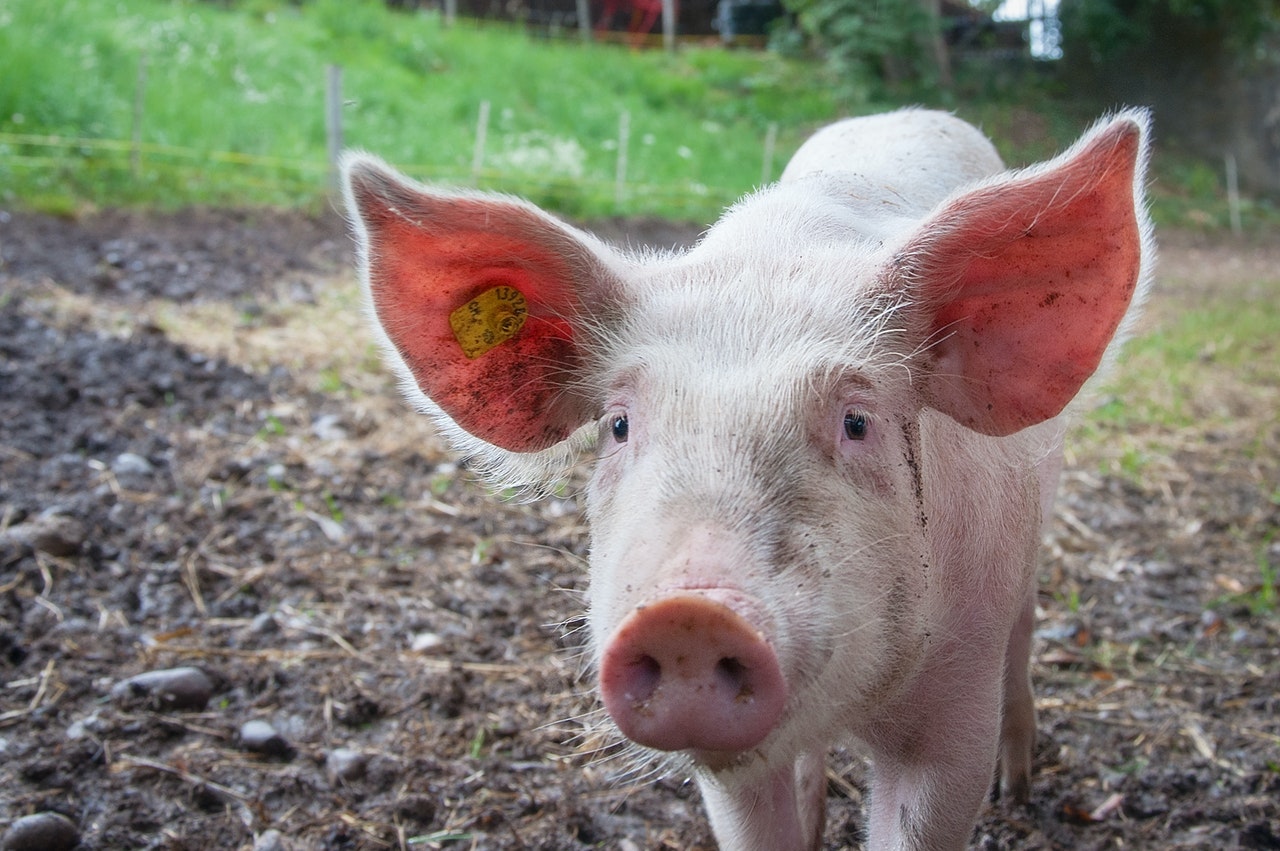
I stood in the barnyard facing a long metal barn. It is about 90 feet long, maybe 30 feet wide with 10-foot walls. The light breeze coming off the Calapoolya River stirs a little dust. Still, it feels cool in the midday heat of July in the Willamette Valley. Not a soul in sight, Ernie had called, saying he needed emergency help with a pig. There was no other explanation. I pondered my next step. The house looked empty, nobody ran to meet me. My guess is they must be in the barn.

   Then a hear a very faint, “help.” Where did that come from, it was too weak for me to get a bearing. Then it happened again. “Help,” a little louder this time, or maybe I was expecting it. It came from the barn, probably the left end.

   I entered the barn and started threading my way toward the far corner. Now I could see them. Ernie’s son-in-law, a stout young man with glasses and a crew cut, was laying across this 150-pound pig, holding him down. Ernie, a thin, wiry old guy, was lying behind the pig. Ernie was holding a pile of intestines protruding from the rear end of the pig. The floor was loose dirt, and every movement produced a cloud of dust the settled on the men, the pig, and the pile of intestines.

  “Thank God you made it, Doc,” Ernie said. “I can’t hold this much longer.”

   I walked over to them, trying to not stir up too much dust. They were castrating this pig. They had a big hernia with a pile of intestines that would fill a gallon bucket protruding from the scrotal incision. I looked close, the other testicle remained, that was a good thing. That would allow me to quickly sedate this pig and see if I could clean things up and replace all the gut.

   “Hang on just a little longer, Ernie,” I said. “I have to get a few things from the truck, and then I think we have a shot at fixing this guy up.”

   I slowly moved away from the group and then ran to the truck to gather things. A drop cloth to put everything on, a plastic bag to put under the guts, an emasculator, surgery pack, scalpel blade, bucket of water with Betadine scrub and solution, suture material, fly spray and antibiotics. One bucket with water, the other full of everything else. I almost forgot the Pentathol. I mixed a 5-gram bottle and drew up 3 grams into a 60 cc syringe, attaching a sixteen gauge, one and one half inch needle to the syringe.

   The office was too busy for me to bring anybody to help, I could have used an extra hand right now. I knew that I would probably forget something, so I went over the list in mind one more time before heading back into the barn.

   “Just another couple of minutes and I will let you relax Ernie,” I said as I started laying out the drop cloth, moving Ernie a little to the side. Then I slid the plastic under the intestines. 

   “Now you can let them go, Ernie, we will just let them lay here for a few minutes,” I said. Ernie let go of the guts, and he just rolled away, laying on his back in the dust with his bloody hands in the air.

   I washed my hands and swabbed the scrotum over the intact testicle. This testicle was several inches in diameter and over four inches long. I popped the 16 gauge needle into the testicle up the hub. The pig was about as tired as Ernie and only slightly flinched. I injected the 3 grams of Pentathol into the testicle.

  “This guy will be asleep in a minute, and you can also rest,” I said to Bill. He had been quiet throughout the whole time.

   I opened the surgery pack quickly and attached the scalpel blade. The pig was pretty sleepy now. I incised the scrotum over the testicle and through the tunic. I squeezed the testicle out of the scrotum and clamped the cord with large Oschner forceps.

   “You can relax now,” I said to Bill. “I have him under control. Just stay close in case I need you.”

   The beauty of this anesthesia in castration is the clamp on the cord. I the pig starts to stir, I release the clamp and let a little more anesthetic into his circulation. When I get the hernia repaired, I will remove this testicle, and he will wakeup pretty quickly.

   Now I turn my attention to the gut pile. Covered with dust, but there does not appear to be any tears or other injuries. They are a little purple, but the time frame is such that they should be okay if I can replace them. I rinse the dust off with a good splash of water. Then Betadine Surgical Scrub, a little more water, and a good scrub.

   “If you could take this other bucket and fill it with water from the hose in the back of the truck, I would appreciate it,” I say to Bill. He jumps up and grabs the bucket. I think he wanted to have a little break.

   “Doc, is he a goner?” Ernie asked as he sat up, mostly recovered from his ordeal.

   “I think things look pretty good, Ernie,” I replied. “I get these guts back where they belong and close up this hernia, he should be good to go.”

   “I’ll be damned If I am going to try to save a farm call again,” Ernie said. “I am done with castrating pigs.”

   “It is a lot easier if you do it when they are under 10 pounds,” I said. “However, you could still have this problem even on the little ones.”

   Bill got back with the water. I made a solution with the Betadine solution in the bucket. Port wine color, they always said in school. I don’t think I ever saw port wine. I flushed the guts with a large splash. Then holding the mass up level with the inguinal canal, I began to feed them back into the abdomen. When the guts were mostly back into the abdomen, I freed the tunic from the scrotal tissues. Twisting the tunic like I was closing a plastic bag, the last of the exposed intestines squirted back into the abdomen. Then I placed a clamp across the tunic to hold everything in place while I got the suture ready. 

     I released the clamp on the testicle for a couple of minutes and watched as the pig made a big sigh. Then, I reapplied the clamp.

   I placed a transfixing suture of #2 Dexon on the tunic. Then I palpated the external inguinal ring. I could put 3 fingers into the ring. I placed one mattress suture in the posterior half of the ring and tightened it to close the ring’s size. This done, I emasculated the other testicle. Again on this side, I freed the tunic and closed it up and sutured it closed. The external ring on this side felt normal. I don’t remember ever seeing a bilateral hernia in pigs.

   I squirted both incisions with Betadine solution and sprayed the whole area with fly spray. Then I gave a large dose of Amoxicillin SQ in the front quarter. The pig was starting to stir a little.

   “He will be on his feet before I have everything back in the truck, “ I said as I started gathering things up. 

   “Boy, was ever glad to see you, Doc,” Ernie said with a still bloody hand on my shoulder. “I don’t know what we would have done without you, just would have had to butcher him, I guess.”

   “Just remember, Ernie, next time do it when they are little,” I replied.

   “I am thankful you could come so quickly, I guess I wasn’t even thinking of how much it was going to cost. Just remember Doc, when you are filling out the bill, he is just a pig, can’t be worth much,” Ernie said.

   “Well, Ernie, I’ll tell you one thing, he is worth a damn site more today than he was yesterday,” I replied.`

Photo Credit: Photo by mali maeder from Pexels
Another Ellwood

D. E. Larsen, DVM

The sun was just setting when we pulled into the driveway after taking the kids to a matinee in Albany. Derek was sound asleep in his car seat, and the girls had been sleeping but were slowly getting out of the car and into the house. I followed, carrying Derek, still sound asleep.

I had just laid Derek down in his crib when the phone rang.

“No rest for the wicked,” I said, looking at Sandy as she picked up the phone.

“Yes, he is right here,” Sandy said. “We have just got home, but I think he can talk with you.”

Sandy held the phone out to me. “It’s Sandi, about some sick puppies.”

“Hi, Sandi. What is going on?” I asked. “I didn’t think you had any puppies due.”

“I have some friends outside of Portland with a litter of pups that are having problems,” Sandi said. “These puppies are three days old and having a lot of problems.”

“Sandi, they should take them to a veterinarian,” I said. “We can’t be much help for them over the phone.”

“They are at the vet clinic now,” Sandi said. “There are three of the pups that the vet thinks will die. He tells them it is an infection from their navels. He has given them some fluids under their skin and an injection of antibiotics.”

“Puppies that young and that sick need IV fluids and IV antibiotics,” I said. “You and I have been over that several times.”

“I know, and I told them that,” Sandi said. “They say the vet says that the veins on puppies are too small for IV treatment.”

“They have to use the jugular vein,” I said. 

“Doc, they want to bring them down for you to treat,” Sandi said. “I told them I would ask.”

“Sandi, it’s Saturday night,” I said. “I have enough trouble taking care of Sweet Home, and I can’t take care of Portland too. Besides, it will be nine o’clock when they get here.”

“They only want to bring three of the pups,” Sandi said. “And one of those might be dead by the time they get here.”

“Okay, tell them to get on their horse,” I said. “And Sandi, this is as a favor to you. And I keep track of those things.”

“Yes, I know, Doc,” Sandi said. “I will try to make it up to you, and I will tell them to ride that horse hard and fast.”

It was almost nine o’clock when Sandi came through the door with her friends and a box with three puppies. 

The one puppy was close to death. He was dehydrated, cold, and unresponsive. The other two were slightly better but very sick also.

After an exam, I talked to the owners.

“We might lose all three of these pups,” I said. “This little male has only a slim chance of survival. These pups need some IV fluids and IV antibiotics. I will place an IV catheter in the jugular vein of each pup. I will be using an antibiotic that could be toxic to their inner ears and kidneys. That will have to be a risk we have to take if we have any chance of saving them.”

“The vet in Portland said they were too small to get a catheter into a vein,” Roy said.

“Roy, you’re not in Portland anymore,” I said. “You’re here because you, or Sandi, didn’t like how things were going in Portland. I am no specialist, but I know what I know, and I know what I can do. Any veterinarian should be able to hit a puppy’s jugular vein. So, there will be no more discussion of the Portland vet.”

“Fair enough,” Roy said. “Sandi has a lot of trust in you. That’s good enough for us, do what you have to do.”

“Okay, we will treat these guys tonight, and then I will send them home with you for the night,” I said. “Assuming you stay here overnight, I will need to see them first thing in the morning. They will do better at home than here, where nobody can watch them. We will have a good chance of saving any of them who are alive in the morning.”

“What are we going have to do with them?” Sharon asked.

“Just keep them warm and feed them clear fluids if they get hungry,” I said. “I don’t want them to have milk tonight.”

With Sandi holding the pups, I clipped their necks and prepped them for the catheter.

Working on the sickest pup, I held off the jugular vein and slipped a catheter into the vein.

“Even I can see that that vein is large enough for a catheter,” Roy said as he watched over Sandi’s shoulder.

“This puppy is cold, his circulation is dismal, and he won’t absorb anything given under his skin fast enough to save him,” I said. “His only chance is with IV fluids and IV antibiotics. And to be honest with you, I think his chances are slim to none at this point.”

“But, if he survives the night, you think we have a chance,” Sharon said.

“We will just have to see what the morning will give us,” I said.

I gave each puppy a calculated dose of IV fluids via a syringe. Then I gave each of them a dose of IV ampicillin and gentamicin.

“That’s all the magic I have for the night,” I said. “Keep them warm, and if they get hungry, give them some oral fluids out of this bag. And I will see any survivors at eight in the morning.”

“They will sleep on my chest,” Sharon said. “We left their mom and the other puppies at home.”

***

To my surprise, all three puppies came through the night with flying colors. They were active and looking for breakfast when I examined them. 

“What do we do now?” Roy asked.

“I will repeat the treatment we did last night,” I said. “Then, with this response, almost this miracle, we will send you home with some oral antibiotics. And I would expect things to heal up and be fine.”

“Can they have some milk now?” Sharon asked.

“Yes, I think they are up to some milk,” I said. “And when you get home, they can go back on their mom.”

We worked through the treatments much faster since the catheters were in place. After treatment, I removed the catheters.

Roy was at the front counter with his checkbook, waiting for the bill.

“We were talking this morning,” Roy said. “We think we will name the little male after you since he would have been dead without your treatment.”

“David is a poor name for a pup,” I said.

“We were thinking of using Ellwood,” Sharon said. “Isn’t it usually spelled with one ‘l’?

“It is a family name,” I said. “At least for the last few generations, I don’t know where it started. The others are all spelled with one ‘l.’ My mother said she just didn’t know how to spell it when she filled out the papers in the hospital.”

“Well, now there will be another Ellwood,” Roy said.

“That’s great, but there are a couple of those running around now,” I said.

The pups went home and grew into adult dogs without complications from the infection or treatment. Roy and Sharon remained friends and occasional clients. And over the years, Sandi more than made up for the imposition on my time.

Photo by Sergio Souza on Pexels.

Another Gus 

D. E. Larsen, DVM

Glenn was waiting in the exam room with his new pup, an 8-week-old border collie.

“Where did you get his guy,” I asked.

“A friend in Eugene had a litter of eleven pups, and he couldn’t get rid of this last one,” Glenn said. “Since the old dog died, I figured I could use a new dog. I call him Gus.”

“Well, let’s get a look at Gus,” I said as I started an exam. “Then we will get him started on his vaccines.”

“What do you think of Border Collies?” Glenn asked.

“They are great dogs, probably one of the smartest of all the dogs,” I said. “They are working dogs, however. They need something to do, or they sort of go crazy.”

“He has plenty of room but probably no specific job,” Glenn said. “We don’t have any other animals.”

***

After his initial vaccinations, I didn’t see Gus for a couple of years. Then one morning, Glenn called.

“Doc, Gus has a broken leg. Can I bring him down?” Glenn asked.

Gus had a broken tibia, the lower leg bone on his rear leg. Tibia fractures were always a joy because they were easy to repair. If there were money problems, they could be fixed with a splint, and you could expect good results. We repaired the fracture on Gus with a steel pin in the bone.

Gus was fine to work on. We got him under anesthesia, took a couple of x-rays, and prepped his leg for surgery. Gus had a simple fracture, and I made in small incision over the fracture site, placed an IM pin in the bone starting at the knee joint, and pushed it down to the fracture site. With the pin in view at the incision, I threaded it into the distal bone fragment and seated the pin. The reduction of the fracture was almost perfect. I closed the incision at the fracture site and cut the pin at the knee after bending it slightly so it would not interfere with the joint function. 

Gus woke up and was bearing weight on the fractured leg.

“What do I need to do with him now?” Glenn asked.

“Not much,” I said. “I think that by the time we get his sutures out in two weeks, he will be walking on that leg like nothing ever happened. At six weeks, we will plan to take that pin out.”

When Gus was in for his pin removal, he was walking normally. He proved a little tricky to handle then, but I didn’t think much of it. We sedated him, took an x-ray to make sure the bone was healed and removed the pin. That would prove to be the last time that I actually was able to handle Gus.

***

Two years later, Gus came to the clinic for his vaccinations. He was not happy, and to say we had a struggle would be an understatement.

Small dogs often bite out of fear or anxiety, and those bites are usually unannounced. Large dogs tell you they are going to take your arm off, and over the years, I have learned that you had better believe them.

Gus was no exception. Glenn had to restrain him from the moment I stepped into the exam room. I think he was thinking of a leg rather than an arm.

Glenn couldn’t get a muzzle on Gus, and we finally tied him short to the exam table, and I was able to get a rabies vaccine into him.

“That will keep him legal. Let’s call it a day,” I said

“I tell you, Doc, he is not like this at home,” Glenn said. “Of course, he is not around other people much.”

“He may just associate this place with his broken leg,” I said. “I seldom get credit for helping these guys.”

“When we do this again, maybe we should do it at the house,” Glenn said.

“Yes, that might be better,” I said. “I will make sure we mark his record.”

And mark his record we did. Sandy had large caution marks all over his chart so nobody would be taken by surprise when working with Gus.

***

It was three years later before I saw Gus again. Gus was even worse at the house than he was at the clinic. He was displaying some severe aggression now, to heck with an arm or a leg. Gus was going for the jugular now. Glenn finally tied him to a tree in the backyard, and I was able to get a rabies vaccine into him. 

“I don’t know, Glenn,” I said. “Gus has some real problems. This isn’t just a dislike of me. I think he has some real aggression issues, and he is probably a liability for you.”

“Yes, we know,” Glenn said. “He is aggressive to almost everyone now. We must be careful to have him in his kennel when we have anybody visiting.”

Getting a rabies vaccine into Gus every three years became a herculean struggle. The older he got, the worse the battle. Gus had become the stereotypical junkyard dog.

***

And then it happened. Glenn and his wife went on an extended vacation, and their son was in charge of caring for Gus. In no time, Gus escaped from his kennel. He was at large for some time before a young couple found him and somehow read his rabies tag. They brought him to our clinic.

“You seem to know this dog without even checking his rabies tag,” the young man said.

“Oh, yes, I know Gus by sight,” I said. “In fact, I am surprised you still possess your right hand.”

“I told you that I didn’t think he was a dog we could trust,” the young lady said, looking at her husband.

“I’ll take Gus and get him into a kennel, and we will make sure he gets home,” I said. “And thank you for bringing him in to see us.”

I grabbed the leash and literally ran Gus into the back. Terri had a gate open to a run, and I had Gus in the run before he knew what had happened.

“Do those two know that this dog is mean?” Terri asked.

“The gal suspected it,” I said. “Gus must have known that he needed help, or he would have taken the kid’s hand off.”

Glenn’s son came by and picked up Gus. He seemed at ease with him and had no problem getting him out of the dog run and into his truck.

Two days later, the whole thing was repeated. This time another young man brought Gus into the clinic. I couldn’t believe it when he petted Gus after placing him in the kennel.

We called Glenn’s son a second time, and he was prompt in picking up Gus.

“They’re due home this evening,” he said. “None too soon. I have a hard time keeping track of this old dog.”

“When are your folks going to be home?” I asked.

***

I wish I could say that was the end of the story. But in those escapes that Gus enjoyed, he found a Black Labrador in heat. And a couple of months later, there was a litter of pups.

We saw the litter for vaccinations when they were six weeks old. You had no problems believing that their father was Gus. These pups were biters from the start. They were perfect examples of the inheritability of behavior. 

The pups were all adopted out to new owners. We heard that most of them were never able to be trained, and most were given to the humane society. We saw two of those pups. One for only a visit or two before the new owner gave up on trying to make him a trainable pup. 

The other was owned by a lady who worked hard with the pup, and she could make him behave pretty well for several years. But like his father, his behavior worsened as he aged, and in the end, that last pup was given up on by a sad owner.

Photo by Julissa Helmuth on Pexels.