On the Wheel with a Broken Wheel, From the Archives

D. E. Larsen, DVM

Pat was standing at the counter, clutching a shoebox in her hands.

“I know we impose on your generosity, Dr. Larsen,” she said. “But the class is heartbroken over Blossom. Can you get a look at her?”

“Don’t feel like you’re imposing, Pat,” I said. “I see all the classroom pets in Sweet Home at no charge.”

“I think this is a major injury,” Pat said. “You are maybe not going to be able to fix it.”

“Let’s get a look at Blossom,” I said as I led Pat into the exam room.

I opened the shoebox, and Blossom was huddled in the corner of the box. She was almost in a ball, and her fur was fluffed up. This was definitely a hamster who was not feeling well.

I started to reach into the box to pick Blossom up, so I could get a better look at her.

“Oh, be careful, Dr. Larsen,” Pat said, reaching out for my forearm. “She bites at times, especially if she is unhappy.”

I put my hand over her body, securing her head between my thumb and index finger. I carefully lifted her from the box. As I turned her over, her injury was visible. She had a fracture of her right tibia.

“Is it bad?” Pat asked. She had probably not been able to bring herself to look at the injury.

“Blossom has a fracture of her tibia on her right hind leg,” I said. “I am not sure that it is fixable. There is a lot of displacement.”

“We knew it was bad,” Pat said. “The class is very upset. It was that way when we came to school this morning. If there is anything that can be done for her, you would be their hero.”

“I think I am hearing that replacing her might not be an option,” I said. “Or at least, not if there is any chance of fixing her.”

“I told the class that I was sure you would do everything in your power to fix her, but we might have to talk about what to do if she can’t be fixed,” Pat said.

I looked at Blossom closely and mulled over repair options in my mind. I could possibly fashion a Thomas Splint that would work. That would be difficult to manage in a classroom pet. It would be easy to amputate the lower leg. She might do surprisingly well on three legs, but the classroom would have some difficulty with the decision. Just maybe, I could get an intramedullary pin into this bone. I could attempt to pin it, and if unsuccessful, I could go ahead and amputate the lower leg at the fracture site.

“Okay, Pat, here is my plan,” I said. “I don’t think that trying to splint this leg is a good option. There is a chance that I could repair this fracture with a pin on the inside of the bone. I am not sure about that, my experience base for repairing hamster fractures is zero. But I think I should try to pin this fracture. If I cannot get that done, I will amputate the leg at the fracture site. Blossom needs to stay overnight. That means you will need to bring her cage down, so we are not tearing the clinic apart tomorrow, looking for a fugitive hamster. You also need to prepare your class for the possibility of Blossom losing her leg, She will do well with 3 legs. It is just that some kids might be upset with that option.”

“Okay, I can bring the cage down after school,” Pat said. “We have a cage that the kids take her home in on the weekends.”

“That will be good,” I said. “I have some time this afternoon. We will do this then. I may well be done by the time you get back here with the cage.”  

I put Blossom entirely into a large dog facemask to induce anesthesia. When she was asleep, we secured her head in the smallest cat facemask. This allowed for reasonable control of anesthesia and access to the fracture site.

After prepping the leg, I covered the foot with a sterile gauze. Securing it with a couple of purse-string like sutures around the top and bottom of the foot.

I made a short incision over the fracture site on the inside of the leg. Bending the leg, I could expose both ends of the fractured tibia. Looking at the size of the medullary cavity, I selected a 20 gauge needle to use as an intramedullary pin.

I snipped off the sharp point on the aluminum needle. Then I inserted the blunt needle into the bone of the distal fracture fragment. This needle fits perfectly. And without any pressure applied, I measured the depth of insertion to be 3 mm. My plan was to bury this IM pin. This was something I had done in repairing fractures of the radius in tiny dogs.

I snipped the needle hub off and inserted the needle shaft into the proximal fracture segment. When it was fully seated in the upper bone fragment, I measured and snipped the needle to leave just over 2 mm of the exposed needle shaft.

Now it was a simple task to toggle this exposed needle shaft into the distal fragment. It required a little stretch, but it popped into the distal fragment quickly. The bone ends slid together better than expected. This proved to be an excellent repair. I closed the incision with a couple of sutures of 5-0 Dexon in the subcutaneous tissues and then closed the skin a couple of subcuticular stitches with the same material.

Blossom was placed in her shoebox with a warm towel for her to recover. By the time Pat had returned with the cage, Blossom was up and running around like nothing was wrong with her leg.

“Oh my, she acts like nothing is wrong,” Pat said as we moved Blossom into her larger cage.

“So, I think Blossom is doing well enough that you can take her home tonight,” I said. “You need to drop her by tomorrow just so I can check her over really quick. I want to make sure she is still using the leg and that the incision is okay.”

“Do I need to do anything for her?” Pat asked.

“I would bed her down with a fluffy towel for the night,” I said. “Other than that, I don’t think we need to do anything. I think we are home free.”

“I want to thank you, Dr. Larsen, from the bottom of my heart,” Pat said. “And I am sure the class will be thankful also.

The following week Blossom was in for her checkup with the entire class. We went into the surgery room, where there was room for the group. Blossom was the star of the show, and her broken wheel was healing well.

“She is back to running on her hamster wheel, and she doesn’t even limp when she runs,” one of the little girls said.

Photo by Frances Goldberg on Unsplash

An Unfortunate Family Conflict 

D. E. Larsen, DVM

Cody almost danced on the exam table. His stub of a tail wagged so hard that it wagged his entire rear end.

“Whoa!” I said as Cody was trying to lick my face. “You can hardly contain yourself, Cody.”

“He is so happy to go in the truck. He doesn’t care where he goes,” Renea said. “But he does seem to like you, Doc.”

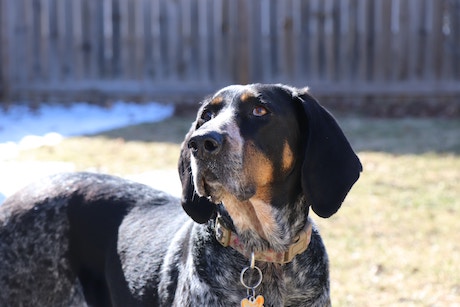
Cody was almost two years old, and his activity level showed it. He couldn’t sit still if his life depended on it. He was a dark liver and white springer spaniel, healthy, happy, and high-strung.

“What are we doing for Cody today?” I asked.

“He is overdue for his rabies vaccination, and my sister and her family are coming for a week next month,” Renea said. “She has a little boy who is a holy terror. The last time he was here, he wouldn’t leave Cody alone. I just want to be safe and make sure Cody’s rabies vaccine is up to date.”

“You’re being very wise,” I said. “Just in the event Cody would nip the little hellion, you will keep the public health people out of the issue if his vaccine is current.”

After the exam and vaccine, we put Cody down on the floor. He bounced around the room. He was so happy he nearly knocked me down.

***

It was several weeks later when I noticed Renea sitting in the busy reception area, wringing her hands as she waited to talk with the front desk. When she caught my eye, she jumped up and came back to talk with me.

“Doctor Larsen, I have to talk with you. Do you have a minute?” she asked.

“We’re pretty busy, but I can spare a moment,” I said. “The exam rooms are busy. Let’s step into my office.”

As soon as the office door closed, the tears started.

“I just don’t know where to start,” Renea said as she dried her tears. “My sister’s little boy tormented Cody from the moment he came through the door. It went on continually. I tried to keep them separated, but I couldn’t do it all the time. Anyway, he was on the back porch with Cody, pulling Cody’s ears, when Cody had finally had enough. Cody snapped at him and caught him on the side of his face.”

“I hope it wasn’t a vicious bite,” I said. “Is the little guy okay?”

“Yes, he is okay,” Renea said. “It was just a snap, but it did break the skin, and it looks like there may be a scar. But you would have thought the world came to an end.”

“So, if he is okay, what is the problem?” I asked.

“My sister is insisting I put Cody to sleep,” Renea said. “If I don’t, she will never visit again. I just can’t do that, doctor. She doesn’t understand. Cody is my child.”

“There must be a resolution here,” I said. “Have you explained your position to your sister?”

“Yes, but I don’t think it meant anything to her,” Renea said.

“A little tincture of time will help,” I said. “Give her a couple of weeks, and then talk with her again. There should be an easy compromise to offer. Maybe you could board Cody in a kennel or with some friends anytime your sister visits. Cody might not like that, but it might be better than the alternative. Some dogs love going to a kennel. It is sort of a social event for them.”

“My sister thinks I’m crazy to call a dog my child,” Renea said. “Do you think I am crazy?”

“When I was in vet school, we had a similar event happen,” I said. “It was a couple of classmates in the class ahead of us. The circumstances were a little different because the bite was a vicious one, and it caused significant injury to the child. I am unsure if there was any provocation involved. But it led to a lot of discussion in the school. Dealing with the ethics of pet ownership and the owner’s bond to the pet. And the child substitute pet, which is becoming more common.”

“How did that turn out?” Renea asked.

“I’m not sure I know the whole story,” I said. “I know the dog was not put to sleep, and there was never a consensus from all the discussions between classmates. But I don’t think the friendship between the two involved survived. However, it’s much easier to give up a friend than to give up a sister.”

“That is for sure,” Renea said. “I like your advice about the tincture of time. The emotions will have cooled in a couple of weeks, and I think she will accept the kenneling offer.”

“Now you should know, I was in favor of euthanasia for the dog in Colorado when I was in school,” I said. “But the situation was different. It was a vicious bite that scarred the kid’s face for life. That doesn’t say anything about the potential emotional scars after being attacked by a dog. And there was no clear evidence that the child provoked the attack. I felt at the time that the dog was untrustworthy. Your situation is far different. Cody is a good dog; he just had his fill of being tormented. And to answer your question, no, I don’t think you are crazy.”

“Well, I’m glad I came and talked with you,” Renea said. “I feel much better now. Thank you.”

“If your sister wants to talk with me, that would be fine. Just have her call me,” I said.

***

Things worked out between the sisters. Cody went to stay with Renea’s friend and neighbor, Marsha, whenever her sister visited. I never met her sister or the little boy, but I don’t believe the boy was scarred for life, either physically or emotionally.

Photo by Celyn Bowen on Unsplash.

The Heel Fly 

D. E. Larsen, DVM

I watched in amazement as the group of cows ran through the lower field with their tails in the air. They all came to a stop at the edge of the pond and waded out into the shallow edge of the water.

“What makes those cows run like that?” I asked Dad as he worked on the mowing machine.

“They are running from the heel flies,” Dad said. “Those flies bite them on their heels, and that is why they stand in the water. Those flies cause the warbles we see on the back of cows.”

I had seen the warbles on most of the cows and watched as my older brother sometimes squeezed a large grub out on them. It was a bit of a mystery to me how a fly could cause a warble on the back of a cow by biting her on the heels.

***

My attention was averted from the new leaves sprouting on the trees outside the classroom window as I heard the parasitology professor mention heel flies.

“There are two species of the heel fly, Hypoderma bovis and Hypoderma lineatum,” the professor explained. “These flies lay their eggs on the hind legs, usually on the heels of cattle. After a few days, the larva hatch and penetrates the skin, then they migrate through the body, ending up on the back of cattle, in what is called a warble, some four to six months later.”

“I’ll be damned,” I thought as I concentrated on the remaining lecture.

“The important thing to keep in mind is the timing of treatment for these grubs,” the professor continued. “By fall, they will be massed around the spinal cord or the esophagus. Treatment at this time will have the potential of causing life-threatening reactions as the dead larva cause local inflammation.”

The veterinary school continued to resolve my childhood mysteries. As a boy, there were no treatments available for these grubs. The large warbles set atop some of the most valuable meat on the carcass of slaughtered animals, and there was no thought of treatment in my world.

“These times vary, depending on latitude,” the professor continued. “You need to make sure you read the label of any of the products you use.”

***

In the late spring of 1975, I took a call to look at a Jersey cow with a problem involving the warbles on her back. Fresh out of school, I was in a dairy practice in Enumclaw, Washington, and I was intrigued to be looking at warbles. Most of the time, in my early experience, they were just there and caused no real problem.

“This is a cow belonging to George and Sue,” Ann explained. “They are that hippie couple who bought the Allen dairy a few years ago. They have some strange ideas, so it is hard to say what you will be looking at.”

It was a short drive out to the old Allen dairy, and Sue had the young Jersey cow waiting in a stanchion when I arrived. 

“What’s going on with your cow?” I asked Sue as we walked to the barn.

“This is Cindy. She had a bunch of warbles on her back, so George treated her with a mixture of rotenone and linseed oil,” Sue said. “Now it looks like the skin is dead over all those warbles.”

“I have never heard of treating warbles once they are on the back,” I said. “We generally treat them with a pour-on product in the early fall. Dairy cows have to be in their dry period before you treat them. But it is important to do the treatment before November.”

“Yes, but rotenone is a natural product,” Sue said. “We don’t use any of those new artificial products.”

I looked at Cindy. Her back was covered with a mass of warbles, and dead skin covered each warble. I pinched at one warble, and the skin and exudate easily pulled off, leaving a hole almost an inch in diameter.

“This is a mess, Sue,” I said. “Just because it is natural doesn’t make it an appropriate treatment option. Any of the new insecticides would have had the same results. Rotenone killed the grubs, but this isn’t the time to be treating these grubs. The dead grubs lay in there and rotted, which set up an infection that killed the surrounding tissue and skin. This is what you have left.”

“What are we supposed to do to treat them?” Sue asked.

“The best time to treat them is with a systemic product in the fall. The cow has to be in her dry period, and she has to be treated before November. If you are not going to use a product that kills them in the migratory phase, then you shouldn’t treat them at all,” I said. “It’s not a big thing if the cow isn’t going to be slaughtered. It might cause some loss of production when there are this many warbles, but it’s not a major loss. In the early summer, the grubs come out and fall to the ground, where they turn into a fly. Then the wound on the back heals, and the cycle starts over again.”

“And what do we do with her back now?” Sue asked.

“I’m going to remove all these patches of dead skin, flush out the exudate and apply some antibiotic ointment,” I said. “Then we will put Cindy on some antibiotics for a week.”

“We don’t like to use antibiotics,” Sue said.

“Well, I guess we could just let her die a horrible death then,” I said. “Not using antibiotics in this situation would be close to animal abuse.”

“What do we need to do with her milk while we have her on antibiotics?” Sue asked.

“You will need to discard it,” I said. “You can use it for feeding the calves or the cats, but otherwise, you should discard it. There will be a withdrawal period to observe after you complete the course of antibiotics. Things are set up for the appropriate use of antibiotics. If you make a mistake and ship her milk, it might get expensive. They test your tank before putting it on the tanker truck. If your tank tests positive for antibiotics, you could end up paying for an entire truckload of milk.”

“George is pretty careful, so we won’t have that to worry about,” Sue said. “Let’s go ahead and treat her.”

I clipped the entire area of her back involved with the warbles and scrubbed it with Betadine Surgical Scrub. Then I removed the necrotic skin and flushed the pockets with hydrogen peroxide to remove all the pus and debris. I applied a thin coat of nitrofuran ointment to the lesions. Her back was covered with a mass of open wounds.

“You’re going to have to keep these wounds clean,” I said. “I am going to give Cindy an injection of Polyflex and leave you a bottle for daily injections.”

“That sounds expensive. Can’t we just use Combiotic?” Sue asked.

“They have changed the withdrawal times on Combiotic to thirty days,” I said. “Polyflex has a five-day withdrawal time. The money you will lose on milk sales with a thirty-day withdrawal will make your Combiotic much more expensive.”

“Okay, I am sure George will want to talk with you about all this stuff,” Sue said. “I am not sure I understand all the life cycle stuff and why there are treatment times and the like.”

“I’m in the office on Saturday this week,” I said. “I am usually not busy this time of the year. It would be a good time for George to drop by and visit. I can make some copies for him on the life cycle and treatment recommendations.”

***

Cindy healed uneventfully, and George came by and discussed the heel fly’s life cycle and treatment options. I am sure that his decision was to do nothing for treatment.

Photo by Peter Scholten on Unsplash.

https://livestockvetento.tamu.edu/insectspests/cattle-grub-heel-fly/