Albert’s Last Cow

D.E. Larsen, DVM

I stood at the small makeshift corral waiting for Albert to make his way from the house. Albert was old and arthritic. He walked pretty slow these days.

The corral wouldn’t hold a cow if she wanted out. The posts were propped up instead of set in the ground, and the old boards used for rails were ancient. Something Albert probably found in a pile behind the barn.

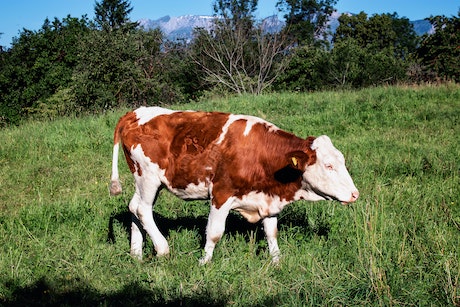
The cow standing in the middle of the corral looked more concerned with her next breath than trying to test the strength of the corral.

She was standing with her head extended and lowered. The swelling under her jaw was no simple bottle jaw. It spread down her neck to a massively swollen brisket. Even from my position at the edge of the corral, I could see a bounding jugular pulse.

“How are you doing these days, Albert?” I asked as I extended my hand.

“I think I’m too old for this cow business, Doc,” Albert said. “I have enough trouble getting myself dressed and fixing something that I can call breakfast. Let me tell you, Doc, this getting old stuff is no fun. And then when Verna passed on, it got even harder.”

“I suppose that was the hardest part,” I said.

“I watched you looking at my old Sally cow,” Albert said. “What do you think is wrong with her, Doc?”

“I think she is a pretty sick cow, Albert,” I said.

“I know that, damit,” Albert said. “Why the hell do you think I called you.”

“I think she has a wire,” I said. “It is not a simple hardware disease. It has progressed to what we can call traumatic pericarditis.”

“If it is just a wire, you can go in and get it with surgery,” Albert said.

“Sally is beyond that stage, Albert,” I said. “Actually, we don’t go in and get those wires anymore. We use a magnet that pulls the wire back into the stomach. But Sally’s problem is an infection in the sac around her heart.”

“If it’s just an infection, you should be able to give her a shot and take care of that,” Albert said.

“It’s more complicated than that, Albert,” I said. “She has had that infection long enough; there is a lot of infection debris in the sac around the heart. After some time, that infection debris around the heart starts to mature, constricting the heart’s function. There is no fixing this, Albert. Your Sally cow is going to die.”

“How can you be so sure, just standing here looking at her?” Albert asked.

“I have seen it before, Albert, many times,” I said. “I do need to examine her just so I don’t miss something, but my confidence level in my diagnosis is very high.”

“You doctor guys make mistakes sometimes. I think just putting her on some antibiotics might be the way to go,” Albert said.

“Nobody is perfect, that is for sure,” I said. “I have always been cautious about saying an animal is going to die because once that is said, that will be the animal that will come back through the door for the next twenty years. But looking at Sally, I am certain that there is nothing we can do at this point that will help her.”

“It’s not that I don’t trust your opinion, Doc. It’s just that I don’t understand how you know so much,” Albert said.

“Last month, I did a necropsy on a cow up Wiley Creek,” I said. “She had the very problem as Sally. Before she died, she looked just like Sally looks. When I opened her chest, there was a piece of wire sticking through her diaphragm, the wall between her chest and her abdomen, into the sac around her heart. With all the infection debris, that sac was over an inch thick. Normally, it is thinner than the material of your shirt.”

“Okay, but how do you know that nothing can be done to help her?” Albert asked.

“When I was in school in Colorado, a cow came to the veterinary hospital in this very condition,” I said. “She was a valuable cow, and the owner wanted to save her at any expense. So the doctors at the vet school removed a rib over her heart and opened the heart sac to the outside so they could drain it and flush it daily. You could look in the hole and see the heart beating, and you could see the very thick sac around the heart.”

“So, did they save that cow?” Albert asked.

“No, that cow died,” I said. “The time to save these cows is when the wire first appears. In the old days, when I was a kid, and you were a young man, they would do surgery. Today we use a magnet. Once we reach this point, the ball game is over, and the cow dies.”

“Can I eat her?” Albert asked. “I mean, Sally is the last cow I have, and I want to save her, but if she is going to die, can I eat her?”

“She is not fit to eat,” I said. “Maybe if you were starving, you could eat her, but you would have to be pretty hungry to choke the meat down. There is not a slaughter outfit around that would hang her carcass in their cold room.”

“I don’t understand how a wire that the cow swallows can get from her stomach to her heart and cause all this problem in the first place,” Albert said.

“The cow is not very discriminating when they eat,” I said. “So if there is a piece of baling wire in the hay, they will just swallow it down with the hay. The second stomach, or compartment, is called the reticulum. It catches all of the foreign material. Suppose that material happens to be a wire. In that case, it can punch through the wall of the stomach, pass through the diaphragm, and into the pericardium. The way things are put together, the wall of the reticulum and the tip of the heart are separated only by the diaphragm. So that is a very short distance for the wire to travel. That injects a lot of infection from the stomach into the chest and the sac around the heart. When it first happens, the cow will be painful, not eating, and have a bit of a temperature. At that point, we treat her with antibiotics and a magnet. The magnet will attract the wire and pull it back into the stomach. Often times we just put a magnet into every cow. That is especially done in dairy cows. And, just a point of interest, the reticulum is sold in the grocery store as tripe.”

“So I would guess that is one reason they no longer use wire to bale hay,” Albert said.

“Baling wire was always around when I was growing up, but I would guess that hardware disease was much less common before the days of baled hay,” I said.

“So what are we going to do with Sally?” Albert asked.

“In my view, you have two choices,” I said. “You can put her down, or you can let her die. It won’t be a pleasant death if you let her die.”

“I think I would like you to give her some shots for a few days,” Albert said. “Just in case you are wrong.”

When I first started practice in Enumclaw, Washington, Don Henricksen, the older associate veterinarian in the practice, had warned me to always give a cow a shot before leaving her, even if it wasn’t indicated. If you don’t give her something, you will be accused of not doing anything, and you will be a villain if the cow dies. You will be a hero if you give her a shot and she gets well.

“I can give her a big dose of antibiotics,” I said. “But I want you to remember, this cow is going to die. I don’t want to hear any stories about how the antibiotics didn’t work. There is no chance of saving this cow.”

“Okay, but I just want to try, just to make sure,” Albert said.

I gave Sally forty ccs of Combiotic, a large dose.

“It will be interesting to see what morning brings,” I said. “I will be back right after lunch tomorrow to give her another dose.”


The following morning, Albert was on the phone a few minutes after eight.

“Doc, I just wanted to thank you for trying to help Sally,” Albert said. “She was down this morning and struggling to breathe. I looked her in the eyes, and she asked me to put an end to my foolishness. So, Doc, I went and got my rifle and shot the old girl. That was the hardest thing I have had to do in a long time.”

“It is always hard to do,” I said. “But it was the right thing. Do you want me to come out and show you inside of that chest?”

“No, you explained things pretty well,” Albert said. “I have the neighbor coming with a backhoe, and we will bury her out under the old maple tree. I thought about calling the rendering company to pick her up but decided that she had earned her hole in the ground.”

“That’s a good thing, too,” I said. “Have you given any thought about what you are going to do with your pasture land now?”

“No, I haven’t thought about it,” Albert said. “I don’t want any more cows at my age.”

I know a couple of young guys who would jump at the chance to rent it from you,” I said. “They are hard workers and trying to get a herd started. I could send them your way if you would like.”

“That would be good, Doc,” Albert said. “Thanks again.”

Photo by Harry Dona on Pexels.

Alice’s Leg 

D. E. Larsen, DVM

I was just finishing up in the surgery room after doing a spay on a small dog when Sandy appeared at the surgery room door.

“Larry is on the phone,” Sandy said. “He thinks he has a cow with a broken front leg. He wants you to get a look at her. If you are done here, you probably have the time to run out there now. At least enough time to get a look at her.”

“Okay, tell him I will run out and see if I can do anything with it,” I said. “It depends on where the fracture is located and how much he wants to spend on the cow.”

“After you pinned that calf’s leg for him, he will expect you to fix this one,” Ruth said. 

“Yes, and he said that this was his favorite heifer, and she was due to calve in a couple of months,” Sandy said.

We hurried to finish the surgery and ensured the pup was fully recovered from anesthesia before jumping in the truck to run out to Larry’s place on the edge of town.

Larry had the heifer in his small corral. From a distance, it was obvious that the left front leg was fractured. It looked like a fracture just below the carpus.

“Larry, how did she do this?” I asked as I got out of the truck.

“I have no idea, Doc,” Larry said. “The wife noticed her out the kitchen window. She just limped up to the barn like she knew where to get help.”

“Let me get a rope on her. I don’t want to put her in the chute with that leg flapping around,” I said.

“Doc, I just can’t shoot this little gal. She is one of the few cows of mine with a name. I call her Alice, after a girl who used to work for us at the Busy Bee.” Larry said. “And even if I did, I couldn’t eat her. Can you fix a broken leg on a cow?”

“It’s just like everything, Larry, any more it’s just a money game,” I said. “We can send her over to Corvallis, and they will fix her for a few thousand dollars.”

“Well, I really like Alice, but let’s be reasonable,” Larry said. “If it will be that much, I will just have you do the shooting.”

“Let me look at her, and we will talk about what I can do,” I said. “Some fractures will heal if you just pen a cow up in a small pen where they can’t move around much. Especially fractures higher up in the leg where the bone is supported with a lot of muscle. This is lower on the leg, but maybe we can fashion a splint that will work.”

When I crawled over the fence into the corral, Alice didn’t move. I scratched her on the head, and she licked at my arm. She was content to just stand there while I looked at her.

I stepped to her side and rubbed her back before kneeling down beside her fractured leg. I ran my hands down her leg. The fracture was a clean break of her cannon bone, about one-third of the length below the carpus. This would heal well if we could get her in a splint.

When I stood up, Larry was holding the corral gate open for me.

“They make gates, Doc, for people who don’t like to crawl over fences,” Larry said.

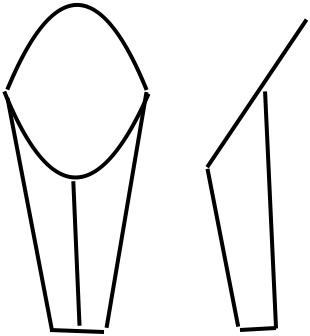
“Larry, we can fix this leg with a Thomas splint,” I said. “We just have to get someone to make one for us.”

“Show me what you’re talking about, Doc,” Larry said. 

We walked over to the truck and drew a rough sketch of what I wanted.

“So, this needs to be made out of good solid steel, like half inch rod. The leg fits through the upper circle, and I will wire the hoof to the plate on the bottom. This has to fit snuggly in her armpit. You need to measure the distance from her armpit on her good leg to the ground and use that measure for the distance from the bottom edge of the circle to the footplate. The circle can be round, looking at Alice, I would guess twenty-four inches in diameter, and a round plate on the bottom with some holes drilled in it so I can wire the hoof in place.”

“I see. This is sort of like a crutch,” Larry said. “But won’t it wear of sore in her armpit?”

“I will pad it with cotton,” I said. “And we will need to pen her up in the barn for the duration of the healing, about six weeks.”

“They can make this down at the welding shop in no time,” Larry said.

“Good. You get it done, and I will be back at the end of the day and put it on,” I said. “Just leave Alice right where she is until then.”

When I returned in the late afternoon, Alice had hardly moved. I looked at the Thomas splint that Larry had made. It was heavier than I expected, but that was probably good, we didn’t want Alice to be too mobile while this fracture was healing, and she sure wasn’t going to bend this thing.

I used a cotton roll to pad the upper ring and secured it with heavy adhesive tape. Holding it beside her leg, it looked like it would be a perfect fit.

I put a halter on Alice and tied her to the corral fence. 

“I think I can get this on with her standing,” I said. “If I can’t, we might have to lay her down. I will need an electric cord, Larry. I am going to drill a couple of holes in the edges of hooves so I can wire them to the base plate.”

Larry strung out an extension cord, and I drilled four holes on the outer edge of each claw. Then I carefully threaded the splint onto Alice’s leg. You could almost hear her relax when it was in place and providing her some support.

I took a roll of 20 gauge stainless steel wire, wired the hoof to the base plate, and finished by taping around the two sidebars to provide some internal support for the lower leg.

When I removed Alice’s halter, she immediately took a few steps, looking for some grass at the edge of the corral.

“That looks like it is going work like a charm,” Larry said.

“It will be like a part of her by the time we take it off,” I said. “But I want her penned for the next six weeks. I will swing by every week to make sure this is holding up okay. But I bet we could use this on an elephant, as sturdy as it is.”

“I told them what it was for and that you didn’t want the cow to be able to bend it,” Larry said. “They do a pretty good job down there. And they liked your sketch.”

***

 I stopped by and checked on Alice every week. She was doing so well with the splint that I was tempted to take it off after 5 weeks but restrained myself.

When I arrived on my six-week check, Larry had Alice outside in the corral.

“I’m a little anxious to see how she does when you take this off,” Larry said.

“So am I, Larry, so am I,” I said.

First, I removed all the tape from the splint and palpated the fracture site. There was a lot of boney callous at the fracture site, and the leg was well healed. Some wires had broken on the hoof, but I snipped the others and pulled the foot free. Then I took the splint off.

There was only a minor abrasion in the armpit, nothing that required any attention.

Alice stood, holding her foot up momentarily, then took several steps. Then she walked around the corral, looking out at the other cows in the pasture.

“She has a limp, but that is expected for a time,” I said. “But I think we are home free. Her leg is solid. You should leave her penned tonight so she makes an adjustment to not having that splint to haul around and turn her out in the morning.

I could still see a slight limp when I drove by and watched Alice in the pasture the following week. I doubt anyone would notice it if they didn’t know her history.

Larry came in a couple of weeks later to pay the bill. He was happy.

“Alice had a calf a couple of days ago,” Larry said. “I can’t believe I almost shot her before I called you. I just couldn’t bring myself to shoot her. That was the best thing that ever happened.”

Alice was around for many years and popped a new calf every year. Larry made an excellent investment in repairing her leg.

Photo by Rabia Hanım on Pexels.

Larry’s previous story about a fracture –

https://docsmemoirs.com/2023/02/22/my-calf-needs-a-little-repair-from-the-archives/

Ruth and the Goose, From the Archives

D. E. Larsen, DVM

“Doctor doesn’t generally work of birds,” Sandy said to the lady on the phone. “He does make exceptions at times when it is a farm bird and not a pet. I hear you call this goose a pet.”

“I only called it a pet because that is how my husband treats it,” Sharon replied. “It is the only goose we have. It lives in the barnyard and herds the chickens around all day. He acts like he is the chicken leader.”

“Let me go ask the doctor before you come all the way from Brownsville to have him say no,” Sandy said as she laid the receiver down.

“I am talking with a lady with a pet goose. It lives in the barnyard. It has a large laceration on its chest. She is wondering if you will take care of it?” Sandy asked.

“If she understands that I treat farm birds like food animals, not like pets, I will take care of it,” I said.

Sandy scheduled the appointment, and everyone waited in anticipation for the arrival of the barnyard goose.

When Sharon arrived, the parking lot was packed, and the clinic reception area had no room, filled with clients and their pets. I was busy in the exam room, but Sandy popped in and said, “You have to come to look at this.”

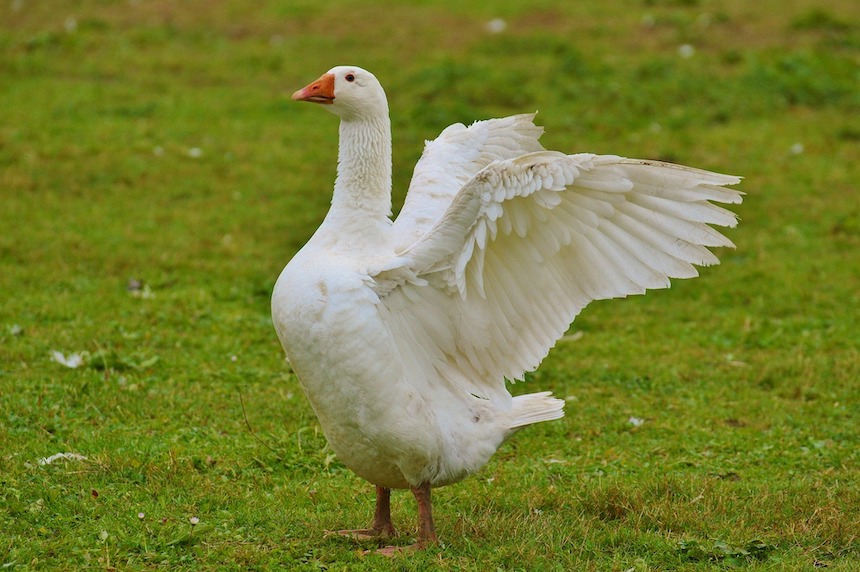
I stepped out front, and everyone in the waiting room was standing and watching Sharon leading the goose down the street and across the parking lot. She had a baling twine tied around the goose’s neck, and the goose was waddling along like a dog on a leash.

As soon as the goose came through the door, chaos erupted in the reception room. The goose spread his wings and charged at the german shepherd pup, trying to crawl under the owner’s chair to escape the charge. The cat in its carrier on Rosemary’s lap was puffed up and hissing at the goose.

Ruth was quick to lead Sharon and her goose back to the surgery room, the only unoccupied space at the time.

When I finally had a few minutes to look at Timmy, the goose, everything in the clinic had settled down. Timmy had a long laceration on the right side of his breast. It was through the skin and extended into the muscle about a half on an inch deep.

“Wow, how did this happen?” I asked.

“We have no idea. My husband noticed it when he was feeding the chickens this morning,” Sharon said.

“We need to get Timmy under an anesthetic and clean up this wound and close it. Things should go well. Birds have a high body temperature, so superficial infections are not common following wound closure. He will just have a bare patch on his chest for a time. We’ll do this right away. I’ll have to work him in between patients, and he will have to stay until he recovers from anesthesia. Still, we should be able to send him home early this afternoon.”

As Sharon gave Timmy a kiss on his beak, I drew up a dose of ketamine for anesthesia to give as soon as she left.

“I am going to give him an injection of ketamine. This should allow us time to close the wound and have him wake up pretty quickly,” I said to Ruth.

“How quick is this going to take effect?” Ruth asked.

“It will take a few minutes. I am going to finish up in the exam room, and then I will be back. It should only take a few minutes to close this wound.”

With that, I left Ruth, a short, petite gal, holding a large goose on the surgery table. 

I hurried through the vaccination on Rosemary’s cat, Whiskers.

“Are you going to be able to take care of that poor goose?” Rosemary asked as we returned Whiskers to his kennel.

“Oh yes, he should be asleep shortly.”

All of a sudden, there was a terrible ruckus coming from the surgery room. Timmy was squawking, and we could hear his wings flapping.

“Excuse me, Rosemary. Sandy can check you out. I think Ruth needs a hand.”

I rushed to the surgery room. There was Ruth, desperately trying to hold onto Timmy. Timmy was flapping his wings wildly and squawking at the same time. I quickly grabbed him and got his wings under control. Ruth and I held him for a moment, and he drifted off into a deep slumber.

“What caused that?” Ruth asked. “He was fine and then just sort of exploded.”

“Just an excitement phase of anesthesia,” I said. “It is common with all anesthetics. We just don’t see it because what we generally use has such a rapid induction. I haven’t seen it with ketamine before, but then, how many geese have we had in this surgery room.”

With Timmy under anesthesia, we plucked the feathers around the wound and scrubbed the area with Betadine Surgical Scrub. After cleaning the wound with a vigorous flush, I sutured the heavy fascia covering the muscle layer with a continuous suture of Dexon. Then closed the skin with a buried subcuticular suture, also with Dexon.

With Timmy in a kennel to wake up, we thought the day’s excitement was over. That was until the girls were discharging one of the morning surgeries cases. The young dog freaked out when he was lead past the kennel with a goose flopping about a little. That just made the pup jump about a bit.

***

“Sharon, Timmy is all fixed up,” I said as Sharon returned to retrieve Timmy. “He is going to have a bald patch on his chest until he grows some new feathers, but that shouldn’t bother him much.”

“No, I don’t think he will care,” Sharon said. “Can he walk?”

“Yes, he is wide awake. We had a little struggle with him as he was going to sleep, but he recovered with no problems. He can walk out of here now. And it is probably a good time since there are no dogs.”

“He doesn’t like most dogs, and he is pretty protective of his barnyard. He sends our little house dog packing every time he strays too close.”

Sharon tied a twine around Timmy’s neck, and he hopped out of the kennel. He waddled out out the door on his leash, like he knew where he was heading.

Photo by Alexas_Fotos from Pixabay