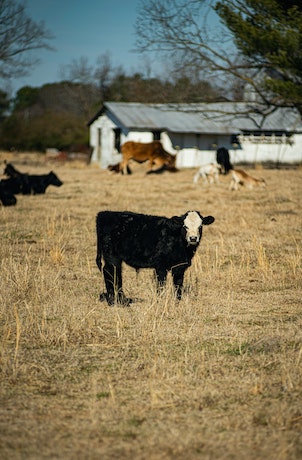
The Heel Fly 

D. E. Larsen, DVM

I watched in amazement as the group of cows ran through the lower field with their tails in the air. They all came to a stop at the edge of the pond and waded out into the shallow edge of the water.

“What makes those cows run like that?” I asked Dad as he worked on the mowing machine.

“They are running from the heel flies,” Dad said. “Those flies bite them on their heels, and that is why they stand in the water. Those flies cause the warbles we see on the back of cows.”

I had seen the warbles on most of the cows and watched as my older brother sometimes squeezed a large grub out on them. It was a bit of a mystery to me how a fly could cause a warble on the back of a cow by biting her on the heels.

***

My attention was averted from the new leaves sprouting on the trees outside the classroom window as I heard the parasitology professor mention heel flies.

“There are two species of the heel fly, Hypoderma bovis and Hypoderma lineatum,” the professor explained. “These flies lay their eggs on the hind legs, usually on the heels of cattle. After a few days, the larva hatch and penetrates the skin, then they migrate through the body, ending up on the back of cattle, in what is called a warble, some four to six months later.”

“I’ll be damned,” I thought as I concentrated on the remaining lecture.

“The important thing to keep in mind is the timing of treatment for these grubs,” the professor continued. “By fall, they will be massed around the spinal cord or the esophagus. Treatment at this time will have the potential of causing life-threatening reactions as the dead larva cause local inflammation.”

The veterinary school continued to resolve my childhood mysteries. As a boy, there were no treatments available for these grubs. The large warbles set atop some of the most valuable meat on the carcass of slaughtered animals, and there was no thought of treatment in my world.

“These times vary, depending on latitude,” the professor continued. “You need to make sure you read the label of any of the products you use.”

***

In the late spring of 1975, I took a call to look at a Jersey cow with a problem involving the warbles on her back. Fresh out of school, I was in a dairy practice in Enumclaw, Washington, and I was intrigued to be looking at warbles. Most of the time, in my early experience, they were just there and caused no real problem.

“This is a cow belonging to George and Sue,” Ann explained. “They are that hippie couple who bought the Allen dairy a few years ago. They have some strange ideas, so it is hard to say what you will be looking at.”

It was a short drive out to the old Allen dairy, and Sue had the young Jersey cow waiting in a stanchion when I arrived. 

“What’s going on with your cow?” I asked Sue as we walked to the barn.

“This is Cindy. She had a bunch of warbles on her back, so George treated her with a mixture of rotenone and linseed oil,” Sue said. “Now it looks like the skin is dead over all those warbles.”

“I have never heard of treating warbles once they are on the back,” I said. “We generally treat them with a pour-on product in the early fall. Dairy cows have to be in their dry period before you treat them. But it is important to do the treatment before November.”

“Yes, but rotenone is a natural product,” Sue said. “We don’t use any of those new artificial products.”

I looked at Cindy. Her back was covered with a mass of warbles, and dead skin covered each warble. I pinched at one warble, and the skin and exudate easily pulled off, leaving a hole almost an inch in diameter.

“This is a mess, Sue,” I said. “Just because it is natural doesn’t make it an appropriate treatment option. Any of the new insecticides would have had the same results. Rotenone killed the grubs, but this isn’t the time to be treating these grubs. The dead grubs lay in there and rotted, which set up an infection that killed the surrounding tissue and skin. This is what you have left.”

“What are we supposed to do to treat them?” Sue asked.

“The best time to treat them is with a systemic product in the fall. The cow has to be in her dry period, and she has to be treated before November. If you are not going to use a product that kills them in the migratory phase, then you shouldn’t treat them at all,” I said. “It’s not a big thing if the cow isn’t going to be slaughtered. It might cause some loss of production when there are this many warbles, but it’s not a major loss. In the early summer, the grubs come out and fall to the ground, where they turn into a fly. Then the wound on the back heals, and the cycle starts over again.”

“And what do we do with her back now?” Sue asked.

“I’m going to remove all these patches of dead skin, flush out the exudate and apply some antibiotic ointment,” I said. “Then we will put Cindy on some antibiotics for a week.”

“We don’t like to use antibiotics,” Sue said.

“Well, I guess we could just let her die a horrible death then,” I said. “Not using antibiotics in this situation would be close to animal abuse.”

“What do we need to do with her milk while we have her on antibiotics?” Sue asked.

“You will need to discard it,” I said. “You can use it for feeding the calves or the cats, but otherwise, you should discard it. There will be a withdrawal period to observe after you complete the course of antibiotics. Things are set up for the appropriate use of antibiotics. If you make a mistake and ship her milk, it might get expensive. They test your tank before putting it on the tanker truck. If your tank tests positive for antibiotics, you could end up paying for an entire truckload of milk.”

“George is pretty careful, so we won’t have that to worry about,” Sue said. “Let’s go ahead and treat her.”

I clipped the entire area of her back involved with the warbles and scrubbed it with Betadine Surgical Scrub. Then I removed the necrotic skin and flushed the pockets with hydrogen peroxide to remove all the pus and debris. I applied a thin coat of nitrofuran ointment to the lesions. Her back was covered with a mass of open wounds.

“You’re going to have to keep these wounds clean,” I said. “I am going to give Cindy an injection of Polyflex and leave you a bottle for daily injections.”

“That sounds expensive. Can’t we just use Combiotic?” Sue asked.

“They have changed the withdrawal times on Combiotic to thirty days,” I said. “Polyflex has a five-day withdrawal time. The money you will lose on milk sales with a thirty-day withdrawal will make your Combiotic much more expensive.”

“Okay, I am sure George will want to talk with you about all this stuff,” Sue said. “I am not sure I understand all the life cycle stuff and why there are treatment times and the like.”

“I’m in the office on Saturday this week,” I said. “I am usually not busy this time of the year. It would be a good time for George to drop by and visit. I can make some copies for him on the life cycle and treatment recommendations.”

***

Cindy healed uneventfully, and George came by and discussed the heel fly’s life cycle and treatment options. I am sure that his decision was to do nothing for treatment.

Photo by Peter Scholten on Unsplash.

https://livestockvetento.tamu.edu/insectspests/cattle-grub-heel-fly/

Gus and the Manure Pile, From the Archives

D. E. Larsen, DVM

Manure piles were (and still are to some extent) standard fare on Oregon farms.  They were located around the barn somewhere and served multiple uses.  They came in many shapes and sizes.  Smaller places had a simple pile outside a doorway where the barn was cleaned.  Larger farms had more elaborate piles.  In my experience their edges were the easiest place to collect a can of worms for a day’s fishing.  They also were used to dispose of small animals that were casualties during the year on the farm.  They were the ultimate compost piles.

Gus was a typical barn cat.  Well past middle age when I first met him when I came to Sweet Home in 1976.  Gus was lucky to have been neutered early in his life, but still had his share of scraps defending his turf.  He was nothing special, gray tabby in color and not large, maybe 8 pounds.  He lived with his extended family on a small acreage on a hill outside of Sweet Home.  Grandma and Grandpa lived on the “farm”.  Not much of a farm, but enough for a few cows and sheep and a small barn.  The son and his family lived about a quarter mile up the road on a neighboring taxlot.  When Gus came to the clinic he came with Carol, the daughter-in-law.

Over the first few years of practice in Sweet Home Gus was approaching his golden year.  In those times I didn’t see neutered male cats over 15 years of age.  This was before the advent of the feline leukemia vaccine, and diets did not address urinary tract and heart issues.  For barns cats to reach that age was truly exceptional.

One cold winter morning Grandpa hurried into his pickup truck in the carport on the side of the barn.   It was cold and he was anxious to get the truck started.  “Thump, thump” came from under the hood.  Gus had sought the warmest spot he knew of to sleep the night before.  The warm engine block was one of his favorites.  Usually able to scramble out before the engine started, this morning it didn’t work.

Grandpa knew what the noise meant, he had seen more than one cat caught in a fan belt on cold mornings.  He was disappointed when he found Gus, he had been such a good cat.  Gus was a mess, broken leg with bone poking out, left eye hanging out of the socket, several large lacerations and bleeding from his mouth.  In Grandpa’s mind there was only one thing to do.  Picking up a hammer, he made a quick whack to the back of Gus’ head.  Disposal was easy.  Gus’ final resting place was the manure pile on the other side of the barn.

In most cases that would be the end of the story, but remember, cats have 9 lives.  Gus had already used several of his just surviving to this advanced age.  Now he would need to cash in all the others.

Carol had noticed that Gus had not been to his dish on the back porch for several days.  She mentioned his unusual absence to Grandpa.  Grandpa was quiet, knowing the she would have rushed Gus to clinic and spent a lot of money on an old cat.

The next morning, she heard a noise on the porch.  She opened the door and was aghast at the scene.  There was Gus.  Covered with manure, left eye hanging out, broken and torn.  How had he managed to make it to the door? How had he known which door was the one to provide him help? She carefully boxed Gus and headed for the clinic.  Grandpa was outside as she drove by so she stopped to show him what she had found.  Grandpa had no choice but to confess.  He said that the vet could do a better job than him, assuming that Gus would be put to sleep.  In those years, in Sweet Home, if a cat couldn’t be fixed for $100.00 it probably was not going to be fixed.  Gus would surely be well over that figure.

Carol laid Gus on the exam table and related the story.  Gus looked hopeless to me.  She wanted to know her options. Gus was a pitiful sight as he lay on the table, looking cautiously at me out of his one good eye. 

“What are your options, Gus?”  I thought to myself as I pondered the situation.

My initial thought that Grandpa had Gus’ best interest at heart, he just didn’t do the job very well.  I’m not sure that was what his owner wanted to hear.

“We have a lot problems here” I started.  “Contaminated compound fracture of the tibia, fracture of mandible, eye that needs to be removed, broken teeth and multiple lacerations that are very contaminated.  The first question we need to discuss is do we want to put him through all this over the next few weeks?”

Carol was quick to respond, “We are not going to put him to sleep, not until we don’t have any other option.  I don’t care what it costs. If we have to, Grandpa can log a few trees.  That’s the least he can do after what he did to this cat.”

I knew Grandpa.  He would log his trees for his family or for the Grandkids.  I wasn’t so sure about a cat.

Now we were on to option number 2.  Referral was out of the question. There were no specialty clinics around at that period of time.  If Gus was going to survive it was going to be by my hands only.

“We have several things to do, first we need to sedate him and get him cleaned up, get him on some fluids and antibiotics.”

“The wounds are too contaminated to close; if we clean them up and remove the grossly contaminated tissues, they will heal if he lives long enough.”

“I can probably wire the jaw and remove the broken teeth.  The eye is toast and has to go.”

“The fractured tibia is too contaminated to fix, the ends of the bones are likely dead,  The leg has to go.”

Carol finally spoke, ” I want to save the leg!”

“Can’t be done.”  I responded.

Again Carol spoke, “I want to save the leg, we can try!”

“Okay, we can try, but if it happens it will be a miracle.  And the leg will be short.  We will try.  He will have to stay a few days.  I don’t know what this will cost.”

Carol left, convinced that Gus was going be back to his old self in a few days.  Might take a little longer than that, I thought.

We sedated him with a dose of Ketamine and got him under the spray nozzle in the tub.  After cleaning the manure and dirt, it looked like things were almost doable.  We got him dried off and an IV started.  Antibiotics on board and warmed up a little, he was ready for the first of several procedures.

Putting Gus on some gas anesthesia, we started cleaning wounds.  Shaving hair from the wounds. We removed contaminated tissues and packed with Furacin Ointment (the best topical antibiotic ointment I had at the time).

I worked on the tibia next.  The ends of the bone were dry and brown with debris stuffed into the ends.  I cleaned the wound as best I could.  Calculated that I would have to removed bone from both exposed fragments.  I couldn’t make myself think this was going to be anything but a waste of time. We packed the wound with antibiotic ointment and would do the repair tomorrow.

The left eye was hanging out of the socket and did not require much to remove.  Placed a single suture around the optic stalk and removed the eye.  I could deal with closing the socket later.  

The mouth was clean compared to the rest of the cat.  Gus was missing both upper canine teeth and one lower canine tooth.  His jaw was fractured on the left side and separated at the symphysis (the mid point at the front of jaw were the mandible bones join in a non movable joint).

The symphysis was repaired by passing a 20 gauge wire around the mandibles just behind the lower canine teeth, exiting on the ventral midline where I twisted the ends to tighten the ligature, cut the ends short and buried with a single suture.  The fracture of the mandible was stabilized by wiring around two teeth on each side of the fracture.  Probably will need to do more but later.

The next morning Gus was looking pretty good and actually was ready to get out of here and back to his barn.  We gave him a few laps of gruel and continued the fluids.  We were going to tackle the leg later today.  I still felt this was a waste of time.

With Gus under anesthesia, I went to work on the exposed bone.  To my surprise, I did not have to trim too much bone before I came to bleeding bone.  The marrow cavity appeared pretty clean with the superficial debris was removed.  I repaired the fracture with a threaded intramedullary pin.  Inserted at the knee and threaded down the marrow cavity to the fracture site.  Placed the ends of the exposed bone into normal position and seated the pin into the distal fragment.  This was the common repair at that time.  We will have problems due to the contamination at the fracture site.  I cleaned up the wound as best we could and closed this wound.

Gus was ready to go home for a few days before we started the next round of repair and treatment.

Both Carol and Gus were happy to see each other.  Gus was actually stepping on the fractured leg.  Cats always make surgeons look like they know what they are doing.

Over the next few weeks, Gus became a standard visitor to the surgery room.  We would clean on his open wounds, which were granulating well.  We closed his eye socket and placed an additional wire in his jaw to improve the repair.  On each visit I was more and more cautious on how the leg was healing.  The soft tissues were looking good but I was still skeptical about the bone.  Carol was in great spirits, and I think that Grandpa was getting to come out of the doghouse once in awhile.

Finally, push comes to shove.  Time to x-ray the leg to see how the repair is going.  Gus is still quite a sight.  One eye and one lower canine tooth protruding out on the outside of his upper lip.  Larges patches with no hair, but the wounds are mostly healed.  Probably as good as they would have healed had they been sutured.  He would purr and he was bearing weight on the fractured leg.

The x-rays were better than I expected.  There was some healing but not what was needed.  We would have to try something different.

So at 6 weeks from the time of injury I removed the IM pin.   There was a pretty good fibrous union of the fracture, but no boney union.  The next try was an external fixation device, 4 small pins driven into the bone, 2 above and 2 below the fracture site and bolted to an external pin to fix the bones in position.  A tall order for a cow doctor but I got it done.

Another 4 weeks and we were done.  The leg was healed, Gus was happy, Carol was happy.  I don’t know about Grandpa.  The total dollars are lost to a clouded memory.  Anyway, it was never about the money.

The last time I saw Gus was almost a year later.  Into his golden year now, and with none of 9 lives to spare, he was truly an old cat.  He was in for routine stuff, an abscess on the side of face, (left side, he probably didn’t see the punch coming) and tapeworms.  Still defending his turf and still able to catch a mouse or two. I always wondered about his final resting place.  Was it the manure pile, again?

Photo by Pitsch on Pixabay 

The Poll Presentation

 D. E. Larsen, DVM

I was cleaning up at Robert’s place in Brownsville when his wife came out of the house at a trot.

“Doc, your office is on the phone and would like to talk with you,” Alice said. “We have an extension near the back door that you could use now without removing your boots.”

I headed around the house, and Alice with waiting at the back door with the phone receiver in her hand.

“Hello, what’s up?” I asked.

“Elaine is at a place just over the hill on Mountain Home Drive,” Ruth said. “She has a mare in labor, and there is a problem. She was hoping I could catch you. She would like you to stop by and give her a hand.”

When Elaine joined the practice, it gave me the opportunity to step aside from working with horses. Now, I am being pulled back in to help. 

“I know the place,” I said. “If she calls back, tell her I am done here and will head that way as soon as I clean up a bit. I should be there within fifteen minutes.”

“I don’t think she will call back,” Ruth said. “She sounded pretty exhausted, and I think she is having problems with this mare.”

I hurried, cleaned up, got everything in the truck, and headed to Mountain Home Drive.

Difficult deliveries in the mare were extremely rare and my worst nightmare. The contractions are so powerful the foal is usually delivered rapidly. Difficulties are hard to deal with because of those contractions. War stories abound. Veterinarians get their arm broken when it is between the foal and mare’s pelvis during a contraction. Stories of having to anesthetize the mare to make any manipulations of the foal’s position or placing a stomach tube into the trachea of the mare to reduce her ability to do an abdominal push. 

I had once asked a horse veterinarian how he handled difficult deliveries.

“I call one of you cow doctors,” he had replied. “You’re the ones who do all the delivery work. I see a problem once every five years.”

I could only imagine what Elaine was dealing with today, but I wasn’t looking forward to helping her.

Elaine was waiting outside the old garage by the edge of the driveway. I could see the mare down inside the old garage.

“What do you have going on?” I asked.

“She has been in labor since sometime during the night,” Elaine said. “I think she has just about had it. The foal is in a poll presentation, and its head and neck are stuffed into the birth canal so hard I can’t budge it. She strains so hard against my efforts to push the head back. I thought you might have a little more strength and be able to correct this presentation.”

“I would assume the foal is dead,” I said.

“I think so, but I don’t know how to be certain,” Elaine said.

“We should be able to reach an eye,” I said. “You stick a finger in his eye, and if he is alive, he will react to that with a contraction of the eyelids or something. You check that while I get my coveralls and boots.”

When I was ready and scrubbed up, I knelt beside Elaine behind the mare.

“There was no response when I stuck a finger in his eye. He is probably long dead,” Elaine said.

“Let me get in there and see if I can move this head,” I said, reaching my left arm into the mare’s vagina.

The foal’s front legs were in the birth canal in normal position, and the top of the head was the next thing I encountered. The bridge of the nose was impacted against the brim of the mare’s pelvis. I pushed with all strength on the foal’s head. The mare stained, and the head hardly moved.

“In the cow, I would push this head back alongside the calf, put the leg back into the uterus, and then pull the head back to normal position. It would be simple to get the leg back up to normal position and deliver the calf. But I can budge this foal’s head.”

“What do you think? Should we sedate the mare and try?” Elaine asked.

“When we have a dead fetus, my training says we make decisions that are easiest for the mother,” I said. “I think we should cut the head off.”

“I know you do fetotomies all the time on cattle, but I have been told they are dangerous in the mare,” Elaine said.

“The concern in the mare is the exposed sharp bone lacerating the birth canal,” I said. “I can cut the head off with a fetatome and cover the exposed bone with my hand. She will spit this foal out with one or two contractions.”

Elaine took a deep breath. “Okay, let’s get it done,” she said.

While Elaine was putting the fetatome together, I threaded a length of OB wire between the foal’s head and neck. This would cinch down and make a clean cut right at the base of the skull. We threaded the wire into the fetatome, and we were ready to go.

“I will hold the fetatome in position, and you work the saw,” I said. “When the cut is complete, I will pull the head out and then place my hand over the exposed neck bone. That will be a rapid move because once that head is out, this old gal will be pushing.”

I placed the head of the fetatome against the side of the foal’s head and had Elaine take up the slack in the OB wire. I double-checked the position of the wire.

“Okay, let’s go, long, slow strokes to start, then pick up the speed,” I said. “This will be an easy cut. You will be done before you know it.”

Elaine started the saw, and the wire sliced through the foal’s neck in a half dozen strokes.

I grabbed the head by an ear and pulled it out of the mare, immediately putting my hand back in to cover the exposed bone of the foal’s neck.

The mare made a strong contraction, pushing the foal into the birth canal. The exposed bone popped out of the vulva. I grabbed the foal’s legs and gave a tug, and the mare pushed again. The rest of the colt was out, followed by all the membranes.

“Wow! That was some fast action,” Elaine said. 

We stood up, and the mare rolled up onto her sternum, and then she stood up. She turned to look at the foal but Jose, the owner was already pulling it out of the garage.

“What do you think we should do for her now?” Elaine asked. 

“I will put some antibiotic powder in her uterus and check for any damage to the birth canal,” I said. “I think giving her some IV antibiotics, maybe a dose of dexamethasone and oxytocin, would be a good idea. Whatever you think.”

I placed five grams of tetracycline powder into the mare’s uterus and did a thorough exam of the uterus, vagina, and vulva. There were no birthing injuries. This mare should be in good shape for breeding in the future.

“Okay, Elaine, you finish up here, and I will run back to the office and get things caught up there,” I said. “I think this gal is fine and should have no problems, but I would suggest some antibiotics for a few days at least.”

I was thinking of how good it felt not to deal with the mare and the owner following the delivery. People always feel like they are on the losing end of things when the foal doesn’t survive. They don’t understand how close they were to lose the mare also.

This mare did well following the delivery and lived to have at least a couple of foals in the future with no problems.

Photo by Faris Hamza on Pexels.