http://bluebirdofbitterness.com/2023/06/20/thanks-a-latte/
Salmonella Infection in Calves

D. E. Larsen, DVM
Larry was waiting at the barn when I pulled off Old Holley Road. I parked in front of the barn, stepped out of the trunk, and shook Larry’s hand.
“What do you have going on today, Larry?” I asked as I opened the back of the truck.
“Doc, I have been buying all the bull calves from a dairy over by Shedd,” Larry said. “I was up to twenty-four of them the first of the week. I got them for a good price, and I was figuring I would make a bundle on them. Then, this week, I have lost six calves. Two of them just this morning. I guess I want to know what’s going on with them.”
“Let’s look at what you have set up before I get anything out of the truck,” I said.
We walked through the barn door, and Larry had the two dead calves laid out in the straw by the door. They were thin, skinny would be a better description, and their rear ends were soiled from diarrhea.
“When this started, I just thought it was a case of scours,” Larry said. “So I picked up these scour pills from the feed store. But they haven’t helped at all.”
Larry handed me a package of scour pills, Aureomycin, a tetracycline pill. Looking at the calves in the pen, they were all thin, and most of them were showing some signs of diarrhea. They were well bedded in straw, but it looked like new straw was laid down over older straw when it became soiled.
“If you have lost six calves this week, you need to load these two dead calves up and take them over to the diagnostic lab at Oregon State,” I said. “This is not just a simple case of scours.”
“I figured that out when two of them were dead this morning,” Larry said. “Do you think these pills are okay?”
“No, I don’t use tetracycline in nursing calves,” I said. “Some of the drug might be bound up with the calcium in the milk, and you need a stronger antibiotic anyway. I will leave you some trimeth/sulfa until we get the results from the diagnostic lab. I also want you to turn these calves out on pasture, if that is possible. This setup is okay, but when we have a lot of diarrhea, pasture just gives these calves a cleaner environment.”
“I was thinking of turning them out anyway,” Larry said. “The pasture is really starting to grow with the warmer weather. And Doc, could you give me a prescription for those pills from the pharmacy. I need to save as much as possible with this many calves.”
“Okay, and call if you see any calves not eating or with watery diarrhea,” I said. “They will need some fluids, and if we start early, we can use oral fluids. Those are a lot cheaper than giving IV fluids.”
“Will the lab know I’m coming?” Larry asked.
“Yes, I will call over there and try to build a fire under them so they will put these calves at the head of the line,” I said. “We will need to get early results if we can.”
Larry was loading the dead calves into the back of his pickup as I pulled out of the driveway. I called Dr. Snyder at the diagnostic lab when I returned to the office.
“Stan, I am sending a client over this morning with a couple of dead calves,” I said. “He has a bunch of calves that he gets from a dairy, and he has lost six out of twenty-four calves this week. I guess I’m asking for some special treatment if that is possible.”
“We see some nasty bugs in some of the dairies around the valley here,” Dr. Snyder said. “I will take the case when he gets here. We will have the gross necropsies done this afternoon. But, as you know, any culture will take a day or two.”
The initial results of the necropsy had Dr. Snyder thinking we were dealing with one of the virus diseases, probably bovine virus diarrhea, but the following morning he was on the phone again.
“Dave, the initial culture results look like we are dealing with a Salmonella bacteria,” Dr. Snyder said. “That’s really preliminary, and it will take another day to put an accurate name on the bug, but we will start a sensitivity test right away, so you should have those results in the morning. You need to caution Larry about this bug. It is definitely zoonotic. If any of his kids have been working with these calves or anyone with any immune suppression, they should be checked by a doctor if they have any problems.”
“Okay, I was going to stop by his place this afternoon anyway,” I said. “Thanks for the special attention in this case. I know you guys are busy over there most of the time.”
When I stopped at Larry’s place, he seemed all smiles.
“These calves are looking better already with that new antibiotic,” Larry said. “Most of the stools I see are looking almost normal.”
“Initially, Dr. Snyder thought we had some virus problems, but this morning it looks like they have a positive culture for salmonella,” I said. “If the stools are looking better, I maybe made a lucky guess on the antibiotic. We also need to worry about any infection in you or your family. Salmonella bacteria is a serious infection, and looking at your dead calves, it can be life-threatening. It can definitely cause disease in people.”
“My son has had some diarrhea the last couple of days,” Larry said. “We didn’t worry much about it. It’s just one of those things kids have at times.”
“This is nothing to play around with, Larry,” I said. “You need to have him checked by your doctor. I can send him the culture results tomorrow when I get the report, but you should get your son to the doctor today.”
When the culture results came in, they listed a heavy growth for Salmonella species, type D, cultured from the lungs of both calves. The sensitivity showed resistance to many antibiotics. Just by the luck of the draw, the bug was sensitive to trimeth/sulfa.
The remaining calves continued to improve and thrived on the pasture. When I stopped for a quick look the following week, you couldn’t tell they had ever had a problem.
Larry’s son went to the doctor and was started on antibiotics. I never heard any results, but the two of them were in later in the summer talking about fishing the canyons of the upper Santiam River, so I would guess his problems resolved just fine.
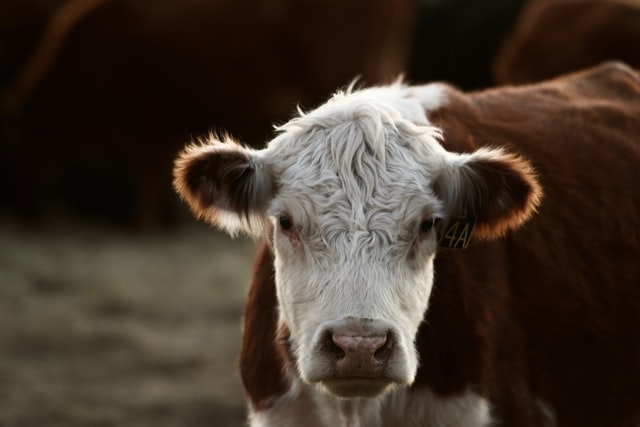
Photo by Evgen Slavin on Unsplash.
Rosebud’s Wire, from the Archives
D. E. Larsen, DVM
Hardware disease results from the indiscriminate eating habits of the cow. It was frequently seen when hay was baled with wire. Any stray sharp metal, like a nail, could be involved. The hardware will fall into the reticulum, considered the second stomach. The cow’s heart lies just on the other side of the diaphragm from the reticulum. Then when the wire pierced the reticulum and the diaphragm, it would poke into the heart. This can cause acute discomfort and rarely rapid death, but more likely a slow death from an infection around the heart and chronic heart failure.
My first recollection of a cow with hardware was with our Linda cow at Broadbent. Named after my sister, Linda cow was a Jersey cross cow. Of all our cows, she was the least attractive. Probably crossed with a Guernsey, she was mostly white with some orangish brindle coloration.
In the early 1950s, hardware disease was treated with surgery. The rumen was opened on the left side, and the operator would remove some of the content, and then reach anteriorly to the reticulum and extract the offending wire. Dr. Crawford, a veterinarian from Coquille, did the surgery on Linda. She carried an ugly scar for the rest of her life, which was not unusual with that surgery.
By the 1960s, hardware disease was treated with a magnet given orally to the cow. The magnet would fall into the reticulum, secure the offending hardware, and through regular stomach activity, withdraw it into the stomach. It would stay there, with the magnet until it rusted away.
We had one valuable cow that was treated at Colorado State University Veterinary Hospital while I was in school. It was suffering from severe pericarditis (infection around the heart) from hardware disease. In a last-ditch effort to save the cow, they removed one rib section and opened the pericardium to the outside. They could flush this area a few times a day. The problem was a large amount of inflammatory tissue in the pericardium became constrictive as it aged, and the treatment failed.
My first case of hardware disease after graduation occurred in Enumclaw. Andy had called with a steer that was not doing well.
“I don’t know what is going on with him, Doc,” Andy said. “He just stands mostly and walks sort of stiff-legged when he does move.”
Andy had the steer in his old dairy barn, just loose in the stanchion area.
“Let me get my rope, and we will get a look at him,” I said.
When the lasso landed over his head on the first throw, it surprised but the steer and me. He jumped to the right, and then back to the left, and then he fell over dead.
“What the heck happened to him?” Andy said in amazement.
A quick necropsy showed a five-inch wire poking into his heart. Had I been able to restrain him quickly, a magnet possibly would have saved him.
“My guess is you are feeding hay baled with wire,” I said.
“Yes, I just got a new load of alfalfa,” Andy said.
“I would suggest you give all your other cows a magnet,” I said. “It is pretty easy to do, and it is a good preventative for this type of thing. Although it is rare to see a steer drop dead like this one.”
“So, was that in the hay or did I do that when I opened the bale,” Andy asked.
“There is no answer to that question,” I said. “I guess it doesn’t matter to this guy.”
“Can we eat him?” Andy asked.
“I guess that depends on how hungry you are,” I said. “He doesn’t qualify according to the food inspection criteria. He probably had a temperature and some inflammation. Obviously, you could eat him, but I don’t think the meat will be very good.”
And then there was the call from Barney. Barney was my very first call in Sweet Home. I had only been in town for a couple of days when the phone rang.
“Doc, this is Barney. Stan over at the feed store told me you were in town. I have a cow that stopped eating a couple of days ago and she is just not doing very well. I sure would like for you to get a look at her.”
“Barney, I am really not ready to do any calls,” I said. “I don’t have most of my equipment and drugs yet.”
“If you could just look at her,” Barney said. “If I have to call Albany, it will take them 3 days to get out here. It is going to be great, having you in town.”
“Okay, I will get a look at her, but no promises,” I said.
Barney’s place was up Ames Creek. He had several acres and a couple of cows. I pulled into the driveway in our car as I didn’t have a truck yet. Barney was waiting to greet me.
“Hi, I am Barney. I hated to pressure you, Doc,” Barney said as he shook my hand. “But you have to realize how difficult it has been to get a veterinarian out here in the past. Everybody is excited that you are coming to town.”
“I’m glad to meet you, Barney,” I said. “I am here, it is just that I am not quite organized yet. Shipments of equipment and supplies are coming everyday but the clinic is way behind schedule. The little 2 bedroom apartment we have rented is bursting at the seams. We have boxes stacked to the ceiling. But let’s get a look at this cow of yours. Oh, by the way, Barney, you are my very first client in Sweet Home.”
Barney’s cow, Rosebud, was a Hereford. She was in good shape, in fact, probably a little overfed. I would guess she was 5 or 6 years old. Doing an exam showed a slightly elevated temperature and much reduce rumen motility. Everything else was within normal limits.
“How long has she been sick, Barney?” I asked.
“I noticed that she stopped eating a couple of days ago. She has just been standing around, not moving much.”
I squatted beside Rosebud on her left side. I leaned against her belly with my elbows on my knees. I placed both hands in the center of her belly, close to the edge of her ribs. Then with a hard push upward, like a punch in the gut, I jiggled her entire abdomen.
Rosebud let out a noticeable groan. Almost a diagnostic pain response for hardware disease.
“She has wire, Barney,” I said.
“A wire, what are you talking about?” Barney said.
“Cows aren’t very discriminating when they are chewing on hay,” I said. “If there is a wire in that hay, it goes right on down. It falls into the reticulum, a little pouch on the front on the rumen. If the wire happens to puncture the wall, it is a very short distance to the heart.”
“So, what do we do about it?” Barney asked. “It seems I have heard about them doing surgery because of a wire.”
“At this stage in the game, we rarely have to do surgery,” I said. “I will give her a magnet and some long-acting sulfa boluses. I just happen to have both of those. That should take care of things in a day or two.”
“That sounds better than surgery,” Barney said. “Do I have to do anything with her?”
“You just keep an eye on her,” I said. “Call if she is worse tomorrow. I will give you a call or probably just drop by when you get off work in a couple of days. Since you are my first call, I don’t have a lot to do just yet. I should have plenty of time to look after her.”
Rosebud recovered in a couple of days and returned to her normal appetite and activities. Barney became a good client, friend, and neighbor for a few years that we lived on Ames Creek. And he was always proud of the title of my first client in Sweet Home.
Photo by Stephen Wheeler on Unsplash

