The Land is Cheap There

 D. E. Larsen, DVM

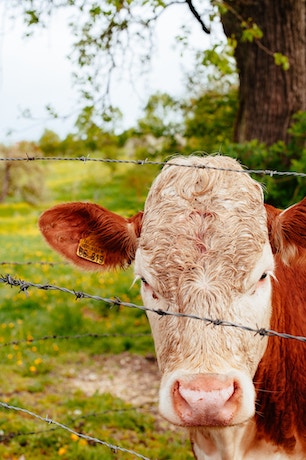
When I pulled into the driveway, I could see Don waiting in the doorway of the little barn behind their house. He had one old Jersey cow when I called on him at his little place over on North River Drive. He had said he wanted his cows checked for pregnancy, so I figured he had more than one cow in this new place.

“This is a nice little place you have out here, Don,” I said as I got ready to check his cows.

“Yes, we enjoy it out here,” Don said. “But little is the keyword in your sentence. I only have four cows. I could probably run six if I bought more hay. But my pasture is pretty limited.”

“What do you do with your milk?” I asked.

“I suppose I should be careful telling you, but I jug it,” Don said. “Raw milk is pretty popular around here. I have people lined up at the milk house every evening.”

“I don’t know all the rules, I think there is a small farm exception, but raw milk sales on the retail level are illegal in Oregon,” I said. “When I was in Washington, I cared for a large raw milk dairy. There were a lot of rules and a lot of testing for them to keep their milk on shelves.”

“I don’t know why that is. Raw milk is probably better for you than the stuff you buy in the store,” Don said.

“That’s a discussion we won’t find common ground on, Don,” I said. “There are some arguments in favor of raw milk, but there is a whole list of diseases that can be transmitted by the stuff. Some of those are probably considered rare in a small, closed herd like you have here. But if they start selling raw milk in a big way, there will be problems. I say that even though I grew up on the stuff. The immune status of a farm kid is probably far stronger than in the little girl in town who seldom gets out of the house.”

“Well, let’s get these cows checked,” Don said. “I am selling them next week. We are going to sell this place and go to Iowa and buy a farm.”

“I will be sorry to see you go,” I said. “But what made you choose Iowa. It gets pretty darn cold there in the winter.”

“My wife is from Iowa,” Don said. “Land is a lot cheaper there.”

“I used to tell people that when I was in school in Colorado, we used to go up in the mountains so we could watch the riverboats on the Mississippi River,” I said as seriously as I could. “We could do that because there was nothing in-between. All the land is flat.”

Don was quiet for a few minutes. Deep in thought as he processed my statement.

“That must be a joke,” Don finally said. “I don’t think you could see that far.”

“It’s a joke, Don,” I said. “It is meant to illustrate that there is a lot of flat land between the Rocky Mountains and the Mississippi River.”

“It might be flat, but it’s good land,” Don said. “And it is cheap. I can sell this little place and go back there and buy a hundred-and-sixty-acre farm. And I will probably have money left over to buy cows. That is what I am going to do. I am going to buy a little dairy instead of playing around with three or four cows.”

We went in the barn to check the cows.

“How far along are these cows?” I asked.

“I only had a bull for a month, so if they are pregnant, they will be about five months along,” Don said. “I really don’t need a close timing. The guy who is buying them just wants to make sure they are pregnant. I haven’t seen any of them in heat, so they have to be pregnant. He just wants your opinion on a piece of paper.”

“At five months, I can’t give you much more than an approximate month,” I said. “Before ninety days, I can get that down to plus or minus five days.”

I pulled on a plastic OB sleeve and checked the first cow. The fetus is often out of reach in the cow at three and four months of pregnancy, but I can usually feel the calf at five months. Size is pretty variable, however.

“This cow is pregnant, and five months is a good estimate. I can feel the head,” I said as I changed sleeves.

I worked through all the cows, changing sleeves between each cow. That was not something I usually didn’t do, but the numbers were small, and with Don selling raw milk, it was probably a better practice.

“Everybody is pregnant,” I said. “I think they are closely grouped. That bull must have had a busy few days.”

“He was a little Hereford bull,” Don said. “I like using a Hereford bull on these jerseys. They spit those calves out like nothing is happening.”

“I grew up on a Jersey dairy,” I said. “I never saw a calf pulled until I got to vet school. The shape of the Jersey pelvis makes them the easiest calving cow of them all.”

“Thanks for services over the years, Doc,” Don said as he shook my hand. “I might not see you again. These cows go next week, and the realtor says this place won’t take long to sell. I will probably buy cows in Iowa by next month.”

“Good luck, Don,” I said. “You probably want to buy some long johns and insulated coveralls, along with those cows.”

***

It was months later, in the middle of November, when I came in from a farm call, and Sandy handed me a note with a telephone number.

“Don called from Iowa,” Sandy said. “He sounded a little upset and wanted you to give him a call if you could.”

“Hello, Don,” I said as soon as Don answered the phone. “How are things going, and what can I do for you?”

“I guess I will never be smart enough to know how you can be so smart,” Don said. “I finally broke down and bought a pair of the insulated coveralls you told me about. It is so damn cold here. I don’t understand why anybody settled in this country in the first place.”

“They didn’t know to fix their wagon wheel when it broke,” I said. “So they were stuck and decided to make the best of it.”

“You might be right, Doc,” Don said. “The other morning, a cow pissed on the floor and plastered it everywhere. The damn stuff froze in no time, and I slipped on it and fell. I spilled a bucket of milk and thought I broke a hip at the same time. My hip is okay, but I am still crying over that bucket of spilled milk.”

“You be careful, Don,” I said. “You are starting to talk like me. You didn’t call to tell me stories. How can I help you?”

“Doc, I need help finding a veterinarian,” Don said. “The guy I had out here this week seems like a quack to me.”

“Don, I don’t know any veterinarians in Iowa,” I said. “You might call the vet school at Iowa State and ask them for a list of veterinarians in your area they could recommend. In fact, it might be better to try to talk with one of the large animal professors and ask him. He probably will remember all the ones he thought should be washed out of school.”

“This guy came out to pregnancy check a bunch of cows for me, and he didn’t even change sleeves between cows,” Don said.

“Don, in a large group of cows, that is common practice,” I said. “It is different with I checked your cows here. You only had a few cows.”

“Okay, maybe I was too rough on him,” Don said.

“If it is important to you, just ask him to do it,” I said. “I would guess he would not be bothered by the request. He might make you pay for the extra sleeves, but that is only fair.”

“Okay, I will do that,” Don said. “And I wish you had told me to come back here for a winter before I bought into this place.”

“Just wait, Don, it’s only November,” I said. “You have a long way to go before spring.”

Photo by Get Lost Mike on Pexels.

Where is the Volar Pouch, from the Archives

D. E. Larsen, DVM  

Dr. Adams was a massive man, both in his physique and in his professional reputation. He was not tall, less than six feet, but very muscular. His rugged facial features made him appear to have a scowl on his face in the best of times. In those moments, when he was mad at a horse or a student, some would say he was fearsome.

There was a story while we were in school about Dr. Adams attending a meeting of equine veterinarians. The first presenter was doing a ground-up portrait of the perfect equine veterinarian to lighten the audience. 

He started with the feet, then the legs, on up to the chest and arms. The picture was that of a cartoon gorilla. In actuality, it portrayed Dr. Adams pretty close. Dr. Adams was in the front row and was becoming red in the face because it seemed everyone except the presenter recognized the similarity to Adams. I have no idea if the story was true, but it was told a lot in those years.

However, he was a great teacher. When I was assigned to him for my senior rotation in large animal surgery, I was thrilled. That thrill did not last long.

On the first Monday morning of my two-week rotation, the Junior student and I waited in front of the large animal surgery room. Finally, Dr. Adams arrives at 8:00 AM sharp.

“Good morning, Guys,” Dr. Adams says. “You two are lucky. We have a busy couple of weeks coming up. I want to get off to a running start here.”

He throws up an x-ray of the lower leg of a horse on the viewer.

“Where is the Volar Pouch, Larsen?” Dr. Adams asked. 

“Um,” I stammer.

“Jon, same question?” Dr. Adams says to the junior student.

“I guess I don’t know,” Jon replies.

“Okay, let’s get started on the day,” Adams says. “But, you two have an anatomy test in my office at 1:00 PM on Wednesday. If you fail that test, you fail the rotation.”

And if the rumors of Adams’ power were correct, we will play hell graduating if we fail the rotation. This was not only intimidating, but it was also damn scary.

When the casework was done for the day, Jon and I were in a rush to get home. I had managed to get through the first 3 years of Vet School with little studying outside of the classroom and clinic. Now, I had a couple of nights to review the anatomy of the horse in exquisite detail. 

Dr. Adams was the author of Lameness in Horses and enjoyed the reputation as the leading authority on the horse’s legs. That gave us a clue. Make sure you know every detail of the anatomy of the horse’s legs.

For the next two nights, I reviewed my anatomy notes from my freshman year. I committed the equine section of Sisson’s book, The Anatomy of Domestic Animals, to memory. My memory is pretty much photographic. I can save pictures in my mind, but not text. On occasion, I can save captions to the photos for a brief time.

Finally, Wednesday came. We had surgery scheduled for the morning. Dr. Adams was a skilled surgeon. In this jumper, there was a chip fracture of a carpal bone. A significant amount of the time involved getting the horse under anesthesia and positioned on the surgery table. The surgery was brief in Dr. Adams’  hands. The chip was removed, and Dr. Adams left the closure to his intern and senior student, me.

“Don’t forget the test in my office at 1:00,” Adams said as he pulled off his surgery gloves.

“We’re looking forward to it,” I replied with an unseen smile, but I am sure it reflected in my eyes.

Adams smiled and departed the surgery room. 

When the horse was recovered, and back in the stall, Jon and I had a full hour and a half for a final review.

“I am going to take Sisson and go grab a coffee and a sandwich over at the MU,” I said.

“That might be good,” Jon said. “I will join you, but I think I have had my quota of coffee for the week.”

There was no real conversation at the table. We ate a quick sandwich, and both did a final review of Sisson. My pages turned much quicker than Jon’s. When the time came, we got up and walked back to the hospital. 

Dr. Adams’ office was on the second floor of the hospital. When we turned the corner to his office, we ran into a crowd of classmates. Word of our test had spread through the classes, and everyone wanted to watch. It must be like a crowd viewing a hanging. We worked our way through the crowd and took our seats in the office.

These professors all tried to present themselves as intimidating as possible. I found it almost laughable. In my last year in the Army, it was common for me to make presentations at general staff meetings, for generals with 2 or 3 stars on their collars. They were much more formidable than any professor. So in this situation, I was pretty relaxed. Jon was not so much.

Dr. Adams wasted no time. He started firing questions, some oral, some with x-rays on the viewer, and some with pictures from slides projected on to the wall. Like all tests, they are easy if you are prepared. I think the fact that both of us didn’t miss a question was getting to Dr. Adams. 

“You haven’t asked about the volar pouch,” Jon said.

“I figured that would be the question you studied first,” Dr. Adams said. “But since you mention it, why don’t you tell where it is located and what it is, and why it is important on that x-ray I had Monday morning.”

“The volar pouch is an extension of the joint capsule and is located between the cannon bone and the suspensory ligament, just above the sesamoids of the fetlock. If it is distended, it indicates inflammation in the joint.”

“That’s a good answer, Jon,” Dr. Adams said. “You should not overlook that on an x-ray.”

“If you did an adequate clinical exam, you should know it is distended before the x-ray is ever taken,” I said.

“That’s a good point, but in this business here, I am often looking at x-rays of horses that I didn’t examine,” Dr. Adams said.

Finally, he puts a picture on the wall. This was a picture of the two planter nerves on the lower front legs of a horse. There is a nerve that communicates between these two nerves. It crosses the leg at an angle. . You could tell which leg you were looking at by the directing that this nerve was running between the two primary nerves. This was a picture right out of Sisson.

“Larsen, what leg is this?” Dr. Adams asked.

“The left leg,” I said. “The left front leg,” I added.

“How do you know that?” Dr. Adams asked.

“That is the picture out of Sisson,” I said. And then, looking at a blank wall, I used my finger to trace the words in the caption of that picture as I read the caption.

The hallway audience erupted in laughter.

Adams shook his head and smiled. “That’s all I have, I can’t top that.”

That could have been the only time I ever saw the man smile. There was never a mention of the test in the remaining time days of the rotation. We learned a lot, and even though I was not fond of horses, I learned everything I could from the man.

Photo by Laila Klinsmann from Pexels

A Chilly Birth

D. E. Larsen, DVM

I stood looking out the living room window. The world was blanketed with six or eight inches of snow. This was unusual for Sweet Home. 

“Are you going to the office this morning?” Sandy asked. “Nobody has come down the road yet.”

“You need to call the girls and tell them not to worry about coming in early,” I said. “Maybe check about noon, and we will see what the snow is like then.”

“I don’t think you should plan to go to the office in this stuff,” Sandy said. “The county won’t get around to plowing this road until this afternoon or tomorrow. Last night’s news said it would be cold, down in the teens or the single digits today.”

“I have a dog in the clinic that needs to be taken care of, and I can forward to phone to the house so you can answer any calls,” I said. “Judy cleared the morning appointments before she went home last night. But with this snow and these temperatures, we are bound to get a call with a downer cow that is half frozen.”

“You shouldn’t be out on these roads until they are plowed,” Sandy said. “You won’t do anybody any good if you wind up in a ditch somewhere or worse.”

No sooner than those words were said, the telephone rang.

“Good morning, Doctor Larsen. This is Sue out on Berlin Road,” Sue said. “Our first ewe had a lamb sometime last night or this morning. She is doing okay, but the lamb is nearly frozen. This is a young ewe. I don’t think she knows what she is supposed to do. Can you come out and get a look at it?”

“I’m not sure I can get up your hill, Sue,” I said. “I guess I’ll put chains on the truck and try it. If I can’t make it, you need to get that lamb in under a heat lamp in the barn or in the house, dry it off, and warm it up. Then milk the ewe and get some milk into the lamb.”

“Bob is gone until tomorrow,” Sue said. “Maybe longer with this terrible weather. I can’t do those things, Doctor. That is why I am calling this morning. I don’t think we have a heat lamp, and I will not bring that lamb into my house.”

“Sue, I am not going risk my neck to try to save your lamb if you are not going to do your part,” I said. “If that lamb is not dried off and warmed up, it will die. So if I come out, you will end up with a lamb in front of your fireplace.”

“How long are you going to be, Doctor?” Sue asked. “I guess we will have a pet lamb for a little while this morning. At least the kids will be happy.”

“I have no idea what shape the roads are in, Sue,” I said. “My truck is in the garage, so I can put the chains on without laying in the snow. But our road is not plowed, and I doubt if have your road plowed either. I will get there as soon as I can, but I am sure it will take more than an hour. While waiting, you run a load of old towels or blankets in the dryer so they will be warm for the lamb.”

When I hung up the phone, I went to the kitchen and filled a thermos with coffee.

“You be careful out there,” Sandy said.

I pulled on my down vest and then my heavy jacket. 

“I’ll be alright,” I said. “I will give you a call when I get back to the clinic. I will stop there and forward the phone. Just take names and numbers, don’t make any promises. This will probably be a slow day. At least I can put the chains on in a dry garage.”

With chains and four-wheel drive, the truck thought it was driving on dry pavement. I stopped at the clinic, checked the dog, and forwarded the phone to Sandy at home. Then I headed out to Berlin Road. Sue’s place was up the hill from Pleasant Valley. It might be a challenge to get to today.

There were no tire tracts in the fresh snow. Things went well, I slipped a bit on the first corner going up Berlin Road, but otherwise, things were fine. Sue must have been watching for me because she was heading out to the barn as I pulled into her driveway.

I realized how cold it was when I stepped out of the warm truck. I filled my bucket with warm water and grabbed my bag before heading into the barn.

Sue had the ewe and lamb bedded down in a pile of straw just inside the door. The ewe seemed comfortable but concerned about her unresponsive lamb.

The lamb was very cold. His mouth was cold, and there was hardly a suck reflex when I stuck my finger in his mouth. The ewe had done a pretty good job drying him off, but the cold was more than he could handle.

“This guy is so cold, he could be too far gone to save,” I said. “I’m going to milk this ewe and get some milk into him, and then we will take him in the house to warm up.”

“Will the one feeding be all he needs?” Sue asked. “I’m not sure I can milk that ewe, and I am not going to town for milk replacer in this snow.”

The ewe was fine to milk, and I emptied both sides of her udder. Then I gave the lamb a good meal via a feeding tube.

“The plan is to get this guy warm enough to take a bottle,” I said. “There is enough milk here for two feedings. Hopefully, by then, you will be able to reunite the lamb with this ewe. I would leave the ewe right here.”

“I called Bob, and he is coming home this evening,” Sue said. “At least he will be able to care for things then.”

“This lamb will do much better if we can get him back with his mother,” I said. “But he has to be up and about and able to nurse. If he doesn’t nurse, you feed him with a bottle and leave him with mom as long as he can get up and around and keep warm.”

“Doctor, if I take this lamb in the house and he dies, what am I going to do with him?” Sue asked.

“What does Bob do with dead animals?” I asked.

“I have no idea,” Sue said. “This farm thing is his business. I’m a city girl, and this is more time I have spent in the barn than all of last year.”

“I don’t think this lamb will die if we get him warmed up in the house,” I said. “But if he does die, you call me first so I can have you check a couple of things to make sure he is dead, and then you can just set him outside for Bob to deal with when he gets home. The temperature outside is colder than your freezer right now.”

I picked up the lamb and handed Sue the bucket of milk from the ewe.

“Okay, I will help you get this guy settled in a warm spot in the house,” I said. “Did you warm up some towels or blankets?”

“Yes, the drier is running, and the kids have a spot ready in front of the wood stove,” Sue said.

The lamb was starting to stir a little when we got to the house. The feeding was doing its job. We balled him up in a pile of warm towels, and the fire in the wood stove was roaring.

“You kids can help by petting this lamb and rubbing him to help him warm up,” I said. “You want to keep the dryer going and keep warm towels around him.”

“I have a heating pad,” Sue said. “Would that be okay to use?”

“It would be better not to use a heating pad,” I said. “We see some horrific burns from those things, especially in animals who can’t move around much.”

“What am I supposed to do with this milk?” Sue asked. 

“I brought you a couple of lamb nipples,” I said. “You can use them on a Coke bottle. Just make sure you sterilize it first. I want you to feed this lamb four ounces every two or three hours. I think you will have three feedings. Hopefully, Bob will be home by then.”

“Can I call you if I have any questions?” Sue asked.

“Yes, you can call,” I said. “But you are not my only client. When people start getting up and around, I might not be immediately available to the phone. But someone will answer, and I will get back to you. Sue, you are going to be fine. Look at the kids. This lamb will be up and ready to get back to mom in no time.”

“When should we put him back in the barn?” Sue asked.

“You get at least two feedings into him,” I said. “And if he is eating vigorously, you can put him back with mom. If Bob is not too late, it would probably be better to wait until he can put him out there and make sure he can nurse on mom.”

“That’s a good idea,” Sue said.

I left feeling that the lamb had a good chance of survival, even with Sue’s reluctance to become a farm girl. I slipped a little on the same corner going down the hill. And there were still no tire tracks in the snow other than mine.

When Bob got home, he called to let me know the lamb was back with his mom and nursing well. 

“Do you think I should get a heat lamp for him tonight?” Bob asked.

“That might be a good idea,” I said. “Those things are good to have around when we get a cold snap like this.”

“I hope I don’t have any more lambs until it warms up a little,” Bob said. “How do these newborns survive in a country like Montana?”

“Some of them don’t,” I said. “They try to miss the severe weather and protect things as best they can. But if you drive through that country, you will see animals with short ears where they have lost their ear tips to frostbite. Sometimes the tails on cows will also be frozen.”

The lamb did well. The ewe took him back, and they enjoyed the straw bed in the barn. Bob had a couple more lambs before the weather returned to mild temperatures typical of western Oregon. And I don’t think Sue ever became the farm girl Bob hoped she would.

Photo by Carolina Schornsteiner on Pexels.