First Snow in Sweet Home
D. E. Larsen, DVM
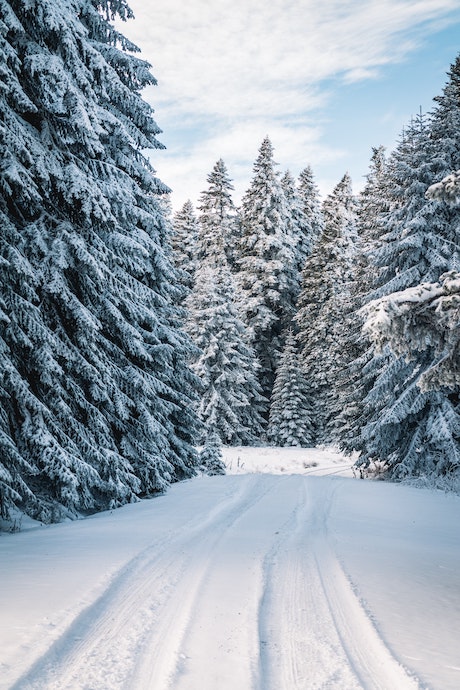
I stood in the empty reception room and watched the snow falling. It had started before noon and has been coming down heavier as the afternoon has worn on.
“I am going to leave early just to make sure I don’t get stuck here,” Judy said. “You have a guy who called earlier with a horse that he couldn’t get to stand. He wanted to wait a bit to make sure he wanted you to come out. I told him if he waited too long, you wouldn’t be coming out if the snow continued.”
“I can just about draw you a picture of the horse,” I said. “It probably doesn’t have anything but skin covering its bones and down in an open shed with no bedding.”
“He said it was a little thin,” Judy said as she gathered her belongings. “He is out on Berlin Road. If this snow keeps up, you shouldn’t be out there.”
The phone rang, and Judy sat her things down and answered it.
“I think I had better have Dr. Larsen look at my horse,” Wayne said.
“Let me check, just to make sure he wants to travel in this weather,” Judy said.
“That’s fine, Judy,” I said. “Just get good directions, and I will get out right away so I can be home before dark.”
“I just switched the phone to the answering service. and you be careful on that road,” Judy said as she scooped up her things and backed out the door. “Wish me luck.”
Spoken like a true native of Western Oregon. Snow was unusual, if not rare for Sweet Home. People were uncomfortable in driving in the stuff. Two or three inches of snow just about paralyzed the town. As this snowfall was approaching six inches and still falling, hardly a car was on the road.
I dressed for the call before going out to the truck. I pulled on a pair of rain pants and then rubber boots. This was snow, but wet snow. You would be soaked to the skin if you didn’t have rain gear on.
I brushed the snow off the windshield and the hood of the truck. Then I allowed the truck to idle to warm up. Not so much the engine, for I wanted some heat in the cab. I had no idea how cold it was. I would guess it was going to be in the twenties tonight. Not much by Colorado standards, but it was a wet cold and a wet snow. I think this would not be the only downer I would look at the next couple of days.
Wayne was waiting for me in his driveway. It was a slight uphill, and my tires slipped a little, but with four-wheel drive, I quickly pulled up to the shed at the corner of his garage.
I could see the horse when I stepped out of the truck. Pretty much like I had described to Judy.
“She has been down all afternoon, Doc,” Wayne said. “I even beat on her a little, trying to get her up. But she just acts like she is going to lie there and die.”
“You don’t have to beat on them when they are down,” I said as we walked over the horse. She was lying under a roof, sort of a lean-to that provided some protection on one side but was otherwise open. “If they don’t show any effort to get up with a good slap on the butt, you try something different.”
Looking at the horse, she wasn’t in as bad of condition as I expected. Thin, but not skin and bones.
“Her name is Fancy,” Wayne said.
I looked at him out of the corner of my eye at that name.
“She is my daughter’s horse,” he said. “We really aren’t set up for a horse, but she wanted her so bad, I couldn’t refuse.”
I parted her hair on the side of her neck under her main. Fancy was covered with lice.
“She has a lot of lice,” I said. “When did you worm her last?”
“To be honest with you, Doc,” Wayne said. “We have had her for going on three years this coming spring, and we haven’t wormed her. Is that something you can do for her now, treat the lice and give her some worm medication?”
“We’re going to do that. Then I’m going to give her some medication and a bottle of glucose. Hopefully, we can get her up and get her somewhere to warm up and be protected from the snow and the cold. Do you have any room in that garage?”
“My wife’s car is in there,” Wayne said.
“I would guess we could move the car out and bed the horse down in the garage,” I said.
“My wife doesn’t like getting into a cold car when she goes to work in the morning,” Wayne said.
“That car isn’t going to die if it is outside overnight,” I said. “This horse is going to be dead in the morning if she stays here all night.”
“Okay, she probably isn’t going anywhere in the morning if this snow keeps up,” Wayne said.
“I will get to work on this horse,” I said. “You get the car moved and make a bed for this horse with a couple of bales of your hay. If there is a heater in there, get it turned on, and if you have an old blanket or quilt, bring it out here and cover this horse with it so we can start warming her a bit.”
I gave Fancy a bottle of fifty percent glucose by an IV injection along with a hefty dose of dexamethasone. Wayne came out of the garage with a big furniture quilt and covered Fancy while I was giving the IV.
By the time I had a dose of worm medicine into her and scattered some louse powder under the blanket, Wayne had the garage ready for Fancy. Now we just needed some luck getting her up on her feet and into the garage.
I pulled her up on her sternum and let her rest a moment. She looked like she was ready to get up.
“Give her a little slap or her rump, and I will pull on her lead rope,” I said.
Wayne swatted her rear, and I leaned back on the lead rope. Fancy resisted for a moment, then jumped to her feet. I steadied her with a firm hand on her shoulder, and when she was stable, I started leading her to the garage. When she saw where we were headed, she was excited. Fancy hit that pile of hay and was down and curled up in it an instant.
We closed the garage door, and you could feel the warmth from the heater almost instantly.
“You get her a bucket of warm water and cover her with that quilt,” I said. “I might even think she will be alive in the morning. If you have any grain, give her a small scoop tonight. I will call you in the morning, and we will go from there.”
The snow was falling the entire time I was working on Fancy. There were close to nine inches on the ground now. I loaded everything in the truck and started down Wayne’s driveway.
There were no tire tracks on the Berlin Road as I headed down the road toward Pleasant Valley. When I came to the corner at the bottom of the hill, the truck slid a little, but I recovered quickly.
The road was slick all the way to the house, and I moved along at a snail’s pace. I pulled the truck into the garage when I got home. I would be in the dry to put on chains.
When I finally got into the house, dinner was long since over. The kids were excited about the snowfall, and the place was warm and inviting.
Sandy had saved my plate, and she had the table set as I washed up.
“This horse was a close call,” I said as I pulled my chair up to the table. “But I think it might just survive the night.”
“Eat hardy. You have a cow down up on Fern Ridge,” Sandy said. “I told them I didn’t know if you could get there tonight or not.”
“If this snow keeps up, we will have eighteen inches by morning,” I said. “There won’t be any chance of getting up there until the county plows the road. That will probably be several days. I have chains on the truck. I guess I had better run up there. It will probably be one of those last rites things.”
I gulped down my dinner and pointed the truck back toward town. The snow was coming down harder now. Not a whiteout, but for Western Oregon, this was a heavy snowfall.
There wasn’t another vehicle on the road as I crept through town and started up Fern Ridge Road. The route up Fern Ridge was not steep coming from town. The road up the other side was steep and would be dangerous tonight.
Jane’s driveway was on the lower level of the ridge. The snow was coming down harder now. I doubt that I could make it to the top of the ridge. I pulled into her driveway and stopped at the little shed that served as a barn.
Jane had been separated from her husband for I don’t know how long. She was trying to hold her small farm together along with all the other stresses of a single mother.
“At least you have her inside,” I said as I gathered my things from the truck.
“Yes, she is inside, but I’m afraid she is in poor condition,” Jane said. “I know you are going to scold me, but things have just sort of snuck up on me.”
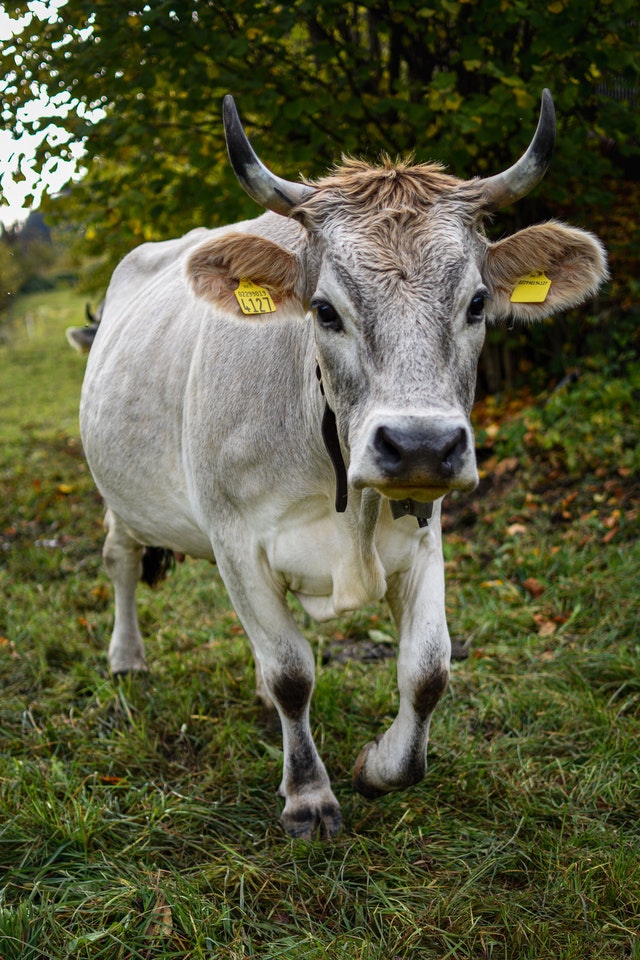
The cow was thin. I could see that before I entered the stall. The good thing was she was still on her sternum. This would be touch and go, but at least she wasn’t flat out on her side.
“I got her to walk in here this morning when this snow started,” Jane said. “I bedded this stall and made sure she had water and some good hay. By noon, she was down, and I haven’t been able to get her up since.”
I started my exam, and it only took a minute or two before my forearms were covered with chewing lice. I pulled up a sleeve and showed my arm to Jane.
“Oh! my gosh,” Jane said. “I’m sorry, how are you going to get rid of those things now?”
“Lice are species-specific,” I said. “Their claws are designed to grasp the hair shaft of a specific size. They will wash right off my arm. But for Betty here, she is going to need some louse powder and probably an injection of Levasol, for worms.”
I gave Betty some intravenous glucose and a dose of MuSe, a vitamin E and selenium combination. I would have given her some dexamethasone, but she was pregnant. Then I powdered her with louse powder and finally gave her an injection of Levasol.
“Putting a heater here would probably not be too safe, but if you have a heat lamp, that might help her tonight,” I said. “I think we have a chance of her surviving this, but it will be touch and go if this snow and cold weather hangs around for a few days.”
“What should I do for her?” Jane asked.
“Give her some warm water and some grain tonight,” I said. “We are going to need a little luck to get her through this thing. There is no magic, just some good nursing care at this point.”
“Well, thanks for coming tonight,” Jane said. “At least we have given her a chance.”
“You are probably going to be on your own tomorrow,” I said. “If this snow keeps falling, I won’t be able to make it until the county plows the road. If the phones are working, give me a call in the morning and let me know how things are going.”
The trip down the hill was slow and scary. I took a deep breath when I pulled onto the highway and had a set of tire tracks to follow through town.
I could wait to get home and get through the shower to ensure I got the last louse off me.
Morning came, and the snow had stopped sometime during the night. It was cold and crisp, and there was well over a foot of snow on the ground and not a tire track on the road.
The first phone call came as I sat down with a cup of coffee. It was from Wayne.
“Good morning, Doc,” Wayne said. “It is cold up here this morning, and the snow is almost knee-deep. Fancy is on her feet and looking for more of that grain. We can’t thank you enough.”
“That’s good news, Wayne,” I said. “You need to keep some good hay and grain in front of her all the time. Plan to repeat the louse powder every week for several applications. The powder kills the adult lice but not the eggs. And plan to worm her again in two or three weeks. Hopefully, we are out of the woods.”
I had no more than hung up the phone, and it rang again, Jane this time.
“Doc, I am so happy you could get here last night,” Jane said. “It is cold, and there is more snow than I have seen before in my five years on this place. But the good news is Betty is up and eating this morning.”
“Aw, that is good news,” I said. “Now we have to work at getting some fat on Betty’s ribs before the next snowfall. You need to powder her weekly for lice, at least 3 or 4 more times. Plan to repeat the worm medicine in a couple of weeks. And keep good hay and some grain in front of her at all times.”
“Consider it done, and thanks again,” Jane said.
Epilog
This first day of my first snow in Sweet Home gave me a couple of successes. But there would be other downer cows and horses in the days and months to follow. Unfortunately, not all of those had happy endings. It would take me several years to educate my client base to prepare their animals for winter.
Photo by Burak Kebapci on Pexels
The Big Horse Race
D. E. Larsen, DVM
I purchased Judy the summer following my sixth grade. It took a lot of chitum peeling to come up with the purchase price.
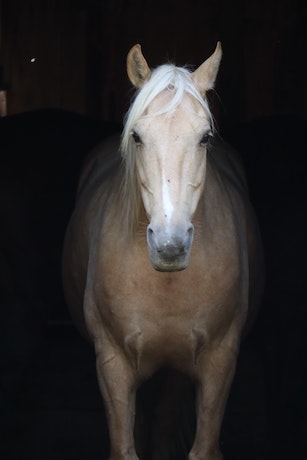
She was a light palomino and had a big scar on the back of her neck like she had been bitten by another horse when younger.
Our neighbor trimmed her hooves and shod her for me. He would not take any money for the chore.
I rode Judy everywhere. She required a strong hand on the reins to make her do what the rider wanted. Judy was barn sour. She was uncomfortable away from the barn. When we would turn toward the barn, and I let her have her head, I knew I had better hang on tight.
One afternoon, Dana Watson and I rode Judy down the creek to Herman’s new barn. We met Jack and Larry Herman there and rode the horses up their hill a bit. The Herman horses made Judy look like a pony. Both were outfitted with full saddles, while Dana and I were riding bareback and double on Judy.
When we got back to the barn, we tied the horses and looked over the barn and the haymow.
“Why did you buy such a small horse?” Jack asked.
“I really wasn’t looking for a horse,” I said. “My cousin Peggy had a friend selling her, and the price was something that I could afford.”
“She doesn’t look like much of a horse,” Jack said.
“She might not look like much, but she is the fastest horse I have seen,” I said. “I have been horses a lot, and I don’t think I know a horse that could outrun her.”
“Our horses are quarter horses, and they are pretty fast, too,” Jack said. “And they are so much bigger than that little thing, I don’t think she could begin to keep up with them.”
“Well, the only way to know is with a horse race,” I said. “What do you think, Dana. Do you want to ride with me?”
“Sure, those big horses are all weighed down with saddles and everything,” Dana said.
“Okay,” Jack said. “We will start on the road here, race down across the creek and up the field to where it starts uphill. Do you want to do this, Larry?”
“Sure, I have wanted to see which one of these horses is the fastest for a long time,” Larry said. “The only problem will be if Dad sees us. He will be furious. You know he does like us to gallop the horses.”
“He is in town,” Jack said. “We will be able to get these horses cooled down and turned out before he gets home.”
I jumped up on Judy, and Dana got up behind me. We rode out to the road where the race was going to start. I had to hold a tight rein on Judy because we were pointed at her barn.
“You have to hold on tight, Dana,” I said. “Judy is barn sour, and when she is headed home, she runs like the wind. These Herman horses are going to be left in her dust.”
Jack and Larry pulled their horses up beside us. I was holding a tight rein on Judy, and I could hear her heavy breathing. She was excited to be headed home and had no concept of a race.
I looked up at Jack. For the first time, I realized just how much taller their horses were.
“You say the word,” I said. “Something like ready, set, go.”
“Go,” Jack said as he and Larry spurred their mounts.
I released my grip on Judy’s reins and let her have her head. I leaned forward with my head against her neck and took a firm grip on her mane. Dana leaned forward and tightened his grip around my midsection.
I looked back, and the Herman horses were thundering along on our left, but they were a least two lengths behind. Judy was headed home, and nothing was going to slow her down.
The creek was approaching. This time of the summer, there was only a trickle of water that ran between the deeper holes. The road crossed the creek, but there was a substantial bank on this side and a rocky creek bottom before going up on the other bank and then out into the field.
Judy flew down the bank and did not slow across the rocks. The downward force when she hit the creek bed caused Dana and me to slip. We were off Judy’s back and hanging on her left side. I still had my grip on her mane, and we were both desperately holding on with our right legs still over her back. I looked back, Larry’s horse had slowed at the creek, but Jack was spurring his horse, trying to catch up with us. If we fell, there would be no way his horse could avoid running over us.
Judy did not slow with our slippage. She was up the far bank and turned up the field. Her barn was in view, and I felt a surge in her speed. Dana was able to pull himself back up on Judy’s back first, and with a bit of tug, he helped me right myself. Judy was oblivious to our struggle to remain mounted.
Once back in a normal position, I looked back. Jack’s horse had faded a bit, and Larry’s horse was abreast with him. The distance at this point was probably a half-mile, and the quarter horses had spent their best energy. Judy continued at her wicked pace. My only problem was going to be in stopping her when we reached the hill.
When we came to the hill, I sat up and pulled back on Judy’s reins.
“Whoa, whoa,” I said as I pulled her to a stop.
Jack and Larry pulled their horses up beside us.
“You guys should join the circus,” Jack said. “How did you get up on her back?”
“I had enough of a grip with my right leg that I was able to pull myself up and then help Dave,” Dana said. “I thought we were goners.”
“Ha,” I said. “I was just looking at your horse’s hooves that would be running over us.”
“Well, you were right about how fast that horse of yours is, and she didn’t slow down a bit,” Larry said. “Our horses just about were done for when we got halfway up this field.”
“I have to admit, it would have been a different race if we were going the other direction,” I said. “Judy is barn sour, and when she is going home, she goes like the wind.”
“Maybe so,” Jack said. “It sure would have been a different race if you guys hit the ground.”
Photo by Zachariah Smith on Unsplash
 Memoirs of a Country Vet