D. E. Larsen, DVM
After moving to Sweet Home, I had only provided care for a few dairy cows. Most dairies were too far for me to seek as clients.
John had a small dairy near Lacomb. It was further than I liked to travel, but I enjoyed keeping my dairy skills current. His phone call came shortly after six in the morning. Early, but not as early as the calls I got in Enumclaw.
“Doc, my best milker is sick,” John said. “She calved a few weeks ago and has been fine. But the last few days, she has eaten less and less. I don’t think she took a bite when we milked this morning. And with her not eating, her milk production is way down also.”
“It sounds like I should get a look at her, John,” I said. “There is any number of issues that could be causing her problem.”
“I left her in the barn this morning,” John said. “I was hoping you would get out here early this morning.”
“I will get myself around early this morning,” I said. “I can probably be out there a little after seven.”
***
John was waiting at the barn door when I pulled into his driveway. John was an old-time dairy farmer. None of his cows had dangling ear tags, they were all named, and he had a close relationship with each of them.
“Who are we looking at today, John?” I asked as I gathered things from the back of the truck.
“This is Susie,” John said. “She is going on five years old, and she usually gives me over seventy pounds of milk every day. But she is down under thirty pounds right now.”
“Have you checked her for mastitis?” I asked. “That is probably one of the most common causes of that kind of a drop in milk production.”
“I have checked her all over,” John said. “No mastitis is evident. She doesn’t have a temperature. And I am not as good as you when it comes to rectal exams, but I don’t feel anything alarming with her uterus.”
“That doesn’t leave much to check,” I said. “Maybe Susie has some ketosis, or maybe a belly problem. Have we given her a magnet?”
“You know, after that talk you gave me about magnets, in front of the old lady, no less, all the cows get magnets,” John said. “I hear people talk about ketosis all the time, but I don’t know anything about it.”
“It is sort of a disruption of carbohydrate metabolism,” I said. “We stress these high producers a lot. Milk production demands a lot of energy from the system. If anything goes wrong, the cow starts pulling energy out of her fat reserves. Once a little ketosis develops, the appetite falls off, and then things get worse.”
“How do we check for it?” John asked.
“Some people can smell it on their breath,” I said. “I don’t trust myself with that, so I check her urine.”
“Ha! And how do you get urine out of a cow?” John asked. “I sure am going to stand that with a cup, waiting for her to pee.”
“I’ll show you a little trick,” I said. “Most of the time, I can tease some urine out a cow pretty easily.”
“This show might be worth the call charge by itself,” John said.
I dug into my bag, found a urine dip-stix, grabbed my stainless steel quart measure, and headed into the barn to show John how to collect urine from a cow.
Susie was locked in a stanchion and standing, waiting to be turned out. I stood behind her and lifted her tail up, and rested it on my shoulder. Then, holding the measure in my left hand, I stroked her on the midline below her vulva with the back of my index finger of my right hand. Short, firm strokes, about six inches long. Stroking up and ending at the base of her vulva. After about four or five strokes, Susie humped up and let the urine flow. I caught a splash in the measure and moved away from the splatter on the floor.
“Well, I’ll be damned. I would have bet any amount of money that you were pulling my leg,” John said.
I dipped the dip-stix in the urine and set the measure aside in case we needed to save it.
“The dip-stix looks pretty good,” I said. “Susie does have a little ketosis, but it is not enough for that to be her primary problem. So let me grab a few things, and we will do a full exam.”
I looked over Susie from her nose to her tail. The rectal exam showed her uterus was well involuted following calving and should not be the cause of her problem.
Finally, I laid my stethoscope on her chest. Going over the entire lung field on both sides of her chest, I found no issues. Her heart sounds were normal. I moved to her belly and listened for rumen sounds on the left side of her abdomen.
The rumen should contract two or three times a minute. Susie’s rumen was pretty quiet. Holding my stethoscope on the left side. I thumped a finger, hard, against the belly wall. There was a distinct ping heard in response to the percussion. I thumped the finger again. The ping was still there. I outlined an arc on her belly wall where the ping was heard.
“John, Susie has a left displaced abomasum,” I said.
“Your talking greek again, Doc,” John said. “What the hell is an abomasum?”
“Okay, the abomasum is the true stomach in the cow’s digestive tract. It is the glandular stomach. Normally, it lies across the bottom of the abdomen. Sometimes, shortly after calving, it will slip to the side. We usually find it here on the left side. It doesn’t work well here, and these cows stop eating, and then a lot of things start to go wrong.”
“So, what can we do to fix it?” John asked.
“Generally, it requires a surgical repair,” I said. “I did correct it one time in a cow in Enumclaw by just rolling her. I ended up having to do it several times before it stayed in place. We did it because the old farmer wanted to save some money. By the third time of rolling her up on her back and shaking the abomasum back in position, I think he would have been better off just doing the surgery.”
“I guess we should do the surgery then,” John said. “When can you do it?”
“I think I have time this afternoon,” I said. “I should discuss the procedure with you a bit. There are multiple options for surgery. The one that I use involves putting the cow on her back and bouncing her belly to get the abomasum back into a normal position. Then I make an incision and suture abomasum to the belly wall. It is pretty simple and, in my experience, works the best. Multiple other surgical procedures are done.”
“You are my vet, Doc,” John said. “You’re as honest as they come, and whatever procedure you feel is best is fine with me.”
I was glad that Susie was a Jersey. Surgery would be much easier on her than on a big Holstein. I loaded the truck with everything I would need and headed out to John’s place right after lunch. Hopefully, I could be back in the office well before three. That would help John also. He would be able to do his evening milking on schedule.
I fitted Susie with a halter, and John led her out to the small pasture beside the barn. Then I put a flying W on her with my large cotton rope and cast her to her right side.
“Barnyard surgery is always less than perfect, but it usually turns out pretty good,” I said. “I don’t know if cows are just tougher than people or if those hospital surgery rooms are dirtier than they think they are. If I had as many infections in my surgeries as they have in those hospitals, I think I would quit doing surgery.”
“I know,” John said. “I am almost afraid to go to a hospital anymore.”
We rolled Susie up on her back and tied both her front and back legs. With my stethoscope, I found the bubble in the abomasum. By bouncing her belly, I work the bubble over to where it should be located. Then I clipped and prepped an area on her ventral abdomen so I could make an incision a few inches to the left of the mid-line.
After injecting lidocaine for local anesthesia, I made a six-inch paramedian incision. I carefully extended that incision through the abdominal muscles and opened the peritoneum carefully.
With the incision open, the abomasum was right there under the incision where it was supposed to be. I scarified the belly wall and the exterior of the abomasum. Then with some number two Dexon, I sutured the scarified area of the abomasum to the similar area of the belly wall. This would allow for a firm adhesion to form, holding the abomasum in place.
Closing the abdominal incision in three layers with number two Dexon completed the procedure. Time-wise, it probably took longer to position Susie than it took to do the surgery.
We untied Susie’s legs and let up. She shook a little. I think she was probably was tired of the position we had her.
“What do I need to do with her now,” John asked.
“This pasture might be a good place to keep her for a couple of days,” I said. “Just so you can keep an eye on her. You want to offer her some good alfalfa. We want to increase the roughage in her diet for a time, and we want to spread her grain ration out over the day rather than giving it only a milking. She can have the same ration, just not in a couple of big meals.”
“Are you going to do anything for her ketosis?” John asked.
“Not unless she doesn’t go right back to eating,” I said. “Most of the time, these cows go right back eating, and their recovery is remarkable. Sort of like a dog with an intestinal obstruction. You fix the gut, and they are instantly well.”
“She doesn’t need any antibiotics?” John asked.
“This was a pretty short procedure, and we didn’t have to open a gut or anything,” I said. “Most of the time, I don’t have to use any antibiotics. Suppose she gets a little infection around where I sutured the abomasum to the belly wall. In that case, that will just make that adhesion better. These sutures will be absorbed in about forty days. After that time, it is the adhesion that holds the abomasum in place. Those tissues sort of grow together.”
By the time I had cleaned up and got everything back into the truck, Susie was grazing on the grass in the little pasture.
“See that, John,” I said as I motioned to John to look at Susie. “She is back to eating already.”
“That’s great. I haven’t seen her eat like that in a week,” John said.
“I will be back in three weeks to get those sutures out,” I said. “You call if you have any concerns before that time.”
***
Susie healed with no problems. By the time I was back to take the sutures out, she was back to producing her remarkable sixty to seventy pounds of milk daily.
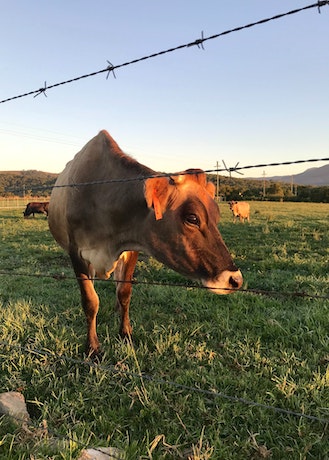
Photo by Steyn Vijoen from Pexels