‘Twas the Night Before Christmas, click on the link:
https://docsmemoirs.com/2020/12/24/its-the-night-before-christmas/
Mixed practice in the 1970s and more
‘Twas the Night Before Christmas, click on the link:
https://docsmemoirs.com/2020/12/24/its-the-night-before-christmas/
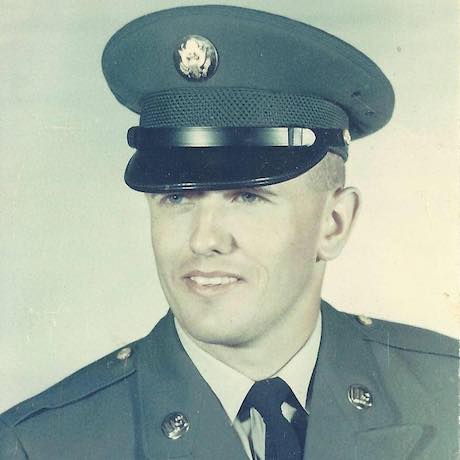
D. E. Larsen, DVM
I looked out the window as the plane made its final approach to land at San Francisco I looked out the window as the plane made its final approach to land at San Francisco International Airport. The water was getting closer by the second. This was the first commercial aircraft I had been on, and I had no concerns until now. The water was getting very close now. I wondered if I should say something to somebody. I was sure we were going to ditch into the bay. At the very last moment, land and the runway flashed into view. I took a deep breath and settled back into my seat as the wheels contacted the runway.
There were about forty of us, new recruits for the Army. We had only a vague idea of what the next few weeks would bring us as we unloaded from the plane and boarded a bus waiting on the tarmac. Now a road trip to Fort Ord, where ever that was located.
It was still daylight when we landed but dark when we pulled into the receiving station at Fort Ord. The drill instructors were quick to make examples of the jokers in the crowd. There was no consideration for dinner. There was a hasty orientation, and then we were herded into our temporary barracks for the night. There was some quick organization of the platoon for the night. Fireguard assignments were issued, and responsibilities were outlined. Then it was lights out.
The next day started early. Formation out front and squad assignments were given out. The platoon and squad leaders were assigned. Then a whirlwind started. An early breakfast, uniform, and equipment were issued, and everything civilian was mailed home. Then we ran through the barbershop. No big deal for most of us, but some of the guys lost a lot of hair.
After lunch, we started testing. For me, the Army tests were a snap. They were virtually all multiple choice questions with easily eliminated two or four possible answers. If I didn’t know the answer, I could make a good educated guess. I would finish their hour test in fifteen to twenty minutes. This gave me lots of time to lay on the lawn, ponder the coming days and the next test..
We pulled KP in the receiving station mess hall on the third day. I decided then that I might not be the best, the fastest, or the biggest, but nobody was going to work harder than me at anything I was going to do while in the Army. The mess sergeant gave us a little pep talk at the end of the day, and he thought we were an exceptional group.
They loaded us and our gear into the back of a few trucks on Sunday morning. The next stop was home for the next eight weeks. Our company was located in the last barracks in a long double row of three-story concrete barracks in the second battalion. We would become the 5th platoon in the company.
Fort Ord was still in the recovery phase of a major epidemic of spinal meningitis. There were a lot of rules and restrictions that we would live with. Most of those probably served to eliminate some of the previous rigors of basic training. We were restricted to the company area, and platoons could not mingle. These forty guys were going to be my world for the next eight weeks.
There were a bunch of guys from Montana and a bunch of us from Oregon, with a few others mixed in from other areas. Most of us were well versed in the outdoors. But some of the kids had never been out of the city. There was one older guy who had been in the Army before and back for a second try. Other than him, everyone was young. I was twenty with a couple of years of college under my belt, and I was one of the older ones. I would guess at least twenty, if not more, were eighteen. At least one was seventeen. Probably half were drafted.
This was right at the big build-up of troops for the Vietnam War. The Army was taking anybody. I had dropped out of school at spring term to work to have enough money for the following year. My draft notice was in the mail in about two weeks. I chose to enlist just so I could have a little more control over my fate than was afforded a draftee.
We settled into our barracks. Our platoon bay was on the ground floor. My squad occupied the first set of bunks on the right as you entered the large bay. Bunks were well spaced, and heads were alternated, the top guy with his head opposite the guy on the bottom bunk. The next bunk was opposite the preceding bunk. This gave everyone the largest amount of breathing space possible. Windows were open, all windows when it was warm, every other window as it cooled down a little.
We made up the fifth platoon, forty men in each platoon, two hundred men in the company. I was in the first squad. The squad was aligned information by height. Being the shortest man in the squad, I lined up at the end. When we marched, I was at the end of the line for the company. We would march down the street; I had two hundred men in front of me. I would learn, this was a very favorable position to be in. We were seldom looked at, back at the end of the company.
Jim was the kid that slept on the bottom bunk below me. Jim was a good kid, a little slow and absolutely dyslectic. I always considered myself somewhat dyslectic. I always had to double-check numbers I wrote down because I would often transpose them, and spelling was a constant challenge.
But Jim literally did not know his right from his left. When we marched, Jim marched just in front of me. When the company made a turn, we would watch two hundred men in front of us, turning right. As we approached the spot to turn, Jim would start bouncing, bobbing his head. We had a right turn coming. I would say in a low voice, “turn to the right.” We would get to the point, and Jim would turn to the left, every time. Then stop and ran to get back in position before he was descended upon by two or three drill instructors. The left turns were worse because he would run into the guy next to him.
We had long marches, several miles, to the rifle range. Most of this distance was on loose sand, which proved very tiring.
These Marches were led by the executive officer. Lieutenant Garcia was a small, stout man from Cuba. He had been in the Bay of Pigs invasion before joining the US Army.
Being in the back of the company, we would pass a canteen around. Smitty and I would tell jokes and laugh, and we had several rows in front of us laughing a little..
We were never bothered by the Drill Instructors. But one day, when we were marching back to the company facility, Lieutenant Garcia, had dropped out to the side of the company and was watching us pass a canteen around as we marched past him.
He was none too happy, to put it mildly. Everyone in front of us was suddenly marching like they didn’t know anything was wrong. Lieutenant Garcia pulled Smitty, Jim, and me out of the ranks and really chewed us out. We had to dump the water out of our canteens. This went on for several long minutes while the company continued to march.
When he was done chewing on us, he pointed to the company, now disappearing over a slight rise, hundreds of yards in the distance.
“You three, run until you are back in position,” Lieutenant Garcia barked. “Run and do not stop.”
We ran, and the Lieutenant was right on our rear. The loose sand made the run seem like a mile. We finally caught up to the company just as it reached the paved road.
“Don’t let me catch you, jokers, again,” Lieutenant Garcia said as he continued to run to the head of the column.
Once we were dismissed and were back in the barracks, everyone wanted to know what had happened. I just wanted to get cleaned up for dinner so I could get to bed. I was planning to wait until morning to clean my rifle since I was generally one of the first ones up in the platoon.
Our DI caught up with me as I was leaving the mess hall after dinner. This surprised me a little, and he was usually not around after dinner.
“Larsen, you guys need to make sure your rifles are cleaned, and your beds and footlockers are ready for an inspection in the morning,” the sergeant said. “I understand that Lieutenant Garcia plans to check in on you three in the morning. It will be a surprise inspection, and he will be surprised if you are ready for it.”
It was late that evening when I had everything done. I had cleaned my rifle and helped Jim with his rifle. Smitty was doing okay with his stuff. We were the last ones to crawl into bed, just before lights out.
“I almost think I should sleep on the floor tonight,” Jim said. “I hate to mess up my bed.”
“I will wake you up when I get up, and we will have plenty of time to be ready,” I said. “You need to get some sleep tonight. Tomorrow won’t be any easier than today.”
***
Lieutenant Garcia entered the platoon bay with our DI right at the stroke of seven in the morning. He casually inspected the first few bunks until he came to Jim and me. He went through our footlockers with a fine-tooth comb. And then he bounced a quarter on our bunks. He smiled and nodded his head at me.
“Which rifle is yours, Private Larsen?” Lieutenant Garcia asked.
I retrieved my rifle from the rack in the middle of the room.
“Is your rifle always this clean, Larsen?” he asked.
“Yes, sir,” I replied.
Then he had Jim get his rifle. I think he was sure he could find an issue with Jim’s rifle. He had to know that Jim was dyslexic.
“Did you clean this rifle yourself, Private?” Lieutenant Garcia asked.
“I did most of it, sir,” Jim replied. “Larsen gave me a few pointers.”
Lieutenant Garcia again nodded his head at me and smiled.
After looking at our rifles, he went right over to Smitty’s bunk and put him through the same routine.
Satisfied, Lieutenant Garcia left. The DI was all smiles. A favorable inspection always reflected well on his leadership. The rest of the platoon was relieved that it was over.
Our conduct at the end of the company formation became a little more in line with standard military discipline for the rest of basic training.

Here is the answer for all the procrastinators out there. Give Three Kindle books from the convenience of your desktop or phone, and all for FREE.
Free Promotion for kindle versions for 3 days:
Start – Thursday, December 23, 2021, 12:00 AM PST
End – Saturday, December 25, 2021, 11:59 PM PST
Links:
The Last Cow in the Chute:
Widow Woman’s Ranch:
Lambs and Crab Legs:

 Memoirs of a Country Vet