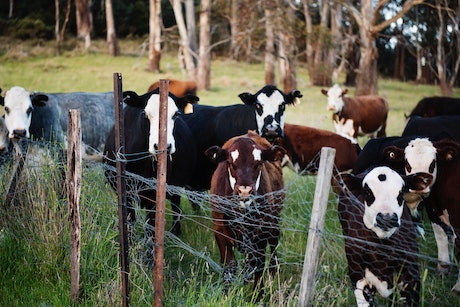
A Hard Job Made Easy 

D. E. Larsen, DVM

It was about nine in the evening when the phone rang. I looked at Sandy, almost wanting to ignore the call. It glanced out the window, and even in the dark, I could see it was raining hard. 

“You better answer it,” Sandy said.

I picked up the phone and said, “Hello, this is Doctor Larsen.”

“Dave, this is Stan. I’m up here at Barney’s with a couple of guys, and we are working on Barney’s heifer,” Stan said. “She has a prolapsed uterus, and we are having one heck of a time trying to get it back in place.”

“Just pretend you are pushing a basketball through a knothole, and you won’t have any problem,” I said.

“You sure got right,” Stan said. “One of the guys here wants to pour sugar on the thing. Do you think that will help?”

“That is something I never do,” I said. “I think you are just asking for a rip-roaring uterine infection if you do that. I know it’s done, probably by some veterinarians even, but I don’t like the practice. This is just a job. You have to make sure that the uterus is well-scrubbed. Then you lube it up, with KY or I use J-Lube. If it is challenging, I use a drug to start the uterus to shrink up a little. And it helps if you can elevate the rear end of the cow, which lets all the guts fall forward a little and makes the job easier. My old boss in Enumclaw would hang cows by their hocks with a tractor’s front-end loader. Then the uterus would just about fall in place then.”

“We don’t have any of that, but I wanted to check with you before we used any sugar,” Stan said. “We will lube this thing up and try again, but if we can’t get it done, do you think you could run up here and give us a hand?”

“Sure, you go give it one more try, and I will get ready to come up the hill,” I said. “You know it is best to set a timer on yourself. If you don’t get it done in twenty minutes, you need to be trying something else.”

“Who was that on the phone?” Sandy asked.

“Stan Walters, he is up at Barney’s trying to get a prolapsed uterus back into a heifer,” I said. “I’m going to get ready and just run there unless he calls back before I leave. Even if they get it back in place, the cow will need some treatment. He has several guys there helping. I think Stan knows enough to keep things clean, but who knows about the other guys. It is sort like the old saying, too many hands in the soup, makes bad soup.”

It had been almost fifteen minutes since Stan had called, and I was ready to go. Rather than wait for a call, I just ran up to Barney’s.

The light was on in Barney’s small barn when I pulled up to the door. Walking inside, I was presented with quite a sight. There was Barney, sort of overseeing the process. Stan and two other guys are down on their knees behind this heifer, pushing and straining and getting nowhere.

“Boy, are we glad to see you,” Stan said. “I just don’t think we are going to get this done.”

I moved everyone aside and slid a plastic bag under the prolapsed uterus that was hanging out onto the straw. Then I gave the heifer an IV dose of oxytocin. You could watch the uterus start to contract as I scrubbed it with Betadine. After rinsing it well, I applied J-Lube. The uterus was probably one-third the size that it was when I started.

I put my fist of my left hand at the end of the prolapse, and with one continued hard push, the uterus slid through the vulva and fell into a normal position.

“Now, we have had three of us working on this thing for over an hour, and you come along and push the thing back in place in less than fifteen minutes,” Stan said.

“Me and a little help from my oxytocin,” I said. “It just helps to know how to do things.”

“Could you do it without the drug?” Stan asked. “I mean, looking at it when you came through the door, could you get it back in place without the drug?”

“Yes, I have done it a lot of times and in a lot of worse situations,” I said. “Like I said on the phone, elevating the rear end makes the job very easy. But it can be done with her lying right here. The uterus has to be clean and then well lubricated. I like to start at the end, just pushing a little at a time and not letting any of it back out once you get it in. It will seem like you are not getting anywhere, and then all of a sudden, it will just sort fall into place.”

“That was part of our problem,” Stan said. “We would get some of it in and then stop to breathe, and it would all push right back out.”

“Yes, you sort of have to think you are in a wrestling match. You can’t stop to take a breath,” I said. “It can be one of the hardest jobs I do, sometimes. But then, with a little oxytocin, and a relatively early prolapse, it can be a hard job made easy.”

“What do we need to do now?” Barney asked.

“I am going to put five grams of tetracycline powder into this uterus just because of all the work that has been done on it,” I said. “And I am going to put a few sutures across the vulva, just to make sure it does come out again. To be honest, I have never heard of a uterus coming out a second time, but I always suture the vulva, just so I can go home and sleep well tonight.”

I opened a five-gram pouch of tetracycline powder and carried it into the uterus with my left hand. I dumped the powder out and squeezed the pouch to ensure it was all dispensed. Then I placed three sutures across the vulva using quarter-inch umbilical tape. And finally, I gave the heifer four boluses of long-acting sulfa. This would give her five days of therapy.

“Barney, I will run by here in three days to check her over and to remove those sutures,” I said while I slapped the heifer on the rump. The heifer jumped right up.

“So what causes something like this to happen in the first place?” Stan asked. “I mean, I have been around calving cows for many years, and I have never seen anything like this.”

“I don’t know how often it occurs, but it is a common problem for me during calving season,” I said. “I mean, I will treat more uterine prolapses than I will do C-sections. It is a sort of positional thing. Maybe five percent of milk fever or other downer cow problems have uterine prolapse. In a heifer like this, if she is down and pushes the calf out, and that uterus falls just right, and she gives one more push, it just pops out. I have had people tell me they were right there and couldn’t do a thing to stop it. It is a very rapid event, one push, and bam, it is out.”

“Is she going to be okay to breed next year?” Barney asked.

“I am sure we lose some fertility,” I said. “In a C-section, we lose six to twenty percent of fertility. I don’t know the numbers here, probably less than that, but there is some loss. A lot has to do with how well the uterus is treated while it is out. But you just never know. I have put some pretty rough-looking uteruses back together, and they do well. Then you put one back that looks fine, and the cow gets a hot uterine infection and dies.”

“You don’t think she is going to die, do you?” Barney asked.

“No, I don’t think so,” I said. “But you need to watch her, and if she is not eating or something, you call, don’t wait for me to check back in three days.”

“Well, thanks for doing the job,” Stan said. “I don’t think we would have got it done.”

“If there is any lesson to be learned here tonight, it is to put a timer on yourself. You don’t want to work for two hours on a calf or on a uterus and not make any progress. If you haven’t got the job done in twenty or thirty minutes, you need to call for help.”

Photo by Aidan Carrozza from Pexels.

A Note to My Readers

My third book is now available on Amazon.

The title is “Lambs and Crab Legs & other stories”.

The Kindle version should be available next week. At that time the free Preview below will work.

I will have books to sell, but probably not until after the first of the year.

If anyone would like an autographed and personalized copy, you can email me at d.e.larsen.dvm@peak.org and I will send you an invoice that you can pay with a secure transaction through Square. The only addition fee will be for postage and handling. But it will be after the first of the year before that will be available.

A Sad Mismating  

D. E. Larsen, DVM

Howard was leaning on the front counter, trying to dig his address out of his wallet and maintain control of Roxy at the same time. Roxy was a young German Shepard. She was pulling hard on the leash, leaning toward the cat carrier in the far corner of the reception area.

Nan was quick to defuse the pending chaos in the waiting room by taking Roxy back to the exam room. At the same time, Howard finished with the paperwork for Sandy. Howard was a new client, and he lived out on Bond Road, out of Brownsville.

“Hi, Howard, I’m Doctor Larsen,” I said as I extended my hand. “What can we do for Roxy today?”

“I am told that there is an injection that will keep a dog from getting pregnant if she is bred by the wrong dog,” Howard said.

“Well, I guess I would say yes and no to that question,” I said. “There is an injection, but it is not safe, and it is something that I don’t use or only rarely use it. At one point, we used DES, a synthetic estrogen. But that drug has been removed from the market. So right now, we only have estradiol. That will eliminate the possibility of a pregnancy, but it is not a safe drug to use in the dog.”

“This is my situation, Doc,” Howard said. “I bought this purebred little German Shepherd with the intent of breeding her with my dog, who has just achieved his champion status. Then what do I find yesterday morning when I get up, the neighbor’s black lab hooked up with Roxy in my backyard.”

“I would assume that she is early in her heat period,” I said. “Not all matings result in a pregnancy, especially if they occur outside of the prime period of ovulation.”

“Doc, I just don’t want to take a chance,” Howard says. “What am I going to do with a litter of mutts?”

“The safest thing for Roxy, if for her to deliver that litter of mutts,” I said. “German Shepherd and Lab crosses are pretty good pups, and you shouldn’t have much of a problem giving them away or selling them for a small fee. I think we do better selling puppies for a small amount rather than giving them away. That way, the new owners are invested in the pup, and that lessens the chance of it winding up in the humane society or being dumped along the road somewhere.”

“I just don’t want to deal with it, Doc,” Howard said. “I want to get her that shot.”

“When I sat this is not a safe drug for the dog, I am not talking about obscure side effect that occurs once in every thousand doses,” I said. “The dog’s uterus is sensitive to estrogen stimulation. After years of stimulation, a fair number of intact females will develop pyometra. This is an abnormal accumulation of pus in the uterus. Pyometra is a life-threatening condition and requires an emergency ovariohysterectomy. With this injection, that condition can be a complication following her heat cycle. I can’t give you a percentage, but I would guess it occurs in over ten percent of the dogs getting this injection. If it doesn’t occur following this heat cycle, it greatly increases the odds of it occurring at a later cycle.”

“Doc, I drove all the way up here because I hear nothing but good things about you,” Howard said. “But if you won’t give Roxy this injection, I will just go elsewhere to get it.”

“Did you hear, and understand, what I just said?” I asked.

“Yes, I heard you. And I understand there is a chance Roxy could lose her uterus, and possibly her life if I fail to watch her close,” Howard said. “But here is my situation, Doc. I don’t want to have to deal with a bunch of mutt pups.”

“Okay, against my better judgment, I will give her an injection,” I said.

***

It was several weeks later, and Howard was back with Roxy. She was dripping pus from her vulva and had been vomiting for several days.

“You know what this looks like?” I asked Howard after looking at Roxy.

“Yes, and I guess I can’t say you didn’t warn me,” Howard said. “So, what do we need to do now?”

“Now we need to take her to surgery and get that infected uterus out of there,” I said.

“Is there no other option?” Howard asked.

“Actually, I did treat a pyometra in an older dog once,” I said. “It is difficult, and we run the risk of losing the dog.”

“How did it turn out for the old dog?” Howard asked.

“We cleared the infection, and the dog got pregnant on the next cycle,” I said. “But things never worked very well, and she never went into labor. The owner brought her in several days past her due date. All the puppies were dead, and the uterus was infected again. 

We spayed her at that time. I learn from my mistakes, and I won’t treat a pyometra without surgery again. And I won’t give that misstating injection again, despite pressure from the owner.”

“Okay, Doc, let’s get it done,” Howard said. “She is too good of a dog to risk losing her. And I am not interested in finding another veterinarian right now. When will she be ready to go home?”

“We will do the surgery at the end of the day,” I said. “I like to get a good level of antibiotics circulating before surgery, and I generally like to get a bottle of fluids into her also. I will give you a call when I’m done. I would expect to send her home in the morning most of the time. There is always a little hedge when working on an infected uterus. There is a chance of some contamination of the incision.”

Roxy was a great dog and a good patient. I was always worried about German Shepherds because there are always a few knotheads in the breed.

The surgery went well. Roxy’s pyometra was an open cervix infection, and there was only a moderate amount of pus present in the uterus. Her surgery was not much different from a standard spay. I did oversew the uterine stump, something not done on a routine spay. I also changed the surgery pack, drapes, and gloves before closing the abdominal incision. Just as insurance, in case there was some contamination from the infected uterus.

Roxy recovered well and healed well. She went home and led a long life as the matron aunt to Howard’s future puppies.

 Howard remained a faithful client, despite the distance from the clinic. He said many times that he appreciated my honesty and straightforward mannerism.

“I always know you will tell it like it is, Doc,” Howard once said.

And, like I mentioned before, I never used a mismating injection again.

Photo by Lindsay Wilson from Pexels.