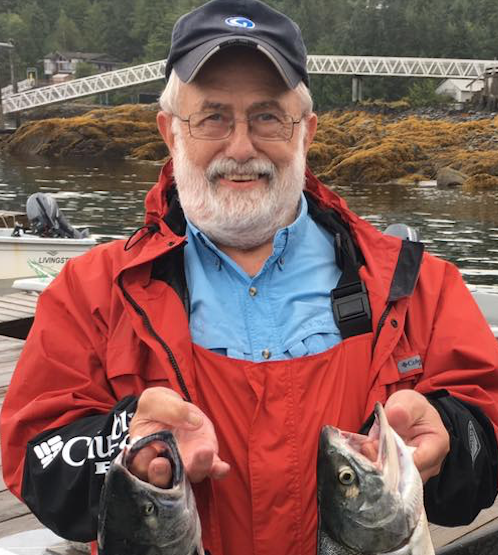
For everyone looking for the perfect gift for Dad, especially those who may be a bit pinched for funds, all four of my books are free this weekend on Amazon Kindle. Running Saturday through Sunday, all my Kindle books are available for immediate delivery at no charge.
Autographed paperbacks are available for sale at Lilies and Lovelies at 1141 Long St., Sweet Home, or by contacting me via email at d.e.larsen.dvm@peak.org.
Links to these books are also on my home page at docsmemoirs.com. They can be previewed at this link. Scroll down the page. The books are near the bottom.
My father’s early life was difficult at its best. He grew into an exceptional father for having grown up without a father. He rarely spoke of his early life. And when he did, he only told stories in small snippets. It took me well over half my life to piece those snippets together into a story.
He was born in Bellingham, Washington. The last of 5 births for his mother. His father was a Norwegian sea captain who sailed lumber schooners from the Northwest to San Francisco. His father went by Samuel Lars Larsen. That is all I knew of Sam for most of my life.
Sam married my Grandmother, Mary Jane (Mollie) Coats, in Bandon, Oregon, in 1903. Sam was 43 years old, and Mollie was 21 and 5 months pregnant. They lived in Bandon and Coos Bay for several years. Sam was known for his fondest of the bottle. Some would call him a drunk, but a high functioning drunk. He had his Master’s License before the age of 40.
In October of 1905, Sam was master of the schooner Sacramento when it ran aground on Coos Bay’s North Spite. The story was he was anchored waiting out a storm. The anchor line broke, and the ship was aground in the morning. The crew was rescued with herculean efforts by the life-saving team. This was 4 years before my father’s birth, so a large debt is owed to those men, and their wives, by many generations of subsequent Larsen kids.
In January 1906, Sam and Mollie arrived in Bellingham, where his 3 brothers lived. They had their first son and an infant daughter. According to the family story, the daughter was smothered in bed that first evening.
Sam never sailed after that. I suspect he was fired following the shipwreck. Maybe he was sobering up rather than waiting out a storm. That is unknown.
In August of 1910, when my father was 1-year-old, his 2-year-old sister died from acute bloody diarrhea. Sam and Mollie separated following that death. Mollie returned to Bandon with the 3 boys to live with her folks, Thomas and Sarah Coats.
Dad only spoke of his grandfather in Bandon a couple of times. He feared the old Irishman, probably with just cause. Dad set fire to a mattress in the upstairs bedroom when he was 3 or 4, and the old man had to throw the burning mattress out the window. That probably did not endear him to his grandson. His grandfather died when he was 4, and Dad remembered they had him stretched out on the kitchen table, preparing him for burial.
In 1917, Mollie and her mother moved to Southern California. Life was not comfortable there. In early 1920, at the age of 10, Dad and his older brother Merle, who was 13, were checked into The Boys and Girls Aid Society of Los Angeles orphanage by their mother. They were there until they turned 14, not long for Merle but over 3 years for Dad.
That Society has evolved into Five Acres (https://5acres.org). An organization offering a full continuum of care for children and families in crisis, serving over 10,000 children and families annually.
When I tracked down Dad’s records, the administrator said it was good to hear a success story from that era. That those kids had a rough life compared to today’s standards, and there were not many success stories.
Dad was released from the orphanage when he was 14. He worked as a caddie. Dad caddied for Oliver Hardy and caddied for one player in a golf tournament at Pebble Beach. His only comment of that event as he had to sleep in the car.
During this time, he developed a love for the movies. He would stand around the theater’s entrance until a family came along and then just go through the door with them. Kids were free with paying adults.
He learned to swim well underwater because the pool had tokens on the bottom of the pool. If you found a gold token, you were given free admission the next visit.
His mother remarried when he was 16, and he did not get along with his stepfather. So he hitchhiked to Oregon and stayed with his mother’s sister, Hattie Rogers, in Coquille. He took the only job available and became a whistle punk in the logging woods.
He returned to California for a time, only to hitchhike again to Oregon. Riding the rails on the second trip, he managed to separate the cars at one point, and the hobos were unhappy because the crew kick all of them off the train.
On his second trip, he stayed with another of his mother’s sisters, Annie Tripp. He returned to high school at Myrtle Point at the age of 21. Met my mother, worked in the woods for a time after graduating. After they were married in 1934, he attended Oregon State for a couple of terms.
There are few stories of his high school years. He finished in 2 years, and I find his name on the honor rolls, something I would have never dreamed of growing up. He spoke of stealing Mom from her boyfriend, right in front of him, something I think he looked on with pride.
1934 OSU Rooks, Frank Larsen, 4th row, behind #64. Slats Gill, 1st row, far left, in suit
At Oregon State, he managed to make the freshman football squad, The Rooks, coached by Slats Gill. He did get his picture taken with the team but quit before the season was over.
“They just use us for fodder for the varsity,” he told Mom at the time.
After winter term, they came home to Myrtle Point, hitchhiking from Corvallis to Myrtle Point.
I heard Dad tell a friend. “We ran out of money, and I knocked up the old lady. I had to quit.”
After that, it was work and family. Dad worked in the woods, eventually becoming a donkey puncher, and they lived in logging camps and isolated houses. My sister, Linda, was born in 1935, brothers Larry in 1936, and Gary in 1941. I came along in 1945.
Life was different in Western Oregon in the 1930s and 40s. My brother told my sister’s whittling story on a door jam, and she dropped the knife. It stuck in her eye. Dad had the one car at work, no phone in the house. Mom held my sister with a washcloth over the wound until Dad got home and could get to the doctor.
In January of 1950, Dad purchased a small dairy farm above Broadbent. I am sure this was a significant achievement in his life. We milked cows, and he continued to work in the woods. We were taught work ethics by observation. We would be considered poor by today’s standards, but we thought of ourselves as well to do. California cousins would visit. Arriving in new cars and leaving with soiled clothes and broad smiles.
Dad would build a fire in the kitchen stove, the only heat in the house, before leaving for work at 5:00 AM. Mom and kids did the morning milking before cleaning up to go to school. Dad would get home and do the evening milking, also with the kids.
Dinner was always a family affair, and you would eat what was on your plate, period. Fried chicken nights were always open warfare over the white meat. Mom became creative in cutting up the one chicken for dinner.
I was home when Dad got the call that his mother had died in 1957. He cried, the only time I saw that, and he was mad at himself for it. He never had a relationship with his mother. She never did anything for him, never sent a card to any of the kids.
I was the youngest of four kids in our family of 3 boys and 1 girl. Everyone argues about which family position is the most favored by the circumstance of birth. I can’t resolve that debate, but I believe that I benefited from observing my siblings receiving their lessons on life from our father.
Teenage years are always difficult to live through. My father was always there and supportive. When I was 14 or 15, I challenged him, and I learned in no uncertain terms that I was the lesser man. He came at me like a charging bull, and I learned quickly. And that was that.
He saw that I understood that a job was necessary, and I got one starting my junior year in high school. I made cheese for 4 years, after school and summers.
“You do the best job you can at whatever you do, and you will do well in life,” he told me once. I have taken those words to the bank for many years.
I don’t think he agreed with my enlistment in the Army when Vietnam was a threat, but he supported that decision. I learned in the Army that anyone with a farm boy’s work ethic was ahead of his peers. Work hard and play hard was my philosophy for those 4 years.
Dad played very little golf when we were growing up. Money and time were always in short supply. But when they became empty-nesters, he returned to the golf course. He played well, and I never beat the man. I always thought that he would get old enough and I could beat him one day. But one of his long time playing partners died suddenly, and at 81, Dad quit the game, undefeated by his son.
A couple of years later, Dad was dying from liver disease. I believe it was from a botched gall bladder surgery, but that is another story. When the Doctor in Eugene said he had done all he could do, Dad said, “I want to go home.”
He wanted to die at home, but that was too hard for Mom. Each trip to the hospital left him weaker and weaker. His final few days were spent in a nursing home. And like in birth, death is an event we all must do ourselves.
It took several years for me to fully realize the impact of his passing had on me and my life.
Della was a middle-aged white poodle. She could hardly contain herself and was wiggling all over the exam table when I entered the room.
Wilma displayed no such excitement. She was a nurse and usually knowledgeable about Della’s health care.
“What is going on with Della today?” I asked as I struggled to keep Della from licking my face.
“I must admit that I took Della to another veterinarian in Albany yesterday,” Wilma said. “I am here because I disagreed with his assessment of Della’s problem. She has a small mammary tumor that just appeared, and he said most of these are nothing to worry about and we should just watch it. I don’t think I want to watch it.”
I generally do a complete exam first and then end with a closer exam of the problem at hand, but with Wilma’s immediate concern with the mammary tumor, I quickly turned Della over onto her back and palpated her breasts.
There was a single, solid tumor in her right inguinal breast. It was firm and round, with an irregular surface. It was a centimeter in diameter, a little smaller than a marble.
“How long has this been here?” I asked.
“I first noticed it last month,” Wilma said. “I think it has grown since I first noticed it.”
“Could it have been longer, and you didn’t notice it?” I asked.
“I lost my last poodle to mammary cancer,” Wilma said. “I check Della’s breasts every month. If it had been tiny, I guess I could have missed it.”
“In the Albany veterinarian’s defense, many older female dogs have small mammary tumors that are benign,” I said. “These tumors will be present for years and cause little or no problem. They are often scattered in multiple breasts and may have been noted by the client for months or years before we see them. It is common to monitor those for growth or to do simple lumpectomies. I think this tumor is different. It is single, apparently rapidly growing, and it is new.”
“I think we should do a biopsy,” Wilma said with some finality in her voice.
“I’m not going to put Della through chemo,” Wilma said. “But, what do you mean when you say you like to do surgery yesterday.”
“I see,” I said. “This is veterinary medicine, and we have limited treatment options for cancer, even when the expense is not an issue. Surgery is often the only weapon we have to fight cancer. The philosophy that I was taught was to cut early, cut wide and cut deep. In human medicine, they schedule some testing, then schedule a biopsy. If the biopsy says cancer, then they schedule surgery. Or sometimes, they do chemotherapy before the surgery. It is often six weeks or more before they get around to treating the tumor. In the life of an aggressive tumor, six weeks is massive. I like to do surgery yesterday.”
“If we do a biopsy tomorrow, by the time we send it to the lab, they process it, then the pathologist reads the slides. We have lost a week by the time I get the report. I suggest we remove this entire breast with a radical resection that includes the muscle fascia under the tumor and the inguinal lymph node. That way, we save a week time-wise. Remember, cut early. If it comes back benign, Della has only lost a breast that she will not use anyway. If the report returns malignant, we are ahead of the game by a week.”
“That sounds good. Do you want her here in the morning?” Wilma asked.
“Yes, bring her in on an empty stomach,” I said. “We will work her into our schedule, one way or the other. She should be ready to go home in the afternoon.”
“And when will we get a report from the lab?” Wilma asked.
“I wouldn’t hold your breath,” I said. “If I can build a fire under them, we might hear something by the first of next week, but I bet it will be later in the week. We should have it by Friday at the latest.”
***
Wilma dropped Della off for surgery in the morning. We were able to reschedule some of the routine surgeries so I wouldn’t be under any time pressure with Della’s surgery.
The surgery was not complicated. I made an incision around the inguinal breast and extended it posteriorly to include the lymph node. I incised through all the soft tissue down to and including the deep fascia of the abdominal muscles. This allowed me to remove the entire breast and all the tissue deep to it in one intact tissue block. A simple two-layer closure proved satisfactory and did not put undue stress on the tissues.
I was tempted to cut into the tumor, but I restrained myself, so the pathologist could have a solid block of tissue to examine.
Della recovered with no problem and was ready to go home when Wilma came in at four in the afternoon.
“Things went really well, and we were early enough that I was able to get the tissues on the way to the lab with the afternoon courier,” I said.
“How did it look to you?” Wilma asked.
“I was really tempted to open it up and look, but the pathologist will be able to give the best information with an intact block of tissue,” I said. “So, we will have to wait and see the results.”
“I know I said I wasn’t going to put Della through any chemotherapy, but are there other treatment options available?” Wilma asked.
“You are probably going make me hit the books a little,” I said. “We can talk more when we get the lab results, but we might be able to use some immune stimulators. Those are new things in this fight against cancer, but the good thing is they don’t make the patient sick from the medication.”
***
The good news was the lab results came in the form of a phone call from the pathologist early Tuesday morning. The bad news was that there was no good news. The tumor was a mammary adenocarcinoma and appeared to be very aggressive. There were tumor cells scattered in the tissue surrounding the primary tumor mass. But my wide margins were very adequate to provide clean surgical margins. The real bad news was there were tumor cells in the lymph nodes.
“Dave, with a tumor that is this aggressive, with tumor cells in the regional lymph nodes, this tumor has already metastasized,” Doctor Albright said. “You are dealing with a dog with two feet in the grave.”
“This owner has already said she is not going to do chemo,” I said. “Do you have any thoughts on using levamisole as an immune stimulant?”
“I don’t know,” Doctor Albright said. “You can read the reports as well as I can read them. The information appears promising at buying some time, but in an individual case, how do you quantify that. The good thing about it is it gives the owner the feeling that they are doing something.”
***
I had Judy call Wilma and schedule an appointment to review the lab results and discuss using some treatments. That signaled that the lab report was not favorable, and Wilma was anxious when I stepped into the exam room.
“The news is not good,” I said.
“I assumed that,” Wilma said. “How bad are things?”
“The surgical margins were clean, but the tumor appeared very aggressive, and there were tumor cells in the lymph node,” I said. “That means this tumor has already metastasized or moved to other parts of the body. Most of the time, that means the lungs.”
“Can an x-ray tell us that it is in the lungs?” Wilma asked.
“Probably not at this time,” I said. “The tumors need to be about nine millimeters before they can be seen on x-rays. At this point, that information is sort of academic. We are not going to do chemo, so we go until Della starts having respiratory issues before an x-ray.”
“What about the immune treatments?” Wilma asked.
“The reports show a favorable extension of survival times with levamisole,” I said. “That is what we are talking about now. We are talking about buying time and quality of life. We are not talking about curing her cancer.
Levamisole is used routinely in large animal medicine as a dewormer. It is safe, inexpensive, and readily available. And it has few, if any, side effects. There could be some injection pain, but Della’s dose will be small, so that shouldn’t be an issue.”
“When can we start those injections?” Wilma asked.
“We can start now,” I said. “I will give Della an injection today and then set her up for injections every two weeks.”
“Is that an injection I could give at home?” Wilma asked.
“You probably could, but I mentioned that levamisole is a cattle drug,” I said. “It comes in five hundred cc bottles, and Della’s dose is less than one cc. It would probably be better to use it out of my bottle here.”
***
Stay tuned for the next edition with Della’s immune therapy, some additional surgery, and the eventual outcome in the story that follows on Friday in Della’s Mammary Tumor, Part Two.