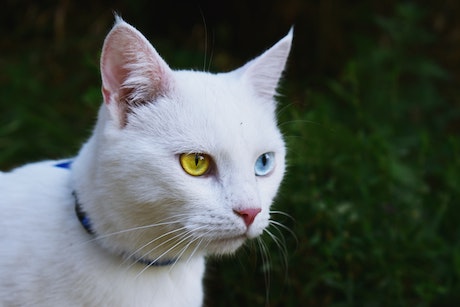
Morris 

D. E. Larsen, DVM

The girls were all waiting for me when I came through the door after work.

“We have kittens!” they all screamed in unison.

“We have lots of kittens,” Amy said.

“Both Sam and Mittens had kittens,” Brenda said. “Sam only had one kitten, but Mittens had seven.”

“Come on, we will show you,” Amy said as she tugged my arm.

So off to the garage we went. Dee tagged along with the two older girls in the lead. 

Mittens was in her box, carefully tending to her large litter, and Sam was nearby with her single kitten. 

I grabbed Sam and palpated her abdomen to ensure there weren’t more kittens that didn’t make it out. No kittens in her belly.

“And look at Mitten’s white kitten,” Brenda said.

Sure enough, in the tangle of kittens was a white kitten.

“I think that is a siamese cross kitten,” I said as I picked it up and checked its sex. “He is a boy. We will keep this kitten; he will darken like a siamese as he gets a little older.”

“Mom said we are not to pick the kittens up,” Brenda said as I returned the kitten to the box.

“I get to do things sometimes that Mom says not to do,” I said.

We left the mothers with their kittens and returned to the house to prepare dinner. Sandy was just finishing up getting Derek fed and in his crib. I started putting together the dinner.

The girls were all atwitter about the kittens all through dinner.

“Can we check the kittens after dinner?” Brenda asked. 

“You can check them, but they need some privacy for a few days,” I said. “If you bother them too much, the mothers will move them. Maybe move them outside or hide them somewhere in the house.”

There was no slowing them down. The girls were done eating almost by the time Sandy got to sit down.

“Can we go check them now?” Brenda asked.

“You have to wait until Dee is ready to get down from the table,” I said. “And she will need some help washing up after dinner.” 

That would have been a chore from hell any other day, but Brenda rushed Dee to the kitchen sink to wash up her hands and face after she climbed down from the table. Then all three girls disappeared into the garage.

Amy was the first to return, almost out of breath from the excitement. 

“Sam stole the white kitten,” Amy said as Brenda and Dee rushed up behind her.

I got up and followed the girls to the garage. Sure enough, Sam had the white kitten snuggled up with her other kitten, and Mittens didn’t seem too bothered.

I picked up the white kitten and carefully returned him to his mother’s box.

“Why did she do that?” Brenda asked.

“I don’t know,” I said. “Maybe Sam thought she could help Mittens out with her bunch. Now let’s all go back in the house and leave the kittens alone for the evening.”

I checked the kittens one last time before going to bed. Sure enough, Sam had the white kitten in her box. I was tempted to leave it, but I carefully returned it to Mittens.

“Sam really wants that white kitten,” I said to Sandy as we got into bed.

“Both Sam and Mittens are black. Maybe she just likes the contrast,” Sandy said.

“If it keeps up, I am just going to let her have it,” I said.

Sure enough, Sam had the white kitten when the girls checked the kittens in the morning.

“I think Sam is just helping Mittens out,” I said. “I think we will let her adopt this little white kitten,”

“Brenda wants to call him Morris,” Amy said.

So Morris was raised by Sam. Sam was happy, Morris had little competition for milk, and Mittens was not bothered by the loss.

***

When Morris and his litter mates were still nursing, we made our move from Enumclaw to Sweet Home. Because we were going to be in an apartment initially, our eleven cats were delivered to my folks in Myrtle Point until we were in a house.

At Myrtle Point, cats were not allowed in the house. So our cats became barn cats.

“Why won’t Grandma let the kittens live in the house?” Amy asked.

“Grandma was raised on a farm, and cats and kittens were always in the barn,” I said. “The kittens will be fine. The biggest risk will be if the older cats leave to try to find their way back to Enumclaw.”

“You mean they would run away from Grandma’s?” Brenda asked.

“It probably won’t happen, but it is possible,” I said. “We have no other choice. They will just have to make do with the barn.”

***

When we finally were settled in our house on Ames Creek, we made the trip to Myrtle Point to gather all the cats. By some miracle, they were all there. And they had no adjustment with the move back to Sweet Home.

“I think Morris likes to live outside,” Brenda said shortly after we had the cats back home.

“He grew up in the barn at Myrtle Point,” I said. “He probably likes the freedom.”

It was not long after that discussion, and Morris was gone. The girls were crushed. The days turned into weeks, and the weeks turned into months. 

Then one Saturday morning, we loaded everyone into the car to go to the lake for lunch. We were less than a quarter mile from the house when Amy screamed.

“There is Morris,” Amy said, pointing out the window. Morris was sitting in the middle of a cat road that led up to some timber.

I stopped the car and walked up the cat road for twenty yards.

“Kitty, kitty,” I called to Morris. 

Morris turned and ran into the brush.

“Was that him?” Brenda asked as soon as I got back in the car.

“I am pretty sure that was him, but he wasn’t interested in being caught,” I said.

***

After that sighting, we would see Morris on multiple occasions. He was apparently living in the timber not far from the house. He evidently had no interest in coming home.

That was until one Sunday morning. Amy heard a cat meowing at the front door. She opened the door, and it was Morris.

“Let me pick him up,” I said. “He might not be ready for any hugs yet.”

I petted Morris, and he purred but made no effort to move. I picked him up, and there was the reason that he came home. His right hind leg was broken, a mid-shaft fracture of his tibia. I took him into the house and closed the door.

“Morris has a broken leg,” I said. “At least he knew where to come for help.”

Morris made a trip to the clinic with me that Sunday afternoon, and I called Dixie to come in and give me a hand with the surgery. He was like the plumber’s pipes. If I didn’t repair his leg today, it might be several days before I had the time.

Fractured tibias were probably the easiest of the bones to repair. I used a combination anesthesia of xylazine and ketamine. Then I made a small incision at the fracture site and placed an inter-medullary pin into the bone in a retrograde manner. The entire procedure took less than a half hour.

“Are you going to get an x-ray?” Dixie asked as I placed Morris back in the kennel for his recovery.

“I feel good about how things went together,” I said. “And I don’t think there is any need to document my work. I doubt if the girls will sue me for malpractice.”

“I wouldn’t be too sure about that,” Dixie said. “Those girls are all pretty fond of their cats.”

***

Morris healed well, and I removed the pin in six weeks, right on schedule. He was content to live in and around the house for the next fifteen years.

Photo by Amy Larsen.

Widow Woman’s Ranch, From the Archives

D. E. Larsen, DVM

I could see Dan waiting at the gate to the barnyard when I pulled into his driveway off of Pleasant Valley Road. There was still some snow on the ground from a late spring snowfall, and it added a chill to the air.

“Dan, I got the message that you wanted me to stop by, but I didn’t get any other information,” I said as I extended my hand.

Dan shook my hand. His hands were heavily calloused, and his fingers bent from arthritis. I am sure his handshake was much firmer in past years.

“I want you to look at my old horse, Joe,” Dan said. “This time of the year, I keep him in the barn. I’ve noticed that he has one heck of a time eating. He takes a mouthful of grain, and more of it dribbles back into the feed rack than he swallows.”

“That might be something pretty simple,” I said. “How long has it been since his teeth have been floated?”

“They probably have never been floated, since I don’t know what that means.”

“The horse’s teeth continue to erupt throughout their life. They wear against themselves, and sometimes, when they get a few years on their mouth, they develop sharp points on the edge of the teeth that need to be filed off.”

“You just say, open wide, I guess,” Dan said.

“Some horses object to the procedure more than others, but we have a little device to help hold the mouth open. Some horses stand right there and let it happen, some need a twitch, and then there are a few who need some drugs to help them relax.”

“Joe, he’s a pretty mellow old horse. He’s sort of like Mom and me. He was a lot prettier twenty years ago than he is today.”

“Let’s go get a look at Joe,” I said.

“I’m a little embarrassed to take you into the barn,” Dan said. “This place looks like a widow woman’s ranch anymore. I’m too damn old to keep it up anymore. Our son, Stan, died in that war, and our daughter doesn’t live close. She tries to help some. But you probably know how it is when you are working and have a young family. There is just so much time you have to give to the old man.”

“I’m sorry about your son. There were far too many young men lost over there. I was in the Army for four years, but I was able to avoid Vietnam. I had a good friend who came home in a box, though. I am glad that it is over.”

Dan didn’t respond to my comment. He busied himself with the gate that we had stopped at on the driveway leading to the barn. Dan was having some trouble untying some baling twine that held the gate closed.

“I’ve never heard the term, ‘widow woman’s ranch’,” I said.

“Nothing is fixed. All the fences lean this way or that. Everything is held together by baling wire or twine. The wire lasts a lot longer than the twine, but they don’t bale hay with wire much anymore. Or maybe, I just don’t buy alfalfa much anymore. Twenty years ago, I would’ve replaced any leaning post. Or at least, reset it. Now I just support it with a mesh made out of twine. It is a good thing I don’t have much stock anymore. We feed out a steer for meat, for ourselves, and our daughter’s family. And then there is Joe. And Joe knows he doesn’t want to get out. He’s got it made here, three square meals a day, and nothing is expected in return. Even the grandkids don’t seem to want to ride him anymore.”

I helped Dan with the large barn door. We had to lift it a bit, and then it would slide. It looked like the rollers needed a little grease, but I wasn’t going to say anything. 

I was shocked at the inside of the barn. It was immaculate, like stepping into a barn twenty years in the past.

“I try to keep this place like Stan would remember it,” Dan said.

Joe was in a large stall. He whinnied and tossed his head happily.

Joe was old, a buckskin. He was probably a striking horse in his day. Now his face was grayed, and his muscle mass was fading.

“Let’s get a halter on him so I can look at that mouth,” I said as I reached for a halter and lead rope hanging on a hook at the gate leading into the stall.

“Don’t use that one,” Dan said. “Stan hung that one there the last time he rode Joe before going to Vietnam. Joe was Stan’s horse, you see. Joe is the only connection I have to Stan. I worry what will happen to him if this old guy outlives me.”

I could see some moisture in Dan’s eyes as he spoke. I had to look away for a moment and take a couple of deep breaths before I tried to talk.

“I’m sure your daughter will take care of Joe,” I said.

“She has nowhere to keep him, but I guess she could find someone to take care of him. I have it all spelled out. I have a place picked out for him behind the barn. Joe and I go out at times and talk about how things used to be when Stan was around.”

I grabbed the old halter that Dan had been holding and stepped into the stall. I needed to get to work to change the subject.

Joe nuzzled me when I slipped the halter over his nose. I tied the lead to a ring hanging on the feed rack. Joe had no problem when I ran my index finger along the insides of his cheeks to feel the points on his back teeth.

I grabbed Joe’s tongue and pulled it to the side, causing Joe to open his mouth a little. With a small penlight, I got a good view of the left side of his mouth. Switching hands and pulling the tongue to the other side, I viewed the right side of his mouth.

Joe had jagged points on the inside of his lower cheek teeth and the outside of his upper teeth. I could see sores on both sides of his tongue and on the inside of both cheeks. Joe should feel much better with these teeth floated.

Joe was remarkably tolerant. I grabbed his tongue and inserted the float in the left side of his mouth. With long slow strokes of the float blade, you could hear the points disappear as the sound went from a rough rasping sound to a smooth, almost silent sound. I finished the floating in a couple of minutes.

I smiled as I felt Joe’s teeth after I was done.

“These are as smooth as can be now. I think you’ll see a big difference for Joe.” 

“I hope so. I am a little surprised that Joe wasn’t bothered by that whole thing,” Dan said.

“Yes, he is pretty exceptional to stand there and take it with no restraint and no speculum.”

“Do you think he is going to be able to eat now?”

“I think you’ll find he is a new horse. But to be sure, I’ll check with you in a few days.”

***

I was driving by Dan’s place a few days later, and when I noticed him coming out of the barn, I stopped to ask about Joe.

“Good morning, Dan,” I said. “I just wanted to check on how Joe was eating after I worked on him the other day.”

“He’s doing great. Doesn’t dribble a bit of grain. I think he enjoys eating now. If I had known that was a problem, I would’ve had you do his teeth a long time ago.”

“At his age, we should plan to check him every year, just to keep him as comfortable as we can for his old age.”

“That sounds like a good plan,” Dan said. “I’ll try to remember to give you a call.”

***

It was probably 3 years later when Dan gave me a call. He wouldn’t talk to Sandy when she answered the phone. He only wanted to talk with me.

“Doc, this is a terrible day for me,” Dan said. “I think I need you to come and put Joe to sleep for me. He sliped going out of the barn the other day, and he must have hurt a hip or something. He can hardly walk.”

“Do you want me to examine him first?” I asked. “It could be something simple that we help with some medication.”

“No, I think it is time for him to go see Stan. I’ve already had a neighbor over. He dug a hole with his backhoe, out behind the barn, under that big maple tree.”

“When do you want to do this, Dan?” I asked.

“The sooner, the better, do you have time to come now?”

“I’ll make time, Dan. I’ll be out there in a few minutes.”

Dan was waiting for me at the Barn door. I helped him with the door again. Joe was lying down when we entered the barn. It was quite a struggle for him to get on his feet.

Dan had tears in his eyes and one running down his left cheek.

“Can you get Stan’s halter down for me?” Dan asked. “This getting old stuff is no fun for me either.”

I remembered that Dan didn’t want to use this halter when I was out before to look at Joe.

“You want the one that Stan hung up?” I asked.

“Yes, we are going to bury him with it. I figure that is what Stan would have wanted.”

I carefully, almost reverently, lifted the halter and lead rope off the hook. Dan took it and held it close to his chest as he walked through the gate to Joe’s stall. Joe snickered softly as he smelled the halter. Dan slipped in on the halter and patted Joe on the neck.

“We can go out the back door,” Dan said as he started Joe toward the door. Joe was hardly bearing any weight on his right hind leg. Dan was correct. It was probably time.

Dan lead Joe out and had him lying down by the large hole that was recently dug. 

“He knows the routine. I’ve been bringing him out on good days for the last year. He lays down, and I sit here with him, and we talk about the old days.”

“Dan, do you want to stay for this?” I asked. “You could wait in the house or the barn.”

“No, Joe wants me to be here. It’s okay, Doc. Joe’s going to see Stan.”

“This is pretty fast stuff. I’m going to give him an injection to sedate him a little. Then, when I give him the big injection, he’ll be gone in an instant.”

“Okay, let’s get it done.”

Joe went quietly, resting his nose on Dan’s legs when he was sedated.

Dan shed a couple of tears, patted Joe’s neck, and stood up.

“Do you need me to help to put him in the hole?” I asked.

“No, the neighbor is going to come back with his backhoe. Our daughter will be here before too long. She and her husband will be able to take care of everything. You can stop at the house, and Sue will give you a check.”

“There’s no charge for this, Dan. Stan paid the bill some time ago.”

I walked back to the truck alone, leaving Dan to pay his last respects to Joe. I sat in the truck for a moment, took a few deep breaths, and dried my eyes before pulling out onto the road.

Photo by Idella Maeland on Unsplash

It’s a Wire Cut 

D. E. Larsen, DVM

The phone rang a second time. I looked at Sandy and Dixie, but they made no move to answer it. I looked at the clock. It said five fifteen. The phone rang a third time this Friday afternoon.

“It’s a wire cut,” I said as I reached for the phone.

“How do you know that?” Sandy asked.

“It’s after five on Friday,” I said. “This is a wire cut that happened on Tuesday, and she needs it sewn up tonight, so she can go riding tomorrow.”

I picked up the phone.

“Hello, this is Doctor Larsen,” I said into the phone.

“Oh, Doctor, I am so glad I caught you,” Wendy said. “Bullet has nasty-looking wire cut on the right front leg.”

“Did this just happen?” I asked.

“No, Bob said he saw it Tuesday night,” Wendy said. “I have been busy at work and couldn’t take time off during the week. I was lucky that I could get off a little early to get here to call you.”

“Where is this cut located?” I asked.

“It’s on his right front leg, near his elbow,” Wendy said. “It looks infected, it is all puffy, and there is some yellow stuff in the wound. It is almost two inches long.”

“Being three days old and on the upper leg, it can wait until morning,” I said.

“Doctor, it is so infected. I’m afraid it is an emergency,” Wendy said. “I was hoping you could run out here this evening and take care of it. I am supposed to go riding in the morning.”

“Wendy, It was an emergency on Tuesday, and maybe even on Wednesday,” I said. “On Friday evening, at best, it is a convenience call. It is not an emergency to look at a wound that has been neglected for three days. Especially a wound that can be treated as an open wound with little difference in the outcome.”

“Doctor Larsen, I did not neglect this wound,” Wendy said. “I was just too busy to deal with it. I would appreciate it if you could look at it this afternoon.”

“I can look at it, but there will be an after-hours fee,” I said. 

“But you are still at the office. Why should I have to pay extra?” Wendy said.

“Because it is almost five thirty, and this is not an emergency,” I said. “Otherwise, I could look at the first thing in the morning.”

“Okay, I will pay the extra fee if you can come tonight,” Wendy said. “But I won’t be able to pay you tonight.”

Sandy handed me Wendy’s account card. When we charged her in the past, it was always over ninety days before she paid.

“You know our policy is payment at the time of service,” I said.

“Yes, but this is an emergency,” Wendy said.

“Wendy, this is not an emergency,” I said. “This wound can be handled as an open wound with very little difference in the healing. You can come to the office in the morning and pick up some medication, and I can give you some instructions on treating this wound.”

“My friend thought it should have sutures,” Wendy said.

“It is three days old and in a location that heals in spite of how it is handled,” I said. “If your funds are limited, I suggest treating it like an open wound. You can do that, or I can come out first thing in the morning and show you how to do it.”

“Okay, Doctor, I will be here at eight,” Wendy said. “I think I can convince my friends to a little later start for our ride tomorrow.”

***

Wendy was waiting with Bullet tied to a fence post when I pulled up in the morning.

“Good morning, Wendy,” I said. “Let’s look at this wire cut so you can get on your ride.”

This cut was actually above Bullet’s elbow. It was just over two inches and didn’t appear to be into the muscle tissue. There was some minor swelling, but not anything that was a problem.

“I have to be honest with you, Wendy,” I said. “If you did nothing with cut, it would heal just fine. I will clean it up, shave the hair away from the wound, and give you some ointment to keep on it. There is a little swelling, so I will give Bullet a long-acting penicillin injection. I don’t think he will need any more antibiotics. I will also booster his tetanus vaccination.”

“Your sure it will heal?” Wendy asked. “When Susie looked at it, she thought it needed sutures.”

“Tuesday night, I would have sutured it,” I said. “After two or three days, there is a good chance that the sutures would break down. Then you would have put a lot of expense in the surgery just to get back to treating it like an open wound.”

“That makes sense, I guess,” Wendy said.

I scrubbed the wound with some warm water and betadine scrub. Then with my shoulder firmly planted in Bullet’s side, I swabbed the wound firmly to remove all the accumulated exudate. Bullet never flinched.

“Now, I’m going to shave the wound edge,” I said to Wendy. “In wound treatment, if you can only do one thing, it should be to get the hair away from the wound.”

With the wound cleaned up, it didn’t look nearly as bad. Wendy looked at it closely.

“It doesn’t look bad now,” Wendy said.

“I’ll apply a little Furacin ointment,” I said. “I will leave you this small jar. You should do this once or twice daily for a week or so. By then, this will be nearly closed up, and you can relax on the treatment.”

I gave Bullet an injection of long-acting penicillin and tetanus vaccination.

“Why does he need a tetanus booster?” Wendy asked. “I give him a vaccination every year.”

“The horse is pretty susceptible to tetanus,” I said. “The protocol is an annual vaccination and then a booster with any wound. Failing to do that, I would be in jeopardy of a malpractice lawsuit, and Bullet would be less protected.”

“Have you ever seen a case of tetanus?” Wendy asked.

“Oh, yes, and most of those just die,” I said. “I have talked with a couple of veterinarians who say they have saved horses when they were given a blank check on treatment expenses. I have never seen that happen, but I am sure it does.”

“Can I ride him today?” Wendy asked.

“I don’t think he will notice this cut,” I said. “You noticed that he didn’t object to my treatment. Riding him will probably make his muscle feel better.”

“And I can give you a check this morning,” Wendy said. “However, it would be better if you could wait till the end of the month before depositing it.”

“That will make Sandy feel better,” I said. “I will make sure she gives you a call before she deposits it. And if you are concerned about how this wound is coming along, you give me a call.”

***

Bullet’s wound healed nicely. In fact, Wendy was surprised that there was almost no scar when it was healed. And Sandy deposited her check on the first of the month, and it went through with no problems.

Photo by Jacque B on Pexels.