Another Gus 

D. E. Larsen, DVM

Glenn was waiting in the exam room with his new pup, an 8-week-old border collie.

“Where did you get his guy,” I asked.

“A friend in Eugene had a litter of eleven pups, and he couldn’t get rid of this last one,” Glenn said. “Since the old dog died, I figured I could use a new dog. I call him Gus.”

“Well, let’s get a look at Gus,” I said as I started an exam. “Then we will get him started on his vaccines.”

“What do you think of Border Collies?” Glenn asked.

“They are great dogs, probably one of the smartest of all the dogs,” I said. “They are working dogs, however. They need something to do, or they sort of go crazy.”

“He has plenty of room but probably no specific job,” Glenn said. “We don’t have any other animals.”

***

After his initial vaccinations, I didn’t see Gus for a couple of years. Then one morning, Glenn called.

“Doc, Gus has a broken leg. Can I bring him down?” Glenn asked.

Gus had a broken tibia, the lower leg bone on his rear leg. Tibia fractures were always a joy because they were easy to repair. If there were money problems, they could be fixed with a splint, and you could expect good results. We repaired the fracture on Gus with a steel pin in the bone.

Gus was fine to work on. We got him under anesthesia, took a couple of x-rays, and prepped his leg for surgery. Gus had a simple fracture, and I made in small incision over the fracture site, placed an IM pin in the bone starting at the knee joint, and pushed it down to the fracture site. With the pin in view at the incision, I threaded it into the distal bone fragment and seated the pin. The reduction of the fracture was almost perfect. I closed the incision at the fracture site and cut the pin at the knee after bending it slightly so it would not interfere with the joint function. 

Gus woke up and was bearing weight on the fractured leg.

“What do I need to do with him now?” Glenn asked.

“Not much,” I said. “I think that by the time we get his sutures out in two weeks, he will be walking on that leg like nothing ever happened. At six weeks, we will plan to take that pin out.”

When Gus was in for his pin removal, he was walking normally. He proved a little tricky to handle then, but I didn’t think much of it. We sedated him, took an x-ray to make sure the bone was healed and removed the pin. That would prove to be the last time that I actually was able to handle Gus.

***

Two years later, Gus came to the clinic for his vaccinations. He was not happy, and to say we had a struggle would be an understatement.

Small dogs often bite out of fear or anxiety, and those bites are usually unannounced. Large dogs tell you they are going to take your arm off, and over the years, I have learned that you had better believe them.

Gus was no exception. Glenn had to restrain him from the moment I stepped into the exam room. I think he was thinking of a leg rather than an arm.

Glenn couldn’t get a muzzle on Gus, and we finally tied him short to the exam table, and I was able to get a rabies vaccine into him.

“That will keep him legal. Let’s call it a day,” I said

“I tell you, Doc, he is not like this at home,” Glenn said. “Of course, he is not around other people much.”

“He may just associate this place with his broken leg,” I said. “I seldom get credit for helping these guys.”

“When we do this again, maybe we should do it at the house,” Glenn said.

“Yes, that might be better,” I said. “I will make sure we mark his record.”

And mark his record we did. Sandy had large caution marks all over his chart so nobody would be taken by surprise when working with Gus.

***

It was three years later before I saw Gus again. Gus was even worse at the house than he was at the clinic. He was displaying some severe aggression now, to heck with an arm or a leg. Gus was going for the jugular now. Glenn finally tied him to a tree in the backyard, and I was able to get a rabies vaccine into him. 

“I don’t know, Glenn,” I said. “Gus has some real problems. This isn’t just a dislike of me. I think he has some real aggression issues, and he is probably a liability for you.”

“Yes, we know,” Glenn said. “He is aggressive to almost everyone now. We must be careful to have him in his kennel when we have anybody visiting.”

Getting a rabies vaccine into Gus every three years became a herculean struggle. The older he got, the worse the battle. Gus had become the stereotypical junkyard dog.

***

And then it happened. Glenn and his wife went on an extended vacation, and their son was in charge of caring for Gus. In no time, Gus escaped from his kennel. He was at large for some time before a young couple found him and somehow read his rabies tag. They brought him to our clinic.

“You seem to know this dog without even checking his rabies tag,” the young man said.

“Oh, yes, I know Gus by sight,” I said. “In fact, I am surprised you still possess your right hand.”

“I told you that I didn’t think he was a dog we could trust,” the young lady said, looking at her husband.

“I’ll take Gus and get him into a kennel, and we will make sure he gets home,” I said. “And thank you for bringing him in to see us.”

I grabbed the leash and literally ran Gus into the back. Terri had a gate open to a run, and I had Gus in the run before he knew what had happened.

“Do those two know that this dog is mean?” Terri asked.

“The gal suspected it,” I said. “Gus must have known that he needed help, or he would have taken the kid’s hand off.”

Glenn’s son came by and picked up Gus. He seemed at ease with him and had no problem getting him out of the dog run and into his truck.

Two days later, the whole thing was repeated. This time another young man brought Gus into the clinic. I couldn’t believe it when he petted Gus after placing him in the kennel.

We called Glenn’s son a second time, and he was prompt in picking up Gus.

“They’re due home this evening,” he said. “None too soon. I have a hard time keeping track of this old dog.”

“When are your folks going to be home?” I asked.

***

I wish I could say that was the end of the story. But in those escapes that Gus enjoyed, he found a Black Labrador in heat. And a couple of months later, there was a litter of pups.

We saw the litter for vaccinations when they were six weeks old. You had no problems believing that their father was Gus. These pups were biters from the start. They were perfect examples of the inheritability of behavior. 

The pups were all adopted out to new owners. We heard that most of them were never able to be trained, and most were given to the humane society. We saw two of those pups. One for only a visit or two before the new owner gave up on trying to make him a trainable pup. 

The other was owned by a lady who worked hard with the pup, and she could make him behave pretty well for several years. But like his father, his behavior worsened as he aged, and in the end, that last pup was given up on by a sad owner.

Photo by Julissa Helmuth on Pexels.

Long Road Home for Tramp, from the Archives

D. E. Larsen, DVM

“Slow down a minute, Ralph,” Jan said as she was watching the old cat on the edge of Pleasant Valley Bridge in Sweet Home. 

“Turn here,” Jan said, pointing at the bridge.

Ralph turned and headed across the old bridge.

“Stop, stop right here. That cat needs some help.”

Jan almost jumped out of the car before it came to a stop. She crouched down and called softly to the cat. “Here, kitty, kitty,” Jan said as she stretched out her hand and made a couple of short, shuffled steps toward the dusty old tabby cat.

The cat hesitated for a moment as if trying to decide if he should run or not. But something was inviting in this lady’s voice. He eased forward and sniffed at her fingertips. She patted him on the top of his head.

A couple of cars had stopped behind their vehicle, and Ralph was getting a little impatient.

“Hurry it up, Jan. We are holding up traffic.”

A lady started to get out of a car that was a couple of cars back in the line. Jan motioned for her to stay back. 

The old tabby cat moved up to Jan’s knees and pushed against her.  

Jan could feel a stifled purr. She took a deep breath, leaned over, and scooped the old guy up.

Jan slid into the car with the cat and pulled the door shut. The cat leaned into her and purred as Jan stroked his back and sides.

Ralph swallowed and put the car in gear. “I hope this isn’t a mistake,” he said as the car moved forward.

“This is a nice cat,” Jan said. “And he has a collar and a tag.”

“We don’t have time to deal with a stray cat today,” Ralph said.

“We need to find the vet’s office in town,” Jan said.

Ralph pulled over as soon as they were across the bridge. The car with the lady who wanted to help pulled up behind them, and the lady came up to Jan’s window. The cat was now wholly under Jan’s spell as she continued to stroke him with long slow strokes from the top of his head to his tail.

Jan rolled her window down a bit. “Where can we find a vet in town?” she asked.

“There is a clinic in the Safeway shopping center in the middle of town,” the lady said. “Is the kitty okay?”

“I think he is okay, maybe lost, but okay,” Jan said. “He looks a little rough like he has been traveling a bit. He has a tag. We will drop him at the vet’s office. We are headed for Bend and don’t have a lot of time.”

***

Jan was breathless as she came through the clinic door and perched the cat on the counter in front of Judy.

“We found this cat on the bridge coming into town,” Jan said. “It looks like he needs some help, and we are on our way to Bend.”

“It looks like he has a tag on that collar,” Judy said. “Is he nice?”

“He is the sweetest old thing,” Jan said. “I think he must be lost.”

Judy looked at the tag. “It says Tramp,” Judy read. “I guess that fits. Let me check with the doctor.”

I came out and looked at the cat. He was thin but okay otherwise, and it had a collar and a tag. The tag gave the cat’s name, Tramp. It also had an owner’s name and local phone number. I agreed to keep the cat.

“Thanks a lot, Doc,” Ralph said. “We have to hurry now. We have a meeting in Bend that we will be late for if we don’t get on the road.”

These foundlings were always a problem. Occasionally, the finder would offer to be responsible for the bill if the owner was not found. But most of the time, that expense, whatever it happened to be, fell on the clinic. At least Tramp came with an owner’s name and phone number.

Judy was given the task of calling the owner on the tag. 

“Yes, this is Robert Wilson,” the man said to Judy. “What can I do for you.”

“This is Judy from Sweet Home Veterinary Clinic,” Judy said. “We had a couple find an old cat on Pleasant Valley Bridge this morning. The cat has a tag on its collar with your name and number on the tag.”

“I don’t know what to tell you about that,” Mr. Wilson said. “We don’t own a cat.”

That was great news. We were stuck with finding someone to adopt this cat, not an unusual event for such situations.

  About 30 minutes later, we were still discussing how we would find someone to take the cat, and the phone rang. It was Mr. Wilson, the guy Judy had called about the cat.

  “What does that cat look like?” He asked.

  “It is a brownish tabby cat, neutered male, friendly. He looks a little thin and has sort of a rough hair coat, but otherwise, he is in good shape.” Judy replied.

  “We had a cat about 5 years ago. We had to move to San Francisco for a couple of years. We lost him on the trip down, somewhere in Northern California. His name was Tramp, but I don’t remember a collar. You don’t think that could be him, do you?” 

  “How else do you suppose this cat had Tramp’s collar?” Judy asked.

  “We will come right down and get a look at him.”

  It was not long, and a car pulled up in front of the clinic. Robert and his wife came through the door first, but Susie, their teenage daughter, was right on their heels.  

One look at Tramp, and it became a happy reunion. The daughter opened the cage, and Tramp was instantly on her shoulder and purring, rubbing his face on her neck and face. She was in tears.  

“Susie has suffered for years. We had stopped at a rest stop south of Crescent City, and Tramp got out of the car. The next thing we knew, he was scared by another car and ran into the woods. We looked for him for an hour, but we couldn’t stay there. We had to go on. Susie cried for days.”

“Do you think he has been traveling all these years? That is remarkable,” Judy said.

“It is pretty hard to believe, you saw the immediate recognition by both of them. Pretty remarkable, it will be a happy evening in our house,” Mr. Wilson said. “Do I owe you guys anything?”

“No, we are just happy we didn’t have to find a family to adopt him,” I said.

  The stories Tramp could tell. This was something right out of a Disney movie.

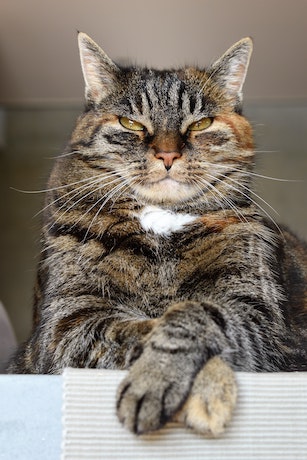
Photo by Gabriel Gheorghe on Unsplash

The Burrito

 D. E. Larsen, DVM

The rain stopped as I turned off the highway onto Wiley Creek Road. I was disappointed that the twilight was fading fast. I would cross the creek at the falls where the old Wiley mill had been located.

A short distance up the road, I turned onto the side road that crossed the creek just above the old mill site. The bridge was narrow and had no guardrail, and I drove across slowly.

I pulled up to the barn that had lights on. There, in a small pen, I could see a Hereford heifer, standing up and straining, with a couple of feet visible at her vulva.

Angie was there, clutching her small pup to her chest.

“Hi, Angie, this must be the heifer you called about,” I said as I stepped out of the truck.

“Yes, she has been like this for a couple of hours now,” Angie said. “Nobody else was home, and I didn’t know what to do, but it just didn’t look right to me. So I gave you a call.”

Calving difficulties in heifers were as close to routine for me as anything I did. But to these hobby farmers, with only a few cows, calving problems might be a once-in-a-lifetime experience.

“Well, it looks like you did the right thing in calling me,” I said. “If she has been at this for two hours, it is time to give her a little help.”

I poured a bucket of warm water, grabbed my rope, and crawled over the fence into the calving pen. This was a tame heifer, and my presence distracted her enough that she turned around, licked at my arm, and sniffed the bucket of water. Her contractions relaxed for a moment.

I slipped the rope over her head and fashioned a halter with a loop over her nose. Then I walked her over to the fence and tied her to a rail. I left enough rope that she could fall down with no problems. That was something that usually happened if they were not already on the ground.

I tied her tail out of the way with a piece of twine and scrubbed her rear end and my arms. I inserted my left hand into her birth canal and bumped into the calf’s nose. With two feet out and a nose close to the vulva, this will be an easy delivery. I stuck a finger in his mouth, and he sucked on it. He was alive.

“This should be an easy delivery,” I said as I climbed back over the fence to get my OB bag and the calf puller. 

“What’s wrong?” Angie asked.

“Not much, just a young, first-time delivery and a calf that is a little too big for her,” I said. “If we left her through the night, I would guess she would deliver this calf on her own. But sometimes, that takes five or six hours of labor, and the calf may or may not survive. It is better this way. Give them two hours, then give them a little help.”

I put a nylon OB strap on the calf’s feet and positioned the calf puller. I hooked the strap to the puller and started cranking. The vulva stretched as the nose appeared. Then the head popped out. A couple more cranks on the puller and the chest of the calf was in the birth canal. The heifer strained, stiffened, and fell onto her right side.

I pulled the calf puller down toward her hocks and cranked fast. The chest cleared the vulva, and then the rest of the calf followed with a gush. The calf raised his head and shook it. 

“It’s alive!” Angie said.

“He is doing fine,” I said. “A little bull, he will be up before mom.”

I treated his navel with iodine and gave him an injection of BoSe to prevent white muscle disease. He was struggling to stand by the time I was done with him.

Since Angie was home alone, I stripped a few swallows of milk from the heifer and gave it to the calf with an esophageal feeder. Then I untied the twine on the heifer’s tail and removed the rope from her neck. 

After I picked my stuff up and got it over the fence, I swatted mom on the butt with my rope. She jumped up in a flash. She was slow to look at the calf but finally sniffed him as he stalked her on wobbly legs.

“What do I have to do with her now?” Angie asked. 

“I would leave her in here until you are sure she is getting along with the calf and he is nursing,” I said. “Sometimes these heifers take some time to figure out just what is going on, but they do fine most of the time, after a day or so.”

“Well, it’s a relief to see him on the ground,” Angie said.

“What going on that you are here by yourself?” I asked.

“We were on a mission, helping build a church in Mexico,” Angie said. “I had to come home early because everyone down there was calling this little pup of mine Burrito. Everyone said they were teasing me but just had to come home.”

Angie tightened her grip on the pup as she told me the story.

“They were teasing you, I’m sure,” I said. “But when I was in the Army in Korea, I am sure that dog meat found its way to the dinner table. If you read the Lewis and Clark Journals, they ate a lot of dog meat on their trip across the country.”

“I know. I just felt better when we got home,” Angie said. “And I’m glad I was here to get help for this little heifer.”

“Yes, and I think she will be fine,” I said. “But if you have any questions about how things are going, you give me a call.”

Photo by WKN on Pexels.