The First Laceration 

D. E. Larsen, DVM

As I got in my van to head to the clinic, the sun was peeking out over the eastern horizon. It looked like it was going to be another great spring day. I thought how lucky I was to have such good weather for my first weeks of practice in Enumclaw.

I entered the back door of the clinic. I was the first one in the office. When I was in the army, I learned that being the first to arrive and the last to leave always caught the attention of the supervisors, whoever they happened to be. I figured it was a good habit to keep in practice.

I went to the front counter and checked the appointment book. There were only three farm calls scheduled for the morning. The procedure was to get the planned farm calls out of the way first, then we could concentrate on the stuff in the clinic.

My name was on the appointment to castrate four bull calves. That should be an easy call, I thought.

Ann, the owner’s wife, entered the front office about then.

“I put you down to do those castrations,” Ann said. “Is that something you can handle yourself?”

This was my second week out of school, and everyone wanted to make sure I could handle everything before sending me out on my own.

“I have done a lot of castrations in school,” I said. “I shouldn’t have any problems.”

“Well, the note says bull calves,” Ann said. “But, Billie always calls everything a calf. These might be close to yearlings.”

“I shouldn’t have any problems,” I assured Ann as I started checking everything to ensure I was prepared to make the call.

It was a short drive to Billie’s place, and Billie and Sue were waiting with the calves in the crowding alley. Ann had been spot on in her assessment. These young bulls were well past weaning. They all probably weighed over six hundred pounds.

“Hi, I’m Doctor Larsen,” I said as I shook Billie’s hand. “Let’s get the first one in the chute, and we will make short work of this job.”

“I was hoping you would take this call,” Sue said. “We have heard good things about you.”

I poured some warm water into my bucket and squirted some Betadine into the water. I put my instruments in the bucket, a large forceps, scissors, the emasculator, and a scalpel with a new blade.

“You seem to be practiced at this for being a new vet,” Billie said. “You must have done this before.”

“I went to vet school in Colorado,” I said. “Castrations were a common procedure for us in school. I have done this quite a few times.”

“So, Jack usually just cuts the bottom of the sack off when he does his castrations,” Billie said. “We seem to have quite a few that have some swelling afterward.”

“On bulls this size, I like to make a cut down each side of the scrotum, do the castration, and then continue those incisions across the bottom of the scrotum,” I said. “That way, we end up with two flaps, and there is no place for fluid to accumulate. When the bottom of the scrotum is cut off, it works great on little calves, but this size, that scrotum sort of closes up too fast during the healing process, and you will see some swelling.”

That discussion put Billie at ease, and I stepped behind the first bull. I grabbed the scrotum and squeezed the testicles down tight against the skin. Then with one swipe of the scalpel, I opened the side of the scrotum, cutting into the testicle at the same time.

The bull jumped and kicked a little, hitting my right forearm. The scalpel, held in my right hand, found the heel of my thumb on my left hand, making a neat laceration a little over an inch long. Damn, that hurt.

I stood up and returned to the van. I wrapped my hand with some gauze and pulled on a surgical glove.

“Are you going to be okay with that cut?” Sue asked.

“I think so. It won’t take long to finish here,” I said. “Then I can go take care of this hand.”

“We don’t have any problem with waiting on the others,” Sue said.

“I will be okay,” I said. “But I think we will tail these guys. Let me show you what I want you to do, Billie.”

I showed Billie how to bend the bulls’ tails up over their backs, putting enough pressure on the tail to cause a bit of a nerve pinch. This helped immobilize the bull and lessened the procedure’s pain.

I finished the first bull, and the other three didn’t take much time. There was no more dancing in the chute with Billie bending their tails.

When I was done, and all the bulls were sprayed well for flies, I went to the truck and pulled off the surgery glove. It was filled with blood. I put another wrap on my hand and another glove for the drive back to the clinic.

“How did things go?” Ann asked as I walked into the clinic. “It didn’t take you very long.”

“The castrations went well, but I cut my hand a little,” I said.

Ann watched as I pulled the surgery glove off. 

“That looks like it needs to be sutured,” Ann said. “We have a busy morning, but you should go to the doctor and get that taken care of before it gets infected.”

“I think I will sew it up myself,” I said.

“Now, how can you do that with just one hand?” Ann asked.

“That won’t be a problem. The problem will be getting it injected with some lidocaine,” I said. “I’m not very good at sticking myself with a needle.”

We went into the surgery room and laid out a surgery set and suture. I drew up a dose of lidocaine in a syringe and scrubbed the laceration with Betadine. Then after several attempts, I injected some lidocaine around the cut.

Placing the sutures was no problem with my right hand. But I wished I had practiced my one-hand surgery ties a little more. But, with some help from Ann, I got the wound closed.

“That looks pretty good,” Ann said. “But what about a tetanus shot?”

“I just had one last fall,” I said. “I should be good to go.”

The rest of the day went along well. I kept my left hand gloved just to keep it clean. 

Sandy was quick to notice the glove when I got home.

“What happened to your hand?” Sandy asked.

“I cut it on my first slice of a scrotum,” I said.

“Very funny, let me look at it,” Sandy said. “Who sutured it?”

“I did it myself,” I said.

“They do have state comp insurance, you know,” Sandy said. “You should have gone to the doctor.”

“We had a busy day,” I said.

***

Sue was in the clinic a few days later to pay her bill.

“I just wanted to check on your hand,” Sue said. “And Billie wanted to let you know how pleased we were with your job. Those steers acted like nothing had happened. They had no swelling at all.”

“My hand is healing well,” I said as I held my hand for her to see.

“That looks good,” Sue said. “Who sewed that up for you? I might want to go to that doctor.”

“He did it himself,” Ann said. “Can you believe that?”

“When it happened, I thought it would be the end of the call,” Sue said. “But he just wrapped it up, put on a glove, and finished the job.”

Photo by Jonathan Borba on Unsplash.
The Shadow Knows, From the Archives

D.E. Larsen, DVM

I first met Dr. Al on a hillside up 50th Ave on the East side of Sweet Home. I was in the middle of doing a C-Section on a 15-month-old heifer who was stretched out on the ground. Dr. Al was visiting at a neighbor’s house and came out to watch. I think he was surprised at the surgery in the middle of a pasture.

“How does a little heifer like this get pregnant in the first place?” Al asked.

“If they cycle and are not separated from the bulls, the system is made to work,” I answered. “I have done this on heifers under 14 months of age.”

About now, I had entered the abdomen through an incision on the left flank. The inside of the abdomen of a cow is always sort of a mystery to MDs. Al looked on with interest as I pushed the rumen aside a brought the uterus up the incision.

“That looks pretty simple,” He said.

“All surgery is pretty simple as long as everything goes well,” I replied.

I incised the uterus and had both hind feet sticking out of the incision. I secured the feet with an OB strap and handed the strap to the owner standing behind me.

“Pull straight up and then let him down to the ground easily,” I instructed as I guided the calf out through the uterine incision.

The calf hit the ground, raised his head, and shook fluid out of his nose.

“He is going to be up before mom,” I said.

“Now, how do you close all of that?” Al asked.

“It won’t take long,” I said. “I use a single layer on the uterus with number 2 Dexon in a pattern developed by Utrecht University in the Netherlands. It closes the incision securely and does not leave any of the suture material exposed to the abdomen. That way, there is little chance for adhesions to form and less loss in future fertility. The rest is just routine abdominal closure.”

“You won’t have any infection problems?” Al asked. “I mean, you’re out here in the pasture, with only gloves on, instrument pack opened on the ground. In people, we would have a mess.”

“I never, knock on wood, have an incision infection on a C-Section,” I said. “Maybe your hospitals are the problem.”

“Ha, that might be,” Al said. “Thanks for letting me watch. It was fascinating.”

Following that meeting, Al’s family became regular clients. They had a Great Dane. Al always enjoyed sharing similarities in our professions and the differences. I think he envied the lack of regulatory restrictions I enjoyed. He often spoke of early days in practice in Colorado and how he enjoyed making house calls and having close relationships with his patients.

Great Danes never seem to live very long, and it wasn’t very long until they were in with their Dane with an enlarged breast. It had developed very rapidly, and chest x-rays showed tumors in the lungs and in the vertebra already. There was nothing we could do at the time except to provide comfort care for a short time.

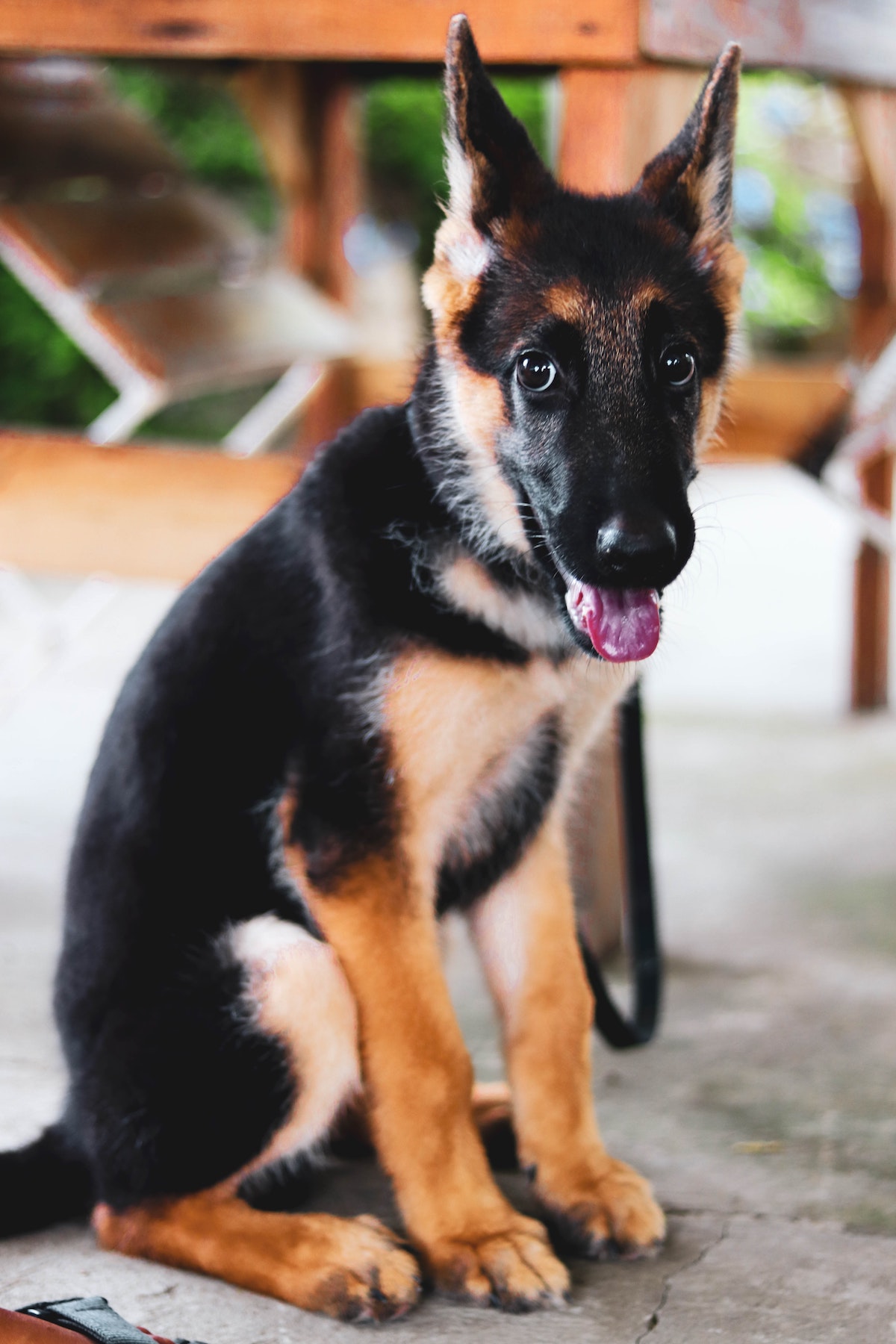
It was not long after the loss of their Dane that Al’s wife Jane and a daughter brought in a new German Shepherd pup. They were going to try a new breed. German Shepherds were a breed that I was always cautious about. There are many super dogs, but there seemed to be an increasing number of screwballs.

“We have always had Great Danes, but they never seem to live very long,” Jane said. “A friend has a German Shepherd that seems to be a great dog. So anyway, here we are.”

“He is a pretty good looking pup and well behaved already,” I said. “What are you going to call him?”

“We haven’t made the decision just yet,” Jane said. “Al wants to call him Rudy, the girls and I are thinking Shadow is a better name.”

“We will write Shadow on the record,” I said. “That is how it usually works out.”

I lifted Shadow up on the exam table. For a young German Shepherd, he looked good. Both ears are erect, teeth are good, and he is responsive to the people around him. Ruth hands Shadow a tennis ball to chew on as I start with his exam.

I start at the nose and work toward the tail.

“Everything looks good,” I tell Jane as I put my stethoscope to my ears.

The lung sounds are healthy, and the heart sounds strong. I almost put my stethoscope down and then remembered to check the left anterior thorax, which I always try to remember on young pups.

My expression immediately changes. Jane, who worked alongside Al for many of his early practice years, instantly recognizes the concern on my face.

“What is it?” she asks.

“There is a machinery murmur in the left anterior thorax,” I said. “That almost always means there is a PDA, a patent ductus arteriosus. That is a vessel between the aorta and the pulmonary artery that normally closes at birth. In Shadow’s case, it did not close.”

“Does it need to be fixed, or can he live with it?” Jane asked.

“He can live with it for a short time, but when he starts his rapid growth phase around 4 – 5 months, it will become life-threatening,” I explain. “Virtually all of these dogs will die before they reach adult size. Some small breeds might live longer, but not the large breeds.”

“How do we fix it?” Jane asked.

“Right now, in the dog, the fix is a surgical one,” I said. “They go into the chest and ligate the vessel.”

“You say they, does that mean you don’t do that surgery?” Jane asked.

“I have never done one, but I could probably do it,” I said. “We do have a cardiologist in Portland. He would be a better choice.”

“I don’t think Al is going to be up to sending a new puppy to a specialist for surgery,” Jane said.

“Will, we don’t have to make the decision right now,” I said. “You have Al listen to this heart and give me a call this evening. We can go from there.”

It was after dinner when Al called.

“I’m not sure I hear what you heard today,” he said.

“Put your stethoscope on the left side of the chest and move it way to the front of the chest, almost under his elbow,” I instructed.

There was a pause on the phone.

“Dang, do you think that is a PDA?” Al asked.

“It is a PDA or a large defect in the ventricular septum,” I said. “In veterinary medicine at this time, a PDA can be fixed. A septal defect cannot.”

“We are not going to Portland with this pup,” Al said with a finality in his voice. “Can you do this surgery?”

“I can do the thoracotomy,” I said. “But ligating the PDA, I have never done, but it should be something that I can do. The important thing for you to remember, this is a veterinary clinic. I am the only veterinarian. If I make a mistake, if I were to tear the ductus or puncture a vessel, the ball game is over.”

“I have watched you in surgery, I don’t think you will have any problems,” Al said. “You go ahead and get set up and schedule it, we will have him there.”

Jane had Shadow in the clinic at 8:00 AM sharp on his surgery day. She was obviously worried and understood the gravity of the undertaking. She patted Shadow on the head as the girls took him into the exam room, then she shook my hand as she wiped a tear from her eye.

“We are hoping for the best,” she said.

“I think we can do this with little problem, I will call you when he is recovered,” I said.

We completed Shadow’s exam and had him under anesthesia in short order. We clipped the entire left side of his chest, laid him on the surgery table on his right side with a towel roll under his chest to facilitate spreading his ribs.

When he was prepped and draped, I made a curved incision between his 4th and 5th ribs. I continued this incision down to his intercostal muscles. Then I carefully divided these muscles and opened the chest.

My surgical philosophy was to work fast. I had sure hands and utter self-confidence, in the environment of a veterinary clinic surgery room, the longer an incision was open, the better the chance of having an infection.

We had Shadow hooked up to a ventilator with his chest open. We paused the ventilator and moved his anterior lung lobe out of the way and packed it off with a moist lap sponge. I could put my finger on the PDA, the mechanical murmur shook the whole heart. I isolated the vagus nerve and pulled it out of the way with a loop of umbilical tape.

Now I was at the most critical point. I had to bluntly dissect a pathway around the PDA so I could place the ligatures. This dissection, especially on the deep side of the short vessel, could result in a catastrophic tear in the vessel that would most likely lead to a fatal hemorrhage.

I took a deep breath and began the dissection. My inexperience made me a little more aggressive with the dissection than a surgeon who had seen a vessel rupture. It only took me a couple of minutes, and I could grasp the middle of a length of 0 silk and pull it through the open pathway around the vessel. 

I divided the silk into two ligatures.  Then I slowly tightened the ligature closest to the aorta.  I moved to the ligature on the pulmonary artery side. I slowly tightened this ligature. Then I took another deep breath.

I returned the vagus nerve to normal position and placed a couple of sutures to close the soft tissues in the area. I removed the packing from the lung lobe and allowed the ventilator to expand this lung lobe. I placed a ten french chest tube with a 3-way stopcock on the outside of the chest. 

I did a nerve block on the intercostal nerves to help control pain and closed the ribs with 4 sutures placed around the 4th and 5th ribs. After insuring an airtight closure of the chest wall, the remaining closure was routine.

After putting a light wrap on his chest, we moved Shadow to a kennel to recover, and I began to relax. Looking at the clock, surgery was less than 50 minutes. I listened to Shadow’s chest. Nothing but good heart sounds. This guy should have a long and healthy life.

“Surgery went well, we were done in less than an hour,” I told Jane.

“Oh, thank you!” she said. “I was so worried.”

“We will keep him overnight, just to make sure everything is okay. But if I can pull his chest tube in the morning, he can go home.”

Shadow went home in the morning. After his hair grew back, nobody ever knew he had had a problem. 

Some years following Shadow’s surgery, one of Al’s daughters called. She had a friend in Bend, Oregon, who had a dog with a PDA. Her friend was being referred to Portland for surgery and could not afford the fee. They were hoping I would do the surgery.

I declined. Working with an established client, who I had a good relationship, I could feel confident they understood the risks. It would be far different from someone I did not know. They would likely have a whole different set of expectations.

The last time I saw Shadow, it was almost twelve years to the day following the surgery. Like a lot of his breed, old age was not kind to his body. He was crippled with arthritis in his back and hips. His life had become a struggle. You never heard him complain, but his efforts to get up and down had become unbearable for Jane. Al had died a couple years before, and the girls had moved on with their lives.  

Shadow’s last trip to the clinic with Jane saw tears in her eyes as they were on the first trip. The clinic where we had years before given him an opportunity for a full life was where we gave him a silent and humane end to that life. Putting Shadow to sleep was one of the most challenging things I have had to do. May he rest in peace.

Photo Credit:https://www.pexels.com/@carl-adrian-barcelo-1978030

Josie’s Going Bald

 D. E. Larsen, DVM

The sun was bright this morning. It looked like it would be the first dry day we had seen for several weeks this spring.

When I pulled up to the office, I grabbed a bucket of stuff that needed to be washed from the back. All left from last night’s calf-pulling.  

When I entered, Lisa, a trim young mother, was waiting in the reception area. She had a couple of horses that I cared for.

“Lisa is here to talk with you when you have a minute,” Judy said.

“Hi, Lisa!” I said. “Give me a minute to get rid of this bucket and wash up a bit.”

“No rush, Doc,” Lisa said. “I just have a few questions.”

I dropped the bucket in the tub in the back. Then I washed up and went back out front to talk with Lisa.

“Let’s step into an exam room,” I said as I opened the door to the reception area.

When I closed the exam room door, Lisa’s calm demeanor changed to near tears.

“Doc, I got Josie in this morning to clean him up for a ride this weekend,” Lisa blurted out. “Doc, he looks terrible. He is losing large patches of skin on his rump; has scabs and sores all over his back and down his legs. It looks like he is going bald.”

“We have had a pretty wet winter and spring this year,” I said. “I sounds like a case of streptothricosis.”

“Oh, Doctor Larsen, that sounds terrible,” Lisa said.

“Rain rot,” I said. “Very common. He has been out in the rain all winter. He probably never really gets a chance to completely dry out, and he gets a superficial infection in his skin. In most cases, it resolves with more of this stuff we see this morning.”

“Can you look at him today?” Lisa asked. “I would feel so much better. I am afraid to put a saddle on him the way he looks. And I promised the girls I ride with that I would ride with them up Quartzville on Saturday. They are planning to use my trailer.”

“I have some time early this afternoon,” I said. I can stop by your place right after lunch if you have him in his stall.”

“Okay, I will have him in, and thank you, Doc,” Lisa said.

I hurried through the morning surgeries and treatments. There was a full schedule of appointments from ten to noon, but I was able to finish up the morning, and Sandy and I went to the Skyline for lunch.

Lisa was waiting at the barn when I pulled into her place.

“Okay, let’s get a look at Josie,” I said.

When Lisa led him out of his stall, it was obvious that she had not exaggerated his condition. His entire back was matted and had several large patches of hair missing. The matted coat extended down his legs, and his front legs were stocked up a little.

I did a quick exam, which was normal except for his skin condition, and then started carefully looking at the hair coat on his back. When I would come to a loose scab under the matted hair, I would pull it off, leaving another bare skin patch. I could see Lisa flinch every time I did this.

“This is a pretty good case of rain rot, Lisa,” I said. “But, like l said in the office this morning, it looks worse than it is. If you want to ride Josie this weekend, I will put him on some antibiotics; and leave you some medicated shampoo to bathe him. If this dry spell holds for a few days, bathing him daily will be helpful. Just make sure he has a chance to dry after each bath.”

“Do you think he will be okay to ride by Saturday?” Lisa asked.

“After you bathe him a couple of times, this skin will look much better,” I said. “The antibiotics will take care of the infection right away. The thing that you are going to have to make yourself do is to remove any scabs you find when you are bathing him. That will help the skin infection clear up. It will leave a bald patch, but his hair will grow back right away. Not by Saturday, but he will look slick in a few weeks.”

“Dixie told me you were a scab picker,” Lisa said.

“Those scabs just trap the infection against the skin. He is a lot better off with them gone,” I said. “You need to be pretty rough when you give him a bath. Really work the shampoo into his hair coat, either with your fingers or with a brush. Then let the shampoo set for at least ten minutes; fifteen minutes might be better for Josie. Rinse him well, towel dry, and then let him out in the sun. You will notice that he will feel better right away.”

***

Lisa stopped by the office on Friday morning. She was all smiles.

“Doc, I could just hug you,” Lisa said. “Josie looks so much better, and he feels better too. His hair coat is even looking a little like his slick summer coat. Those bald patches are still there, but I can see that some new hair is starting to grow back already. I am out of his shampoo. Do you think I need some more?”

“If he looks like he has a summer coat, you don’t need any more shampoo,” I said. “When you go riding in the morning, you will be surprised at how the other horses look. If they haven’t lived in a barn this winter, they will all look just like Josie looked the other day.”

“Well, Josie isn’t going to get in that condition again,” Lisa said. “I feel terrible for letting it happen. I guess I will have to blanket him in the future.”

“Blankets will help, but just remember, horses survived just fine for many centuries without being blanketed,” I said. “You can control that rain rot with a good brushing every few days and making sure that he has a chance to dry out completely.”

As I predicted, Josie was the best-groomed horse in Lisa’s group on Saturday. And Lisa enjoyed her status as she explained to the other girls in the group how they should manage their horse’s hair coats after the wet winter and spring.

Photo by Loli de Elia on Pexels.