Sandy was standing at the front counter when I returned from a farm call. I was hoping to get lunch before the afternoon appointments started in the clinic. She looked like she had something to say. I would guess that my lunch idea was going to be shoved onto the back burner.
“Charlie called,” Sandy said as soon as I stepped through the door. “He has his new Angus bull caught and would like you to put a ring in his nose. I told him the only open time you had today was over lunch. He said, ‘That was alright, he really needed lunch, and you looked like you could afford to miss a meal or two.’”
“I don’t know if I have a ring,” I said.
“Ruth already looked,” Sandy said. “You have a large ring, and she laid everything out before she went to lunch.”
I gathered everything and verified that I had all the necessary items. I headed out to Charlie’s place on Crawfordsville Drive.
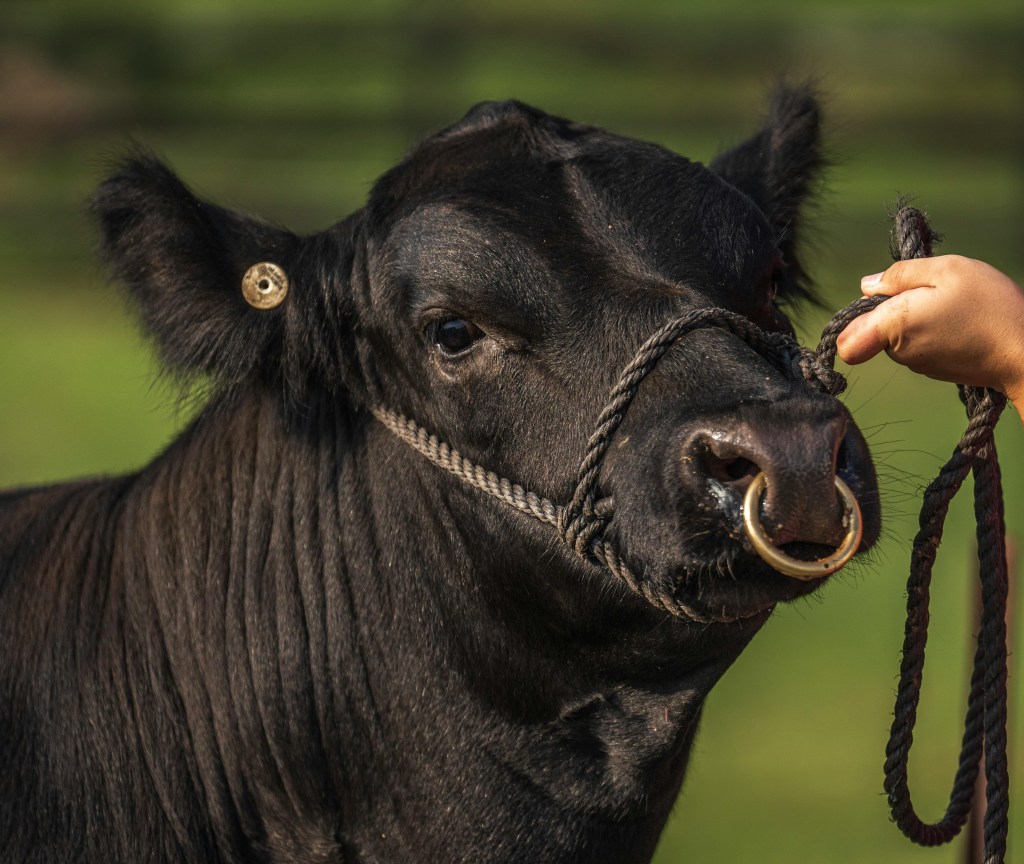
Charlie was waiting at the corral when I pulled into his barnyard. He had the bull in the crowding alley. This was a big bull. It looked like it weighed close to a ton.
“Charlie, I don’t think this guy is going to fit into your chute,” I said as I shook his hand.
“I was thinking the same thing,” Charlie said. “What do you think we should do?”
“Even if we get him into the chute, his neck is too big, we won’t be able to close the head gate,” I said. “If we can get a halter on him, we can do this right there in the alley.”
“He is pretty gentle,” Charlie said. “I think he was probably a show animal in his younger days. Just a moment, I have a big rope halter in the barn. I’ll grab the ring I bought. Maybe you can show how the thing works. I can’t quite figure it out.”
“That will help us put a halter on him,” I said. “But you need to remember, the bull that is considered gentle is the most dangerous.”
“Why do you say that?” Charlie asked.
“They are the ones that you don’t expect to be a problem,” I said. “You let your guard down. You need to respect all bulls as if they can kill you. Sort of like all guns are handled as if they are loaded.”
We slipped the halter on the bull with no problem. Then I pulled his nose up high and tied the halter short, on the strongest post along the alley.
“How do you get this ring in the nose?” Charlie asked.
“You removed this little screw,” I said as I removed the screw and opened the ring on its hinge. “You see, this sharp end is made to just shove through the nasal septum, but I use a surgical trocar to make it easier. That and some lidocaine for local anesthesia.”
“I was wondering if it was going to hurt,” Charlie said.
“The lidocaine stings a bit, but if we did this ring without the anesthesia, we would find out how strong that was,” I said as I drew up a syringe full of lidocaine.
“That looks like a bunch,” Charlie said.
“I don’t want to end up with a broken arm,” I said.
The bull complained a bit when I injected the lidocaine into his nasal septum. But he quieted quickly as it took effect.
“We will give it a minute or two, just to make sure things are good and numb,” I said.
“I hear stories of bulls tearing these rings out,” Charlie said. “Does that really happen?”
“I’ve heard those stories,” I said. “But I have never seen it happen. I grew up around Jersey bulls. They are reputed to be some of the meanest of our bulls. I’m not sure if that’s true or if it was said to make sure the kids get close to them. I did see a couple of bulls become belligerent when I was young. But they could still be handled with that ring in their nose.”
I stuck the bull’s nasal septum with the point of the trocar, and there was no response. With a quick shove, I pushed the sleeved trocar through the septum. Then I pulled the trocar out, leaving the sleeve in place.
At that point, it was a simple chore to fit the open nose ring into the end of the trocar sleeve and retract the sleeve, leaving the nose ring in the nose. I closed the ring and replaced the screw holding it closed.
“There you go,” I said as I untied the halter and pulled it off.
“What about that bleeding?” Charlie asked.
“It will stop shortly,” I said. “All bleeding stops, eventually. Besides, it’s a long way from his heart.”
Charlie smiled, not quite sure whether I was trying to be funny or not. We backed the bull out of the alley so he wouldn’t have to try to fit through the chute. He licked the blood and snorted a bit as he shook his head, not quite sure of his new jewelry.
Photo Credit: Mark Stebnicki on Pexels
Epilogue:
Today I noticed two young ladies, both in their early twenties, with nose rings. It is beyond me to understand why they would do such a thing to themselves.
My guess is they feel it makes them feel more attractive. But to whom, or to what?
When I was a young man, if a guy was under the spell of a young lady, he was often said to be led around by a ring in his nose. That was a metaphor, equating a situation to a bull. There were other terms, some not so nice. Pussy whipped for one.
My grandfather, who grew up in a time when there was no treatment for a dog with Salmon Poisoning, would say that “he was salmoned on her.” The thought of a girl with a ring in her nose did not exist.
It was getting late in the evening when the phone rang. I looked at Sandy and frowned. A call at this hour on a Thursday night could only be an emergency.
“Are you going to answer it?” Sandy asked.
With a bit of reluctance, I got up and walked over to the phone. Not a fast walk, I was hoping it would stop ringing.
“Hello,” I said. “This is Dr. Larsen.”
“That’s pretty formal, talking to your brother,” Gary said. “I know it’s late, but I was just talking with Marty, and they are catching a lot of salmon over in the bay at Empire. We plan to put the boat in the water and fish on Saturday. I just thought you might want to come along.”
“This isn’t going to be like the last time, is it?” I asked. “Like when they were catching fish like mad on Wednesday, but when I got down there on Saturday, there were no fish.”
“The bay is full of fish returning to that commercial hatchery they built a few years ago,” Gary said. “They collected their quota, and the state made them close their gate for a full week. These fish have nowhere to go until they open those gates on Tuesday. There will be a lot of fish, but we should get some.”
“Are you going to have enough room for me to bring a kid to two along?” I asked.
“Yes, Aaron’s busy and the girls aren’t interested, so there is plenty of room,” Gary said.
“Do I need to pick up some eggs, or anything?” I asked.
“They are using Buzz Bombs with a lot of success,” Gary said.
“Never heard of those things,” I said.
“They are new, sort of wobbling lure,” Gary said. “You need to pick up several at a sporting goods store. They come in several sizes, get the biggest ones they have. Everyone is saying pink is the hottest color.”
“Okay, I will talk with you when we get to the folks,” I said. “I am guessing that Derek and Dee will want to fish.”
At noon on Friday, I stopped at DanDee Sales in Sweet Home.
“I’m looking for some large pink Buzz Bombs,” I told the clerk.
“These things are pretty popular right now,” the clerk said. “They are using them in the bays this year. I only have four pink ones left, and they are the large, four-inch ones.”
“I’ll take all four,” I said. “Maybe I should ask what the cost is?”
“They are five and a half dollars each,” the clerk said.
“No wonder my brother wanted me to buy them,” I said. “Twenty-two dollars to maybe catch a fish. I don’t think that pencils out very well.”
Saturday morning came, and it was hard getting Derek and Dee up. They were tired from the 3-hour drive from Sweet Home to Broadbent, and they didn’t have to drive.
We got to Gary’s just as he was finishing loading the boat.
“I see some things never change,” Gary said. “You show up after all the work is done.”
“My passengers slowed me down a bit,” I said. “We were a little late getting out of the clinic. So that put us in to the folks at almost ten.”
We loaded into his old pickup and stopped in Myrtle Point to pick up Marty. It was a cool fall morning, but no rain. It should be a good day of fishing.
Just as Gary had warned, the bay was full of boats, and they all circled the entrance to the commercial hatchery.
We found our spot in the circle and set up to catch a bunch of fish. Gary gave a brief lesson on Buzz Bomb fishing to Dee and Derek.
“Cast this as fast as you can, let it settle to the bottom, then retrieve it in slow jerks,” Gary instructed. “Reel it up six or eight feet, then let it fall. Repeat that until you get it in. The bite will come as this falls back toward the bottom. It has a lot of action as it falls. Do you know how to cast, Derek?”
Derek looked annoyed at that question. He was only ten years old, but he couldn’t remember a time when he didn’t fish.
“Yes, I can cast,” Derek said.
With that, the fishing started. And turn to form, there were no fish today. I watched the other boats. Nobody was catching fish.
Then, all of a sudden, just as Derek was pulling his Buzz Bomb out of the water, this massive salmon was after it, right at the edge of the boat. It looked like Derek just pulled the lure out of the fish’s mouth.
Derek saw the fish also. He instantly cast the Buzz Bomb right back into the water, about fifteen feet from the edge of the boat. The salmon immediately took the lure and dove toward deep water, stripping line off the reel.
Derek was able to hold him up a bit on this initial run, but it was evident that the water was too crowded to land this fish in this lineup of boats.
“Is that a big fish?” Gary asked.
“It’s a big chinook,” Marty said. “I got a good look at it. I think we should lead it out to the middle of the bay, where we will have room to get it in the boat.”
We pulled up the anchors and headed out to open water. Who was leading whom was an open question. This fish was headed out to deeper water, and we followed.
“Keep a tight line,” I reminded Derek. “And take up as much line as you can.”
Derek struggled to keep control of the fish. He was doing well, but tiring some.
“You know, you are going to have to take that pole sometime,” Gary said to me as we maneuvered the boat out to the middle of Coos Bay.
“I’m not taking that pole,” I said. “He is going catch that fish, or lose it, all on his own.”
The fight went on for a good twenty minutes. Finally, the fish was close to the surface, allowing us to get a good look at it.
“This is a big fish,” Marty said to Gary as he got ready with the net. “It’s almost dead in the water.”
With that statement, Derek leaned over the boat to look.
“It’s okay,” Marty said. “Just reel him in a little more, and I’ll get him in the net.”
The fish was played out, Marty scooped him into the net and put him in the bottom of the boat. Derek put his rod down, sat down, and looked at his tired hands. He had outlasted the fish, but not by much.
We fished the rest of the morning, with limited success. Marty managed to catch a nice salmon. It looked small lying beside Derek’s chinook in the fish box.
We stopped at the tackle shop in Coquille on the way and weighed Derek’s fish. It tipped the scales at thirty-five pounds. Pretty good for a ten-year-old kid.
The following week, I bumped into Jim Riggs, the principal at Foster Elementary School.
“Derek came through the front door with a pretty broad smile on Monday,” Jim said. “He had quite a fish story. Lucky kid, I wish I could catch a fish like that.”
“It might prove to be a two-edged sword,” I said. “He will spend a lifetime trying to match something that probably only happens once in a lifetime.”
Some people actually thought that I was the boss. They seldom experienced the quiet, yet solid, push from the front desk regarding the clinic’s functions. Unless they had a collection account. Her domain encompassed all things not related to medicine. And most of the time, things ran like a well-oiled machine.
I had completed an exam on a cat with a bite wound that was brought in by new clients. The young couple was at the counter settling the bill with Sandy.
“We just moved to town,” Steve said. “I’m with the Forest Service. We will be looking for a house, just in case you know of anything available.”
“I don’t know of anything right now, but there are several good real estate offices between here and the Forest Service building,” Sandy said.
“Oh, and what about the app?” Steve asked as he looked at Ruth.
“Yes, I was going to pick up a job application if you have anything available,” Ruth said.
“I’m not sure what the Doctor is thinking right now,” Sandy said. “But we have been swamped. At the very least, we can keep the application on hand. Just a moment, and I will grab one.”
Sandy retrieved the application from the file cabinet in my office and chatted with Ruth a bit as she handed it to her.
“I will get it filled out and drop it off in the morning,” Ruth said as they made their way out the door.
Sandy stood, watching the young couple load the cat carrier into their car and pull out of the parking lot.
“I think we should hire her,” Sandy said as she sat back down.
“You don’t know anything about her,” I said.
“They just moved to town, with a couple of young kids, and he works for the Forest Service,” Sandy said. “I would guess they will be here for a long time.”
“How do you gather all of that in a couple of minutes?” I asked. “You know, they are probably from California.”
“I don’t know, maybe it’s a girl thing,” Sandy said. “I just have a good feeling about her. I think you should hire her. You’re a good teacher. You can teach her everything she needs to do the job. And you worry too much about people from California.”
The following morning, Ruth dropped off her completed employment application. She spent ten or fifteen minutes talking with Sandy before leaving after Sandy told her we would give her a call after I had a chance to review the application.
When I had a brief break, Sandy handed me Ruth’s application
“You might want to review this,” Sandy said as she handed me the application.
“Is there anything in it that might change your mind?” I asked.
“No, it looks fine to me,” Sandy said. “I think we should hire her.”
“Why do you want me to review it then?” I asked. “You don’t think I would be able to overrule you, do you?”
“Then it is okay for me to call her and offer her a job?” Sandy asked.
“I thought you had already made that decision,” I said.
Ruth started work at the beginning of the following week. Initially, Sandy had her working on the front desk. We were in a period of transition in our record-keeping, and things were new to everyone.
Office computers were becoming practical for small offices. However, veterinary software was still out of reach for small-town practices. At the recommendation of a practice management advisor, I had added a computerized cash register, and we had a new Macintosh computer to keep track of client and patient numbers.
“I guess this new stuff is okay,” Sandy said. “But if we are going to have all this stuff in the cash register and on the computer, I want to make sure we keep a paper copy of everything.”
“Do you realize how much extra work that will require?” I asked.
“I don’t care, that is the way it is going to be done,” Sandy said as she turned and walked out of my office.
Of course, for the next thirty years, that is how it was done. There were a couple of times when it proved to be a good practice.
When she started work, Ruth confessed that she had never worked with a computer before.
“Don’t worry,” I said. “The Mac is very intuitive. By the end of the day, you will be an old pro.”
One morning, a few weeks later, I noticed Ruth frantically searching through the computer desktop screen.
“Are you having a problem?” I asked.
“I don’t know what I did,” Ruth said with some tension in her voice. “I can’t find the client list.”
I looked through the computer’s desktop. The client list was gone.
“It’s gone,” I said. “You must have deleted it, somehow.”
“Oh no!” Ruth said. “What are we going to do now?”
“No problem,” I said as I retrieved the backup floppy disc from the drawer. “I back this computer up every night. I will restore the file, then you have to reenter the new files from this morning by using Sandy’s paper copies.”
That proved to be a good lesson for Ruth and for me. I hated to admit that Sandy’s paper backups served a useful role, and I never skipped an evening backup on the computer. Ruth learned to be more careful before clicking random buttons.
“Jim just called from Foster,” Ruth said to Sandy. “He is on his way with his cat. He says she has an abscess that just broke open.”
“Let’s check that file,” Sandy said. “I think Jim is a collection account from when we just started business. In fact, he might have been our first collection.”
Sandy had to go into the back to the old files, but she returned with Jim’s file. It had numerous red ink markings.
About that time, Jim came through the door. He had the cat wrapped in a towel. The towel was smeared with pus and blood.
“This cat needs some help, right away,” Jim said with tears welling up in his eyes.
“We have a little problem to settle first,” Sandy said with little emotion in her voice. “You have an unpaid balance from back in 1976. That has to be paid before services are available for you at this clinic.”
“That’s almost ten years ago,” Jim said. “I thought you were supposed to purge your records after seven years.”
“That might happen in some clinics, but it doesn’t happen here,” Sandy said as she sat down and busied herself straightening up the old file.
“How much do I owe?” Jim asked.
“With the collection fees, the total is one hundred and thirty dollars,” Sandy said. “And that doesn’t include any interest charges. If you pay it today, I’ll waive the interest charges. Otherwise, I will update the file, and you will also owe for the interest.”
“Okay, I have enough to pay the old bill,” Jim said. “Then I can charge today’s bill.
“It doesn’t work that way, Jim,” Sandy said. “The doctor trusted you with a handshake, and you have made no effort to pay this old bill. If you had paid five dollars a month, this would have been resolved years ago. Now, if you want the doctor to take care of your cat’s problem, you have to pay the old bill and the estimate for today in advance.”
“That’s hardly fair,” Jim said, his tears wiped away with the back of his bloodied hand. “All you guys worry about is the money.”
“The next clinic is fifteen miles down the road,” Sandy said. “I would suggest you call before you arrive. We have to pay wages, rent, medication costs, and make enough profit to feed the kids. If we don’t do that, we won’t be able to stay in business to help people who pay their bills. When you don’t pay, you are stealing from every one of our clients, not just from us.”
“I can’t go down the road,” Jim said. “I owe them money, too.
“That is not a surprise,” Sandy said, her voice now tiring of the conversation. “In that case, you had better hurry, Albany is over thirty miles.”
“Okay, I’ll go talk with my wife,” Jim said. “How much do you think I will need? And can I leave the cat here while I talk to her?”
“No, you are not trustworthy enough to leave a sick cat here,” Sandy said. “I can’t say for sure until the doctor writes an estimate, but I would guess you will need two hundred and fifty dollars, at least.”
Jim took his cat and went to speak with his wife.
“What is going to happen to his cat if he doesn’t have the money?” Ruth asked.
“Most abscesses will heal on their own,” Sandy said. “It just takes a lot longer and puts the cat through a lot more pain. He probably can’t go to Albany either. In the last ten years, he has probably had a collection account with every veterinarian in the county. It’s the family names you will learn. Our collection accounts are filled with a dozen family groups. It is a lifestyle, they don’t pay for anything until their back is against the wall. Jim is going to be back in a few minutes with three hundred dollar bills, you watch.”
Sure enough, Sandy and Ruth had no more than finished the conversation when Jim came back through the door.
“Okay, my wife had three hundred dollar bills,” Jim said as he handed Sandy the bills. “If I can leave the cat, I assume he will be ready in the morning, and we can do the receipts when I pick him up.”
“Let’s have the doctor get a look at him first,” Sandy said.
I examined Jim’s cat, Tom. He had an open abscess that just needed to be cleaned up and some antibiotics. His main problem was his set of testicles.
“I can take care of this abscess and send you home with some antibiotics for Tom and some change in your pocket,” I said. “If I do that, you will be back with another abscess before summer comes. Since you are clearing up an old bill, I can make you a deal. I will throw in some brain surgery and vaccinations, and keep the total under the three hundred you put on account. There won’t be much change, but you might be able to buy a beer or two.”
“What do you mean by brain surgery, Doc?” Jim asked.
“If we neuter Tom, it will change the way he looks at the world,” I said. “He is still a young tomcat, so his fighting days will probably be behind him. If we leave those testicles, he is going to continue to be out there fighting with the boys. Tomcats tend to have a lot of infections, and in the end, they don’t live very long.”
“You will do that for me, after I didn’t pay my bill years ago?” Jim asked.
“See how good things happen when you become a responsible pet owner,” I said. “Your neighbors are probably going to be happy when Tom is neutered and quits beating up their cats.”
“Okay, do what you need to do, and I will be back in the morning to pick him up,” Jim said. “And you might want to apologize to the lady out front for me. I gave her a bit of a hard time, trying to get something for nothing.”
“Sandy is a pretty tough girl,” I said. “My bet she gave it right back to you.”
“Yes, she did a good job at that, alright,” Jim said. “I will speak to her when I leave. Thanks, Doc!”
Jim stopped at the front counter as he was leaving.
“Sandy, I’m sorry I was so ornery earlier,” Jim said. “You and the Doc are okay. I’ll be back in the morning.”
Ruth smiled as Jim went out the door.
“My, what a change of character,” Ruth said. “I wonder what brought that on?”
So, Tom went home in the morning with his wound cleaned and an entirely new man. A few days of antibiotics and he was as good as new. Many would say better.
As our computer use in the practice progressed, we continued to maintain a paper backup of all our work. It seemed unnecessary to me, but it was not worth the battle with Sandy. We did shorten the time we maintained the paper backup to about three months.
Ruth remained a valuable employee for many years. She progressed to a licensed veterinary technician before moving to Eugene.


 Memoirs of a Country Vet