The year was 1949. I was four years old. We had just moved onto an old farm outside of Broadbent, Oregon.
That is probably a bit of an overstatement, Broadbent was only a bit more than a wide spot in the road. The farm was 160 acres, run down and in need of a lot of work.
But to my father, I am sure it seemed like an impossible achievement. His childhood had been difficult. His parent separated when he was less than two. He moved with his mother and brothers, first from Bellingham, Washington, to Bandon, Oregon, and then later to Van Nuys, California. His mother left him in an orphanage for three or four years when he was eleven.
When he was sixteen, he hitchhiked back to Oregon and worked in the woods, logging. He returned to high school at twenty-one, and after he married, he attended Oregon State briefly. He made the football team, but those were rough years, and the young couple ran out of money and returned home in Myrtle Point when a pregnancy happened.
This ranch was a dream come true after fifteen years of working for wages and supporting a growing family.
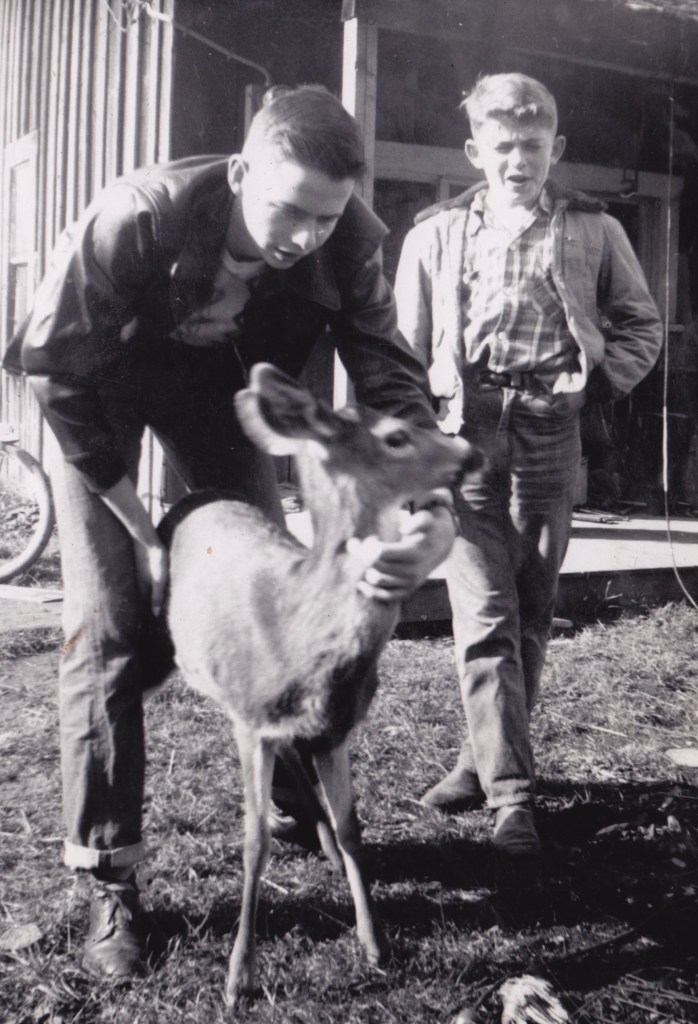
Along with the farm came a tame wild deer. A little buck, tamed by the neighbors, and just sprouting spikes. It was more of a pest than a pet. It followed my older siblings to school, a mile and-a-half walk. He caused a real stir there.
When spring came, and the spikes grew longer, he became a little aggressive. With the bigger kids, that wasn’t too much of a problem. But I was sort of eyeball to eyeball with the guy, and that sort of bothered him.
One sunny weekend, we hosted a family gathering. Aunts, uncles, and cousins came to help with the cleanup chores. After lunch, all the kids headed for the creek. Of course, the deer followed, or led, the group.
We explored the favorite spot on the creek. A six-foot waterfall with a large pool under it. There was a wide rock ledge along one side, making it a great fishing spot. The group spent some time here, and then the larger kids headed down the creek. That left me with the little buck.
It didn’t take long for the little buck to assert his dominance over this little squirt. I think the other kids were still in view. He butted at me first, and when I pushed his head away, he reared up and struck me with his front feet, putting a couple of deep lacerations on my chest and knocking me backwards into the water.
I don’t remember hollering, but I would guess I did. In any case, the older cousins came running and scurried the little buck into the woods. My sister pulled me out of the water, and we went to the house to tend to my wounds.
After that event, the buck fell out of favor. He still tried to hang around the house, but we ran him off as best we could. When fall came, with hunting season and then the rut, he was just gone.
Mom said she didn’t know what happened to him. Knowing now how such critters were thought of in those years, I wouldn’t be surprised to learn that he ended up in our freezer. Especially, since Dad was ready to do him when I was attacked.
That memory definitely stayed with me through the years and helped cement my professional opinion when making recommendations concerning wild pets.
In Oregon, it is a continual problem to have people ‘rescue’ abandoned fawns. Most of the time, the mother left those fawns to hide in the grass when she stepped away. They seldom need to be rescued. Everyone is better off if they are left alone.
Other animals, raccoons, skunks, squirrels, or whatever, fall into the same recommendation. Leave them for nature to take care of. That is also what the law says.
Photo by Dolores Larsen, my cousin, Bill Davenport, and my oldest brother, Larry Larsen.
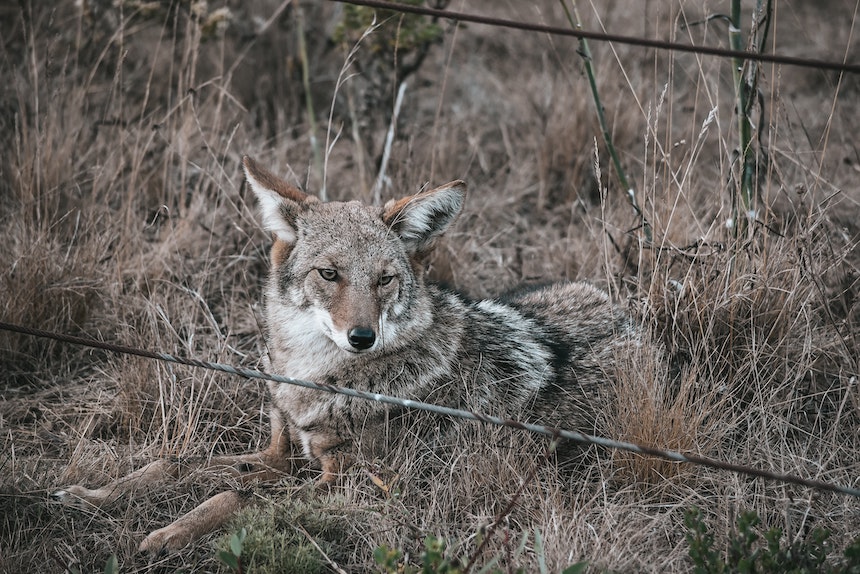
When I was growing up in Coos County one rarely encountered a Coyote, except on the high ridges. We didn’t think much about it at the time. That was just the way it was. I remember the first coyote I saw, on the top of Sugarloaf Mountain, on a cold morning Jeep ride with Uncle Robert.
Twenty years later coyotes had moved into the valleys and were heard regularly and encountered with little effort if hunting them. They had become a significant problem to sheep ranchers, and an occasional brave one would come close enough to the barnyard to snatch a chicken.
My Uncle Duke’s explanation for the change was probably the most accurate. I didn’t have a full understanding at the time but would later come to appreciate his wisdom. In my younger years, 1940s and early 1950s, all the creeks in the area were full of spawning salmon and steelhead in the fall and winter. Dead, spawned out, fish were present on the riverbanks and all the creek banks. Later in the 1950s and 1960s, commercial fishing for salmon moved from the steams to the ocean. Spawning fish numbers decreased and dead fish were only occasionally encountered on most streams.
Duke’s opinion was that when the streams were chuck full of fish the coyotes would have easy access to salmon and would die from the disease. The only viable populations thus existed on the high ridges far removed from the spawning streams.
Salmon Disease (or Poisoning) is a complex disease of all canines. It occurs approximately 7 days after a dog (or coyote) consumes infected raw salmon, trout or steelhead. The fish carry a larva of an intestinal fluke. The fluke causes only mild disease and can infect a number of species, but the fluke also carries a rickettsia. It is this rickettsia that makes all canines ill and is the cause of Salmon Disease.
Salmon Disease is treatable if it is caught in time. Ninety percent of dogs (and coyotes) will die within 7 – 10 of becoming sick if they are not treated. Survivors may be immune for long periods if not for a lifetime although there are exceptions to this immunity.
I was on a farm call, talking with Dick Rice. Dick owned a ranch on the Calapooia River. His ranch was one of the early pioneer ranches in the area.
“Doc, I have been having a heck of a problem with coyotes the last couple of years,” Dick said. “It seems to be the same coyotes most of the time. He has only three toes on one foot. He catches any lamb left out of the barn overnight. Can’t trap him, he is too wise.”
Dick was at his wits end on how to deal with this bandit. I related my Uncle Duke’s opinion on the shift of the coyote population into the Western Valleys. He listened with interest but just seemed to take it in as a story. I finished with the calf we were treating, loaded up and returned to the clinic.
I never gave the conversation much thought after that until I bumped into Dick outside of Thriftway one afternoon. Dick had hurried to catch up to me in the parking lot. It was apparent that he wanted to talk.
“Hi Doc, how have you been?” he said, a little out of breath. “I have wanted to talk to you about that Old Three Toes.”
“Aw, yes, I remember you talking about him,” I replied.
“You know, I got thinking about the story you told about Salmon Poisoning. One night after work, I stopped in here and bought a hunk of salmon tail. I have an old burn pit and garbage pile on the far side of the pasture behind the house. I took that salmon out there and put it on the edge of that pile. It was gone the next morning.”
“And Doc, that was a couple of months ago. I have had no more coyote problems, and Old Three Toes is gone. I have not seen his tracks anywhere. Can’t thank you enough for that story.”
“I’m glad it helped you, Dick. You can thank the observation skills of an old farmer for the information. I am not sure that I would have ever put that information together to come up with that conclusion,” I replied.
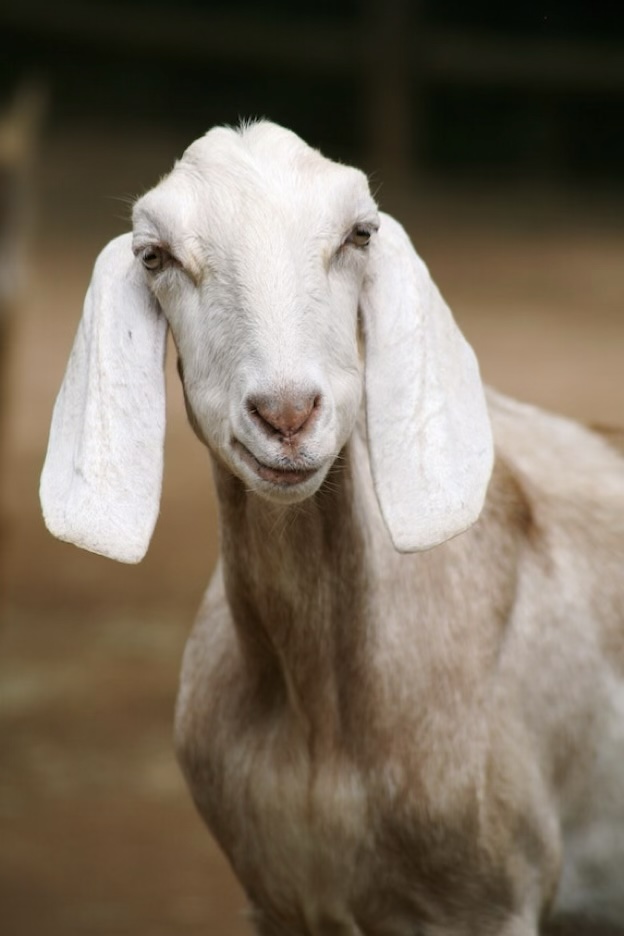
“Dr. Larsen, This is Maude, from Brownsville,” Maude said into the phone. “Cookie, my best milk goat, is about ready to deliver. She is so large that she has been down for two days. Can I bring her up to your place so you can look at her?”
“That’s fine, Maude. You just need to know that we are not in the clinic yet,” I said. “We are still practicing out of our house on Ames Creek.”
“I think I can find it,” Maude said. “It doesn’t bother me, and Cookie is used to an old barn, so a garage won’t be a problem for her.”
When Maude arrived, and we got Cookie unloaded, her appearance was amazing. She had been down for two days because her abdomen was so massive, she could not support it standing. I was worried that she might even have a Hydrops Allantois, but I could easily palpate a couple of very active kids in the uterus.
The only time I had seen Hydrops was while I was in school at Colorado State University, in a cow bred to a Bison bull. In that cow, you could not palpate any fetus. And on C-Section, the calf was dead. Hydrops is common in cows bred to Bison bulls. The Beefalo’s calves come from Bison cows bred to a Bovine bull.
“We have some decisions to make, Maude,” I said. “If we wait for her to deliver, there is a good possibility that she will suffer significant musculoskeletal injury from being down for such a long time. If we do a C-section, we take a chance on the kids being early. That will mean that all of them may not survive.”
“You say, all of them,” Maude said. “How many do you think are in there?”
“I think a bunch,” I said. “I have seen 4 lambs in a ewe, and she was almost this big. There is about a 1 in 10,000 chance, and it might even be higher in the goat. There are at least 3 kids in there. I think there may be 4.”
“I think I am more worried about Cookie than I am about the kids,” Maude said. “It would be nice to get a bunch of kids out of her, but I want you to know that Cookie is the priority in this event.”
“So, I hear you say that you want to do a C-Section,” I said.
“Yes, that is what I want to do,” Maude said. “When can you do it?”
“Maude, I am just getting started here,” I said. “My days are not full. I can do it right now.”
“Good, can I stay and watch?” Maude asked.
“You are more than welcome to watch,” I said. “In fact, you might be put to work if we have four kids in there. I see you have a couple of bales of straw in the back of your pickup. Is there a chance we could use one of those to bed her down? She would be more comfortable than on the bare concrete.”
“That is what I brought them for,” Maude said. “Let me pull them out of the truck.”
We used one of the straw bales to bed Cookie down in the back of the garage while we set up for surgery. Sandy sets some chairs out for Maude and her driver.
“Once we get set up, things will go pretty fast,” I explained to Maude. “I will roll her up on her back, and we will clip and prep an area in front of her udder. I will make an incision, then we will start pulling kids out as fast as I can. If there are 4 of them, everybody will have a kid to take care of as I close up things for Cookie.”
“I have never seen anything like this before,” Maude said. “I guess I will be okay. At least if there are kids to care for, I will have something to do.”
Paula had everything ready, so we rolled Cooked up on her back. Again, I was amazed at the size of her belly. It spread out in both directions.
“I don’t think she could roll off her back if she tried,” I said to Paula. “You better tell Sandy to get every spare towel she can find. We are going to spell all sorts of fluid out of this uterus.”
With the abdomen clipped and prepped, I made the incision on the ventral midline in front of the udder. My kids watched from the kitchen doorway, and Maude sort of stretched her neck to see better.
“I thought there would be more blood,” Maude said.
“As long as I can avoid these large milk veins coming from the udder, there should be very little blood,” I said.
I extended the incision through the linea alba, pulled the omentum forward so it was out of the way. Then I reached in to grab the head of the first kid I encountered. I drew this head through the abdomen incision and incised the uterus carefully.
The kid’s head popped out of the incision and shook. I think she was ready to be out of there. Grabbing her neck, I pulled her the rest of the way through the incision. There was a rush of fluid that came with her. I handed her back to Maude. Maude was waiting with a towel.
“This kid is the same size as a single,” Maude said.
“No wonder she is as big as a house,” I said as I reached in and grabbed the second kid by the head also.
This kid came out fighting also. And like her sister, she was the size of a single.
“Two girls so far,” I said. “In a couple of years, you’re going to have so much milk you won’t know what to do with it.”
I reached in and grabbed a couple of hind legs in the far uterine horn. I tugged, and they did not move a lot. I felt close. I had one leg from two different kids. Correcting my error, I pulled the third girl out by her hind legs.
“Maude, there is another one in there,” I said. “And this one is another girl.”
Sandy stepped up, with the help of our girls, to take this kid. Maude had the first kid standing already. Everybody was busy now, and there were smiles all around. Nothing like baby goats to make people happy.
I reached in and pulled out the last kid, another girl.
“This probably sets some sort of a record. Quadruplets, and all females,” I said as I handed the last kid to Paula.
I started pulling as much of the fetal membranes out through the incision as I could. There is no way to take them all out without damaging the uterus. But I would pull out a bunch and cut them off with scissors. We had all the towels and straw soaked with uterine fluids.
“This is probably going to take as long to clean up this mess as it took for the surgery,” I said, more to myself than to anybody else.
I closed the single incision in the uterus. It was about a six-inch incision. It was sort of amazing that you could drag four kids through that incision. After returning the uterus to a normal position, I closed the Linea Alba with a sliding mattress suture using #2 Dexon. The external incision was closed in a conventional two-layer manner.
“Cookie, you are going to have a flabby belly for a time,” I said as we rolled her off her back and made her comfortable on a clean spot in the straw. She wanted the kids, so Maude started handing them over to her one at a time. It didn’t seem to bother her at all to have all four of them to care for.
“What do you think we should do with her now, Doc,” Maude asked.
“I think we should milk her out and get some colostrum into the kids,” I said. “It is early enough that leaving the kids with her for the day will probably be the best. I will give her some IV Glucose and Calcium just to give her a little more energy. I am guessing that she isn’t going to be up until morning. I would like like to keep her until then. I don’t know if I can handle the 4 kids running around the house.”
“I will go home for the day,” Maude said. “I have a lot of chores waiting. I will get back here around 5:00 this afternoon if that is okay. I will take the kids home. That is not a big thing. I have plenty of colostrum in the freezer, and I don’t leave the kids with my milkers anyway.”
“That will work fine,” I said. “Then, we will just see what morning gives us with Cookie.”
Cookie was up and looking for both food and a milker when I checked her early the following day. Luckily, Maude pulled into the driveway about when I was heading into the house to give her a call.
“I guessed that Cookie would be up and ready to be milked,” Maude said. “I figured you would appreciate getting her out of here early.
“I think she will be ready for the milking stand by the time you get home with her,” I said. “She should be good to go. I see she passed her membranes last night. Just keep an eye on her, and I will drop by to just glance at that incision in a couple of days. I generally leave those sutures in place for about 3 weeks, just to be safe.”
Cookie healed with no problems, and the kids became a great addition to Maude’s milking string.