The Powers That Be

 D. E. Larsen, DVM

I always hated looking at a group of cattle for someone I did not know. They often wanted you to look over the fence and give them a diagnosis rather than running them through a chute for an individual diagnosis.

Just looking over the fence for the diagnosis was risky in the best situations. But with herds that I worked with on a regular basis, I would occasionally provide that service for simple things.

I mulled over the situation as I was driving to a herd of heifers that had recently arrived from Montana, and one heifer had aborted. The possibilities were endless, all the way from travel stress and trauma to infectious disease.

I was relieved when I pulled up to the corral, and there was a heifer in the chute.

George met me when I stepped out of the truck. We shook hands. I had heard of George, but this was our first meeting. He was professional, with a practice in Eugene. He had a small ranch here in Brownsville and ran a small herd of cattle, probably as an investment. More for land speculation than making money from cattle. But most of these guys had all the answers before they asked the questions.

“This truckload of heifers came in last night from Montana,” George said. “This heifer aborted during the night. I just thought we should do some diagnostics on her. I mean, I don’t want something that will go through the entire bunch.”

“What do you know about the place they came from?” I asked.

“I guess I don’t know much,” George said. “The whole deal was done over the phone. I do know a guy who knows the guy who owned the heifers.”

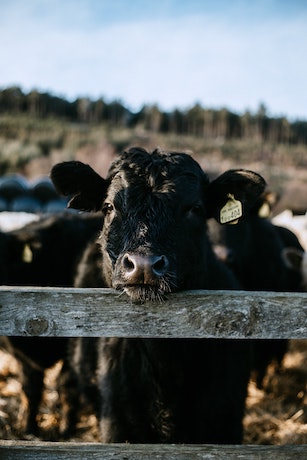
I glanced at the heifer in the chute. She had ear tags, like the rest of the group, and she had a brucellosis tag. She also had membranes hanging from her vulva.

“Let me look at their health certificate,” I said.

“We didn’t do a health certificate,” George said. “The guy said he ships cattle into Oregon all the time without a certificate.”

“Do you have a brand inspection?” I asked.

“No brand inspection either,” George said.

“George, how do you know these heifers were not rustled?” I asked.

George was quiet after that question. I don’t think the possibility had entered his mind.

“The guy sounded honest, and he has a ranch,” George said.

“You might want to think about the ownership thing,” I said. “I am sure that Montana considers a brand inspection a big deal. Here in the valley, it is a pain in the butt because we don’t have any range animals. I am not sure what Oregon will say about no health certificate and no permit.”

“The state shouldn’t know anything about it,” George said.

“If you want some testing done, I will send samples to Oregon State Diagnostic Lab,” I said. “Several abortion diseases are reportable. Once I send the samples, it is completely out of my control. I will probably be a little at risk if I don’t quarantine this entire group. But if you can assure me they are not going anywhere, I will wait until we get lab results.”

“I would be pissed at a quarantine,” George said.

“Then you should be following the rules,” I said. “If you just received the shipment, you are probably not at fault. The shipper would be the one in violation.”

“Would they do anything with the cattle?” George asked.

“They should, but I doubt they would do anything,” I said. “The state veterinarian doesn’t have any police powers. So if it was considered a problem, he would have to go through the sheriff. I doubt that would happen unless there was a major outbreak. The rules are set up to protect all the producers in the area. If someone imports a disease into the area, everyone here could suffer. If it was bad enough, the entire state could suffer.”

“It sounds like some significant liability could be involved,” George said. 

“With the travel history and stress involved, this abortion is probably just the luck of the draw,” I said. “Let me get some samples, and I will get them sent to the lab, and we will worry about things when we have something to worry about.”

I did a clinical exam of the heifer and collected blood and urine samples. I also removed some of the membranes from the uterus and collected a sample of histopath exam.

“Do you want all her tag numbers?” George asked.

“No, I will just use her bangle tag,” I said. “She is too young to be eligible for a brucellosis test, so I don’t need that number.”

“When will you have results?” George asked.

“I will have a currier pick up these samples when I get back to the office,” I said. “We could have some blood and urine results by late afternoon. The histopath on the placenta will take several days. To be honest with you, we seldom end up with a diagnosis on most abortions like this.”

“So, I will just wait for your call,” George said. “Do I need to do anything with this heifer?”

“I am going to give her some long-acting antibiotics and put a couple of boluses into her uterus,” I said. “Other than that, I don’t think you need to do anything with her.”

Once I got back to the clinic, it didn’t take long to package the samples and send them to the lab.

It was about four-thirty when Dr. Johns, the pathologist, called. Dr. Johns was new to the lab and fresh out of school.

“I ran the serology you requested on that heifer from Montana,” Dr. Johns said. Everything was negative, so I went ahead and ran a brucellosis titer. I showed a pretty strong positive.”

“That heifer was too young to be test eligible,” I said.

“Well, with this high titer, I have already contacted the state veterinarian,” Dr. Johns said. “It will be a few days before I get to the histopath.”

***

I had just hung up the phone after talking with Dr. Johns about the histopath results on the placenta. He had found nothing. So the diagnosis was negative except for the brucellosis titer.

Sandy brought Dr. Wilson back to talk with me. He was the field veterinarian from the state veterinarian’s office.

“I just finished looking at that heifer that aborted out in Brownsville,” Dr. Wilson said. “Why didn’t you submit the brucellosis tag and tattoo information on the test sheet?” 

“That heifer was not test eligible,” I said. “Dr. Johns did that test without a request from me. I send all my brucellosis tests to your lab in Salem.”

“Well, it turns out that the heifer was vaccinated late, she was over a year of age at vaccination, and she is still under two years of age, so she was not test eligible,” Dr. Wilson said. “That test should have never been done.”

“I sort of think that pretty much matches what I just said,” I said. 

“That is a serious oversight on your part,” Dr. Wilson said.

“Now, just a damn minute here,” I said. “I spent four years in the Army and watched how the powers that be found the easiest underling to punish for any problem that developed. Let’s review this situation. A truckload of heifers come from Montana without a health certificate and without a brand inspection certificate. I send some blood samples to the lab on a heifer who is not eligible for a brucellosis test. Still, the lab runs a brucellosis test without my request. Then you come in here and chew my ass.”

Dr. Wilson was silent for a couple of minutes. I waited for his response.

“I see your point,” Dr. Wilson said finally. “I guess your actions were not out of line.”

“I guess when a client calls and asks about a health certificate, I should tell him not to worry about it because the state office doesn’t worry about it,” I said.

“Now that’s not the case,” Dr. Wilson said.

“My point is, if you are not going enforce your rules, throw your damn book in the trash,” I said. “This BS of putting everyone through the trouble and expense of following your rules and then just shrugging your shoulders when someone ignores them is a bunch of crap.”

“What would you have me do?” Dr. Wilson asked.

“I not asking you to do anything,” I said. “l especially don’t want you to do anything to my client. He was almost a bystander. But the guy in Montana should be looked at a bit. I guess I’m just asking you to put down your coffee cup and do your damn job.”

Dr. Wilson left, I think, in a bit of a huff. Public employees always think they are overworked. But I am sure his phone hasn’t rang at three in the morning anytime in the recent past.

Photo by Sinitta Leunen on Pexels.

Look Her in the Eye 

D. E. Larsen, DVM

I pulled up the swinging gate at McCubbins’ Ranch. Frank maintained a wide range of species on this ranch, elk, sika deer, fallow deer, llamas, African antelope, wallabies, and rheas. I enjoyed making calls here. But I hated this gate.

It swung open on each side, pivoting on a center post. It was a heavy wooden gate with a large rubber bumper on it. You hit the bumper, and the gate would swing open. Briefly! Once it swung open, you had to gun the truck through the gate, or it would nail you on the side of the truck as it returned to the closed position.

I looked at Hope. “I hate this gate,” I said. “Hang on!”

I bumped the truck into the bumper on the gate. The heavy gate swung open. I gunned the truck through the gate, snapping Hope’s head against the headrest. The gate closed behind us.

“Wow!” Hope said. “I see what you mean about that gate.”

This was Hope’s first visit to Glacier Springs Ranch. She was a little excited to be doing something out of the ordinary if veterinary practice offered anything normal.

We drove up the long driveway and stopped at the barn.

“We are looking at an older llama today,” I said. “They are usually pretty easy to work with, but this gal has something going on in her mouth. So this might prove interesting. We will have to play it by ear on what we need to restrain her.”

The llama was in the corral, but Frank wasn’t in sight. I got my stuff lined up, trying to anticipate what might be needed to examine and treat this llama.

“These are valuable animals right now,” I said to Hope. “This is an older female, but she is still worth over twenty-thousand dollars.”

“Why are they so valuable?” Hope asked. “What are they good for?”

“There is no viable market for them except for the excess males,” I said. “The males are popular for wilderness pack animals, but that value is only seven or eight hundred dollars. The rest is people buying them for an investment. There is no meat market at all. They can sell their wool, but that is not much, either. It is all a pie-in-the-sky market and doomed to fail someday. Frank has always been trying to get me to buy a female. He says all you have to do is get on a female baby, and you have your investment returned. I just can’t see getting into such a market.”

Frank finally came out of the house and walked over to the corral.

“Sorry to keep you waiting,” Frank said. “I was stuck on the phone with one of those people who can never bring a conversation to an end.”

“That’s okay,” I said. “We have plenty of time. What’s going on with this old gal?”

“You’re right there,” Frank said. “Angel is an old gal, one of my oldest. I don’t have a birthdate for her, but she is over twenty. She is still producing babies, though. That’s what they say about llamas. They die pregnant. So, with today’s market and figuring on a female baby every other year, I can expect to make over ten thousand a year off her. Old but still working. I had one die a couple of years ago. She was twenty-eight and pregnant.”

“I notice her drooling a bit,” I said.

“That’s why I called,” Frank said. “She is having some problems eating, and I think she is losing some weight. I’m not sure how we will get a good look at her. Do you want to try putting her in the chute?”

“I think if we just tie her here and you and Hope sort of restrain her between you will be the best,” I said. “One of you will need to grab an ear, and I will have room to get a good look into this mouth.”

It actually turned out easier than I expected. Angel pulled straight back on the rope when I started grabbing for her tongue. With Frank holding one ear to steady her head, she pretty much restrained herself.

I had to pull some hay and cud out of her mouth to get a good view. I pulled her tongue to the left side of her mouth and shined my penlight into her mouth. 

There was the problem. She had lost an upper molar, and the opposing lower molar was overgrowing. It was a classic step-mouth. I released her tongue and let everyone relax.

“Frank, she has lost an upper tooth in the back of her mouth,” I said. “The lower tooth that wears against that tooth has sort of overgrown. I will need to file it down.”

“Can you just pull it out of there,” Frank asked. 

“I don’t think that is an option for me,” I said. “That is probably the best option, but that is only available at a teaching hospital right now. That would mean a trip to Davis to the University of California Veterinary Hospital.”

“Maybe if she was a little younger,” Frank said. “Do you think you can file it down?”

“I think so. I have a small float that should work for her,” I said. “It won’t take too long, and she is being pretty good.”

After retrieving the float, a rod with a sharp rasp on the end, I started working on the tooth. Things went faster than I expected. Angel shook her head, but Frank’s grip on her ear held her pretty steady. She struck at me a couple of times but missed her mark. When I had the tooth filed down to the level of the other teeth, I smoothed the points on the rest of the teeth.

“There, I think Angel will be back to eating pretty normally now,” I said. “We should probably plan to recheck her in about six months. I don’t know if we will have to do anything then, but we should check.”

“Maybe, I will just wait and see if she gets into a problem again,” Frank said.

“She looks furious,” Hope said. “Her ears are back. Maybe we should let her go.”

“Just look her in the eye,” I said. “That will settle her down.”

Hope started to look her in the eye.

“No! Don’t do that, Hope,” Frank said. “Doc was teasing. If you look these llamas in the eye, they will surely spit on you.”

We turned Angel loose after removing her halter, and she went straight to the feed rack.

“Thanks a lot, Doc,” Hope said. “Frank saved me, I think.”

“I would have stopped her before she nailed you,” I said. “That is just something to know about these critters.”

I never looked at Angel again. I assumed that her mouth never got to be a problem again. Either that, or she didn’t live as long as Frank expected.

Photo be Mike van Schoonderwalt on Pexels.

My Calf Needs a Little Repair, From the Archives

D. E. Larsen, DVM

“Doc, I think I have a calf that needs a little repair,” Larry said into the phone.

“What is the problem Larry,” I asked?

“One of the hind legs is not working quite right. I think it is broken. The cow was having a problem getting it out. She got out into the oak grove up here and was twisting around and slammed it into one of those big oak trees. Is that fixable?”

“That depends, Larry. Where is the break located?”

“I think it is the thigh bone,” Larry said.

“Tell me about this calf, Larry. Sometimes the best medical decision is not necessarily the best financial decision.”

“He is a nice looking bull calf, a half Simmental, but just a market animal,” Larry said.

“The thigh bone is not very amendable to a splint like we used on the front leg of that heifer of yours a couple of years ago. That leaves a surgical repair. My guess is the Vet School in Corvallis would love to repair it, but you will have to sell him and several of his friends to cover the expense.”

“Do you think you could fix him,” Larry asked?

“Well, bring him down to the clinic, and I will get a look at him. If we cut a few corners and get lucky, I might be able to fix him. I need to know if this kind of a repair is a viable option at this clinic anyway. At least we can try. I could maybe split the profits with you.”

The calf was a healthy newborn that was over 100 pounds. He was a bit of a handful, but with several sets of hands, we could get him under anesthesia with a mask.

After he was under anesthesia, I could do a good exam. His left femur had a mid-shaft fracture.

“Larry, this feels like a clean break, but without taking x-rays, it will depend on what we find in there. I am planning to place a couple of pins in this bone, and if we are lucky, this guy will walk out of here.”

“Do your best. That is all I can expect,” Larry said. 

“Plan on picking him up a little after noon, this surgery won’t take long, and he will recover pretty quickly,” I said.

We prepped the leg and draped it for surgery. I made a lateral approach to the femur with no problem. 

“I am planning to use both of those large quarter inch intramedullary pins,” I explained to Ruth.

“Wow! Why two pins,” she asked?

“This guy isn’t going to lay around for a few weeks. He is going to be up following Mom and gaining weight daily. We will try to get Larry to keep her in the barn for the first few days, but that is a bit of a two-edged sword. It will reduce his activity, but the incision will be kept cleaner out in the pasture. This repair has to be strong enough to support that activity. By stacking two pins side by side, we provide enough strength to hold the weight, and they will control any rotation at the fracture site.”

Once exposed, the fracture was a simple transverse fracture with no splintering of the bone. I placed both IM pins retrograde in the upper fragment, pushing them out through the top of the bone at the hip.

With the two pins in position and ready to be pushed into the distal fragment, I brought the fractured ends together and drove the first pin into place. When I finished seating the second pin, I was pleasantly surprised at how stable the fracture site was when I manipulated the leg.

“I think this is going to work pretty well,” I said to Ruth. “Now I just need to close this up and wake this guy up.”

The closure went well, and we recovered the calf in the large dog kennel.

“He is going be a lot bigger when we take those pins out in six weeks,” Ruth said.

“My guess is there is not going to be any taking those pins out. This guy will grow so much, those pins will be buried in the bone. That is probably a good thing because anesthesia is a much bigger problem in an older calf than in a newborn.”

“Why is that,” Ruth asked?

“In six weeks, this guy will have a rumen that is starting to function.  He will have to be starved out for 24 or 48 hours before anesthesia. Then we will need to use an endotracheal tube rather than just a mask. Not to speak of the fact that he will be much larger and harder to get on that table.”

The calf was on his feet when Larry returned to pick him up. 

“He looks pretty good, Doc. Better than I expected,” Larry said.

“If we can keep him restricted for a few days, that would be ideal. But if he can’t be in a clean stall, a small pasture would be better.”

“Yea, I think I can put him and his Mom in the small orchard behind the house for a time. That way, I can watch him better, and they won’t have to deal with the rest of the calves.”

“The other thing, Larry, those pins we put in this bone are going to stay there. When it comes time to slaughter this guy, you need to remember to tell the butcher that those pins are there. Otherwise, he is going to be pretty pissed when he runs his ban saw into them.”

The calf did exceptionally well. I stopped by a couple weeks later and took the sutures out, and you couldn’t tell anything had happened to the leg except for the incision. 

“I think you can turn them out with the herd and treat him like any other calf,” I said. 

The calf grew normally and became a fine market steer. He was close to 1100 pounds when he went to slaughter. And Larry brought the femur in to show me. The butcher had boned it out and carefully cut around it in the middle to expose the pins. Larry probably still has that bone and pins.

Photos by Larry Coulter