The Shadow Knows

D.E. Larsen, DVM

I first met Dr. Al on a hillside up 50th Ave on the East side of Sweet Home. I was in the middle of doing a C-Section on a 15-month-old heifer who was stretched out on the ground. Dr. Al was visiting at a neighbor’s house and came out to watch. I think he was surprised at the surgery in the middle of a pasture.

“How does a little heifer like this get pregnant in the first place?” Al asked.

“If they cycle and are not separated from the bulls, the system is made to work,” I answered. “I have done this on heifers under 14 months of age.”

About now, I had entered the abdomen through an incision on the left flank. The inside of the abdomen of a cow is always sort of a mystery to MDs. Al looked on with interest as I pushed the rumen aside a brought the uterus up the incision.

“That looks pretty simple,” He said.

“All surgery is pretty simple as long as everything goes well,” I replied.

I incised the uterus and had both hind feet sticking out of the incision. I secured the feet with an OB strap and handed the strap to the owner standing behind me.

“Pull straight up and then let him down to the ground easily,” I instructed as I guided the calf out through the uterine incision.

The calf hit the ground, raised his head, and shook fluid out of his nose.

“He is going to be up before mom,” I said.

“Now, how do you close all of that?” Al asked.

“It won’t take long,” I said. “I use a single layer on the uterus with number 2 Dexon in a pattern developed by Utrecht University in the Netherlands. It closes the incision securely and does not leave any of the suture material exposed to the abdomen. That way, there is little chance for adhesions to form and less loss in future fertility. The rest is just routine abdominal closure.”

“You won’t have any infection problems?” Al asked. “I mean, you’re out here in the pasture, with only gloves on, instrument pack opened on the ground. In people, we would have a mess.”

“I never, knock on wood, have an incision infection on a C-Section,” I said. “Maybe your hospitals are the problem.”

“Ha, that might be,” Al said. “Thanks for letting me watch. It was fascinating.”

Following that meeting, Al’s family became regular clients. They had a Great Dane. Al always enjoyed sharing similarities in our professions and the differences. I think he envied the lack of regulatory restrictions I enjoyed. He often spoke of early days in practice in Colorado and how he enjoyed making house calls and having close relationships with his patients.

Great Danes never seem to live very long, and it wasn’t very long until they were in with their Dane with an enlarged breast. It had developed very rapidly, and chest x-rays showed tumors in the lungs and in the vertebra already. There was nothing we could do at the time except to provide comfort care for a short time.

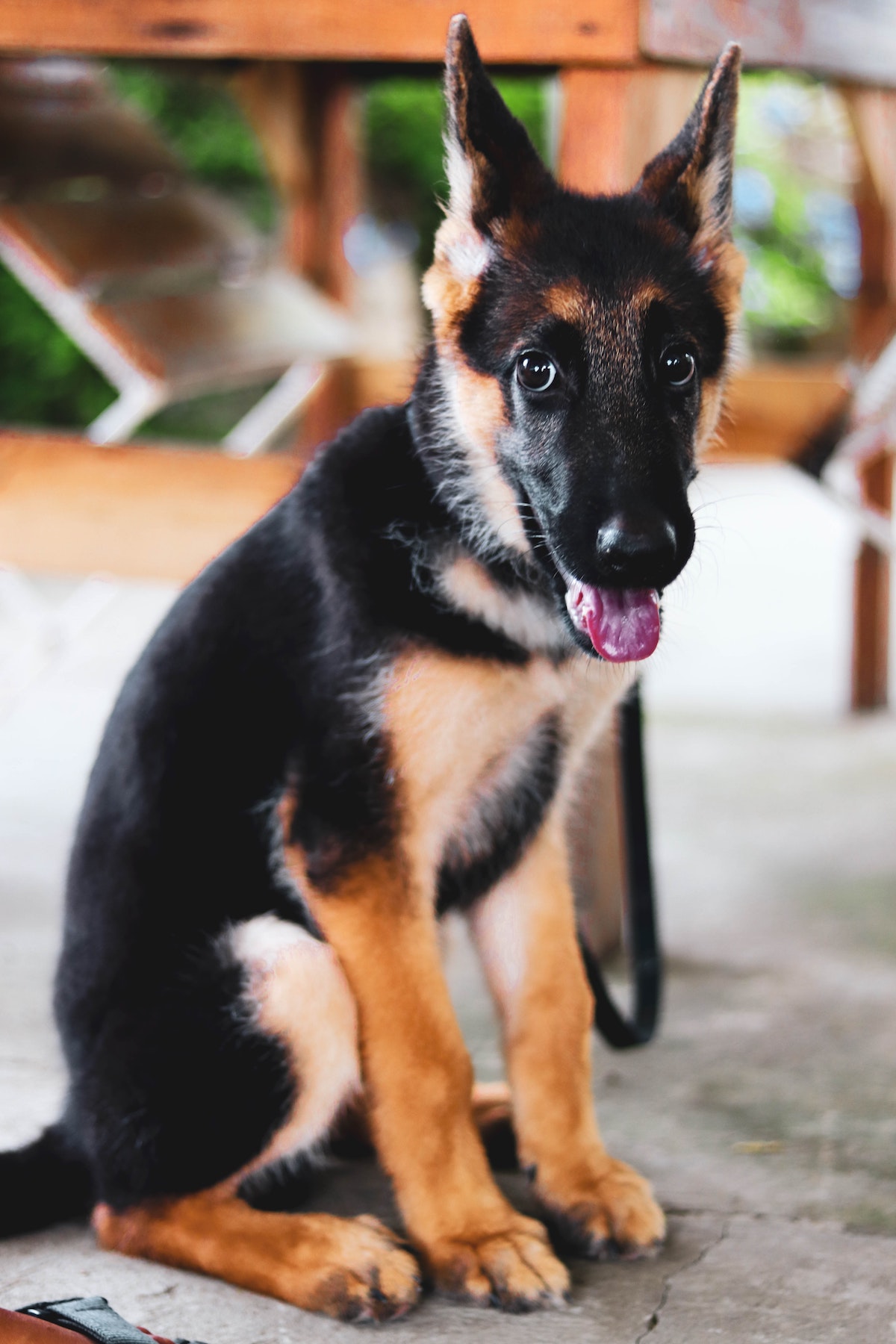
It was not long after the loss of their Dane that Al’s wife Jane and a daughter brought in a new German Shepherd pup. They were going to try a new breed. German Shepherds were a breed that I was always cautious about. There are many super dogs, but there seemed to be an increasing number of screwballs.

“We have always had Great Danes, but they never seem to live very long,” Jane said. “A friend has a German Shepherd that seems to be a great dog. So anyway, here we are.”

“He is a pretty good looking pup and well behaved already,” I said. “What are you going to call him?”

“We haven’t made the decision just yet,” Jane said. “Al wants to call him Rudy, the girls and I are thinking Shadow is a better name.”

“We will write Shadow on the record,” I said. “That is how it usually works out.”

I lifted Shadow up on the exam table. For a young German Shepherd, he looked good. Both ears are erect, teeth are good, and he is responsive to the people around him. Ruth hands Shadow a tennis ball to chew on as I start with his exam.

I start at the nose and work toward the tail.

“Everything looks good,” I tell Jane as I put my stethoscope to my ears.

The lung sounds are healthy, and the heart sounds strong. I almost put my stethoscope down and then remembered to check the left anterior thorax, which I always try to remember on young pups.

My expression immediately changes. Jane, who worked alongside Al for many of his early practice years, instantly recognizes the concern on my face.

“What is it?” she asks.

“There is a machinery murmur in the left anterior thorax,” I said. “That almost always means there is a PDA, a patent ductus arteriosus. That is a vessel between the aorta and the pulmonary artery that normally closes at birth. In Shadow’s case, it did not close.”

“Does it need to be fixed, or can he live with it?” Jane asked.

“He can live with it for a short time, but when he starts his rapid growth phase around 4 – 5 months, it will become life-threatening,” I explain. “Virtually all of these dogs will die before they reach adult size. Some small breeds might live longer, but not the large breeds.”

“How do we fix it?” Jane asked.

“Right now, in the dog, the fix is a surgical one,” I said. “They go into the chest and ligate the vessel.”

“You say they, does that mean you don’t do that surgery?” Jane asked.

“I have never done one, but I could probably do it,” I said. “We do have a cardiologist in Portland. He would be a better choice.”

“I don’t think Al is going to be up to sending a new puppy to a specialist for surgery,” Jane said.

“Will, we don’t have to make the decision right now,” I said. “You have Al listen to this heart and give me a call this evening. We can go from there.”

It was after dinner when Al called.

“I’m not sure I hear what you heard today,” he said.

“Put your stethoscope on the left side of the chest and move it way to the front of the chest, almost under his elbow,” I instructed.

There was a pause on the phone.

“Dang, do you think that is a PDA?” Al asked.

“It is a PDA or a large defect in the ventricular septum,” I said. “In veterinary medicine at this time, a PDA can be fixed. A septal defect cannot.”

“We are not going to Portland with this pup,” Al said with a finality in his voice. “Can you do this surgery?”

“I can do the thoracotomy,” I said. “But ligating the PDA, I have never done, but it should be something that I can do. The important thing for you to remember, this is a veterinary clinic. I am the only veterinarian. If I make a mistake, if I were to tear the ductus or puncture a vessel, the ball game is over.”

“I have watched you in surgery, I don’t think you will have any problems,” Al said. “You go ahead and get set up and schedule it, we will have him there.”

Jane had Shadow in the clinic at 8:00 AM sharp on his surgery day. She was obviously worried and understood the gravity of the undertaking. She patted Shadow on the head as the girls took him into the exam room, then she shook my hand as she wiped a tear from her eye.

“We are hoping for the best,” she said.

“I think we can do this with little problem, I will call you when he is recovered,” I said.

We completed Shadow’s exam and had him under anesthesia in short order. We clipped the entire left side of his chest, laid him on the surgery table on his right side with a towel roll under his chest to facilitate spreading his ribs.

When he was prepped and draped, I made a curved incision between his 4th and 5th ribs. I continued this incision down to his intercostal muscles. Then I carefully divided these muscles and opened the chest.

My surgical philosophy was to work fast. I had sure hands and utter self-confidence, in the environment of a veterinary clinic surgery room, the longer an incision was open, the better the chance of having an infection.

We had Shadow hooked up to a ventilator with his chest open. We paused the ventilator and moved his anterior lung lobe out of the way and packed it off with a moist lap sponge. I could put my finger on the PDA, the mechanical murmur shook the whole heart. I isolated the vagus nerve and pulled it out of the way with a loop of umbilical tape.

Now I was at the most critical point. I had to bluntly dissect a pathway around the PDA so I could place the ligatures. This dissection, especially on the deep side of the short vessel, could result in a catastrophic tear in the vessel that would most likely lead to a fatal hemorrhage.

I took a deep breath and began the dissection. My inexperience made me a little more aggressive with the dissection than a surgeon who had seen a vessel rupture. It only took me a couple of minutes, and I could grasp the middle of a length of 0 silk and pull it through the open pathway around the vessel. 

I divided the silk into two ligatures.  Then I slowly tightened the ligature closest to the aorta.  I moved to the ligature on the pulmonary artery side. I slowly tightened this ligature. Then I took another deep breath.

I returned the vagus nerve to normal position and placed a couple of sutures to close the soft tissues in the area. I removed the packing from the lung lobe and allowed the ventilator to expand this lung lobe. I placed a ten french chest tube with a 3-way stopcock on the outside of the chest. 

I did a nerve block on the intercostal nerves to help control pain and closed the ribs with 4 sutures placed around the 4th and 5th ribs. After insuring an airtight closure of the chest wall, the remaining closure was routine.

After putting a light wrap on his chest, we moved Shadow to a kennel to recover, and I began to relax. Looking at the clock, surgery was less than 50 minutes. I listened to Shadow’s chest. Nothing but good heart sounds. This guy should have a long and healthy life.

“Surgery went well, we were done in less than an hour,” I told Jane.

“Oh, thank you!” she said. “I was so worried.”

“We will keep him overnight, just to make sure everything is okay. But if I can pull his chest tube in the morning, he can go home.”

Shadow went home in the morning. After his hair grew back, nobody ever knew he had had a problem. 

Some years following Shadow’s surgery, one of Al’s daughters called. She had a friend in Bend, Oregon, who had a dog with a PDA. Her friend was being referred to Portland for surgery and could not afford the fee. They were hoping I would do the surgery.

I declined. Working with an established client, who I had a good relationship, I could feel confident they understood the risks. It would be far different from someone I did not know. They would likely have a whole different set of expectations.

The last time I saw Shadow, it was almost twelve years to the day following the surgery. Like a lot of his breed, old age was not kind to his body. He was crippled with arthritis in his back and hips. His life had become a struggle. You never heard him complain, but his efforts to get up and down had become unbearable for Jane. Al had died a couple years before, and the girls had moved on with their lives.  

Shadow’s last trip to the clinic with Jane saw tears in her eyes as they were on the first trip. The clinic where we had years before given him an opportunity for a full life was where we gave him a silent and humane end to that life. Putting Shadow to sleep was one of the most challenging things I have had to do. May he rest in peace.

Photo Credit:https://www.pexels.com/@carl-adrian-barcelo-1978030

The Stone’s Story

D. E. Larsen, DVM

Raymond came through the door with little Sophie cradled in the crook of his arm. Sophie was a really small Chihuahua, and Raymond, her owner, was a large man. It was one of the things that I always found a little odd. Some of the largest men were attached to these tiny dogs.

After he stretched a towel out on the exam table, Raymond placed Sophie in the middle of the towel. Sophie, at four and a half pounds, was overweight. Her spindly legs looked undersized for her round body.

“She has blood in her urine, Doc,” Raymond said. “And she pees a little puddle every 5 or 10 minutes. The wife is getting upset with all the cleaning up after her.”

I looked at Sophie, her gray muzzle told she was past middle age. She should probably weigh two and a half pounds, not four and a half. Her membranes were normal, with normal capillary refill time. Heavy tartar on her teeth and some chronic periodontal disease suggested that she was a good candidate for a heart murmur. That was confirmed when I placed the stethoscope on her chest.

Chronic periodontal disease leaks bacteria into the bloodstream. These circulating bacteria take up residence on the heart valves, in the kidneys, and the liver. Poor dental hygiene, most common in small dogs on pampered diets, leads to all sorts of significant health complications.

She was heavy enough that it was difficult to palpate her abdomen accurately. But when my fingers reached the posterior abdomen, I bumped a hard firm bladder. Sophie immediately squatted and peed a small puddle of bloody urine onto the towel.

“Raymond, we are going to have to pick up the towel so I can get some urine off the tabletop,” I said as I lifted Sophie up so Raymond could remove the towel.

I sat Sophie down and felt her bladder again, more carefully this time. There was a large stone in the bladder. I could feel some movement in the stone, probably a couple of stones. They were large, making the bladder feel full, but there was little room for urine. Sophie squatted again, depositing a small puddle of bloody urine on the exam table.

I drew the urine into a syringe and placed a small drop on a microscope slide. A quick look at the slide under the microscope showed the blood but also many bacteria and struvite crystals.

Struvite stones were the most common type of bladder stones in the dog at that time. Struvite stones in the dog are caused by a urinary tract infection that leads to acidity changes in the urine, crystal formation, and then the development of stones. These stones grow with time. In male dogs, they often cause urinary tract obstruction as the small stones try to pass down the urethra. That seldom happens in the female.

Today there are diets that can dissolve struvite stones in the bladder. That was not the case in the 1970s and 80s. Stones as large as Sophie’s, are best removed by surgery, even today.

“Raymond, Sophie has a large stone, or more likely 2 or 3 large stones in her bladder,” I said. “These are caused by an infection in the urinary tract. She has a lot of bacteria in her urine. We need to do several things. We need to do a culture on her urine, and while we are waiting for the culture results, we will get her started on a good broad-spectrum antibiotic. We need to get an x-ray, so we can see how many stones we are dealing with, if there are stones in the kidneys, or a bunch of little stones also. We need to do some blood work to make sure Sophie’s kidney function is normal. These stones are going to have to be removed with surgery.”

“Doc, you sound like you are talking about a lot of money,” Raymond said. “I don’t have a lot of money. Are there some short cuts we can take.”

“We can shortcut some of the things if that is what you want to do,” I said. “You need to understand, shortcuts are great if everything works out fine. But if things don’t go just right, we end up spending more money than we would have doing things right in the first place.”

“What kind of things are you talking about, Doc?” Raymond asked.

“Looking at her urine, her kidney function is probably okay,” I said. But if it isn’t, and a random urine sample is not the best indicator of kidney function, we might be delayed in finding that out, and we could lose her. If she happens to have an infection that requires a particular antibiotic, we might not know that without a culture. If we have a bunch of little stones along with the big ones I can feel, we could leave a stone behind and have to do a second surgery.”

“She is sort of long in the tooth, Doc,” Raymond said. “Let’s put her on some antibiotics and do the surgery. If things don’t work out, at least we tried.”

“That is fine, just as long as you remember this conversation,” I said as I shook Raymond’s hand.

“Will I be able to take her home tonight?” Raymond asked.

“We are early enough that she should be able to go home tonight,” I said. “We will have her on c/d diet for a time. That will be important, nothing else.”

“You are going to ruin her life and make mine miserable,” Raymond said.

“You know, you are killing her slowly with kindness, don’t you,” I said.

“What do you mean, Doc?” Raymond asked.

“Look at her, Raymond,” I said. “She weighs twice what she should, her teeth are a mess. She should have those cleaned, and there will be many teeth that are not savable. The infection in that mouth could have been what started this bladder thing, and her heart valves are leaking a little. She needs to be eating dog food, period. But we can work on those things after we get this bladder thing fixed.”

I gave Sophie an injection of Amoxicillin and Gentocin. I planned to send her home on Clavamox. We gave her 80 ccs of fluids by subcutaneous injection and placed her in a kennel while we got the surgery room ready. Sophie was unhappy in the kennel, how dare we treat her like a dog.

After anesthesia was induced and the abdomen was prepped for the last time, I draped the incision site, first with towels and then a surgery drape. I made a short incision over the bulge in the posterior abdomen caused by the large stones in the bladder. I was able to squeeze the bladder out of the incision. It was the size of a full bladder but hard as a rock. 

I placed a couple of stay sutures to hold the bladder in position when I incised it and removed the stones. Then I made an incision into the bladder. The bladder wall was thickened from the chronic infection and the mechanical damage from the stones.

I popped the first stone out, then the next. Amazingly large stones for such a small dog. The bladder lining was burgundy red and almost bubbly from the chronic inflammation. I flushed the urethra in both directions and carefully explored the bladder to make sure no small stones were hiding.

Then I closed the bladder in two layers with Maxon and returned it to normal position. I was careful to remove a couple of drops of urine from the incision and flushed the area liberally. Then the abdomen was closed with a standard 3 layer closure.

Sophie recovered quickly and was probably more comfortable than she had been in months. Raymond was pleased with how lively she was when he picked her up.

“I want to see her in a couple of days, just to check the incision and feel her bladder,” I said. “If you get a chance, try to get a look at her urine in the morning. Mainly to see is the blood is cleared up. And Raymond, you have to be strong, c/d diet only for 3 weeks. No bacon off the breakfast table. You understand, we have come this far, don’t ruin it by being weak when she begs.”

“I will do my very best, Doc,” Raymond said.

“I can guarantee you, Doc,” Sue, Raymond’s wife, said. “He has spent our summer trip to the coast, and he will finish the job if he knows what is good for him.”

Photo Credit: d.e.larsen.dvm@peak.org

The Siberian Mouse Hound

D. E. Larsen, DVM

George and Smudge waddled through the door together. Smudge was some sort of a Dachshund mix. Smudge had a long body, broad shoulders, and legs that were just long enough to keep an oversized belly from dragging on the ground.

“What are you two in to see the doctor for today,” Joleen asked.

George was an older man, probably in his seventies. His description would match Smudge’s to the tee if he walked on all fours. 

“I have been treating Smudge’s rectum with Preparation H for nearly a month now, and his hemorrhoids just don’t seem to change much,” George said. “I figured I better get the Doc to get a look at him.”

“You picked a good time to walk in,” Joleen said. “Doc is just finishing up in surgery, and it is half an hour before he has an appointment scheduled. I’ll grab your chart, and we can get you ready to see Doc.”

Hoisting Smudge onto the exam table was a surprising chore. He was so low to the ground and overweight, it was like bending over to pick a bag of concrete off the floor.

Taking a deep breath from that exertion, I started a routine exam on Smudge. 

Starting at the nose and working toward the tail, I did a full exam on every patient before looking at the specific problem.

“You are on the wrong end,” George said. “We are here for you to look at his rectum.” 

“Smudge is no picture of health,” I said. “He is well past middle age and a little overweight. We just want to make sure everything is okay before we start concentrating on one little area.”

“So, what do you find?” George asked.

“I find a couple things, George,” I said. “They are easily fixable. The hemorrhoids you have been treating with Preparation H are actually Perianal Gland tumors. They are seldom malignant, but we should remove them while they are small. They do cause some local issues when they get big. He also has a tumor in his left testicle. If you look, the left testicle is large beside the right testicle that is quite small. There is likely a Sertoli cell tumor in that left testicle. These tumors are also not generally malignant, but they produce estrogens. The estrogens probably account for some of Smudge’s belly and his small right testicle.”

“What do we need to do, Doc,” George said.

“The best thing to do is to get the tumors off the rectum and to get rid of the testicles,” I said.

“Sounds simple enough,” George said. “When can we do it?”

“We need to run some blood work to make sure his liver and kidneys are up to the surgery,” I said. “If that is okay, we can schedule his surgery next week.”

George was right on time for Smudge’s surgery appointment. George was nervous and talkative. 

“I would rather have the surgery myself than to put Smudge through it,” George said to Sandy.

“You do know what they are going to do today?” Sandy says. “You know that he’s being neutered along with the rectal work, don’t you? I don’t think you would like that very much.”

“This dog means more to me than just about anything,” George says.

“We know that,” Joleen says as she leads George and Smudge into the exam room for Smudge’s pre-surgical exam. “He will do just fine. He will bounce out of here this afternoon like nothing happened.”

The surgery went well. We did the neuter first, keeping in mind to do the cleanest surgery first. The tumor in the left testicle was the size of a marble, and the right testicle was atrophied. That would be consistent with a Sertoli cell tumor. Still, just to be sure, we will send the tissues in for a pathologist to confirm the diagnosis.

In Veterinary medicine at that time, there were few options for cancer patients besides surgery. Chemotherapy and radiation were available at a couple of university clinics, namely Colorado State and the University of California. Most clients were not inclined to take such a referral.

The small perianal gland tumors were easily removed with sharp dissection, and the wound was closed with a few silk sutures. When they were this small, dogs did not seem to be bothered by the surgery.

George was anxious when he came to pick up Smudge in the afternoon. I had explained that Smudge would feel much better with the testicular tumor removed, and it should help with his weight somewhat.

“George, I want you to start feeding Smudge a reducing diet,” I said as I handed him the leash. “That means no table scraps. We want to see some space between the floor and the belly. With that tumor gone, he should feel like being more active also.”

George stopped and talked with Joleen and Sandy on the way out the door.

“Now he should be good as new in a few months,” George said. “He should be back into his old hunting shape.”

“Hunting shape, he doesn’t look like much of a hunting dog to me,” Joleen said.

“Oh, I beg to differ,” George said. “He is a purebred hunting dog.”

Joleen leaned over and looked at Smudge on the floor.

“He doesn’t look like any purebred that I know,” Joleen said. “I better get the dog book out and see if I can find him in there.”

“Smudge is a Siberian Mouse Hound,” George said flatly, not cracking a smile. “Full-blooded, he is.”

“A Siberian Mouse Hound, I have never heard of that breed before,” Joleen said. “Now I really will have to get the dog book out to look it up.”

George smiled and chuckled a little as he headed out the door, giving Smudge a pull on his leash.

“What was that all about?” I asked Joleen.

“He says Smudge is a purebred Siberian Mouse Hound,” Joleen answered.

“I think you have been had,” I said with a smile.

Photo Credit: https://pixabay.com/?ref=pexels