D. E. Larsen, DVM
When I was a young boy, my great uncle, Ern Davenport, called me “Goliath.” I never knew why he assigned me that name. My name being David gave an obvious connection, but what event prompted it has been forever lost.
My grandparents had 10 children, and there were 29 of us grandchildren. I always fancied myself as his favorite, and his daily journal entries (found years after his passing) support that idea. I am mentioned far more than any of the other kids. I am always referred to as Goliath in his journals.
As he was reverently referred to by virtually everybody in my world at the time, Uncle Ern had been through some rough times in his life. Times that would destroy many people. He was born in Grizzly Bluff, California. His parents had five children, Dee, Vern, Ern, Mary, and Albert (Bert). They lived on a dairy farm there and built a creamery to make butter from their milk and other farms’ milk. They would ship their butter to San Francisco on one of many lumber schooners sailing up and down the coast.
In 1904 the family sold out in California and moved to Coos County, Oregon. They bought 4 ranches in Coos County, two in Coquille, and two on Catching Creek outside of Myrtle Point. Ern is reported to have driven the family’s entire cow herd from Grizzly Bluff to Coos county.
Ern was married and had two boys, Delos and Ross. Delos was born in 1894 and Ross in 1896. Both boys were great kids, farm boys who loved life, and loved to fish in the streams and hunt in the hills. Both were athletes and were well-liked in school and in the community.
Early in the summer of 1913, Ross fell ill shortly after a swim in the river. The diagnosis was Polio. Before the day of the iron lung, the disease was devastatingly rapid. Ross was gone in a short time.
This loss weighed heavy on the hearts of the entire family. Then early in 1914, Delos became the first person to die in an automobile accident in Coos County. Ern’s marriage did not survive. Lillian left Myrtle Point shortly after Delos’ death. Later that year, Ern’s mother died and then in early 1915, his father. In 2 short years, Ern had lost everything dear to him. He survived by immersing himself in work and embracing the extended families of sister Dee and brother Bert.
He came to live at Bert and Amy’s farm in 1938. He was a constant fixture for me in the early years of my life. The family farm is a perfect place to grow up. Even better is a whole group of family farms. By the time I came along, four uncles had farms near Bert and Amy’s farm. My parents moved to a small farm in Broadbent before I was 5.
These farms, along with several neighboring farms, shared equipment and labor. Hay hauling, silo filling, and spring planting became like family holidays to the kids tagging along and trying to stay out of the way while we learned by observation. The kitchens were also in a holiday mode. All the wives would come to help, and lunch was always a virtual feast. The men would lay in the shade and talk following lunch. Then jump up together to return to work.
Ern was in his seventies during those years. Past the time of heavy labor, he was always there doing what he could. Staying busy was important to him, “retirement was the hardest work I ever did,” he would say. His favorite saying to me was, “the lazy man works the hardest.”
The place where I remember him the most was the lower barn on Grandpa’s farm. The upper barn was used to milk the cows. The lower barn was for horses and the young stock. It was always full of chickens, and one chore the grandkids could help with was gathering eggs. This was a dangerous duty because the hens were nested everywhere, and roosters patrolled the barn’s far reaches. They could send even the toughest kid running for his life.
Ern spent many hours resting in the open door of the barn. He was not a large man, but as strong as anyone I knew. His face was weathered as the boards on the barn. I always remember him sitting on the floor with his legs hanging out the doorway, usually with his legs crossed at his ankles and smoking his pipe. I never thought about it then, but I would guess that was the only place in the barn he allowed himself to smoke. I enjoyed the smell of the pipe smoke. I probably enjoyed the scent of his tobacco better. He would talk to us as we gathered around his feet. Telling stories of herding hogs from Powers to Myrtle Point for slaughter.
“The Indian trails were the best route. Those trails ran along the tops of the ridges”, he would say. I would try to imagine herding 200 hogs along the tops of the ridges.
He would tell of resting along a stream for lunch and watching the trout take Chittum berries. He put some on his hook and caught a mess of trout. Years later, in a similar situation, along the upper Coquille River, I pulled a few Chittum berries from a tree overhanging the stream bed and threaded them on my hook. Sure enough, they were readily taken by the fish in the stream.
The lower barn also housed Ern’s workshop. This was a wonderful place, full of things to get into and invent stories about. There was the large sharping stone wheel with a foot pedal. A kid could pump on the pedal, and the wheel would spin at an ever-increasing speed. There were no bearings in this wheel, and Ern would scurry everyone out of the shop when he found us spinning this wheel. The workbench was as old as the barn, weathered and soaked with oil. It was always loaded with tools, many from yesteryear. There was still a corn knife or two, large machete-like knives used for harvesting corn stocks for silo filling only a few years before my time.
And then there was the bullwhip. A long, black bullwhip hung from a spike driven in a broad beam above the bench. It was an adventure to get that whip down. We would have to climb up on the cluttered workbench and find something to stand on, reach as far as our tippy-toes would allow, and push the whip off of the nail.
It would have made an excellent video to watch us trying to crack that whip. It was a chore to swing it back and then forward, all the time telling stories of Uncle Ern herding cows or hogs along a dusty trail, keeping them in line by using the crack of the whip. In all the times we pulled that whip off the spike, I never once heard it crack. Thinking back, I’m not sure I knew what it meant to crack the whip.
I think Ern would disappear just so we had the time to get his whip down and try to crack it. He would always show up, smile a little as he collected his whip, and carefully coil it again.
“One day, Goliath, you will crack this thing. That is if you don’t break your neck getting it down first”. He would pull a step out from under his workbench, stand on it, and loop the whip back on its spike.
In the fall of 1955, my tenth year, Uncle Ern became ill. He was no longer in his place at the lower barn. Then after Thanksgiving, they moved him to the rest home in town. At my insistence, I was allowed a bedside visit. He was really old and laid flat on his back. When I came in, they elevated the head of his bed. He smiled and shook my hand.
“Goliath, it is nice to see you,” he said as if nothing was wrong. “You will do fine” is about the last words I remember him saying to me. The visit was very brief. The next day or two, Uncle Ern was dead. This was the first time I experienced the death of someone very close. I begged to go to his funeral, begged and begged. My father was adamant, funerals were no place for kids. That is the last time I remember crying. I cried for my loss, and I cried because I could not say a final goodbye. The loss weighed heavy on my heart, and that weight is still felt today when my memories drift to Uncle Ern.
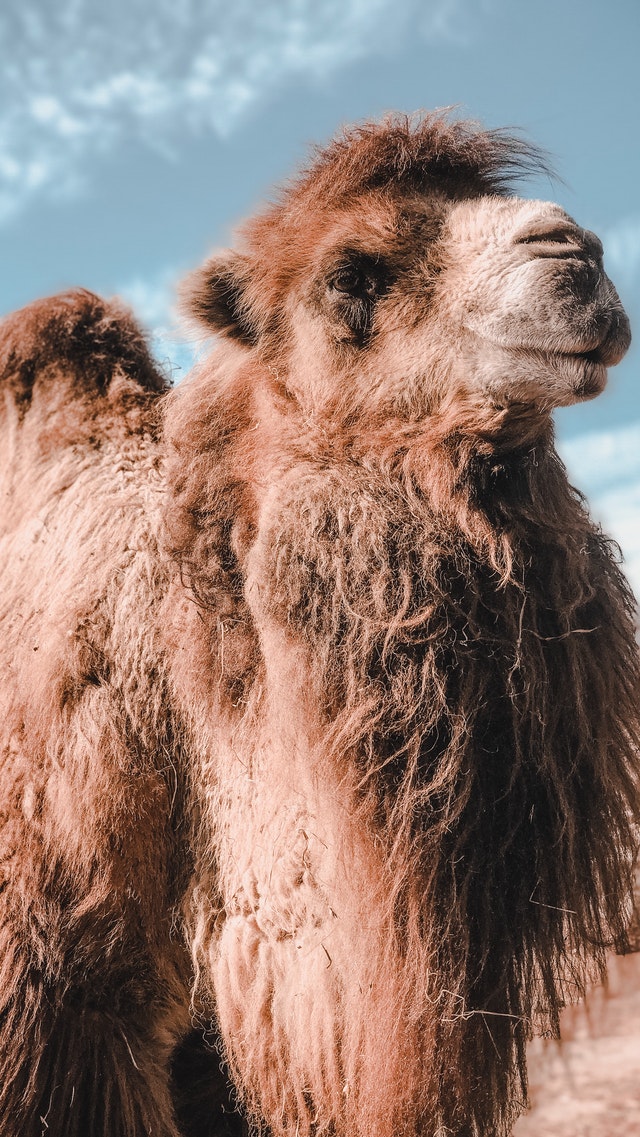
That is where my thoughts were drifting as I drove up Ames Creek road. I was on a farm call to see Goliath. Goliath was a large Bactrian camel belonging to Frank. Frank owned a ranch at the end of Ames Creek Road. I had often visited this farm to see a host of exotic animals. Frank had llamas, sika deer, elk, antelope, wallabies, cattle, and horses. Goliath was relatively new to the farm. Frank had been walking the Pacific Crest Trail with his daughter this summer, and Goliath was with them every step of the way, carrying his load and theirs.
Today Goliath was not well. He truly fits the name. Goliath was a massive animal, and the guy’s sure size was an unexpected surprise for me. He was probably over 2400 pounds and much taller than I would expect. To look him in the eye took a small step ladder. Looking in that eye, I could see more than I wanted to see. The white of his eye was yellow. I crawled back down the ladder without trying to look in his mouth. Standing back and looking at this guy from a little distance, there was edema along his ventral abdomen. His legs were somewhat swollen also.
Drawing blood was a snap. Goliath’s neck was the size of my body’s trunk, and the jugular veins nearly the size of my daughter’s wrist. Goliath didn’t flinch at the needle poke. I made a habit of drawing blood on all exotics that I saw for Frank. We needed as much of a database as possible.
Explaining my findings was a little difficult for Frank. He was not only proud of Goliath, but he had also grown close to him over the long summer of hiking.
“His chances are not good,” I explained. Pointing to the findings, the yellowed membranes, the ventral edema, and Goliath was not eating, not feeling well. “The blood will tell the story, but we are probably dealing with advanced liver disease. It could be from an infection, like Leptospirosis. But more likely it is from a toxin, like Tansy Ragwort. He may die, Frank. He may be dead before we get the blood results.”
“I don’t want him to suffer,” Frank said, looking at Goliath as he said the words as if he didn’t want me to see the feeling in his eyes.
“Let’s give him a big dose of antibiotics, just in case they will do some good. Then we will see what the blood results say in the morning,” I said as I was drawing up a dose of tetracycline and mixing it with a bottle of glucose. We ran the IV quickly and packed things back into the truck. Morning would not come any too soon. Hopefully, he will still be with us, I thought, as I pulled out the ranch gate.
Tansy ragwort, Senecio jacobaea, was introduced into Oregon in the early 1920s. It is widespread in western Oregon. It contains toxic alkaloids that cause irreversible liver damage to cattle and horses and many other animals. It is often consumed in the hay, but some animals will develop a taste for the weed and seek it out while grazing. Obviously, that practice does not last long.
When the blood results came in the morning, the diagnosis was confirmed. The call to Frank was not easy. He wanted me to come up and put Goliath to sleep.
The euthanasia solution comes in 100 ml bottles. The dose is 1 cc per 10 pounds body weight, one bottle does 1000 pounds. The stuff is pretty rapid in its action. Getting an adequate amount into Goliath before his falling over will be a challenge. Having a 2400 pound camel fall on you is not something that brings good thoughts.
When I arrived, Goliath was far worse. He was laying down, his head was still up, but even this stoic camel was not going to last very long. I quickly clipped a patch of hair over the jugular vein and placed a 12 gauge, 2-inch needle into the vein. No head restraint was needed, Goliath sort of looked away, like someone having blood drawn in the lab, he did not flinch, even with the large needle. Four 60 cc syringes filled with euthanasia solution are rapidly injected. Goliath stays immobile for a brief moment then lowers his head to the ground. He is gone.
Frank has difficulty talking, obviously upset. I pack up and prepare to leave. “What are you going to do with him?” I ask.
“He has earned his spot right here under this tree,” Frank said. “I just have to get the backhoe.”
As I drive back to the clinic, my thoughts again drift back to Catching Creek and Uncle Ern. Goliath is a memorable name for me. The old lump in the throat makes the drive a little uncomfortable. Perhaps the rest of the day will be better.
Photo by Alessio Cesario from Pexels