Isabelle, Saved by a Bite

D. E. Larsen, DVM

The two girls standing at the counter were holding something bundled in a sweatshirt. They were young girls, probably 16 or 17. 

“I hope you can help us,” the young blond girl, Sidney, said. “This cat was hit by a car out in front of our house, and she is hurt pretty bad.”

“Whose cat is it?” Sandy asked.

“I don’t know, we have never seen it before. But we couldn’t just leave it lying in the street.”

“Are either of you 18,” Sandy asked?

“No, but this is not our cat.”

Joleen ushered them into the exam room and sat the bundle on the exam table.

“Let’s look at what you have here,” Joleen said.

“She is pretty scared,” Sidney said.

Joleen said. “I think I had better get the doctor.”

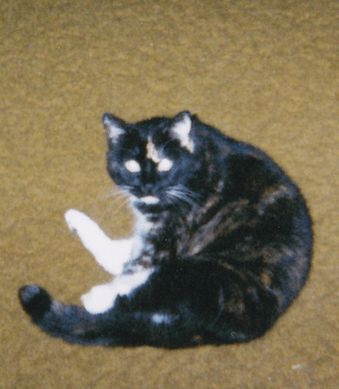
Joleen and I unwrapped the sweatshirt with care. The young calico cat poked her head out of the sweatshirt. I grabbed her by the nape of the neck. With some petting and some soothing words, she calmed down and relaxed under my grip.

When we got her out of the sweatshirt, she was bleeding from her right hindfoot. The foot was mangled. Mangled well beyond repair. Most of the skin was gone, and broken bones were sticking out everywhere.

“Whose cat is this,” I asked?  

“We have never seen it before,” Sidney said. “It was hit out in front of our house.

“We will check around, but if we can’t find an owner, we will probably have to put her to sleep. We can’t let her suffer from that foot.”

The girls said their goodbyes to the cat they thought they had saved, and they collected their bloodied sweatshirt.

“You guys give Sandy your contact information and a parent’s name. In case we need to contact you for some reason,” I said as they departed the exam room.

At the front desk, Sandy was busy getting their information.  Sue, the little brunette, held out her hand and showed Sandy a deep bite wound at the base of her thumb.

“Did that cat bite you,” Sandy asked?

“Yes,” Sue said. “She is not mean. She was just scared and in pain.”

“This changes the whole thing,” Sandy said. “Just a minute while I get the doctor.

“Dave, one of those girls was bitten when they picked up this cat,” Sandy said.

“Great,” I said, looking down at the little cat. “You just got an extension on your death sentence.”

“Did you make sure we have all the necessary contact information of these girls and on a parent of Sue’s. We will have to hang onto this cat for 10 days. That probably means I will need to amputate this foot unless the County Health Department authorizes another option.”

I stepped out to the front office to look at Sue’s hand.

“Sue, that bite wound is a major injury. A cat is the only animal that has put me in the hospital. And that was from a bite wound not too different from yours. You want to call your doctor and get some treatment instructions as soon as you get home. We will report this bite wound to the County Health Department. They will probably contact you. You probably gave us some extra time to try to find an owner. We have to keep the cat for 10 days to make sure it doesn’t have rabies.”

“What are you going to do with her foot,” Sidney asked?

“I will probably do a modified amputation at the joint. Just removing the injured part of the foot. If we find an owner, I will do a full amputation. Either way, we will hold this cat here for the full 10 days.”

“That makes us feel better,” Sue said.

The girls left feeling as good as could be expected. They were going home to search for an owner of this little calico cat. We were left doing surgery with little or no chance of getting paid.

“Set up surgery for just a simple amputation,” I said to Joleen. “This is a contaminated wound, and I am going to remove this foot through the hock joint. I won’t need anything other than a standard surgery pack.”

We finished the appointments for the day and then took the cat to surgery. In that time before surgery, Sandy had the cat calmed down and purring.

“What do we want to call her for the record,” Sandy asked?

“It makes no difference to me, you pick a name, and we will use it.”

“I think we will name her Isabelle,” Sandy said.

The surgery was brief. There was enough skin to cover the stump with no problem. I removed the foot by cutting through the tarsal joints, ligated the bleeding vessels, and closed the skin over the stump. Now we just had to recover her, control the pain, and wait out the 10 days.

“What is going to happen after 10 days,” Joleen asked? 

“If we don’t have an owner, she gets put to sleep.”

The days passed slowly. Sandy spent more and more time with Isabelle. She was labeled a Rabies Suspect because she was on the County watch list, and the staff was supposed to limit their contact with the patient. I mentioned that fact to Sandy.

“Do you consider me staff,” Sandy asked? “I don’t consider myself staff.”

I think it was the third day when Sandy said, “I don’t think I want you to put Isabelle to sleep. She is so sweet, I think we should make her a clinic cat.”

There was little reason for me to respond. I was probably the only person in the entire community who thought I ran this clinic. 

“You are probably right. It will make those girls feel better. And I can watch to see how well she does with a low leg amputation.”

And so it was written, when the 10 days of isolation were up, the County Health Department and the two girls were both notified that Isabelle was alive and well. Isabelle took up her new residence on the front desk, close to Sandy at all times.

Isabelle was a friendly cat. If she was away from the desk when a client came through the door, she would come running and jump up on the counter. Most people were surprised to see she only had three feet if they noticed at all.

Her residence at the clinic was over a year. Much longer than Newt’s and nearly as long as Blackjack’s. Her problem started softly. When some clients would pet her, she would nip at them. The nips soon became a soft bite, where Isabelle would grab the offending hand with her teeth and hold it for a second. Never breaking the skin, but the threat was there.

“I think the risk is too high to keep Isabelle here. We are going to have to take her home. One of these days, she is going to nail someone.”

Sandy agreed, and Isabelle made the trip to the house with us. Newt was still with us in those days. I always wondered if they compared notes.

As the years passed, Isabelle turned up missing one day. After some searching, she was found on the neighbor’s porch. We brought her home, and the following week, the neighbor called to tell Sandy that she was back on his porch. Sandy insisted on her becoming an indoor cat after those episodes.

As a three-legged house cat, Isabelle became a little overweight but still lived a long life in the Larsen household.

The Terrible Breech

D. E. Larsen, DVM

“Doc, this is Peter, out on Brush Creek,” Peter says on the phone. “I have been working on trying to pull this calf for two hours now. I am not getting anywhere. Do you have time to run out here and give me a hand?”

“Sure, I can come right away,” I said. “You caught me just at the right time. What is going on with her.”

“This morning, I noticed her with her tail up and sort of standing around a little odd,” Peter said. “When I ran her into the barn and got her tied up, I saw this tail hanging out of her. I cleaned her up like you always do and started working. There is just this butt of the calf in the birth canal. I can’t get ahold of anything.”

“Sounds like you have a calf in a full breech position,” I said. “I should be able to take care of that with little problem. At this point in time, almost all of these calves are dead. I mention that just so you know. When the calf is in a full breech, there is nothing to engage the cervix. The cow doesn’t usually go into hard labor for a day or sometimes two.”

“I can understand that,” Peter said. “But we have to get it out of there. I would guess you might have to do a C-section.”

“That all depends. Most of the time, I can get the hind legs up and just pull the calf. If not, I usually do a fetotomy. I don’t like to do a C-section on a dead calf unless there is no other option.”

“I have her in the barn. There is no need to stop at the house,” Peter said.

Peter and his young son, Tom, were waiting at the barn door when I pulled up in my truck. Peter was in his late 40s and usually looked too well dressed to be a rancher. Today, that was not the case. His hat was sitting crooked on his head, and it failed to conceal his uncombed hair. He had a swab of blood and mucus across his forehead. Both sleeves of his shirt were bloodied to his shoulders.

“Tom, it looks like your dad has been working hard this morning,” I said.

“He is pretty tired,” Tom said.

“I don’t know how you guys do it?” Peter said. “I have been at this for two hours, and the only thing I have accomplished is to wear myself out.”

“There are a few tricks to learn,” I said. “The most important thing to learn in bovine obstetrics is to set a clock on yourself. If you haven’t accomplished anything in 20 minutes, you need to do something else. That means you should have called me about an hour and a half ago.”

“That’s what Mom said,” Tom said.

“Well, that is enough of the storytelling. Let me get a look at what we have going on,” I said.

Working on a cow that the owner has struggled with for two hours has its own set of hazards. The untrained hands can do all sorts of damage. I have seen ruptured uteruses, broken legs on the calves, and gross contamination of the whole track. That meant I had to check for all of that first, or it would fall on my shoulders.

“I see you have her cleaned up well. That is a good thing.”

“I have watched you before,” Peter said. 

I washed the cow one more time and ran my hand into her vagina. The vagina and what uterus I could easily reach were intact. The calf’s rear end sort of worked like a cork in the birth canal. I stuck a finger in its rectum. No response; this was a dead calf.

“The calf is dead like I explained on the phone,” I said.

“How did you determine that so fast?” Peter asked.

“I stuck my finger in his butt. If he was alive, he would have responded to that. No response equals a dead calf.”

I ran my hand down under the calf. I could reach the hocks with no problem. Peter had stretched out the birth canal in his earlier efforts. I had no trouble getting down and grabbing a cannon bone. With a firm grip on the middle of the cannon bone, I pushed the hock forward to provide room to pull the hoof up into the birth canal. In one motion, I pulled the leg back, and the foot popped out of the vulva. I quickly reached in and repeated the process on the second leg. Now it was a simple extraction in posterior presentation.

“Doc, you embarrass me,” Peter said. “I have been working on her for two hours, and you come along and have the feet out in two minutes, and that includes time for some idle conversation.”

“It is just a matter of knowing a few tricks of the trade,” I said. “Give me a hand. I think we can pull this guy out of here with no problem.”

Tom was quick to jump in to help. At twelve, he was getting strong enough to consider himself almost a man. With the two of us, we quickly pulled the calf. It flopped lifelessly on the ground, and the membranes followed with a splatter of fluid. Tom jumped back, trying to avoid the mess, but it was too late. His pant legs were covered with fluid and mucus.

“One more lesson for today,” I said. “You always want to go back and check the cow. You check for another calf, and you check for any injury to the birth canal. Today, because you worked on her for so long, I will put some antibiotics into that uterus. That probably makes me feel better than it does her any good. Whatever I put in will drain out in a couple of hours.”

I finished up and cleaned up, and we turned the cow out.

“You want to watch her closely for a day or two. Just in case she develops an infection in her uterus.”

“And Tom, it was a good experience for you to be surprised by that splash of fluid. When I was in the delivery room with our first baby, I was surprised at the gush of blood that came with the membranes.”

Tom didn’t say anything but looked at his pant legs with a frown.

“Can I put another calf on her?” Peter asked.

“Sure, most cows will take another calf,” I said. “If you have an orphan or buy one at the sale. There are all sorts of tricks. Keep them in a small pen for a few days. Maybe take the skin off that dead calf’s back and tie it around the new calf, or smear the new calf with the membranes.”

“I will give it a try,” Peter said. “And thanks, Doc. You are good at the things that you do.”

Photo by Erik Mclean from Pexels.

The Lasso and the Wire

D. E. Larsen, DVM

“Andy, how long has this guy been sick,” I asked.

Andy was an old Italian with a small acreage on which he ran a few steers to fatten every year.  He was bald as a billiard ball, short and, shall we say, a well-rounded individual.

We were standing in the middle section of his old dairy barn, where he had milked a herd of 20 cows. In those years, the late 1930s, 20 dairy cows would support a family. And with the support of his wife and two boys, he could work at an outside job that allowed the family to live quite well.

The steer stood looking at us through the stanchions. He was locked in the milking section of the barn and had free movement in the reasonably confined space that measures 16 by 40 feet. This steer was in good shape and probably approaching a year of age. He moved with guarded steps.

“I noticed last night that he wasn’t eating much,” Andy said. “Then this morning, he almost doesn’t want to move. I had a heck of a time running him into the barn. And the whole time I have been waiting for you, I bet he hasn’t taken a half dozen steps. He just stands there.”

“If he is not eating, we are probably not going to be able to entice him to stick his head in a stanchion,” I said. “Is he tame enough for me to put a halter on him?”

“You are probably going to have to rope him,” Andy said.

“That was not something that they taught in school,” I said. “But, you know, I am getting better at it all the time. I was talking to an older veterinarian South of here the other day. He said he has thrown his rope away. People want him to look at a cow; they have to have it caught.

“Are you going to do that?” Andy asked.

“I think I would starve to death around here,” I said.

“You make it too easy for people to take advantage of your rope,” Andy said. “But, like today, I wouldn’t be able to get this guy caught until my son got off work.”

“You might think about buying a squeeze chute, or maybe just a headgate on the end of a crowding alley.”

“I’m too old to be buying new things.”

“Yes, maybe, but you still do enough that it would probably make your life a lot easier. My brother-in-law says that if he had to do it over again, he would have bought a squeeze chute before he bought his first cow.”

“I will give it some thought,” Andy said. “But today, you are going to have to rope this guy.”

I laughed at the old man as I stepped into the milking side with my rope. This was going to be easy. The steer looked at me but never moved a muscle. I think I could have dropped the rope over his head, but I threw it from 8 feet away.

The lasso fell perfectly over the steers head. I pulled the rope tight. The steer jumped right with his front feet, fighting against the pull of the rope. Then he lurched to the left, stiffened, and fell on his side. His legs stuck straight out and quivered for a moment. Then everything was still.

I checked, he was dead.

I looked at Andy, standing there in a state between disbelief and shock. 

“What the hell happened?” Andy said.

“I don’t think he liked the rope.

“No, I mean, how did that happen?” Andy said.

“My guess is, if we open him up, we will find a wire sticking him in the heart.”

“I have heard of wire killing a cow,” Andy said. “But I thought it was a slow process.”

“That is usually the case. The way he was acting, I suspected a wire. I didn’t expect him to drop dead. It must have poked him in the heart and caused a cardiac arrest.”

“I am not going to be able to sleep now if we don’t find out what killed him,” Andy said. “I guess I better have you look.”

I grabbed my necropsy knife and opened the left side of the steer’s chest. Sure enough, a piece of baling wire, about 3 inches long, was sticking through the diaphragm and into the pericardium. It probably stuck the heart when he jumped. I showed Andy the wire.

  “Now explain to me how that got there,” Andy said.

“Cows are not very discriminating when they eat. If they encounter a piece of baling wire in the hay, they just eat it. It collects in the reticulum, a small pouch on the front of the rumen. Probably called the second stomach, it is where they get tripe. The wire or any foreign objects stay in the reticulum. The stomach works; the wire pokes through the wall of the reticulum, passes through the diaphragm. Then it pokes into the heart.”

“In the old days, they would do surgery and remove the wire. Today we just place a magnet. With normal stomach activity, it will pull the wire back into the reticulum and hold it there. We put magnets in all the dairy cows now, not so much in beef cows. Most of the time, if not treated, it does kill the cow slowly, from an infection around the heart.”

“Can I make hamburger out of this guy?” Andy asked.

“It depends on how hungry you are, Andy. These cases almost always have a low-grade temperature, which has probably been going on for several days before things got to the point where the wire was painful for him. I wouldn’t eat him, but it wouldn’t kill you.

“I guess it is just a loss,” Andy said. “Sort of a waste, but if you wouldn’t eat it, that is good enough for me.”

Photo by Pixabay from Pexels