Eperythrozoonosis, From the Archives

D. E. Larsen, DVM

Jack was at the corral gate when I pulled into his upper barnyard. He was opened the gate as I stepped out of the truck. There in the middle of the corral was a young llama lying down and obviously not feeling well.

“Jack, it’s good to see you. How are things going?” I said as I got out of the truck.

“We are doing well,” Jack said. “But this little gal is looking droopy this morning.”

Llama had a strong herding instinct and they rarely showed any sign of ill health until they were in very serious condition. For this little llama to be down in the middle of the morning was a sign she was likely very sick.

“How long has she been like this, Jack?” I asked.

“I guess I don’t know,” Jack said. “I looked at all of them yesterday. I can’t say for sure that I saw her, but I sure didn’t notice her being sick.”

I grabbed my stethoscope and a couple of blood tubes went in the corral with Jack. We had to coax Sugar to stand. I raised her lip and looked at her oral membranes. They were pale, in fact, they were almost white. 

Trying not to get ahead of myself, I took stuck a thermometer into her rectum and listened to her chest and abdomen while I was waiting on the thermometer. Everything was normal except for the obvious anemia.

“Jack, I am going to get some blood out of her. I might need to run it back to the lab before I treat her,” I said. 

I drew a couple of tubes of blood. The blood was almost like water. Obviously, red but it was thin enough that her anemia must have severe. I collected another small amount of blood with a syringe and made several blood smears so they would not have any artifacts from the additive in the purple top tube that keeps the blood from clotting.

“Jack, this is a severe anemia,” I said. “It might even be life threatening, this blood is very thin.”

“What can cause that to come on so fast?” Jack asked.

“I probably didn’t come on so fast,” I said. “These llamas will hold out until they are near death before they will show any signs of illness. It just got to the point where she could not cope with it any longer. I don’t know what it can be. I have seen anaplasmosis in cattle that were this anemic when I worked in the feedlots in Colorado. I haven’t seen anaplasmosis here, but I guess it is possible.”

“Do you think she is going to be okay while you run to the lab?” Jack asked.

“That’s a good question,” I said. “I think with how this blood looks that I should treat her with some tetracycline now. In cattle, prompt use of tetracycline will reduce mortality. Blood transfusions are sometimes necessary, but I need some supplies from the office to do that. I will be able to tell from the initial blood results if a transfusion is needed. I will be sending this blood to the diagnostic lab in Corvallis to check on the diagnosis, but I will look at it in my lab first.”

I gave Sugar a dose of intravenous tetracycline and also some dexamethasone. The dexamethasone was probably controversial, but I always remember Dr. Annes saying, “No patient should die without the benefits of steroids first.” I would at least help to slow the immune response if a blood parasite was the cause of this anemia.

“Jack, I have some time today,” I said. “I will run back to the lab and get this blood looked and also get it on the way to Corvallis and then I will come back here in an hour or two if Sugar needs any additional treatment today. Either way, I will give you a call.”

Back at the clinic, I ran a quick complete blood count. Sugar’s packed cell volume was eighteen percent. Values below fifteen percent were considered to require a transfusion.

My next step was to stain one of the blood smears I had prepared from the  blood collected with the syringe. Under the microscope it always took me a moment to adjust my thinking when looking a llama blood. All the red blood cells were elliptical. 

This slide showed a lot of basophilic strippling. This was indicative of an anemia and was often seen in anaplasmosis in cattle. There was no evidence of any anaplasma organisms on the red blood cells. But there was something there that I couldn’t identify. I would have to send the blood and the smears to the lab.

“Jack, I think the Sugar is okay for today with the treatment that I did earlier,” I said when I called Jack. “I am sending the blood to the lab with a currier, so they will get it this afternoon. She is anemic, but not bad enough to require a transfusion. There is a blood parasite there, or some infection on the red blood cells. We will have to wait for the lab results. I will drop by in the morning to give her another injection and to recheck her blood.”

“Are you sure about not needing a transfusion?” Jack asked. “These little gals are pretty valuable, you know.”

“Her blood is above the line that we draw,” I said. “That said, it’s man that draws the lines, in nature, everything is a continuum. But if we do a transfusion too soon, the bone marrow gets the message that it doesn’t have to work so hard. Sometimes a transfusion given too soon, does more harm than good.”

***

I was in the corral looking at Sugar when Jack came out of the house.

“I thought you said it would around nine when you got here this morning.” Jack said.

“I probably said that, but in this business, I have to to do things when the time becomes available,” I said. “I’m sorry if I hurried you. Sugar is looking better this morning.”

“I thought she was up and about when I watched her out the window this morning,” Jack said. “Did you get any results from the lab yet?”

“The diagnosis is eperythrozoonosis,” I said. “Does that help you out any?”

“Doesn’t do a thing for me,” Jack said. “Does it come with a common explanation.”

“This is an infection of the red blood cells,” I said. “A small organism, a mycoplasma, infects the blood cells and the body removes those cells because they infected. It is sort of a number’s game. If enough red cells are removed, the patient becomes very anemia.”

“How did she get it?” Jack asked. 

“I don’t know that we know for sure,” I said. “Biting insects and ticks can spread it. Also using non sterile needles and surgical instruments can spread it. I am not sure if she could have gotten it from her mother. But that is a possibility. This treatment will make her better and she will unlikely have any more problems, but it is unlikely to eliminate the bug from her system. You just need to remember that she could be carrier for the rest of her life.”

“Do I have to do anything more for her?” Jack asked.

“I am going to come by every morning for another few days, just to give her an injection,” I said. “If you leave her here, you don’t need to be here. I will just run by and give her an injection. After that I will repeat the blood, and if it looks like it is needed, I will fix you up with some oral medication for another week. That will be some powder to put in her water. I think the injections will clear things up her.”

Sugar recovered with no complications and became a part of Jack’s llama herd for the next several years. That was when the llama market collapsed and Jack sold his herd, twice. The final time, for pennies on the dollar.

Photo by Erik McLean on Pexels.

The Swollen Scrotum

Photo Credit: “Bull Rental Services” https://mechanicalbullrentalhouston.com/

D. E. Larsen, DVM

It looked like another hot day with no rain in sight. August in Sweet Home was usually hot and dry. 

With the heat, our days were often slow. Especially the large animal side of things. Dr. Craig had warned me that the cattle practice would be feast or famine. 

“Busy in the fall and the spring,  the winter would be okay, but, except for a few pinkeye cases, you will do almost nothing in the summer,” Dr. Craig had said.

So I was a little surprised to see Pete rush through the clinic door. Pete was an old guy with a hobby farm out in Liberty and hated using the telephone.

“Doc, I have a young bull with a scrotum that is all swollen up,” Pete said. “Do you think you can come out to look at him? I have him caught, and my two sons are at home to help, but only for a couple of hours.”

Pete was pretty shrewd. He had the bull caught, and he had help, but only if I could come right away.

“Okay, Pete, I can change things around a bit and run out there now,” I said. 

“Doc, don’t come to the house,” Pete said. “We have him down at the neighbors. Their place is the one with the Indian Council Tree in the front yard. You know where that is, right?”

“Yes, I know the place,” I said. “It will take me a few minutes to get things together, but I will be right along. Do you have any idea what happened to this guy?”

“I reckon I don’t really know what is going on, Doc,” Pete said. “But he is pretty uncomfortable.”

 When I pulled into the driveway, Pete, his two sons, and a bunch of onlookers were gathered around this reddish yearling bull. 

Looking at the bull’s scrotum, the problem was obvious. This scrotum was swollen to three times its normal size, and the skin at the top of the scrotum had been severed, I would guess, by an elastrator band. 

You didn’t need to get close to smell the infection.

I stuck a thermometer into the young bull’s rectum. I looked at Pete and his entourage while I waited on the thermometer.

“Pete, I thought you said you didn’t know what happened to this guy?” I asked.

“Well, I was a little embarrassed in your office,” Pete said.

“You know, you’re not supposed to lie to your doctor,” I said. “The same thing goes for your veterinarian.”

“I know, Doc,” Pete said. “But I figured you would figure it out fast enough.”

I pulled the thermometer out and wiped it clean. It read a hundred and four.

“He has a pretty good infection, Pete,” I said. “The good thing about this is when we cut all of this off, things should clear up pretty well. You’re probably lucky that he doesn’t have tetanus.”

“I have never heard of tetanus in a cow,” Pete said.

“Well, it happens, not often, but it happens,” I said. “And, most of the time, it is from just this sort of thing.”

I tied the bull to the only fence post I could find that didn’t wobble when it was pushed. Then I pulled him against the wooden fence rails with a sideline.

“You two guys can lean against this guy to hold him a little better,” I said to Pete’s boys. 

“I’m going to do an epidural anesthetic on this guy,” I said. “That is not something we do for a standard castration, but this will require a little digging. 

After doing the epidural, I pulled the bull’s tail up and handed it to one of the boys.

“Just hold it out of the way,” I said.

I scrubbed the scrotum and the wound that circled the top of the scrotum. I stuck a finger into the wound, and there, nearly an inch deep, was the elastrator band. With a scalpel, I carefully severed the rubber elastrator band, and it popped out of the wound.

I picked up the remains of the band and tossed it to Pete.

“These things work on baby calves,” I said. “They don’t work on an animal this size.”

I opened the scrotum with an incision down each side. Then, I dug through the swollen tissues with my fingers until I could expose each testicle. After stretching the cords out, I removed each testicle with an emasculator. Now all I had to do was remove this swollen mass of tissue that used to be a scrotum.

After manipulating the original wound, I just removed the entire scrotum with the emasculator. Making sure I held a firm crush on the tissues for a full minute.

“So what did I do wrong, Doc?” Pete asked.

“These little bands are made to work on lambs and baby calves,” I said. “At this size of a scrotum, there is just not enough strength to cut off the blood flow. The band cuts through the skin and some of the tissue. It probably cuts off the blood leaving the scrotum, but it doesn’t have enough tension to shut off the blood flow into the scrotum and the testicle. So they just swell up, making sure the band can’t do the job. Then it all gets infected, and if you hadn’t called me, this bull would have died.”

“I just can’t afford to have you come and castrate all my calves,” Pete said. “What is a guy supposed to do?”

“Castrate the calves when they are a few days old,” I said. “You can handle them easier when they are that size. These bands work at that age. You just have to make sure you get both testicles. The other way is to use a knife. I can show you how to do that if you bring a baby calf into the clinic next spring.”

“What will we have to do with this guy now?” Pete asked.

“I am going to load him up on antibiotics and spray him real well for flies,” I said. “I will leave you another injection to give him in two days and a can of fly spray to use daily. You will need to keep him up for a few days. Other than that, he should heal up just fine.”

***

I was able to stop by Pete’s place the following week. Pete wasn’t home, but I watched the new steer from over the fence, and he was doing well. Grazing like nothing had ever happened. 

Animals like this little bull are so miserable that they feel great when their problem is finally taken care of.

Photo by Schne Eknirschen on Pixabay

The Hands Tell the Story

D. E. Larsen, DVM

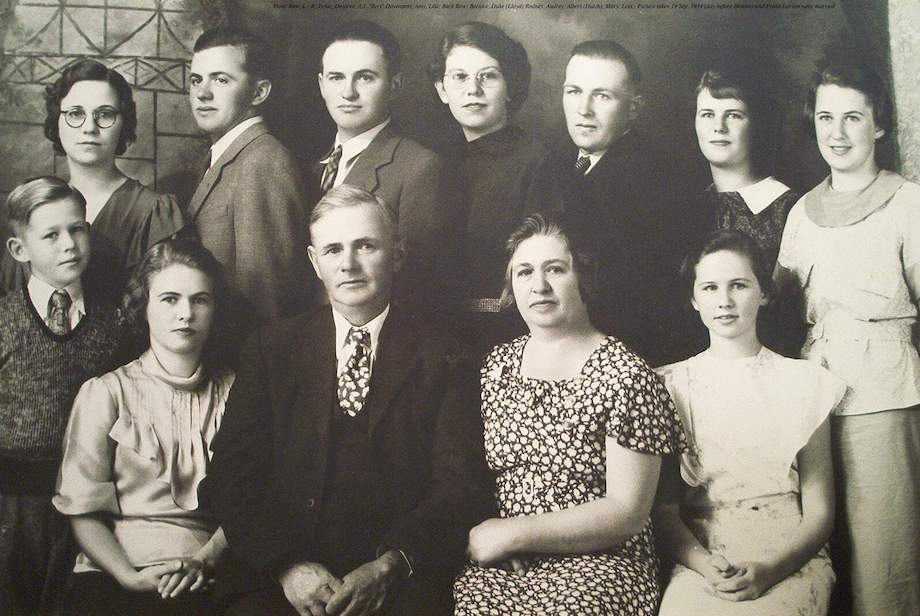
The photo above is of my mother’s family, and this picture is an icon of the Davenport family.

 It was taken on September 19, 1934, the day before my mother’s marriage. Mom is seated next to my grandfather. 

I have looked at this picture multiple times in almost every year of my life. It has served as cement for the large extended family that grew out of this assembled crew.

Well dressed for the 1930s, and I am sure they were carefully groomed for the photo. Such photos in 1934 had to be a substantial investment. 

From the photo, at a casual glance, one could surmise this was a well-to-do family of a prosperous merchant or maybe even a doctor or a lawyer. The truth is they are the family of a farmer. A dairy farmer on Catching Creek out of Myrtle Point, Oregon.

The standing girls eventually ended up in California. Still, their attachment to the family and that piece of ground they had called home for so many years remained intact.

The youngest boy, Ernie, standing at my mother’s shoulder, would go on to serve as a bomber pilot in WWII. He spoke of paying for a plane ride from a barnstormer after he had enlisted in the Army Air Force, just to see if he would actually like to fly. After the war, he became the only one of the bunch to finish college. Teaching, coaching, and finally becoming a school administrator served as his career, but he also remained a farmer.

All the others remained close to the land. Close to Myrtle Point and Catching Creek.

I have no idea of the count of individuals in the four generations that have followed this group, but there are many. There were twenty-nine cousins in my generation. 

In all large families, the group has all degrees of success. As a whole, everyone in this family has done well to carry on the traditions of our grandparents. I cannot think of anyone who would be considered the family’s black sheep. 

Today, for some reason, when I glanced at the picture, my grandfather’s hands jumped out at me. 

He is fifty-four in this picture, and his hands are the hands of a man who knows a life of physical labor. Compared to the skin of my grandmother and his two daughters seated in the front, his hands are dark. Those hands have toiled in the sun. And though you can’t see the calluses on the palms of his hands, you know they are there by course skin and bulging vessels on the back of his hands.

Milking dairy cows in 1934 was not easy. Especially when you had to grow virtually all of the feed for the herd on the farm. By then, the older boys were building farms and families, so much of the work fell squarely on this guy’s shoulders.

The summer I was fifteen, I worked for this man. He was eighty-one that year. I was a stout young man in those years and just starting to build my adult frame. I thought I was pretty tough; by today’s standards, I probably was. The old man worked my butt off on a daily basis. And he was beside me every step of the way. During the whole summer, I saw him sit down once while we were working. 

“The hardest job I ever had was when I tried to retire when I was sixty-seven,” he told me that afternoon while he rested in the shade of a giant ash tree on the bank of Catching Creek.

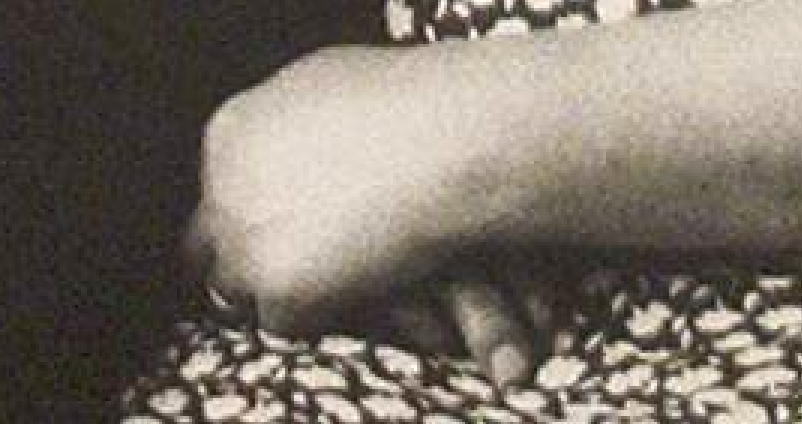
My biggest surprise today was when I looked at those of my grandmother. She was a few days from turning 48 when this photo was taken. Her hands are mostly hidden from view in the picture, and I had to look closely. I am absolutely sure that I had never noticed her hands before.

In my memory, which I always try to think is pretty good, I never witnessed my grandmother in the barn. They had a garage located halfway to the barn, maybe a hundred yards from the house. Grandpa would always bring the car down to the house for Grandma to get into it. I am not sure I ever saw her walking to the garage.

Farm families in those years often had a division of labor, with the women working in the house and the men working in the fields and the barn. But look at her hands, and tell me that she had an easy life.

Besides the daily chores of cooking and cleaning, there were chores that we had completely forgotten about today.

Maintaining a garden for a large family is work enough, and canning the proceeds of the garden can consume days. Wash day was not just throwing clothes in the machine and pushing a few buttons.

Before the luxury of a wringer washer, it was a wash tub and scrubboard. And hanging the clothes on the line in the summer was a luxury, and getting them dry in the winter was a struggle.

The wash tub also gave kids their weekly bath, followed by yourself, hopefully, with some degree of privacy.

My mother’s hands are not the hands one would expect of a twenty-one-year-old young lady today. 

Notice the bulging vessel on her left wrist and enlarged middle knuckles on her left hand. Her fingernails were probably treated better than usual as she prepared for her coming wedding. Still, they are not long and not painted. I remember seeing a bottle or two of nail polish in the house when I was growing up, but those probably belonged to my sister. I have no memory of my mother with painted nails.

And finally, look at Lila’s hands. She is the youngest of the girls and is just fourteen in this picture. 

Her hands are smoother than my mother’s but show some telltale signs of wear and tear, even at her young age. And the nails are trimmed short and functional.

It is said that a picture is worth a thousand words. In this picture, the hands, not the coat and tie or the flowered dress, tell the story.