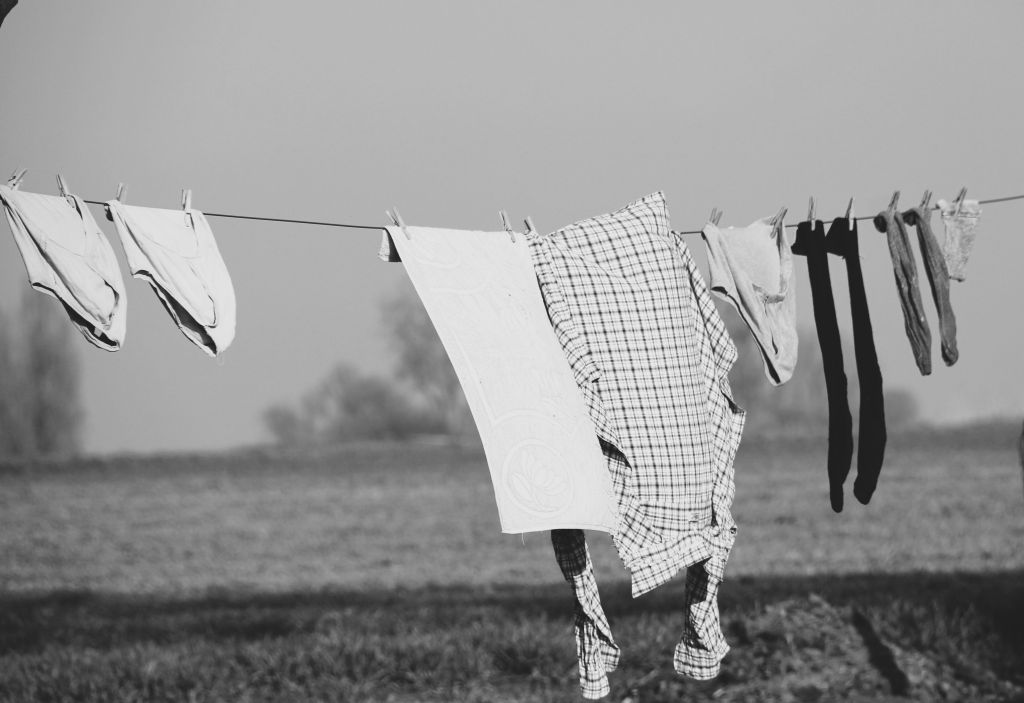
When I was growing up, men, and boys, worked at the barn. Mom and the sister worked in the house. Of course, Mom did a lot more than just housework, which often included the morning milking.
Clean clothes were always carefully folded and in my drawer or hanging in the closet. I knew laundry was done. In those years in an old wringer washer and with the aid of scrub board when needed, but other than noticing Mom hanging clothes on the clothesline to dry, I didn’t know much about what went into getting things clean.
Then came my first experience of living away from home. I have no idea if there were laundry facilities in the college dorm. Mom had packed a laundry bag for me, and when it was full, I drove three hours to home so Mom could do my laundry. That happened every week.
The following year, I went to Colorado State University for one quarter. It was expensive, and they sold beer to eighteen year olds. So I only lasted the one quarter.
The important thing, when the laundry bag was full, I couldn’t just drive home. I was lucky to find a laundromat that was operated by an older couple. They were there all the time and the lady sort of took me under her wing and helped me through the process.
It was nice to return home so Mom could handle my laundry.
Then came the Army. In the Army, you just paid money and someone did all the laundry. You could get your uniform starched and ironed, and all the clothes came back neatly folded. All I had to do was put things away.
For the most part, overseas it was no different. Excellent in Korea. The expense was less but the laundry ladies beat the clothes on flat rocks, or concrete floors, depending on where you were located.
I learned quickly that buttons did not fair well when bashed against a flat rock. Sewing new buttons back on fatigue was a real pain. I learned that they could be secured easily with a paper clip, fashioned with a pair of dikes, punched through the fabric and bent over and flattened with pliers. Not up to Army regulations, but in Korea, nobody noticed.
In Germany, things were gentler. I just handed the bag off to a older guy from a small town near Schöningen, and he would take care the laundry and any necessary repairs. You just paid money, a little more than in Korea.
After my discharge, I returned to school at Oregon State. I purchased an older trailer house and lived by myself in a trailer park.
I was lucky, the neighbor’s wife got me straightened out on how to run the machines in the laundry room. But I was stuck with doing laundry myself.
Then came marriage, and I was not allowed to touch the laundry. Sandy was horrified by the way I would do things. I mixed light and dark colors, I didn’t shake out the wrinkles before putting things in the dryer, and I tended to stuff things away with proper folding.
Of note, when we moved to Colorado when I entered veterinary school, we lived in an apartment without a washer and dryer for the first few months before we we could move into married student housing. We returned to same laundromat that I had used six years earlier. The same couple was there. And with a little jog to their memory, they could remember that kid who had no idea how to do laundry.
Now that we are retired, I am allowed to help a little with the laundry. I am allowed to do any heavy lifting and I can remove clothes from the deep recesses of the top loading washing machines. There are a few other tasks that I can do, under close supervision. And corrections are often made.
Another 3:00 AM emergency, I thought to myself as I started loading things up for my trip into the barn. Glenn was not a regular client but often helped out down the road at Ayer’s place. This large old barn told a familiar story of bygone days, once a thriving little family dairy farm, now the kids are grown, Glenn stove up enough to just being able to manage a few cows and the market for milk from small dairies has long since dried up.
I shook off the chill of the early morning air, hopefully it will be a little warmer in the barn. Glenn was waiting with the large barn door pushed open slightly.
“Morning Doc,” he said with a smile, “sorry to call you so early but she has been at for several hours with no progress.”
I could see the heifer tied to a center post. A large Simmental heifer with a single foot visible at her vulva. The foot was huge, this was not going to be a simple morning.
I approached the heifer cautiously and scratched her forehead. I should have known, she was like a pet, probably the only replacement heifer Glenn had and a far cry from a wild range heifer. I adjusted the halter to make sure it would not choke her if she went down during the exam and then moved to her rear end. The second hoof was just inside the vulva, the soles of the hooves were up. These were hind feet and they were very large, nearly filling the entire birth canal.
I tied a length of twine on the switch of her tail and secured the other end in a loop around her neck. This held the tail out of the way. Then I scrubbed the vulva with warm water and Betadine surgical scrub. After pulling on a plastic OB sleeve I carefully inserted my hand and arm into the vulva to explore the situation. There was just enough room for my arm and the two legs of the calf. I could reach the cervix and palpate the calf’s hocks. This was a massive calf. I strained to reach past the hocks to the rump of the calf. No vulva, this was a bull calf. I inserted a finger into the rectum. There was a strong tightening, he was alive.
“Glenn, this calf must weigh 150 lbs. His two legs and my arm fill the entire birth canal,” I explained. “The only way he is coming out of her is if we do a C-Section. He is in posterior presentation, he is alive but I don’t know if you and I can lift him out of her.”
I thought about the situation. Glenn was a small man but I knew he was no weakling. I have had difficulty in the past bringing the uterus up to a flank incision with a large calf in a posterior presentation. It would be best to use ventral midline incision. Laying the heifer down would be no problem but then lifting this calf out of her was going to be tough.
“Glenn, do you have a block and tackle?” I asked.
“Sure, Doc, what do you want to do with it?
I pointed to a spot in the rafters that could hold the block. “Let’s hang it there, I will lay this heifer down and roll her onto her back. Maybe we could block her up with a couple of hay bales.”
Glenn hung the block and tackle while I got things together for a C-section. The block and tackle looked like it could lift 1000 pounds. These C-sections always took me a couple of hours, probably no chance of getting back to bed before office hours.
We moved the heifer over to where I wanted the throw her. Tied her to a post and place a Flying W on her. This is a standard rope throw that I often used. It always amazed these old farmers and the story would be told over many a cups of coffee. I put the rope over her neck in the middle of the rope, tied a loose knot that fit between her front legs. Then threw each end over her back so they cross in the middle of her back. Then put the ends between her hind legs, exiting on each side of her udder. I grabbed these ends, pulled hard and leaned to the right at the same time. The heifer made a hard flop onto her right side. Glenn looked at me and smiled. By his reaction, I am certain he had never seen that before. I rolled her up on her back, and tied each hind leg to the rope so when she stained or kicked against the rope it would putt more pressure on Flying W and increase the restraint. Then we placed a bale of hay against each shoulder to maintain her on her back.
This done, I stood up and stretched a little. “I hope you can get me an extension cord?” I asked.
Glenn had one hanging on the wall near the door and he had it plugged in and stretched out in no time. I plugged in my clippers and clipped the ventral abdomen from the umbilicus to the udder and to both side. I scrubbed it with Betadine Surgical Scrub and wiped the incision are clean. I used 2% Lidocaine for local anesthesia, about 90 cc and left 30 cc in the syringe in case I needed more.
I did a second prep of the area and wiped it with alcohol, then spayed it with Betadine solution. I laid out my surgical pack on a hay bale and opened 4 packs of #2 Dexon suture material and a scalpel blade. Then I put on a pair of surgery gloves and dropped to my knees beside the heifer. I made an incision through the skin on the midline, about 12 inches long. Extended this though the subcutaneous tissues and exposed the linea alba (white line in Latin, that fibrous band on the abdominal midline). I made a small incision through the linea alba and inserted a thumb forceps to protect the abdominal tissues from the blade. I opened the linea the full length of the incision.
I pulled the omentum forward and there was the uterus filling the abdomen. With one hand I tried to externalize the uterus, I could hardly move the head. I found a foot and moved it to the incision. I incised the uterus, using the space between the toes as a guide to the incision. With this foot exposed through a small incision in the uterus I attached a nylon OB strap to it and hooked the loop of the strap to the hook on the tackle block.
“Take up some slack and put just a little tension on this foot,” I instructed Glenn.
I enlarged the incision just a little to allow me to reach in and find the other foot. I pulled it out and attached it to the other end of the OB strap. “A little more tension,” I said.
As the legs extended through the uterine incision, I enlarged it toward the head of the calf. Now, with most of weight on the block and tackle, I could left head of the calf to the incision. I worked the head through the incision, looked at Glenn and said “Pull”.
The calf glided out through the incision with ease. I guided the hide feet out and away from the heifer and Glenn lowered it to the floor. Indeed, this was the largest calf I had delivered, ever bit of 150 pounds.
He snorted and shook his head. Glenn was all smiles. I took a towel and wiped the mucus from his nose and mouth and rubbed his chest a little. “He will be up before his Mama,” I said.
I changed gloves and started back to work on the cow. I removed some of the membranes through the incision but most were left to pass vaginally. I dumped a package of 5 grams of Tetracycline powder into the uterus. I closed the uterus incision with #2 Dexon in a continuous Utrecht closure. I returned the uterus to the abdomen and covered it with omentum. Then I started on the closure of the linea alba. I closed the linea alba with an interrupted sliding mattress closure using doubled #2 Dexon sutures. Then the free edge was closed with a simple continuous suture using #2 Dexon.
With this done I relaxed a little, thinking to myself, if I dropped dead now the rest of the incision would probably heal on its own. About this time, the heifer strained against the rope. The right foot came mostly free and she kicked hard. The hoof caught me on the left side of my jaw and felt like a very solid punch. It was hard enough to almost set me back on my butt. I shook my head and realized that I was okay. I got back to my knees and retied the foot with an extra wrap or two.
I changed gloves and completed the closure. I used a simple continuous in subcutaneous tissues and a standard mattress on the skin, all with #2 Dexon, I didn’t want to have to crawl under this heifer to take out any sutures. I sprayed the incision with Furacin spray and the whole area with fly spray. Done at last, I thought as I stood up, pulling my gloves off.
Glenn had the calf on his feet already. I took a bottle of Betadine and filled his umbilcal cord, saturating the surrounding area. Then I gave him a 200 pound dose of MuSe, a vitamin E/Selenium supplement. This calf looked a month old already.
We untied the ropes and moved the hay bales. The heifer rolled to her side and onto her sternum in one motion. When Glenn pushed the calf toward her, she jumped to her feet and took control of the calf. I gathered up my stuff and got everything back in the truck. We untied her tail and removed the halter.
“I’ll leave her here for now.” Glenn said.
“Yes, I would keep her close for a few days, just to make sure everything is okay,” I said. “Call if you have any concerns, but I would expect things to be fine. She should pass the rest of her membranes tomorrow or maybe the next day.”
I got back in the truck and rubbed my jaw a little. Opened my mouth wide, everything was okay. My guess is that foot was slowed down by the rope a little, otherwise it would have been worse.
As I headed back toward town the sky was starting to show some light in the East. I would get home for a shower and breakfast before I was due at the office. No rest for the wicked. Sort of reminded me of my Army days.