The Raft
D. E. Larsen, DVM
Don and I duck walked along the old fence line beside the marsh on our place on Catching Creek. I clutched my old shotgun to my chest. Peering through the tall grass that grew along the fence, I kept track of the flock of ducks feeding on the pond.
This pond would be nearly dry in the summer. There was a ditch that drained the pond into Catching Creek. But with the rains and the high water level in the creek, it filled quickly in the fall as the ditch would feed water back into the pond from the creek.
Opening weekend of duck season brought a lot of excitement this year. We were eighth graders and this was our first real duck hunt of the season. Actually, of our lives. Mine was a borrowed shotgun from my Uncle Duke. An old double barrel with a broken stock secured with black elastic tape. It had two triggers and hammers. It was a sixteen gauge, it was hard to find shotgun shells in that gauge. Don’s was an old twelve guage pump. When standing with the stock on the ground, the gun was a good six inches taller than Don.
There was not a lot of cover offered along the marsh. This was going to be a long shot for us. But we had practiced and we were sure we would get a couple of ducks.
I parted the grass for another look. The ducks were as close as they were going to get. We needed to go just a little farther to make sure are line of fire was save.
I motioned to Don, and we went a few more steps. Then, after a couple of deep breaths, we stood up and shouldered our shotguns.
The ducks lifted off the water the moment we stood up. We leveled our guns and fired. I would like to think that I aimed, but I have no visual memory of any aiming. Pointed if a better term
I fired my two shots and the ducks were gone before I could reload. Don got off three shots, but the last one was wasted at fleeing ducks, already out of range.
But there were three ducks floating on the pond. Don and I looked at each other, realizing that we had to retrieve those ducks.
“Where is your dog?” Don asked.
“You mean Dex,” I replied. “He’s a cowdog. He wouldn’t know a duck from a stick of wood. Besides, he is probably hiding under the sink on the back porch. That is were he goes when any guns come out.”
“How are we going to get those ducks?” Don asked.
“I am going to wade out there and grab them,” I said as I handed my shotgun and wallet to Don. I pulled off my sweatshirt and laid it across the fence.
“That’s creek water now. It won’t be warm like it is in the summer,” Don said as I started out into the water.
I quickly reached a depth the was over the top of my boots. The water filled my boots and nearly froze my feet. I continued on, reaching the first two ducks with the water about at the miccle of my thighs. The third duck was another ten yards away.
A few more steps and the water crept up past my belly button. I was chest deep when I stretched out and grabbed the duck by his head. I’m thinking that the duck hunt is over as I headed back to shore.
I dropped the ducks in front of Don and tore off my teeshirt. I was starting to shiver as I pulled my sweatshirt over my head.
Don picked up the large mallard drake. “I take this one,” Don said. “You can have the other two since you are the one that waded out to get them.”
“That’s fine,” I replied as I bent my knees to drain as much water out of my boots as possible. “But I think the duck hunt is over. I have got to get into some dry clothes. In fact, a hot bath might be in order.”
We headed back to house with water sloshing in my boots on every step.
“We need a boat,” Don said.
“I don’t have a boat, but maybe we could build a raft,” I replied. “Let’s give some thought to that. I think we have some old two-by-fours in the barn.”
“We can’t build a raft out of two-by-fours,” Don said. “We need some heavy lumber or logs,”
We walked along the old fence, quiet and in deep thought. I glanced up at the young timber on the hill. I shook my head, too hard. Besides, Dad would never allow us to cut down a tree for a raft.
“We could pick up some of those rail road ties they stack along the tracks up the road by Shulls place,” Don finally said.
“Yah! That would work well,” I said. “We could get some of the used ones. They just throw those away.”
So, on Saturday, after the cows were milked and all the calves were fed, I left the feed wagon hooked to the tractor. Don showed up with gloves in his pocket.
“What are you guys up to this morning?” Dad asked.
“We are going to build a raft for the pond,” Don replied. “Dave doesn’t want to try to train your cowdog how to retrieve ducks.”
That was all that was said. Don and I loaded up on the tractor and headed up the road to Shulls.
We backed the trailer up to the railroad siding to a tangled stacked of used railroad ties.
“These will work great,” I said as I turned over one of the ties on edge of the stack. “The down side is in pretty good shape.”
We loaded six ties onto the feed wagon. They were heavier that we expected, and both Don and I were a little tied by the time we pushed the last tie onto the wagon.
On the way back, we stopped at the river bank and picked out a couple of willow saplings to use for poles. Then we stopped at the barn for three two-by-fours and Dad’s coffee can full of nails and a hammer. Don picked up the hand saw as we were leaving.
We backed the feed wagon close to the edge of the pond and unloaded the railroad ties right at the water’s edge.
The rest of the job was easy. We lined up the ties and secured them them with the two-by-fours, one on each end and one in the middle. Don was busy sawing the ends of the two-by-fours off as I was finishing nailing the last board in place.
“I’ll put the tractor away and take care of the tools,” I said. “You can get this thing in the water and we’ll try it out.”
Don didn’t say anything as I drove tractor and wagon back to the barn. When I returned, expecting to jump on raft, Don was sitting on the edge of raft waiting for me.
“This thing is pretty heavy,” Don said. “I can’t budge it.”
We both tried to push it, to no avail. We could pry it an inch or two using the willow poles. We ninally figured out that we could move one corner a foot or two without a lot of effort. So going from one corner to the other, we walk the raft out onto the water.
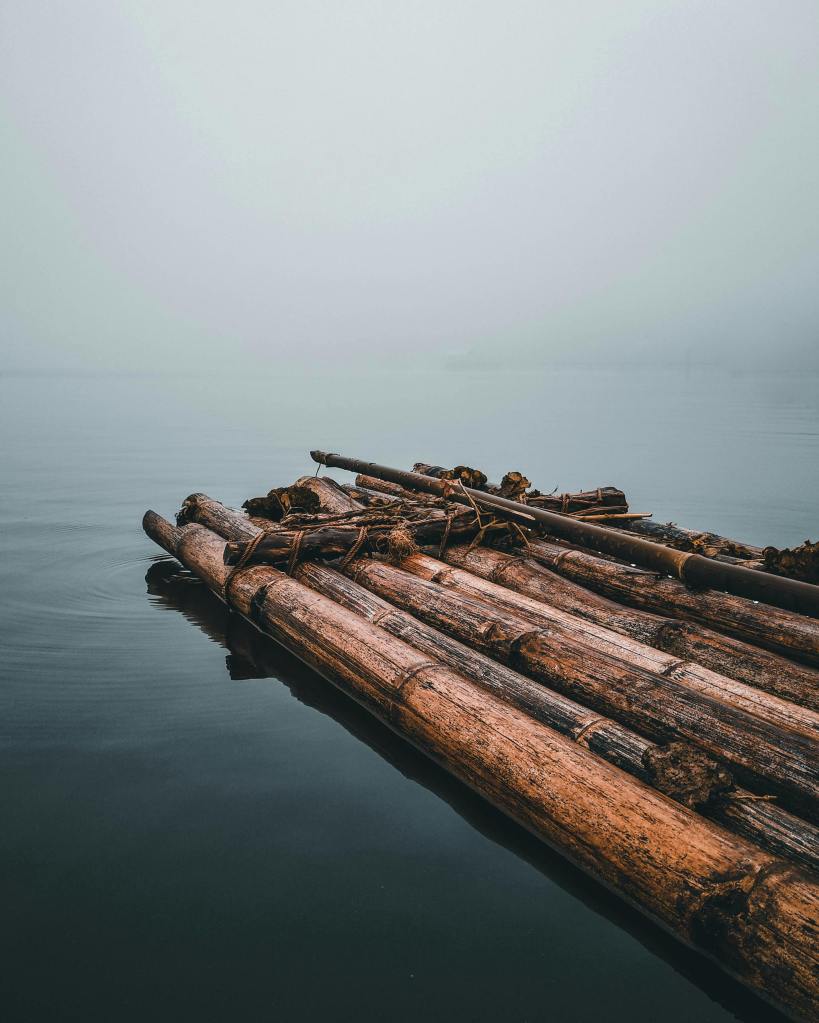
And what a beauty. It floated high and dry. It hardly noticed when we climbed on. We poled out to the middle of the pond with ease. It was stable as the top of a table.
We poled back to the corner closest to the barn and ran it up on shoreline just enough to hold it in place.
“With the rise of fall of the water level this time of year, I better come up with a rope to tie this to one of those trees,” I said.
“My Dad said we build a blind to set on this raft,” Don said. “He said that would make it easier to hunt ducks. We could wait for them in the middle of the pond.”
“Maybe we could even sneak up on them, if we went nice and slow,” I said.
We did fashion a small three sided blind on the raft. We hunted with this raft for a couple of years. But the Coquille River would flood three or four times a year, and with Catching Creek come from the left and the river covering the fields, and the pond, it only took on large flood and one poorly tied knot and the raft was off down the river to find a new home.
One thing for sure, it was not going to sink. I don’t know, in couild have ended up in Japan or somewhere.
Photo Credit: Nafan Faizal on Pexels.
Post Script: Those railroad ties are probably the only thing that I stole in my life. Nobody questioned us, I really think we did the railroad of service in disposing of the old discarded ties. But it probably would have been better had we sought premission first.
PeeWee, From the Archives
D. E. Larsen, DVM
It was early Sunday morning when the phone rang. We were not out of bed yet. We didn’t have any firm plans for the day, but we had discussed going up the Calapooia River to swim. The weather had been warm and dry, and we wanted to take advantage of the river while it was still running full and clear.
“Good morning, Doc, This is Oscar. I hope I didn’t wake you up, but I wanted to catch you before you headed to go fishing or something. I bought this little wiener dog the other day. Cute little guy, he is about 6 weeks old. I fed him a pork chop bone last night. Boy did he like that, he attacked that bone like it was alive. But Doc, this morning, he ain’t feeling too good. In fact, he is pretty darn uncomfortable. I think maybe that bone got stuck.”
“Good morning, Oscar, we were just laying here thinking we didn’t have a thing to do on this beautiful Sunday morning.”
Otto had been in the clinic a few times. Oscar was a large man, with broad shoulders and a muscular build, white hair that he wore in a crewcut. He was gruff to most people but well-liked by everyone. I could picture this massive man with large rough and calloused hands carrying a little 6-week old Dachshund puppy into the clinic. I always found it odd when big men selected small dogs, but it seemed pretty typical.
“I know Doc, it is a nice morning. I suppose you have kids wanting to go swimming or something. But Doc, I’m afraid this little guy won’t wait till Monday morning.”
“Okay, Oscar, I will meet you at the clinic in an hour,” I said. “That will give me enough time to get up and dressed and help with breakfast for the kids.”
Oscar was waiting at the door when I pulled up to the front of the clinic. He had the little pup tucked in the crook of his arm. If you didn’t look close, you would miss him. Oscar followed me through the door, and we went right to the exam room.
It was apparent the little guy was in distress. He stood on the table, trying not to move, with his head and neck extended.
“I call him PeeWee,” Oscar said. “I am not sure why we got him, but he is a cute little guy, and he really likes me.”
PeeWee’s exam was unremarkable except for his discomfort. I had not been in practice too many years, but I had already learned the bone in the throat presentation was never a bone in the throat.
“How big was this pork chop bone, Oscar?” I asked.
“Well, I don’t know, it wasn’t too big, maybe the size of my thumb,” Oscar replied.
Oscar’s hands were massive. The size of his thumb would make two of most other men.
“Are you sure he swallowed it?” I asked.
“He was sure chewing on it. And I looked everywhere, under the kitchen table and everywhere. It was nowhere to be found.”
“Will, let’s take an x-ray and see if it is in his stomach,” I said. “It could have just scratched up his gullet going down.”
I took PeeWee back to the x-ray room. Getting an x-ray on Sunday morning was no problem. The problem was waiting for the developer to warm up so it could be developed.
PeeWee was uncomfortable enough that he laid on the x-ray table without any restraint. I quickly snapped two views for the chest and abdomen. One lateral with him on is side and ventral-dorsal with him on his back.
Oscar and I chatted a little as we waited for the developer to reach a temperature that would be functional. I had watched Oscar at the bowling ally, often wondering if they had needed special bits to drill the holes in his bowling ball.
When the x-ray was finally on the viewer, my heart sank. There it was, a massive bone compared to the small chest of a six-week-old Dachshund, lodged in his esophagus right at the base of the heart. I was unsure that it could be removed by an endoscope. Endoscopes were new things in veterinary medicine in those years. It would mean a referral to a specialty clinic to even have someone try to remove it. And in the 1970s, that meant a trip to a teaching hospital either in Davis California or Pullman Washington.
“Oscar, this is a bad as it can be,” I explained. “This bone is lodged at the base of the heart, right in the middle of his chest. The best way to get it out is to go to a veterinary teaching hospital and see if they can remove it.”
“Doc, that isn’t going to happen,” Oscar said. “I am setting here wonder how the hell I am going to pay you, there is no way I can go somewhere else. It is going to be fixed here, or we will just have to put the poor little guy to sleep.”
In the few years I had been in Sweet Home, I had learned that price was often a limiting factor to medical decisions. If you could fix it for a hundred dollars, that was fine. If it was going to be more, then there was a serious discussion of putting the critter to sleep.
“The only way I can get that bone out of this pup is with surgery,” I said. “That means opening his chest and opening his esophagus to remove the bone. The book says not to do that if you can avoid it, and it is a surgery that will be very difficult for me with one pair of hands. By very difficult, I mean it is over my head in this clinic. We could lose PeeWee in surgery or after surgery.”
“Doc, if there is a chance you can fix him, go for it,” Oscar said as he stood up, towering over me.
“I don’t know what it will have to cost, Oscar,” I said. “You could be paying several hundred dollars for a dead dog.”
“You do what you can, I will just have to come up with the money,” Oscar said. “Do you want me to sign something?”
“Your handshake is good enough for me,” I said, extending my hand as I gathered PeeWee in my left arm. Oscar’s hand engulfed mine, but I shook as firmly as I could. “I will do this today and give you a call when we are out of surgery. He is going to have to stay overnight, maybe two or three nights.”
I gave Sandy a call, telling her I was going to need a hand with surgery. That meant that the kids would have to entertain themselves at the clinic, hopefully, not for the entire day.
While I was waiting for Sandy, I began setting up for surgery. Any thoracotomy for me was major surgery. I was thankful that I had the foresight when I made my equipment purchase to include a ventilator. The problem with that was the size of this patient. I was worried I would have trouble setting the volume of the breath low enough to accommodate this little guy.
When we got going, the first part of things was pretty standard. I induced anesthesia with Pentathol and then placed an endotracheal tube. With gas anesthesia, I ran a high flow semi-open system that was sort of autopilot. That changed when the chest was opened.
I prepped the left side of the chest and did a local block at the fifth intercostal space using lidocaine.
Then with a deep breath and a glance at Sandy, I made my incision. When I opened the chest, we started the ventilator. It worked great, and Sandy could pause it as I needed. I turned off the Halothane to prevent getting the pup too deep in anesthesia. I would turn it back on only as needed.
Moving as quickly as I could, I spread the ribs with a retractor and pushed the lung lobes aside. There was the bulge of the bone in the esophagus. I dissected to the esophagus between the Vagus and the Phrenic nerves. Then carefully packed off the area with moist sponges. I incised the esophagus longitudinally, using as short of an incision as I could. I grasped the bone with forceps, and it slipped out, expanding the small incision only slightly.
I used a two-layer closure of the esophagus with 3-0 Maxon. Being careful to ensure the endothelial layer was securely closed. I place a couple of sutures in the soft tissues between the nerves and then removed the packing. Then we carefully inflated the collapsed lung lobes.
I placed a chest drain and used a Heimlich flutter value on the drain tube. Then I closed the chest by pulling the ribs together with two sutures of 2-0 Maxon encircling the ribs on each side of the incision. When I closed the soft tissues between the ribs, it sealed the chest.
We overinflated the lungs to help evacuate the residual air from the chest. Closed the skin and secured the flutter valve to the chest wall. This valve was nearly as long as the chest. It was definitely not designed for a 6-week-old Dachshund puppy. It sort of looked like a muffler on PeeWee’s side.
After a small dose of Innovar for pain, we woke up PeeWee. Waiting as long as we could before removing the endotracheal tube, just in case we had some respiratory issues. I think PeeWee felt so good with that bone out of his esophagus that he was not bothered by the pain of the chest incision.
PeeWee’s recovery was remarkable. He was bouncing around, looking for breakfast in the morning. I think he was disappointed with his liquid diet. By the end of the day on Monday, I was able to pull his chest tube, and we sent him home. Strict liquid diet for a week, and then it depended on the recheck.
Oscar was a happy man when he picked him up. I cautioned him again about not feeding bones and to be strict on the liquid diet. He pulled out three hundred dollar bills from his pocket and pressed them into my hand. Never asking what the bill was going to be, he shook my hand vigorously and walked out the door with PeeWee licking his face. I was happy with the three hundred dollars.
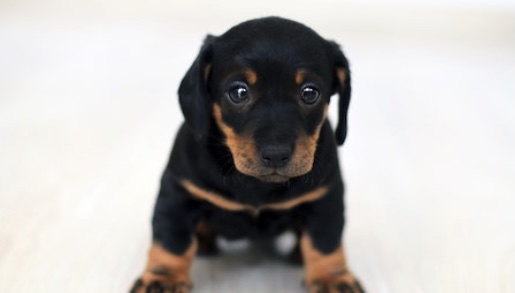
Photo by Dominika Roseclay on Pexels
 Memoirs of a Country Vet