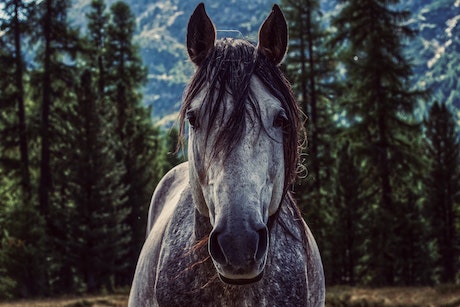
Smoke’s Fracture, From the Archives 

D. E. Larsen, DVM

A slight fog hung low across the moist grass as the early morning sun evaporated the dew. I always liked these sunny spring days that were intermixed with wet showery days.

There were cars already in front of the clinic when I arrived.

“We have a full morning, and Ed is waiting for you to return his call,” Judy said when I walked in the door. “We already have a couple of people in the exams room, but Ed sounded frantic.”

“Did he give you any idea of his problem?” I asked.

“You know these guys,” Judy said. “They only want to talk to the doctor.”

I stepped into my office and called Ed.

“Ed, this is Doc. What do you have going on?” I asked.

“Doc, thanks for calling me back,” Ed said. “I’ve been sitting here shaking. It’s Smoke, my young gray gelding. He has a broken leg. And he is in a hell of a fix. He can’t lie down, and he can’t walk. I don’t know how long it has been since it happened. I just found him this morning.”

“Are you sure it’s broken?” I asked.

“Oh, yes!” Ed said. “It’s just dangling, and it must hurt like hell. He cries out every time he tries to take a step.”

“What do you want to do with him, Ed?” I asked. “Depending on the leg and the break, the new vet school in Corvallis might be able to repair it.”

“No, Doc,” Ed said. “It would be hell just getting him over there. I just can’t see him suffering, Doc. I tried to shoot him. But I just couldn’t bring myself to do it. Can you come out and up him down for me?”

“Sure, I can do that, Ed,” I said. “I have people hanging from the rafters here at the clinic. How long do you think he can wait, Ed?”

“Doc, can you come now?” Ed asked. “Please. The wife is locked in the bedroom with her head buried in the pillows, and I’m a mess. I can hear Smoke squealing every time he touches that foot down.”

“People here can just wait, Ed,” I said. “I will be there as soon as possible.”

I grabbed a couple of bottles of euthanasia solution, three large syringes, and a couple of fourteen-gauge needles.

“Judy, I have to run out to Ed’s place,” I said. “When Dixie comes, you guys deal with people as they want. They can wait if they want or leave their pets. I will probably be close to an hour, but you know how that can go. It could be longer. You better get on the phone and reschedule everything you can that isn’t an urgent appointment.”

It was a short drive to Ed’s place in Holley, and I probably drove faster than I should have. Ed was standing at the gate to his pasture when I pulled into his driveway.

“He’s in the far pasture, Doc,” Ed said. “I think the ground is pretty good all the way out to him, and you can drive right up to him.”

“Okay, Ed,” I said. “Are you going to be okay to give me a hand? I didn’t have anyone at the office to bring with me this morning.”

“What am I going to have to do?” Ed asked.

“I just need you to hold a lead rope if you’re up to it?” I said.

“Okay, I can probably do that and just look the other way,” Ed said. “Let me open the gate, and I will get in and ride out with you.”

Ed’s hands were shaking as we drove out through the pasture. When we got close, I saw Smoke struggling to stay on his feet.

“Is Smoke insured?” I asked.

“Insured? Doc, he’s just a horse,” Ed said. “No, he’s not insured.”

Ed had fractured the cannon bone on his right rear leg. The lower part was just dangled. Every time Smoke tried to move and the hoof touched the ground, he would squeal. Smoke had genuine fear in his eye as I snapped a lead rope to his halter, and I handed the rope to Ed.

“Ed, there is no way to do this easy,” I said. “Lying him down is not an option. I will give him a massive dose of euthanasia solution, and he will be dead when he hits the ground, but it won’t be pretty.”

“I think I’m okay. Let’s just get it done,” Ed said. 

I filled two sixty cc syringes with euthanasia solution and retrieved a large twelve gauge needle from the truck.

“My bet is Smoke will rear up with this injection, and he will go over backward or more likely just collapse in a pile because that one hind leg won’t support him,” I explained to Ed. “Either way, as soon as the injection is done, you let go of that lead rope, and just him go.”

“Okay,” Ed said. “I guess I’m ready.”

“He might squeal, Ed,” I said. “Are you sure you can handle this?”

“Let’s just get it over with,” Ed said.

I leaned hard against Smoke to help give him a stable stance. Holding off his jugular vein, I slipped the 12 gauge needle into the vein. Then, with quick movements, I attached one syringe and then the other to the needle. With the large bore needle, I could push the plunger with ease. I emptied the two syringes in a matter of a few seconds.

I stepped back, and seeing Ed still holding the lead rope tight, I pulled it from his hands and let it fall to the ground.

When the drug hit, Smoke reared up and squealed loudly. When his right hind leg provided no support, he collapsed to his right hip and hit the ground in a heap. As I had promised Ed, Smoke was dead when he hit the ground.

Ed turned and walked several steps away. I thought he was going to vomit, but he was in control and came back in a moment.

“I don’t know you do it, Doc,” Ed said. 

“I’m a farm boy, Ed,” I said. “I learned many years ago that when there is something unpleasant to do, it is best just to get it done. No big fanfare. Just do it, and it is over. It is like a person dying. Everyone expects some profound last words. But that seldom happens. They just fade away.”

“What do I need to do now?” Ed asked.

“You can call the rendering company,” I said.

“I was thinking I would just bring the backhoe out here and bury my right here,” Ed said. “This is on top of a little rise, and it should be a good resting place for him. Do I have to talk to the county about that?”

“Not at this point,” I said. “It probably won’t be long before they require a permit and make you pay a fee. I know one family who has buried three Great Danes in their small backyard in the middle of town. One of these days, the bureaucrats will take control of that stuff.”

“Let’s go,” Ed said as he pulled the halter off Smoke. 

“Have you looked around to find out how he broke that leg?” I asked. “A few years ago, I saw a couple of calves break legs on an exposed root in a creek bank. This could have been something like that, and it might be wise to try to find it.”

“I’ll look after I get Smoke in the ground,” Ed said.

I dropped Ed off at the gate, said goodbye, and headed back to the clinic to salvage as much of the day as possible.

***

The following week, Ed dropped by the clinic.

“Doc, I found the spot where Smoke broke his leg,” Ed said. “It wasn’t ten yards from where  I found him. He must have been spooked or something. He ran right through an old downed oak tree and hung his leg in a tangle of branches. The damn thing is, I was going to clear out that old tree last summer and got sidetracked. I never got back to it. Damned if I didn’t kill Smoke, just as if I had shot him.”

“Don’t be too hard on yourself, Ed,” I said. “Things just happen on the farm.”

“You can bet I won’t put things off in the future,” Ed said.

Photo by Susanne Jutzeler from Pexels.

Morris, From the Archives

D. E. Larsen, DVM

The girls were all waiting for me when I came through the door after work.

“We have kittens!” they all screamed in unison.

“We have lots of kittens,” Amy said.

“Both Sam and Mittens had kittens,” Brenda said. “Sam only had one kitten, but Mittens had seven.”

“Come on, we will show you,” Amy said as she tugged my arm.

So off to the garage we went. Dee tagged along with the two older girls in the lead. 

Mittens was in her box, carefully tending to her large litter, and Sam was nearby with her single kitten. 

I grabbed Sam and palpated her abdomen to ensure there weren’t more kittens that didn’t make it out. No kittens in her belly.

“And look at Mitten’s white kitten,” Brenda said.

Sure enough, in the tangle of kittens was a white kitten.

“I think that is a siamese cross kitten,” I said as I picked it up and checked its sex. “He is a boy. We will keep this kitten; he will darken like a siamese as he gets a little older.”

“Mom said we are not to pick the kittens up,” Brenda said as I returned the kitten to the box.

“I get to do things sometimes that Mom says not to do,” I said.

We left the mothers with their kittens and returned to the house to prepare dinner. Sandy was just finishing up getting Derek fed and in his crib. I started putting together the dinner.

The girls were all atwitter about the kittens all through dinner.

“Can we check the kittens after dinner?” Brenda asked. 

“You can check them, but they need some privacy for a few days,” I said. “If you bother them too much, the mothers will move them. Maybe move them outside or hide them somewhere in the house.”

There was no slowing them down. The girls were done eating almost by the time Sandy got to sit down.

“Can we go check them now?” Brenda asked.

“You have to wait until Dee is ready to get down from the table,” I said. “And she will need some help washing up after dinner.” 

That would have been a chore from hell any other day, but Brenda rushed Dee to the kitchen sink to wash up her hands and face after she climbed down from the table. Then all three girls disappeared into the garage.

Amy was the first to return, almost out of breath from the excitement. 

“Sam stole the white kitten,” Amy said as Brenda and Dee rushed up behind her.

I got up and followed the girls to the garage. Sure enough, Sam had the white kitten snuggled up with her other kitten, and Mittens didn’t seem too bothered.

I picked up the white kitten and carefully returned him to his mother’s box.

“Why did she do that?” Brenda asked.

“I don’t know,” I said. “Maybe Sam thought she could help Mittens out with her bunch. Now let’s all go back in the house and leave the kittens alone for the evening.”

I checked the kittens one last time before going to bed. Sure enough, Sam had the white kitten in her box. I was tempted to leave it, but I carefully returned it to Mittens.

“Sam really wants that white kitten,” I said to Sandy as we got into bed.

“Both Sam and Mittens are black. Maybe she just likes the contrast,” Sandy said.

“If it keeps up, I am just going to let her have it,” I said.

Sure enough, Sam had the white kitten when the girls checked the kittens in the morning.

“I think Sam is just helping Mittens out,” I said. “I think we will let her adopt this little white kitten,”

“Brenda wants to call him Morris,” Amy said.

So Morris was raised by Sam. Sam was happy, Morris had little competition for milk, and Mittens was not bothered by the loss.

***

When Morris and his litter mates were still nursing, we made our move from Enumclaw to Sweet Home. Because we were going to be in an apartment initially, our eleven cats were delivered to my folks in Myrtle Point until we were in a house.

At Myrtle Point, cats were not allowed in the house. So our cats became barn cats.

“Why won’t Grandma let the kittens live in the house?” Amy asked.

“Grandma was raised on a farm, and cats and kittens were always in the barn,” I said. “The kittens will be fine. The biggest risk will be if the older cats leave to try to find their way back to Enumclaw.”

“You mean they would run away from Grandma’s?” Brenda asked.

“It probably won’t happen, but it is possible,” I said. “We have no other choice. They will just have to make do with the barn.”

***

When we finally were settled in our house on Ames Creek, we made the trip to Myrtle Point to gather all the cats. By some miracle, they were all there. And they had no adjustment with the move back to Sweet Home.

“I think Morris likes to live outside,” Brenda said shortly after we had the cats back home.

“He grew up in the barn at Myrtle Point,” I said. “He probably likes the freedom.”

It was not long after that discussion, and Morris was gone. The girls were crushed. The days turned into weeks, and the weeks turned into months. 

Then one Saturday morning, we loaded everyone into the car to go to the lake for lunch. We were less than a quarter mile from the house when Amy screamed.

“There is Morris,” Amy said, pointing out the window. Morris was sitting in the middle of a cat road that led up to some timber.

I stopped the car and walked up the cat road for twenty yards.

“Kitty, kitty,” I called to Morris. 

Morris turned and ran into the brush.

“Was that him?” Brenda asked as soon as I got back in the car.

“I am pretty sure that was him, but he wasn’t interested in being caught,” I said.

***

After that sighting, we would see Morris on multiple occasions. He was apparently living in the timber not far from the house. He evidently had no interest in coming home.

That was until one Sunday morning. Amy heard a cat meowing at the front door. She opened the door, and it was Morris.

“Let me pick him up,” I said. “He might not be ready for any hugs yet.”

I petted Morris, and he purred but made no effort to move. I picked him up, and there was the reason that he came home. His right hind leg was broken, a mid-shaft fracture of his tibia. I took him into the house and closed the door.

“Morris has a broken leg,” I said. “At least he knew where to come for help.”

Morris made a trip to the clinic with me that Sunday afternoon, and I called Dixie to come in and give me a hand with the surgery. He was like the plumber’s pipes. If I didn’t repair his leg today, it might be several days before I had the time.

Fractured tibias were probably the easiest of the bones to repair. I used a combination anesthesia of xylazine and ketamine. Then I made a small incision at the fracture site and placed an inter-medullary pin into the bone in a retrograde manner. The entire procedure took less than a half hour.

“Are you going to get an x-ray?” Dixie asked as I placed Morris back in the kennel for his recovery.

“I feel good about how things went together,” I said. “And I don’t think there is any need to document my work. I doubt if the girls will sue me for malpractice.”

“I wouldn’t be too sure about that,” Dixie said. “Those girls are all pretty fond of their cats.”

***

Morris healed well, and I removed the pin in six weeks, right on schedule. He was content to live in and around the house for the next fifteen years.

Photo by Amy Larsen.

There is Gold in Them Hills, From the Archives

D. E. Larsen, DVM

It was 11:10, and Bob should be coming through the door any minute. He was sort of the highlight of our morning in the office. Bob had been our Postman ever since the office opened. He was older, probably getting close to retirement, but he was a joy to talk with.

I think he must have us as a scheduled break on his route. He always seemed to have several minutes to talk. Bob was a Sweet Home native or as close as one could be to a native. He knew everyone in town. If we wanted to know about someone, Bob could give a pretty good synopsis. 

Bob could talk gold. He knew where to look in every stream, and he shares that information only to a trusted few. I liked to think I was one of those entrusted few. Bob had lost a son who was my age, a Lieutenant in the Army. In those years of the Vietnam War, Bob was probably preparing himself for his son serving in the war. Instead, he was driving home from the East Coast, and died in an auto accident.

The reality of the thing was he knew I was too busy to chase any of his stories.

We bumped into Bob one afternoon when he was panning gold with a friend. Bob took the time to give the kids and me a lesson on how to work the pan. We came up with a lot of black sand but no color. Bob truly enjoyed teaching his hobby to the kids, including myself. Hobby was probably the wrong word. I think gold was Bob’s true vocation. His postal job and any other work in his life only allowed him to pursue his real life’s work.

Bob told me a story one day about one of his trips to the California goldfields. He and a group of friends would make an annual trip to the areas out of Sacramento, California to pan for gold. This was a working trip for this group of guys. They would rework some of the same streams that were the site of the 1849 gold rush.  

Bob said that on one of these trips, they had a new guy along. He was always underfoot and trying to learn every little thing he could from these old guys. Bob finally tired of putting up with this guy. Bob pointed to a distant sandbar up the creek.

“Why don’t you go up there and work that sandbar,” Bob said.

The guy took his shovel and pan and headed up to the sandbar that Bob had pointed out. Bob and the rest of the crew continued to work with the dredge where they had been all morning.

“That was the biggest damn mistake that I ever made,” Bob said to me. “Just before quitting time that afternoon, this guy comes down the creek with a gold nugget the size of the end of your finger. I was so mad at myself after that, I almost couldn’t eat dinner.”

One August afternoon, we had a new client, Rob, came in with his dog, Yoda, a pit bull cross. Yoda had a pretty severe laceration on his large pad on his right front foot. Yoda was camping with his owner way up the Calapoolia River at the mouth of State Creek.

“Yoda spends most of the day in the river with me,” Rob said. “If he is not in the river, he is chasing a squirrel somewhere up the creek. I don’t know when this happened, I noticed him licking his foot last night, and then this morning he was limping on that foot quite a bit.”

Yoda was an excellent dog, and he didn’t flinch while I examined his foot. This was a deep laceration that extended halfway across the carpal pad, front to back. It was deep also. This was going to be challenging to get healed. Especially in a dog who was used to spending a lot of the day in the river.

“Pad lacerations are difficult to manage, in the best of circumstances,” I said to Rob. “In a dog who is spending a lot of his time in the river, it might be impossible.”

“I can keep him out of the water for a couple of weeks,” Rob said. “I am not on any schedule, I am just spending the summer up there panning for gold.”

“I suture most of these,” I said. “By suturing them and keeping them wrapped for a couple of weeks, most of them will heal. If we can’t keep a dry wrap on the foot, there is little chance that the sutures will hold.”

“When can you do this?” Rob asked. “Keep in mind, I am a long way from camp.”

“I can probably do it shortly,” I said. “But it is going to take a little time from Yoda to wake up.”

“This dog is the toughest dog I have ever owned,” Rob said. “You could probably sew this up without giving him anything. Is there any chance you could do it with local anesthesia?”

“We can try,” I said. “Yoda will let us know if that is an option or not.”

We moved Yoda into the surgery room. Laid him down on his side. He did not react as we started scrubbing the wound. Rob stood on the opposite side of the table from me and scratched Yoda’s ears. 

I drew up a syringe of Lidocaine and looked at Rob.

“We are going to find out right now, this stuff stings a little, I hate it myself,” I said.

Avoiding the laceration, I slid the needle through the skin at the front edge of the pad. Injecting a little at a time as I advanced the needle under the pad. I injected half the syringe here and then repeated the process from the back edge of the pad.

After a few minutes, I parted the edges of the laceration. There was no response from Yoda. Spreading the wound wide, I scraped the deep crevice of the wound. After scrubbing the wound, I applied some Neosporin to the wound and wiped it out with a sterile sponge. Then I draped the wound.

Taking a deep breath, I stabbed the pad with a suture needle. There was no response from Yoda. I glanced and Rob and smiled as I continued to close the wound. In this type of deep pad lacerations, I would use a deep vertical mattress suture using stints, made from IV tubing, on each side to spread the tension across the wound edges so the stitches would not tear the tissues.

Closure only took a few minutes. And then I applied a wrap that extended halfway up the leg. 

“The key to healing this wound is the wrap,” I said. “If it gets wet, it needs to be changed. Otherwise, we will change it every 3rd day. Is that a schedule that will work for you?”

“I can work with that schedule,” Rob said as he let Yoda stand up on the table.

“I will put him on some antibiotics just to make sure we keep the infection down as much as possible,” I said.

With that, Rob and Yoda headed back to camp. We started on their schedule of regular visits. Rob did a great job of keeping the wrap dry, and the wound looked better with each wrap change. After two weeks, we had a decision to make.

“We could go without the wrap starting now,” I said. “This wound looks good, but I really would like to go one more week.”

“The squirrels are going to love you, Doc,” Rob said.

The following week we removed the wrap and the sutures. This wound healed as well as any pad laceration that I had managed. I patted Yoda on the head when I set him down on the floor. 

“It has been fun working with Yoda,” I said as I shook hands with Rob. “It has been good working for you too. How long are you going to be around these parts?”

“I will probably break camp in a couple of weeks,” Rob said. “You never know about a guy like me, I might back next year, or I might be in Colorado.”

As the days passed, Rob and Yoda sort of slipped to the back of my mind. I was a little surprised when Rob was in the reception room one afternoon. He motioned to me, indicating he had something to show me. I invited him back into the exam area, and he looked at an empty exam room and stepped into it.

“I have to show this, Doc,” Rob said. “I saw this under a large boulder, and it took me three days to get to it.”

Rob had something wrapped in a square of rawhide in his left hand. He held his hand out as he peeled back the folds of rawhide. There, in the palm of his left hand, was the largest gold nugget that I had ever seen. I didn’t have words.

“Wow!” I said.

“This is what keeps us guys with gold fever going,” Rob said.

It was a few days later when I had time to meet Bob when he came through the door with the mail.

“Bob, I have a story to tell you,” I said.

“Will now, that is a switch,” Bob said, “you telling a story.”

“Bob, I just spent a few weeks working on a dog for a guy who was camped up the Calapoolia River at the mouth of State Creek,” I started.

“I know the area,” Bob said.

“He came into the clinic the other day with a nugget wrapped in a piece of rawhide,” I said. “This nugget covered the palm of his hand and was over an inch thick.” 

I motioned on my hand the size of the nugget. Bob grabbed my forearm, his eyes wide open, and his pupils expanded as wide as possible. 

“No!” Bob said, “I have been all over that river and that area. There is gold there, quite a bit of the stuff. But it is all small, tiny stuff really. I have never seen a nugget come out of the Calapoolia.”

“Well, I don’t know,” I said. “That was the biggest nugget I have ever seen.”

“That is a $20,000 nugget, maybe $30,000,” Bob said. “But, I can’t believe it came out of the Calapoolia.”

“I guess, when I think about it, he never specifically said it came out of the Calapoolia, I just assumed it,” I said. “He has been camped up there most of the summer.”

“Now you have done it,” Bob said. “I am not going to be able to sleep until I can get up there and start looking through the place myself.”

Photo by Csaba Nagy from Pixabay