A Note to My Readers

D. E. Larsen, DVM

The stories on this blog are my memoirs. They are stories based on real people and real patients. However, most of the names are incomplete, changed, or obscured. The exceptions are a few individuals who are now deceased and who I hold in such high regard that I cannot bring myself to hide their identity.

The events are as accurate as my memory allows. The stories are sometimes embellished, only slightly, to allow for a better narrative. There are only a few words of fiction. There are a couple of stories that were related to me by clients, and I had only second-hand knowledge of the event. Still, to the best of my knowledge, the incident happened.

The majority of stories are based in and around Sweet Home. Some are found in Myrtle Point and Broadbent, where I grew up. 

A couple of Army stories may show up. I was in the Army Security Agency for 1965 through 1969. I trained mostly in Massachusetts and then served in Korea and Germany.

There are several stories based in Enumclaw Washington, where I practiced when first out of school. And a few stories from my school years.

Surprisingly, many stories come from events that happened in the middle of the night, I guess those stick in my memory better. I was always a cow doctor at heart, and those events also seem to be higher in my list of memories.

My plan is to publish a series of these memoirs, hopefully starting sometime soon. I also have two easy reader book series in the works. These are written for 4th or 5th grade and up. Books will be 12 chapters, 10,000 to 12,000 words, and based on the adventures of a couple of the patients who have already appeared in this blog.

I am interested in any feedback you may have. You are welcome to give that in the comment section of the stories, or here. You can also contact me with feedback at my email address, d.e.larsen.dvm@peak.org.

Or on Facebook, I am David E. Larsen.

https://www.facebook.com/david.e.larsen/about?lst=1150586366%3A1150586366%3A1580425950

Rosie

D. E. Larsen, DVM

Rosie was a quiet Chocolate Lab who lived with her family up the river from Cascadia. Their driveway was nearly a mile long and joined the highway just below Mountain House. Tall Douglas Fir trees lined the road in this area. The river ran along the south side of the highway. The timber provided shade from the summer sun and the bubbling river provided additional cooling of the area. Even on the hottest day of summer, the upper reaches of the Santiam River provided a gentle breeze and mild temperatures.

The Mountain House was the last semblance of civilization for the next fifty miles. The road started a steep climb to the Santiam Pass in the Cascade Mountains just past the Mountain House. The history of Mountain House goes back to the early years of Linn County. It was a hotel to begin with, serving clients who visited the soda springs in the area. Now it was a backcountry inn and general store. There were no phone lines, so even in this last vintage of civilization, you were isolated.

The road had its share of curves, so any travelers were moving slow. People who took this route over the mountains were not in a hurry. They would turn off their air conditioning and open the windows so they could enjoy the fresh mountain air, hear the rushing water of the river, and hope to see some deer, elk, or any of the numerous birds in the area. Maybe even be lucky enough to glimpse a Big Foot. This area was as wild as any area in the state.

Rosie’s family was small. Her owners were an older couple who had lived in their little house on the banks of Soda Fork for many years. George and Alice Dunn relished the quiet and isolation. They seldom came to town, preferring to get what supplies they needed from the Mountain House. If they needed something special, they order it, and the Mountain House would pick it up for them when they went to town for supplies. Rosie shared this family with an old dog, Nick. Nick was an old Black Lab, very arthritic, and he didn’t often get off the porch. He provided Rosie company, and while she licked his ears, she could share her adventures of the last squirrel hunt or the fishing trip in the deep holes of Soda Fork Canyon. Then they would curl up and sleep on the porch. Rosie keeping one eye open for the raccoons who would come by in the night. She hated those raccoons.

Life on the banks of Soda Fork was not without its challenges. A garden near the house was impossible because of the shade from the timber. They would grow their vegetables on some of the clear-cuts located along road higher up the creek. They had learned to carry water to these gardens from the Marijuana growers in the Cascadia area. They used an old waterbed mattress in the back of their pickup truck. They would attach a hose to the outlet of the waterbed and water the garden as needed.

Their meat supply came from the game harvested from the area. They took only the meat they needed, and they used every part of the animals collected. Be it a deer, an elk, or a couple of squirrels, they only took what they needed, and they gave thanks every time. The short canyon up Soda Fork provided some excellent fishing, especially in the Spring and early Summer. The access to the canyon was too difficult for the fishermen from town. Hunting and fishing seasons had little meaning for them. They did not hunt or fish for sport but for subsistence. Game wardens only ventured into this area during hunting season when there were enough other people to make it safe for them to be off the main road.

We did not see the Dunns often. They would bring the dogs in for their Rabies vaccination every 3 years. They felt they were isolated enough that they did not have to worry about the other vaccines.

“Your isolation might make those other vaccinations more important,” I explained on one of their visits. “Dogs in town get a vaccination as a puppy, and then they see many other dogs in their lifetime. They are likely exposed naturally to most of the important viruses. Their immunity is likely to last for several years. We recommend boosters just to be sure because a disease like canine distemper is often fatal, and parvovirus can be extremely expensive to treat. Your dogs seldom see another dog, their immunity probably weakens much sooner than the town dogs who are likely to come into contact with those viruses naturally. Something to think about when considering their vaccinations.”

During these routine visits, Rosie enjoyed the clinic and the treat jar. Nick, on the other hand, hated the trip to town and shook the entire time in the clinic. He would take a treat, only to drop it on the floor for Rosie. He would not be bought.

Nick continued to age, and his arthritis became so severe that he could hardly get around. There was not much that we had to offer, medication wise, at that time. That last visit came when Nick could no longer get off the porch to do his business.

“Doc, we feel terrible about this, we wanted to wake up some morning and find that he had passed away in his sleep,” George said. “Are we doing the right thing? We don’t want to do this if you think we should wait.”

“It is always a hard decision, but once you make it, you don’t want to put yourselves and Nick through the struggle again. He isn’t going to get any better, and life is going to be miserable for him from here on out. It is better to make this decision one day too soon and a day too late.”

Alice signed the release. “I am going to wait outside George. You stay with him. I wish we had brought Rosie,” she said as she slipped out the door, wiping tears from her eyes.

“What happens now, Doc?” George asked.

“I’m a farm boy, George. Life comes, and life goes. I believe that when the decision is made, and we are all on board, we get it done. No ceremony, get it done, and then we all get on with grieving.”

“Okay, Doc, I am ready.”

I dropped to my knees, Nick was laying on the floor. He hated the exam table. I lifted his head by his chin. His eyes were half-closed, cloudy mucus filled the corners of his eye. There was no longer any black in his muzzle, and gray hair streaked the rest of his coat. I stroked his head and allowed him to lower it back to his paws. I placed a rubber band tourniquet above his elbow and felt to make sure he had a favorable vein. This needed to be a quick procedure. Nick hated this place, and I didn’t want to put him through any more than necessary.

I took his left paw in my left hand and slipped the needle into his vein in one movement. I drew back on the syringe just a little, making sure I was in the vessel, released the tourniquet, and started the injection of a massive dose of pentobarbital. Nick was gone before the dose was fully delivered. I checked his heart and pulse, nothing there. No reflex in his eyes.

I stood and looked at George. “That all?” he asked.

“That’s all, he is gone. Do you want me to take care of him?”

“Oh no, we have his place under his big cedar tree that used to be his favorite place to sleep. That was a long time ago.” George said, wiping a single tear from his cheek. “Can you help me get into the back of the pickup?”

We loaded Nick and said our good-byes. They were having some difficulty talking right now. They needed to get home and finish this terrible day. Hopefully, Rosie will handle the loss, okay.

It was several months later, during one of our early October rainstorms, when a young couple came through the door with a very wet chocolate lab.  

“We found her alongside the road up by Mountain House,” the young lady said. 

The dog went right to the treat jar and sat down, staring at the jar, as if to make it open.

Sandy came around the counter to get a better look, opened the jar and handedk the wet dog a treat. The treat instantly disappeared.

“She acts like she knows the place,” the young man said.

Sandy read the rabies tag hanging from the collar. 

“It is our tag, so she has been here before,” Sandy said as she looked up the number.

“Oh my!” Sandy exclaimed, “This is Rosie.” 

Rosie stood up and wagged her tail at the mention of her name.

“She wasn’t lost, she lives about a mile up the creek from where you picked her up,” Sandy explained. “But that is not a problem, we will make sure she gets home.”

“It is hunting season, and I am sure that Doc will be more than happy to take you home tonight when he is done,” Sandy explained to Rosie as she handed her another treat and escorted her back to a kennel. 

“If you have time, you need to dry Rosie off a bit,” Sandy mentioned to Ruth as she went back to the front desk.

That evening I threw my rifle in the truck and loaded Rosie into the front seat. The drive up the river was a pleasant one. The rain had mostly changed to a light mist. The wind was blowing, and it was brisk along the river. Yellow and Orange leaves were flying off the trees, tumbling in the air and floating down the river. Rosie sat up, looking at the road as we sped along. She seemed to know exactly where we were going.

The Dunns were on the porch when I pulled into their driveway. Rosie was standing and wagging her tail. She almost knocked me over as she scrambled to get past me as I was getting out of the truck.

“Oh Doc, we have been sick all afternoon looking for Rosie. We thought we had lost her for sure. How did you get her?” Alice asked.

“A couple of kids picked her up down at the highway. They thought she was lost. They said they just opened the door and she crawled into the car. They brought her to the clinic early this afternoon.”

“I wish we had a phone, it is terrible that you had to bring her all this way. Can we pay you anything for your trouble?” Alice asked.

“No, I am happy to be able to do it. Besides, I thought I would run up the creek for a few minutes and see if I can get that old buck that George has been feeding all summer.”

“That would be great, Doc. Let me grab a coat and come with you. I just happen to know where a little forked horn sleeps,” George said.

A couple of miles up the road, we came to giant Douglas Fir tree that had been saved for public view. 

“Slow down here and pull off in that pull out up ahead,” George said, speaking in a hushed voice as if the deer could hear us from inside the truck. “Close your door real quiet like, this guy is going to be in that little clearing between the tree and the creek.”

I walked around the truck, George placed his hand on my shoulder and pointed to trail through the brush. We made our way toward the creek, not saying a word, but I could hear George’s breathing behind me. As we approached the clearing, George grabbed my shoulder to bring me to a stop. He pointed over my right shoulder to the far side of the clearing. There was the little forked horn, unaware of our presence, browsing on a low bush.

Bang! One shot through the heart, the deer lurched forward, maybe a few steps, and fell forward in a pile.

“Good shot, clean kill, just like it should be,” George said in a normal voice now. “You bring the truck around to the road toward the creek, and I will get this guy out to the road.”

I pulled the truck around toward the bridge on the side road. George had already had the buck out to the road. It didn’t take very long to take care of him. 

“I never take the heart and liver, Sandy won’t cook them,” I told George.

“Oh, we like those, and I’ll take the kidneys also.”

“I will give you half of this deer, George. I would have never found him,” I said.

“All the hunters just go a barreling past this little place, but I don’t need half, just a hind leg will do us fine. We have plenty of meat most of the time.”

I had a large plastic bag that I used for the heart, liver, and kidneys. We skinned out a hind leg, carefully severed the meat from the pelvic bones, and disarticulated the hip. I removed the lower leg, at the break joint just below the hock, and slipped the whole leg into the bag with the organs.

“You do quite a professional job, Doc. You would be a handy guy to be around hunting camp.”

“I have never had the time for a hunting camp. My hunting is just like this, a stolen hour once in a while. Always feel lucky if I get anything.”

“Doc, if this happens again with Rosie, you don’t have to bring her all the way up here. We will run down to Cascadia and use the phone at the professor’s house. You know, Dr. Hayes. You can also leave a message for us with him.”

“Okay, and we can hang onto her for a couple of days for that matter.”  

“What do you suppose is going on with her, Doc?”

“She was pretty close to Nick, probably just having trouble getting used to his passing. Maybe you guys should get a puppy.”

“No way, we are too old to take on a puppy. Wouldn’t be fair to the pup, might end up being a race with Rosie to see who goes first.

And so it started, it seemed that Rosie came to the clinic every couple of weeks. Her rabies tag was her ticket. She would sit by the road and people of just figure that she was lost. They could not visualize a dog having a home in this area.

Rosie loved to come to the clinic. She would come through the front door and approach the counter with tail wagging. Then she would sit down in front of the treat jar and stare at the jar, mouth open, panting, and saliva draining from the side of her mouth. The people would figure out quickly that they had given her a ride to her favorite place.

“Rosie, what are you doing here again this week?” Sandy would say as she retrieved a treat from the jar.

With the treat in her mouth, she would continue to doors to the kennel room. She knew her routine very well. The couple who brought her through the door stood sort of dumbfounded.

“She obviously knows where she is welcome,” the young lady said. “We found her lost beside the road up by Mountain House. We couldn’t just leave her there to get hit by a car. We stopped and opened the door, and she just climbed in, like she was expecting us.”

“We see Rosie every couple of weeks. She lives up by Mountain House. Her folks have a driveway about a mile long. Rosie gets bored since they lost their older dog, she just goes down and sits by the road. Somebody comes along and picks her up, thinking she is lost or deserted. Most of the time they bring her here, once she was taken to Redmond. Our Rabies tag gets her home every time,” Sandy explained.

This went on for 5 – 6 months. It almost became part of our routine, and we would see the Dunns frequently when they would come to retrieve Rosie. On occasion, the old professor, Doctor Hayes, would be the one to pick up Rosie. And then, suddenly, it all came to an end. The end was one of those things you felt more than something that was on the surface. One day Sandy said, “We haven’t seen Rosie in weeks. I wonder if something has happened to her.”

It was several weeks following that realization when we bumped into the Dunns at Thriftway. Thriftway was not the biggest grocery store in town, but it was the only one that I would use.  

“Hi Doc,” George said as we met at the doorway.

“George, how are things? We have been thinking about you guys at the clinic. We haven’t seen Rosie in a long time. Is everything okay with her?”

“You were right, Doc, about the puppy thing. We didn’t get a puppy, so Rosie sort of took care of things herself. It was sort of funny, you know how she hated the raccoons who came around. Will, an old sow raccoon with a bunch of babies, got hit by a car down on the highway. There were dead raccoons scattered everywhere. Rosie must have heard it, or maybe she was just going down there to catch another ride. Pretty soon, here she came, with a baby raccoon in her mouth. She must have found the only one to survive. Anyway, she adopted the thing. She spends all her time taking care of the little guy.”

“Isn’t that funny,” I said. “I don’t really approve of raccoons as pets, it is illegal for one thing, and there are some health factors, like the raccoon roundworm.”

“It’s no pet, Doc. Rosie takes care of it on the porch. It can come and go as it pleases. It won’t have anything to do with us, except to eat the food we provide. But it sleeps with Rosie, she washes the thing with her tongue every night. I don’t know what will happen with it as it gets older, but right now, Rosie is happy as can be and back to her old self.”

One More Pregnancy

D. E. Larsen, DVM

“I wish Dr. Ball was here,” I thought to myself as I drove my left arm deeper into the rectum of this old fat cow. Dr. Ball was the chief OB instructor at Colorado State when I was in school there. He was tall and thin, and it seemed that his arms were long enough to reach his knees, and his fingers were at least 6 inches long. He could do anything in a rectal exam.

“How am I going to get this uterus retracted,” I thought as I swept my hand across the floor of her pelvis. I could just grasp the cervix; the rest of the uterus hung over the brim of the pelvis and was heavy and resisted my attempts to pull it back so I could get a better grip.

“Bob, I don’t know if I am going to be able to retract this uterus,” I said as I looked at an anxious owner. “Let’s review her history one more time.”

I pulled my arm out and removed the OB sleeve. I could do 100 pregnancy exams in a couple of hours, but this old cow had already tired my arm out. I leaned on the railing of the crowding ally, resting my arm, as I talked with Bob.

“How old is this cow?” I asked.

“She is going to be 19,” Bob answered. “She is my first and is the genetic base of my entire herd. I realize it is a big request, but I would  love to have another calf out of her.”

“When was the last time she had a calf?” I asked.

“Three years ago, probably a little over that,” Bob said.

“When was the last time you bred her?” I asked. “I mean, is there a possibility that she has a pregnancy. I have not even been able to get the uterus up where I can check for a membrane slip.”

“No, I quit wasting semen on her will over a year ago,” Bob said. “I didn’t have a bull before we moved. This young guy I have now might get a chance at her if you say go.”

“So, this is the situation,” I started to explain. “This cow is 19, very over-conditioned, fat it other words. She hasn’t been pregnant in over three years and has a uterus that is out of reach. That most likely means there is some chronic pathology in that uterus. That all adds up to a slim chance of getting her npregnant.”

“What is the first step in trying?” Bob asked.

“The first step is to retract her uterus so we can decide what might be going on inside of it,” I said, a little unsure that I had been clear enough in my explanation. “In school, we had Dr. Ball. He could retract this uterus is a heartbeat. When he wasn’t available, we had a large cervical forceps that could clamp on the cervix and provide a little additional traction to pull the uterus up where you could get ahold of it. i don’t have such a forceps. But I have a large Oschner forceps that has some teeth on it and might be able to provide a little traction. The only problem would be it could put a small tear on the cervix if it doesn’t work.”

“If that is what it takes, let’s do it,” Bob said. “This is probably the last time we have a chance of getting her pregnant.”

“Just to be clear, that chance is less than twenty-five percent,” I said. Why did I give such a figure? Never give odds to a horse owner, or probably a purebred cow breeder. They will take you up on it every time.

I tied the cows tail out of the way, tying it with a loop of twin around her neck. That way if we forgot to untie it before releasing her from the chute, we would not pull the end of her tail off. After prepping her vulva, I tied a length of gauze to the handle of my 12-inch Oschner forceps and carried the forceps into the vagina with my left hand and arm. Along with the forceps, I brought a guarded culture swab.

The cervix was large but felt relatively healthy and was tightly closed. I advanced the guarded swab to the cervical opening and pushed the swab into the uterus. I pulled the swab back into the guard, pulled that out with my right hand, and handed it to Bob.

“Hold onto this for a minute,” I said.

Then, back inside, I clamped the forceps on a stout external ring of the cervix at the top. Then I tested the gauze with a firm pull. The forceps held, and the cervix did retract a little. I withdrew my hand and made sure the gauze followed and hung outside the vulva.

“Bob, do you know if this cow cycles normally?” I asked.

“Yes, she cycles as regular as can be,” Bob said. “You can almost set your calendar on her every 21 days.”

“Do you know when she due to cycle?” I asked.

“She should cycle in the next few days,” Bob said.

I changed sleeves on my left arm. I pulled the fingers of an OB sleeve and pulled it on my arm, then stretched on a latex exam glove. Finally, covering it again with another OB sleeve with the fingers removed. The would provide much better sensitivity in my fingertips.

“This is the plan,” I started. “If this uterus feels like it is salvageable at all, I will infuse it today with an antibiotic. Then if she cycles, you go ahead and breed her with the bull and call me. We will infuse her again, 24 hours after breeding.”

“I would rather breed her with AI semen, and save the bull for the last resort,” Bob said.

“Okay, I just want to try on this cycle, just in case we get lucky,” I said. “We will have the culture results back by next week and be able to make an antibiotic selection based on that culture. If she doesn’t get pregnant, we will go through a series of infusions. We might be working on her for several months.”

I drew an infusion of Furcin solution and Neomycin into a 60 cc syringe and attached an infusion pipette to the syringe. I handed this to Bob, and I took the culture swab and set it aside. That done, I lubed my left hand and arm and pushed as deep into the rectum as I could. I grabbed the cervix and, at the same time, with my right hand, pulled on the gauze attached to the forceps. The cervix and uterine body retracted into the pelvis. I reached forward and flipped the entire uterus back into the pelvis — sort of amazed myself.

“This uterus is the size of a uterus with a 90-day pregnancy,” I said.

Out of habit, I checked for a membrane slip; there was no pregnancy. The uterus was thick and dough-like, with no significant fluid present. Probably just a case of very chronic uterine infection, endometritis, I thought. The ovaries were active and felt normal with a receding corpus luteum on one ovary.

“Okay, hand me that syringe,” I said.

Holding the cervix, I worked the pipette tip through the cervical rings and made the infusion. Then I allowed the uterus to return to its position. I pulled my arm out and removed the sleeve, carefully turning it inside out. I prepped the vulva again. Then with a new sleeve, I retrieved the forceps for the vagina.

And so it began, a months-long battle with an old, chronically infected uterus, trying to bring about a pregnancy. I went through a week of antibiotic infusions based on culture results. We used post-breeding infusions after every breeding attempt. We used artificial insemination, and we bred her with the bull. She continued to cycle regularly. At least she didn’t raise any hopes by missing a heat period.

I was at wit’s end, and then I remembered a conversation with Don in Enumclaw, on our way back to the clinic, from doing some pregnancy exams. Don enjoyed picking my mind. We had gone to different schools, and sometimes our views on how to do things were completely different. We both modified our thinking in small ways from our discussions.

“I want to tell you,” Don started, “if you ever get in a situation where you want to get a cow pregnant, I mean, if you have tried everything and you really want her pregnant. You infuse her with dilute Logul’s.  

“That is probably the only absolute ‘never do’ that Dr. Ball told us,” I said. “That is supposed to do far more harm than good.”

“I am just saying,” Don repeated, “if you really want to get that cow pregnant, use an infusion of dilute Logul’s. It works, maybe not every time, but it works.”

“I don’t know,” I replied, somewhat skeptical of the advice.

“You do an infusion; the cow will cycle in 6 – 8 days, skip that cycle and breed her on the next cycle. You can do a post-breeding infusion if you like. You will have a 70 or 80% conception rate on that breeding. And most important, you will have a very happy client. I know what the literature says. And I know how you were taught, but in this case, my experience trumps all of that. Just file it away in your mind and try it if the need arises.”

On my next trip to check the cow, the uterus was improved. After all the treatment it sort of felt like a normal uterus now. I could retract it into the pelvis in a pretty standard manner now. So things were improved, but still, no pregnancy resulted.

“Bob, I have one more trick we could try,” I started as I explained the new plan. “There is a treatment that I was taught in school never to use, but the guy I practiced with when I was in Enumclaw, swore by the results in just this situation. We have pretty much exhausted the book. We have worked through everything, and the uterus is better. You can probably remember the difficulty I had during her first exam. But today the exam goes easy. 

What I suggest is an old-time treatment. I do an infusion with dilute Logul’s.  This infusion wipes out the lining of the uterus. And then the lining of the uterus is regenerated from a few remaining cells.”

“Sort of like a chemical D&C,” Bob said.

“Yes, I guess that is a good way to look at it,” I said.

“It doesn’t look like we have any other choice,” Bob said. “Let’s do it.”

It took me almost a week to get a bottle of Logul’s. It was not something in the regular supply line. When it came, I had no recipe for mixing a dilute solution. I sort of went by the old Port Wine formula that I used for Betadine. I mixed a solution, and we gave Bob a call and set up a visit.

The infusion was no problem. The old cow was used to the chute now. I noticed that when we turned her out of the chute and started discussing the breeding schedule, she was hunched up a little. There must have been some significant discomfort with the infusion.

“Expect her to cycle in 8 days or less,” I said. “Don’t breed her on this cycle but breed her on the following cycle. We should plan a post-breeding infusion just to on the safe side.”

Her cycles went right by the book, eight days, and 21 days after that. Bob called when he had bred her. I had hoped he would use the bull, but he used artificial insemination. He probably figured he had gone through all this trouble; he wanted a good calf. 

I marked my calendar for her next expected cycle. The date came and went, and there was no call from Bob. Too early to celebrate, I thought, but just maybe, she is pregnant. At 42 days after breeding, Bob called.

“She still hasn’t cycled,” Bob said with some excitement in his voice. “When do you want to check her?”

We waited until 50 days, with her uterus being larger than most, I didn’t want to be in a situation where there was a question with the exam.

When 50 days came, the exam was brief. The uterus felt the best that I had seen in this old girl, and a 50-day pregnancy was present based on a membrane slip and palpation of the amnion. 

I was relieved and happy. Bob was happy. And I am sure the old cow would enjoy not being run through the chute every few days. And the bottle of Lugol’s probably sat on my shelf for the next 20 years before I discarded it.

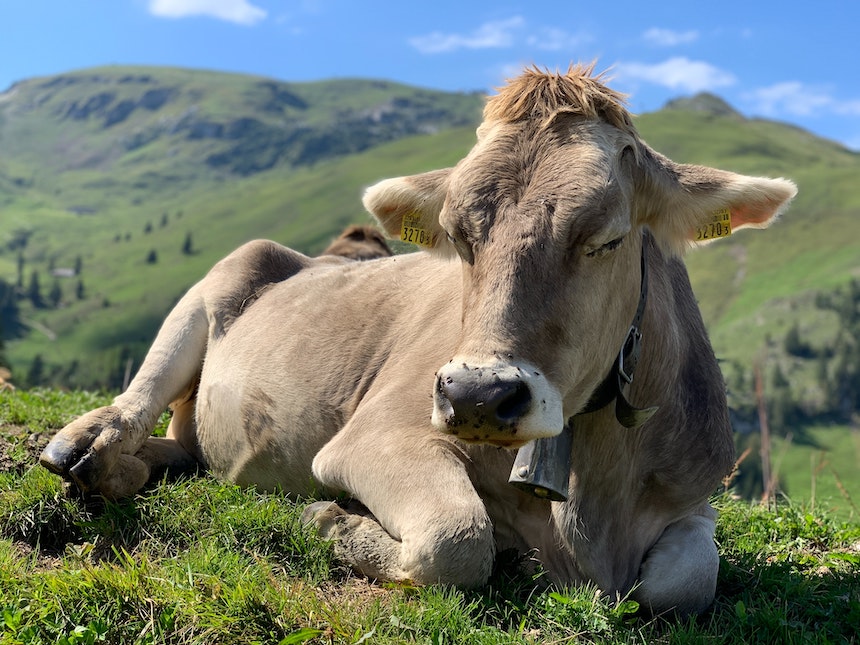
Photo by Harry Cunningham on Unsplash