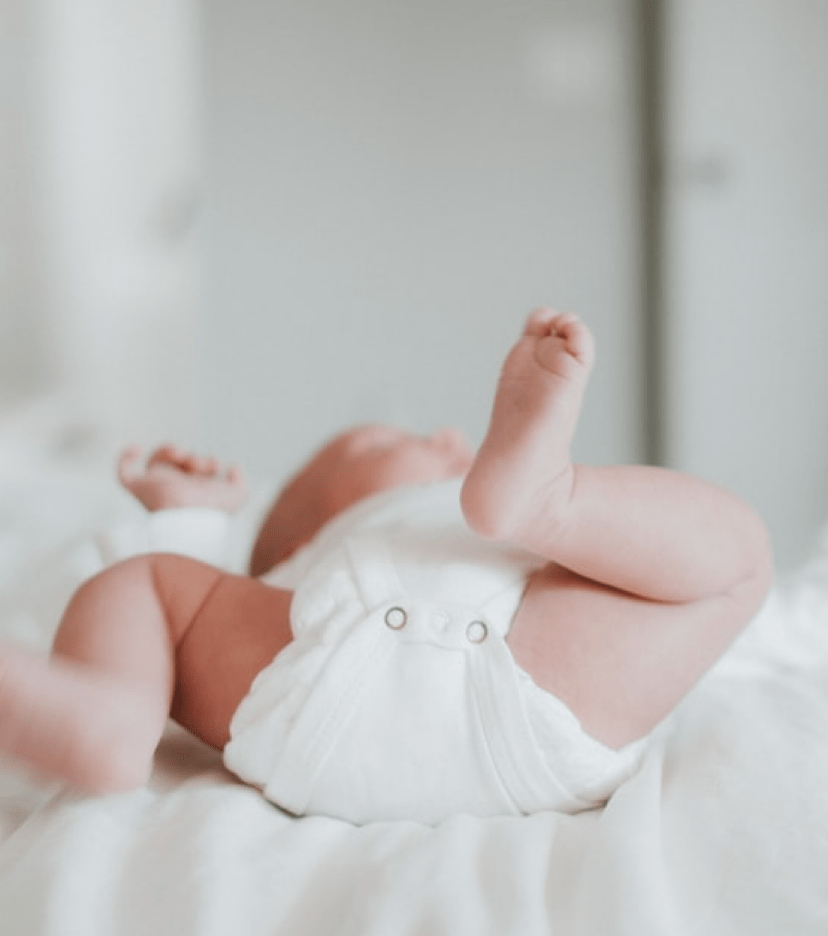
I watched as Sandy was getting ready to change diapers on our young daughter. She was four months old and jabbering in complete sentences. Of course, nobody could understand her, but she seemed confident in what she was saying.
That was at least the way she was most of the time. When her diapers were wet, she howled. She was obviously uncomfortable. In reality, she was in pain.
We had been struggling with a diaper rash for the last couple of months. Sandy had a battery of products that filled the entire basket. The doctor had one suggestion after the other. And nothing changed things that much.
“How does it today,” I asked?
“I think it is worse,” Sandy said. “There are sores now, not just a rash. These sores are deep, and they cover her whole bottom.”
I looked over Sandy’s shoulder as she carefully cleaned the inflamed baby’s bottom. She patted it dry, and one could see a mild red rash across the entire bottom. Multiple deep erosions, the size of the eraser end of a pencil, superimposed on the inflammation.
“What do they have you using now,” I asked? “Did you ask about using a little Neosporin or something for infection?”
“No. Doctor Carlson was busy and behind schedule, so I didn’t get a chance to talk to him much. But he didn’t seem to be very concerned.”
“I think you should let me take her to the next visit,” I said.
“You don’t have the time. You are in clinics all day. Besides, we are not going to treat our daughter like you would treat a cow.”
“Well, I am a ways from graduation, but I have already learned that if what you are doing is not working, it is time to do something else.”
“She goes back tomorrow to see Dr. Carlson,” Sandy said. “I will make sure he understands your frustration.”
“Tell him it is his last chance,” I said. “If he doesn’t solve the problem, the next choice will come from my bag of tricks.”
“I am not going to tell him that. You need to learn some respect,” Sandy said with a scowl on her face.
When I got home the next day, Sandy applied a new ointment to the baby’s bottom.
“Dr. Carlson says this one usually works like magic,” Sandy said. “He doesn’t want to use any Neosporin or antibiotics at this point.”
I looked at the tube, A&D Ointment. It didn’t look much different from the others, only cost a little more.
“I will give you a few days, and we will see what happens,” I said.
On Saturday morning, I was up and changed diapers so Sandy could sleep in a little. There was virtually no change in the now deep ulcerations on the baby’s bottom. I smeared on the A&D ointment and rocked her back to sleep.
I slipped out the door and drove to the veterinary hospital on CSU’s campus. I signed out a large tin of Bag Balm.
When I got back to the apartment, everyone was still asleep. I placed the tin of Bag Balm on top of the pile of Sandy’s pharmaceuticals. Then I started cooking a breakfast of pancakes with some bacon. Everyone was up by the time the cooking was done.
Sandy didn’t notice the large green tin with red lettering until after breakfast when she changed diapers.
“Where did this come from,” she asked?
“I picked it up at the hospital pharmacy this morning while you guys were sleeping.”
“The veterinary hospital pharmacy? I think this new ointment from Dr. Carlson is working. She is not nearly as uncomfortable with wet diapers as she was before.”
“The sores are no better. In fact, I think they are deeper,” I said. “I gave this tube of snake oil 3 days. That is all I ask for the Bag Balm.”
“Okay, but I don’t like it. This is not a cow’s udder,” Sandy said.
“Skin is skin,” I said. “I think you will be amazed.”
Three days later, the superficial portion of the rash was entirely resolved, and the deep ulcers were well on their way to be healed. The baby was comfortable. No more howling when her diaper was wet. As foretold, Sandy was amazed.
“Why don’t the doctors use this stuff,” Sandy asked?
“We are fast becoming an urban society. What would a mother, who was 3 or 4 generations removed from the farm, say if a doctor handed her a tin of Bag Balm?”
“Well, Doctor Carlson is at least going to hear the story,” Sandy said. “It just might save some other baby from the misery of a bad diaper rash.”
At the end of two weeks, the baby’s bottom was udderly normal. Sandy was convinced that I might just know a couple of things. And Bag Balm has been in our medicine cabinet ever since that episode.
My father’s early life was difficult at its best. He grew into an exceptional father for having grown up without a father. He rarely spoke of his early life. And when he did, he only told stories in small snippets. It took me well over half my life to piece those snippets together into a story.
He was born in Bellingham, Washington. The last of 5 births for his mother. His father was a Norwegian sea captain who sailed lumber schooners from the Northwest to San Francisco. His father went by Samuel Lars Larsen. That is all I knew of Sam for most of my life.
Sam married my Grandmother, Mary Jane (Mollie) Coats, in Bandon, Oregon, in 1903. Sam was 43 years old, and Mollie was 21 and 5 months pregnant. They lived in Bandon and Coos Bay for several years. Sam was known for his fondest of the bottle. Some would call him a drunk, but a high functioning drunk. He had his Master’s License before the age of 40.
In October of 1905, Sam was master of the schooner Sacramento when it ran aground on Coos Bay’s North Spite. The story was he was anchored waiting out a storm. The anchor line broke, and the ship was aground in the morning. The crew was rescued with herculean efforts by the life-saving team. This was 4 years before my father’s birth, so a large debt is owed to those men, and their wives, by many generations of subsequent Larsen kids.
In January 1906, Sam and Mollie arrived in Bellingham, where his 3 brothers lived. They had their first son and an infant daughter. According to the family story, the daughter was smothered in bed that first evening.
Sam never sailed after that. I suspect he was fired following the shipwreck. Maybe he was sobering up rather than waiting out a storm. That is unknown.
In August of 1910, when my father was 1-year-old, his 2-year-old sister died from acute bloody diarrhea. Sam and Mollie separated following that death. Mollie returned to Bandon with the 3 boys to live with her folks, Thomas and Sarah Coats.
Dad only spoke of his grandfather in Bandon a couple of times. He feared the old Irishman, probably with just cause. Dad set fire to a mattress in the upstairs bedroom when he was 3 or 4, and the old man had to throw the burning mattress out the window. That probably did not endear him to his grandson. His grandfather died when he was 4, and Dad remembered they had him stretched out on the kitchen table, preparing him for burial.
In 1917, Mollie and her mother moved to Southern California. Life was not comfortable there. In early 1920, at the age of 10, Dad and his older brother Merle, who was 13, were checked into The Boys and Girls Aid Society of Los Angeles orphanage by their mother. They were there until they turned 14, not long for Merle but over 3 years for Dad.
That Society has evolved into Five Acres (https://5acres.org). An organization offering a full continuum of care for children and families in crisis, serving over 10,000 children and families annually.
When I tracked down Dad’s records, the administrator said it was good to hear a success story from that era. That those kids had a rough life compared to today’s standards, and there were not many success stories.
Dad was released from the orphanage when he was 14. He worked as a caddie. Dad caddied for Oliver Hardy and caddied for one player in a golf tournament at Pebble Beach. His only comment of that event as he had to sleep in the car.
During this time, he developed a love for the movies. He would stand around the theater’s entrance until a family came along and then just go through the door with them. Kids were free with paying adults.
He learned to swim well underwater because the pool had tokens on the bottom of the pool. If you found a gold token, you were given free admission the next visit.
His mother remarried when he was 16, and he did not get along with his stepfather. So he hitchhiked to Oregon and stayed with his mother’s sister, Hattie Rogers, in Coquille. He took the only job available and became a whistle punk in the logging woods.
He returned to California for a time, only to hitchhike again to Oregon. Riding the rails on the second trip, he managed to separate the cars at one point, and the hobos were unhappy because the crew kick all of them off the train.
On his second trip, he stayed with another of his mother’s sisters, Annie Tripp. He returned to high school at Myrtle Point at the age of 21. Met my mother, worked in the woods for a time after graduating. After they were married in 1934, he attended Oregon State for a couple of terms.
There are few stories of his high school years. He finished in 2 years, and I find his name on the honor rolls, something I would have never dreamed of growing up. He spoke of stealing Mom from her boyfriend, right in front of him, something I think he looked on with pride.
1934 OSU Rooks, Frank Larsen, 4th row, behind #64. Slats Gill, 1st row, far left, in suit
At Oregon State, he managed to make the freshman football squad, The Rooks, coached by Slats Gill. He did get his picture taken with the team but quit before the season was over.
“They just use us for fodder for the varsity,” he told Mom at the time.
After winter term, they came home to Myrtle Point, hitchhiking from Corvallis to Myrtle Point.
I heard Dad tell a friend. “We ran out of money, and I knocked up the old lady. I had to quit.”
After that, it was work and family. Dad worked in the woods, eventually becoming a donkey puncher, and they lived in logging camps and isolated houses. My sister, Linda, was born in 1935, brothers Larry in 1936, and Gary in 1941. I came along in 1945.
Life was different in Western Oregon in the 1930s and 40s. My brother told my sister’s whittling story on a door jam, and she dropped the knife. It stuck in her eye. Dad had the one car at work, no phone in the house. Mom held my sister with a washcloth over the wound until Dad got home and could get to the doctor.
In January of 1950, Dad purchased a small dairy farm above Broadbent. I am sure this was a significant achievement in his life. We milked cows, and he continued to work in the woods. We were taught work ethics by observation. We would be considered poor by today’s standards, but we thought of ourselves as well to do. California cousins would visit. Arriving in new cars and leaving with soiled clothes and broad smiles.
Dad would build a fire in the kitchen stove, the only heat in the house, before leaving for work at 5:00 AM. Mom and kids did the morning milking before cleaning up to go to school. Dad would get home and do the evening milking, also with the kids.
Dinner was always a family affair, and you would eat what was on your plate, period. Fried chicken nights were always open warfare over the white meat. Mom became creative in cutting up the one chicken for dinner.
I was home when Dad got the call that his mother had died in 1957. He cried, the only time I saw that, and he was mad at himself for it. He never had a relationship with his mother. She never did anything for him, never sent a card to any of the kids.
I was the youngest of four kids in our family of 3 boys and 1 girl. Everyone argues about which family position is the most favored by the circumstance of birth. I can’t resolve that debate, but I believe that I benefited from observing my siblings receiving their lessons on life from our father.
Teenage years are always difficult to live through. My father was always there and supportive. When I was 14 or 15, I challenged him, and I learned in no uncertain terms that I was the lesser man. He came at me like a charging bull, and I learned quickly. And that was that.
He saw that I understood that a job was necessary, and I got one starting my junior year in high school. I made cheese for 4 years, after school and summers.
“You do the best job you can at whatever you do, and you will do well in life,” he told me once. I have taken those words to the bank for many years.
I don’t think he agreed with my enlistment in the Army when Vietnam was a threat, but he supported that decision. I learned in the Army that anyone with a farm boy’s work ethic was ahead of his peers. Work hard and play hard was my philosophy for those 4 years.
Dad played very little golf when we were growing up. Money and time were always in short supply. But when they became empty-nesters, he returned to the golf course. He played well, and I never beat the man. I always thought that he would get old enough and I could beat him one day. But one of his long time playing partners died suddenly, and at 81, Dad quit the game, undefeated by his son.
A couple of years later, Dad was dying from liver disease. I believe it was from a botched gall bladder surgery, but that is another story. When the Doctor in Eugene said he had done all he could do, Dad said, “I want to go home.”
He wanted to die at home, but that was too hard for Mom. Each trip to the hospital left him weaker and weaker. His final few days were spent in a nursing home. And like in birth, death is an event we all must do ourselves.
It took several years for me to fully realize the impact of his passing had on me and my life.



 Memoirs of a Country Vet