Click the link below.
Ruth and the Goose
D. E. Larsen, DVM
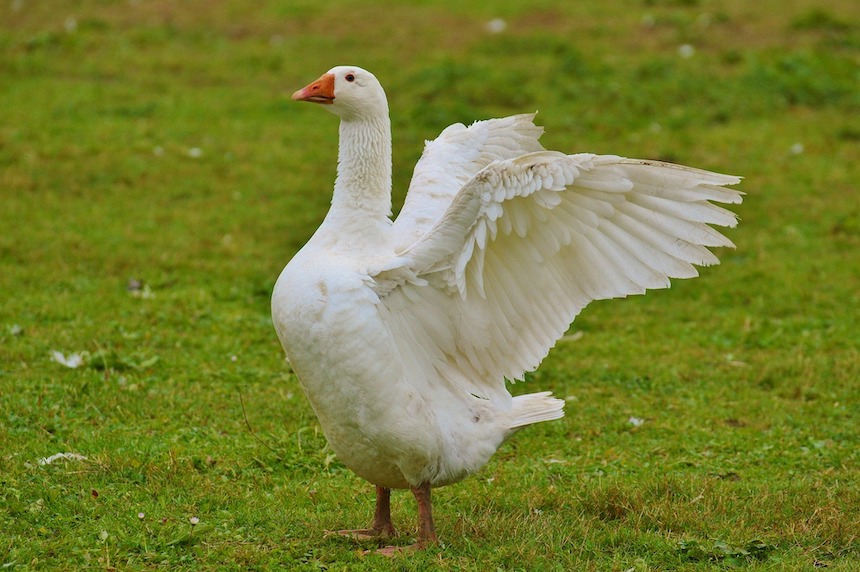
“Doctor doesn’t generally work of birds,” Sandy said to the lady on the phone. “He does make exceptions at times when it is a farm bird and not a pet. I hear you call this goose a pet.”
“I only called it a pet because that is how my husband treats it,” Sharon replied. “It is the only goose we have. It lives in the barnyard and herds the chickens around all day. He acts like he is the chicken leader.”
“Let me go ask the doctor before you come all the way from Brownsville to have him say no,” Sandy said as she laid the receiver down.
“I am talking with a lady with a pet goose. It lives in the barnyard. It has a large laceration on its chest. She is wondering if you will take care of it?” Sandy asked.
“If she understands that I treat farm birds like food animals, not like pets, I will take care of it,” I said.
Sandy scheduled the appointment, and everyone waited in anticipation for the arrival of the barnyard goose.
When Sharon arrived, the parking lot was packed, and the clinic reception area had no room, filled with clients and their pets. I was busy in the exam room, but Sandy popped in and said, “You have to come to look at this.”
I stepped out front, and everyone in the waiting room was standing and watching Sharon leading the goose down the street and across the parking lot. She had a baling twine tied around the goose’s neck, and the goose was waddling along like a dog on a leash.
As soon as the goose came through the door, chaos erupted in the reception room. The goose spread his wings and charged at the german shepherd pup, trying to crawl under the owner’s chair to escape the charge. The cat in its carrier on Rosemary’s lap was puffed up and hissing at the goose.
Ruth was quick to lead Sharon and her goose back to the surgery room, the only unoccupied space at the time.
When I finally had a few minutes to look at Timmy, the goose, everything in the clinic had settled down. Timmy had a long laceration on the right side of his breast. It was through the skin and extended into the muscle about a half on an inch deep.
“Wow, how did this happen?” I asked.
“We have no idea. My husband noticed it when he was feeding the chickens this morning,” Sharon said.
“We need to get Timmy under an anesthetic and clean up this wound and close it. Things should go well. Birds have a high body temperature, so superficial infections are not common following wound closure. He will just have a bare patch on his chest for a time. We’ll do this right away. I’ll have to work him in between patients, and he will have to stay until he recovers from anesthesia. Still, we should be able to send him home early this afternoon.”
As Sharon gave Timmy a kiss on his beak, I drew up a dose of ketamine for anesthesia to give as soon as she left.
“I am going to give him an injection of ketamine. This should allow us time to close the wound and have him wake up pretty quickly,” I said to Ruth.
“How quick is this going to take effect?” Ruth asked.
“It will take a few minutes. I am going to finish up in the exam room, and then I will be back. It should only take a few minutes to close this wound.”
With that, I left Ruth, a short, petite gal, holding a large goose on the surgery table.
I hurried through the vaccination on Rosemary’s cat, Whiskers.
“Are you going to be able to take care of that poor goose?” Rosemary asked as we returned Whiskers to his kennel.
“Oh yes, he should be asleep shortly.”
All of a sudden, there was a terrible ruckus coming from the surgery room. Timmy was squawking, and we could hear his wings flapping.
“Excuse me, Rosemary. Sandy can check you out. I think Ruth needs a hand.”
I rushed to the surgery room. There was Ruth, desperately trying to hold onto Timmy. Timmy was flapping his wings wildly and squawking at the same time. I quickly grabbed him and got his wings under control. Ruth and I held him for a moment, and he drifted off into a deep slumber.
“What caused that?” Ruth asked. “He was fine and then just sort of exploded.”
“Just an excitement phase of anesthesia,” I said. “It is common with all anesthetics. We just don’t see it because what we generally use has such a rapid induction. I haven’t seen it with ketamine before, but then, how many geese have we had in this surgery room.”
With Timmy under anesthesia, we plucked the feathers around the wound and scrubbed the area with Betadine Surgical Scrub. After cleaning the wound with a vigorous flush, I sutured the heavy fascia covering the muscle layer with a continuous suture of Dexon. Then closed the skin with a buried subcuticular suture, also with Dexon.
With Timmy in a kennel to wake up, we thought the day’s excitement was over. That was until the girls were discharging one of the morning surgeries cases. The young dog freaked out when he was lead past the kennel with a goose flopping about a little. That just made the pup jump about a bit.
***
“Sharon, Timmy is all fixed up,” I said as Sharon returned to retrieve Timmy. “He is going to have a bald patch on his chest until he grows some new feathers, but that shouldn’t bother him much.”
“No, I don’t think he will care,” Sharon said. “Can he walk?”
“Yes, he is wide awake. We had a little struggle with him as he was going to sleep, but he recovered with no problems. He can walk out of here now. And it is probably a good time since there are no dogs.”
“He doesn’t like most dogs, and he is pretty protective of his barnyard. He sends our little house dog packing every time he strays too close.”
Sharon tied a twine around Timmy’s neck, and he hopped out of the kennel. He waddled out out the door on his leash, like he knew where he was heading.
Photo by Alexas_Fotos from Pixabay
A Load of Firewood

D. E. Larsen, DVM
John slid through the front door and leaned on the front counter. He waited for the reception room to clear and then leaned over to talk with Sandy.
“I have been out of work for 3 months now,” John said. “I hate leaving my bill unpaid, but with the new baby, we just haven’t had any spare money.”
“I know things have been tough for a lot of people,” Sandy said. “If you could pay anything, we could keep your account current and not turn it over to the collection people.”
“Do you guys have any need for firewood?” John asked. “I just got access to a downed maple tree that I am going to be cutting up. It’ll make good firewood.”
“That would be great, John,” Sandy said. “We can always use some firewood, and Doctor never has the time to get it himself.”
“I could cut you a pickup load, split and stack it at your house, all for a hundred dollars on my bill,” John said, hoping Sandy would not think the price was too high.
“If it is a large load, I will give you full credit on your bill,” Sandy said. “That will be a hundred and thirty dollars.”
“Great, I can do it tomorrow,” John said. “I know where you live, just tell me where to stack it, and I will get it done.”
“We are in the process of building a woodshed up by the pump house,” Sandy said. “But for now, you can stack it under the eves on the backside of the house.”
***
It was about two in the afternoon when John popped through the front door. His heavy wool shirt was wet from the light rain and covered with sawdust and moss.
“I have your wood all split and stacked under the eves of your house,” John said. “That little black dog of yours was none too happy about it either.”
“That’s good John, I can credit your account and give you a zero balance,” Sandy said.
“Well, there is just one little problem that I need to talk to you about,” John said. “I broke a tooth when I was cutting the wood.” John lifted his lip with a dirty finger so Sandy could see the broken tooth.
“Ouch, that doesn’t look good,” Sandy said.
“My problem is the dentist won’t look at me without a payment,” John said. “I was hoping I could sell you the wood instead of putting it on my account. I could probably get by giving him a hundred dollars.”
“I guess we can carry your bill a little longer,” Sandy said. “I will give you what we agreed on when we made the deal. I will put five dollars on your account and give you a hundred and twenty-five dollars. That will keep your account from being turned over for collection, and it will give you a few extra dollars to spend on the new baby.”
***
It was over a month later when John came through the door again. A little more confident that he could get a deal out of Sandy, he quickly started a conversation.
“I have a deal on some red cedar,” John said. “It is a big old windfall, excellent stuff. It makes great kindling.”
“You know how the last deal turned out,” Sandy said. “I still hear about that deal from the Doctor.”
“I’ll be more careful this time, and the ground is much better,” John said. “I can drive right to this log.”
“We have our woodshed completed. You could stack it in the woodshed,” Sandy said.
“Yes, like last time, cut, split, and stacked,” John said. “But this is pretty valuable stuff. If I own a hundred and a quarter, that will be just over a half of a pickup load. That will be enough kindling to last you for several years.”
“When you’re done, you drop by the office, and I will give you a receipt of some kind,” Sandy said. “I don’t think I want to pay taxes on firewood for an old bill.”
“We will drop by, and we don’t need a receipt. Doc always says he prefers to do business with a handshake. And my Sandi wants to show you the baby since you gave us some extra money the last time.”
***
It was late in the afternoon when John and Sandi came by the office. Unlike the day when John delivered the maple, today, he was showered and shaved. Sandi had their baby in her arms. The little girl was approaching 3 months of age.
“I wanted to make sure you had a chance to meet our Josie before she is all grown up,” Sandi said as she lifted the baby up to the counter. “I can’t thank you guys enough for the help you have been.”
Of course, Sandy went around to the reception area to hold Josie. All mothers are the same, and they remember how it was when their baby was shown off.
“We were more than happy to be able to help,” Sandy said. “You two have been good clients, and with the spotted owl business going on around here, times are hard for a lot of folks.”
“Yes, we know that, but you paid for the wood without any hesitation,” Sandi said. “That is what was special. Do you think Doctor would like to peek at Josie?”
“I’ll ask if he has a minute,” Sandy said. “But you know men, one baby is the same as another.”
Sandy, of course, didn’t ask if I had a minute. She instructed me to step out front and say something nice about the baby.
I stepped out and looked from behind the counter.
“Looks like you did good, John,” I said as I reached across the counter and shook John’s hand. “And you must have had a part in the process also, Sandi.”
“I have a bunch of red cedar stacked in the corner of that new woodshed of yours,” John said. “It will be several years before you will need any new kindling wood. This is really choice stuff.”
“Thanks a lot, John,” I said. “I think Sandy has zeroed out your account. I hope things pick up around here pretty soon for everybody.”
“This red cedar windfall that I am cutting on now will make a big difference for us,” John said. “It will be a good supplement to unemployment probably for a couple of months. Maybe by then, I can come up with another job.”
“John, if you need a reference, we are just a phone call away.”
Photo by Austin Wehrwein on Unsplash
 Memoirs of a Country Vet