D. E. Larsen, DVM
I always enjoyed the drive to Lacomb. It was a long drive for me, and it was probably not cost-effective because it took me away from the office too long for the call fee to cover. But I enjoyed the drive.
I pulled into Karen’s driveway, and Karen was waiting for me with her horse, Pepper. This was a simple call to remove Pepper’s wrap and sutures from a repaired wire cut on his left front leg.
The wire cut had been small but left untreated for a couple of weeks. I had to remove a lot of proud flesh and freshen the skin edge before closing the wound. Then I kept the leg wrapped the entire healing period.
“How is Pepper doing today?” I asked Karen as I was getting my things out of the truck.
“I think he is going to be glad to get this wrap off,” Karen said. “The weather is too good for him to enjoy the stall right now.”
I used a prep razor blade to cut the external layers of the wrap. Then after removing the layer of cotton, I cut the remaining gauze with bandage scissors.
I took a deep breath before I pulled the telfa pad away from the wound. I was hoping that it would be completely healed.
I pulled the pad away. The wound looked great.
“Boy, that looks so much better than it did before all that work,” Karen said. “If I hadn’t taken pictures, I don’t think people would believe how it looked.”
“I think we got a little lucky with this one,” I said. “The fact that you could keep Pepper in a stall the whole time probably did as much as the surgery.”
I removed the sutures and cleaned things up, and loaded everything back in the truck. Jason, Karen’s son, came out of the house and stood beside his mother. Jason looked like he was twelve or thirteen. His pant legs were several inches too short.
“Are you going ask him about Harold?” Jason asked his mother.
“Oh, yes,” Karen said. “We were hoping that we could get you to look at Harold while you are here.”
“Sure,” I said. “Can you bring him out, or is he in the barn?”
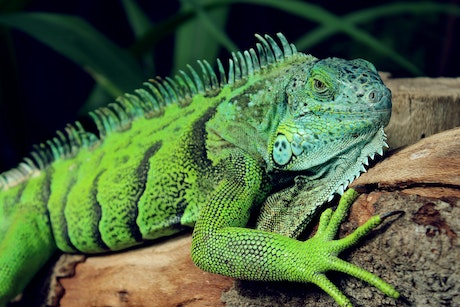
“Harold is my green iguana,” Jason said. “He is in my room.”
“I’ll look at Harold,” I said. “But you have to know that I’m not much of a lizard doctor. In fact, I haven’t looked at an iguana before.”
“He used to be really active,” Jason said. “Now is his sits there and hardly moves.”
I cleaned up and followed Jason into the house while Karen led Pepper through the gate to the pasture.
Harold looked a little concerned when I entered the room behind Jason, but he didn’t move.
“He has the run this room, but lately, he just stays here under the window,” Jason said.
“It is a little chilly in here, Jason,” I said. “Do you have a heat source for Harold?”
“No, he seemed fine in here until lately,” Jason said. “I guess Mom turned down the heat now that spring has come. It might be colder than it was this winter.”
I picked up Harold. He is young. Not counting his tail, he was not much over a foot long. The muscles on all his legs were hard and rigid. His jawbones looked like they were thickened a bit.
“What do you feed him,” I asked.
“He gets some lettuce and other greens,” Jason said. “He really likes the mealworms that I get over at the feed store. And he gets some fruit.”
“Can you bring him into the clinic so we can get an x-ray of him?” I asked.
“I don’t know,” Jason said. “Mom has been worried about her bill. She spent a lot on Pepper. But maybe you could convince her. I am really worried about Harold.”
Karen was just getting to the house as I was leaving.
“Boy, Pepper really liked being turned out,” Karen said with a smile.
“I think it would be a good idea if you could bring Harold into the clinic for an x-ray,” I said. “I think he has some major issues. We are probably early enough that they are manageable. I will need to get some information together for you and Jason on how to manage iguanas and what kind of a diet they need.”
“What do you think is going on?” Karen asked.
“I think it is probably a calcium issue,” I said. “It is a little complex, but it is mostly a diet issue. Harold needs a warm place, and he needs some ultraviolet light. But I will get that information all put together for you after we get an x-ray.”
“What is the x-ray going to tell you?” Jason asked.
“As quiet as Harold is right now, I would guess that he has significant bone loss and possibly one or more fractures. You can do some things right now: throw out those mealworms and pick him some dandelion greens. Then call the office a schedule an appointment for tomorrow.”
***
It was two days later when Karen and Jason came in with Harold. Harold was still quiet and hardly moved on the exam table and placed on the x-ray table.
The x-ray confirmed my fears. Harold had severe osteoporosis. This was the result of nutritional hyperparathyroidism.
This is a common problem with pet reptiles and is generally due to poor nutrition and the environment. Harold also had a mid-shaft fracture of his left humerus.
I placed the whole body x-ray on the viewer and showed it to Karen and Jason.
“The main thing to see here is how thin and pale all Harold’s bones appear,” I said. “He has osteoporosis, and if you look close, you can see a fracture on this bone in his front leg.”
“What are we going to have to do with that fracture?” Karen asked.
“The fracture is the lesser issue,” I said. “It is not displaced and probably not completely fractured through the bone. If we get his diet and his environment corrected, I think we will be okay.”
“I am not sure I understand what has caused all of this,” Karen said.
“It is a little complex. I have everything in this packet for you,” I said. “But basically, the body works very hard to balance the levels of calcium and phosphorus in the blood. When the calcium in the diet is not adequate to meet that balance, the body extracts it from the bones. In the iguana, there needs to be a good heat source and adequate UV light. Both of those can be lacking in the Willamette Valley. That is why we don’t have these things running around here. So what Harold needs is a warm spot with plenty of UV light and a diet of dark greens and some fruit. At this point, getting a commercial diet from a pet store that is supplemented with the necessary vitamins and minerals would be wise. As long as he remains quiet for a time and we correct all these things, I think that fracture will heal fine.”
“Okay,” Karen said as she handed Jason the packet of information. “Now, this is your job. And you can see that dandelion greens are on the list. Lord knows we don’t have a shortage of those.”
Once all the issues in Harold’s environment and diet were corrected, he did well. His fracture healed fine, and he grew into a fine iguana. The best thing was we had a full-body lizard x-ray that became the centerpiece of every elementary classroom visit for the next 20 years.
Photo by Christo Goosen from Pexels.
 Memoirs of a Country Vet