One Bite Deserves Another, Click on the link:
https://docsmemoirs.com/2020/10/19/one-bite-deserves-another/
Mixed practice in the 1970s and more

One Bite Deserves Another, Click on the link:
https://docsmemoirs.com/2020/10/19/one-bite-deserves-another/

D. E. Larsen, DVM
“Doc, I am worried sick about Lily,” Dyann said as I listened on the phone. “She has been vomiting since last night. It is so bad now that everything that goes in comes right back up.”
“Has she gotten into anything that you know about?” I asked.
“No, that is what has me so worried,” Dyann said. “She hasn’t been out of the house, and there is nothing in here that she could have gotten.”
“It sounds like we better get a look at her,” I said. “We are a little busy, but if you bring her in, we will hang onto her and get things checked out over a couple of hours. We are going to need to get some x-rays and do some blood work.”
Lily was a Pug. Actually, for a Pug, she was a pretty good specimen. At least Lily didn’t have any significant upper airway problems, so common to the breed. Dyann was really attached to Lily, and she telegraphed her concern with the stress in her voice on the phone.
When Dyann came through the clinic door, we had just had a cancellation, and we ushered her into the exam room.
“I think she is worse now than from when I called,” Dyann said, obviously holding back tears.
Lily was definitely dehydrated, and she was depressed. Otherwise, her exam was not alarming. On rectal exam, her colon was utterly empty. That raised a red flag when coupled with the constant vomiting.
“I can’t feel anything on abdominal palpation,” I said. “An intestinal foreign body has to be high on the list with Lily vomiting coupled with a completely empty colon,” I said. “Like I mentioned on the phone, we need to do some blood work and get some abdominal x-rays.”
“Will that give you all the answers?” Dyann asked.
“One would hope so,” I said. “But, unfortunately, sometimes all the answers are not always obvious. We had more time than I expected when we talked on the phone. We will have time to get the blood work started and get the x-rays. I should be able to give you a call within the hour. If things are obvious, that will be good. If not, we might have to make a couple decisions.”
“What kind of decisions are you talking about?” Dyann asked.
“I can’t feel anything in her abdomen on palpation,” I said. “Pugs are a little compact, and their abdomen is difficult to palpate. Sometimes, if there is a foreign body, it will not always show up on an x-ray. If it is not obvious, we will have to decide between using some barium or just going to exploratory surgery. Using barium allows us to see the gut a little better and define an obstruction. The problem is if we have to open the gut, the barium remaining in the gut greatly increases the chances of complications if there is a little leakage of it into the abdomen.”
“What about the exploratory?” Dyann said.
“An exploratory is just that,” I said. “We have an idea about what is going on, but we have to go in and look. If we find something that is fixable, we can generally fix it at the time. If we find something unexpected, like a soft tissue tumor that is causing the obstruction, we might have to close up and make other plans.”
“Now I am apprehensive,” Dyann said. “Do you think this could be a tumor?”
“No, those things usually cause other problems before they reach a point of an obstruction,” I said. “But Dyann, I have seen a lot of things in an abdomen that was completely unexpected. I favor an exploratory over the use of barium in a case like this. Hopefully, we can see what we need to see on the plain films.”
“Okay, I will go home and wait for your call,” Dyann said. “If you have to do surgery, when will that happen?”
“We will move appointments around and get Lily on the surgery table as soon as we have a firm decision,” I said. “If you want to come back and see her before surgery, that would be okay. We are going to have to get some fluids into her before we start and surgery.”
“That makes me feel better,” Dyann said. “I will be waiting for your call.”
Blood results showed pretty normal liver and kidney function, along with some significant dehydration. The electrolyte values supported a probable intestinal obstruction.
Unfortunately, the x-rays failed to provide a definitive diagnosis. So now, Dyann would have to make a choice between exploratory surgery or barium x-rays.
I gave Dyann a phone call.
“I don’t know, Doctor Larsen,” Dyann said. “I know you said that you favor an exploratory, but I would hate to put her through surgery if it wasn’t necessary.”
“The possibility of leaking some barium when we open the gut is very real,” I said. “That causes a lot of inflammation in the abdomen. I can’t be positive about a foreign body, but I am confident that this is an intestinal obstruction. I have seen exploratory surgeries that failed to find anything, but I would be surprised if that were to be the case here.”
“Okay, let’s go ahead and do the surgery,” Dyann said. “I don’t need to come down to see her before surgery. I am so worried. I would probably embarrass myself.”
“We will be doing the surgery shortly,” I said. “I think I have a few things to do before we have a block of time set aside of Lily. I will give you a call as soon as I am out of surgery.”
As soon as Lily had enough fluid from her IV to make surgery safe, we got her under anesthesia and prepped for surgery.
I started with a relatively short incision on the ventral midline. I was hoping that I could find a foreign body and elevate it out of this incision without opening the abdomen with a long incision.
Once I had the abdomen open with a three-inch incision, I inserted a couple of fingers with my left hand and swept them through the small intestines. I almost instantly bumped into a hard mass.
I trapped the mass against the abdominal wall with my fingers and pulled it to the midline incision. When I had the mass through the incision, the small intestine upstream from the mass was dilated with fluid. Beyond the mass, the intestine was empty and shriveled in size.
Before opening the gut, I pulled the intestines distal to the mass out of the incision, just to make myself feel confident that there was not another foreign body.
After replacing all the intestines to their normal position, I packed the incision and the exposed loop of gut with the mass with large lap sponges moistened with saline.
I placed a doyen forceps across the dilated intestine to reduce the chance of leakage and contamination of the incision and the abdomen. Then I carefully incised over the mass in the loop of bowel, making an incision just long enough to allow me to express the foreign body out of the gut.
A single ball from the end of a Nylabone dropped onto the waiting surgical sponge. I wondered how that had happened.
I wiped what little intestinal content there was from the edges of the incision. I close this incision with interrupted sutures of Dexon using the crush technique. This allowed for secure closure with no reduction in the lumen size of the gut.
After flushing the area and the abdomen with a saline solution containing gentamicin, I did a routine closure of the abdomen. Then we unhooked Lily from the anesthetic gas and started waking her up.
I headed to the phone to call Dyann.
“Dyann, the surgery went very well, and Lily is waking up now,” I said. “We were able to work through a short incision in the abdomen, and I found a foreign body right away. I removed that mass, and we closed things up. I would expect her to be good as new in a few days.”
“Oh, I am so relieved,” Dyann said. “I have been out of my mind with worry, waiting for this phone to ring. What was it that was causing the problem?”
“It looks like one of the knobs off the end of a Nylabone,” I said. “I am surprised that she could chew one of those off.”
“It wasn’t her,” Dyann said. “Ozie, our large dog, just destroys those bones. Lily probably got in on the end of one of those destruction derbies.”
“Okay, if we can get enough fluid into her by five o’clock, she can go home,” I said. “We will go nothing by mouth until tomorrow afternoon and then only liquids and soft stuff like ice cream for three days. We have a soft canned food that you can use. Then canned food until we get the sutures out in two weeks. If anything concerns you, I should look at it. Otherwise, we will see Lily in two weeks for suture removal.”
“I’ll be there at five,” Dyann said. “And don’t worry, Doctor Larsen, I anything at all looks odd, you will be looking at it.”
***
Lily healed well, and by the time we removed the sutures, you couldn’t tell that there had ever been a problem with her.
“It looks like Lily gets to be an old dog someday,” I said. “Not all dogs are that lucky.”
“Doctor Larsen, I don’t think luck had a thing to do with it,” Dyann said.
Photo by Nikita Telenkov from Pexels.
D. E. Larsen, DVM
“Doctor, I have just moved to town, and my son says that you are trustworthy,” Dorothy said as I lifted Brutis onto the exam table. “This ear has been looked at by three or four veterinarians. We have used just about every medicine in your cabinet. Nothing has helped. Maybe it will get better for a short time while he is on the medication, but it always comes back. They have cultured this ear several times, and they get a different bug each time.”
“That story sounds like it is pretty frustrating for you,” I said as I held Brutis’ head down a little so I could peek into his left ear.
“Yes, I am just about to give up on the whole thing,” Dorothy said. “This has been going on now for about three years.”
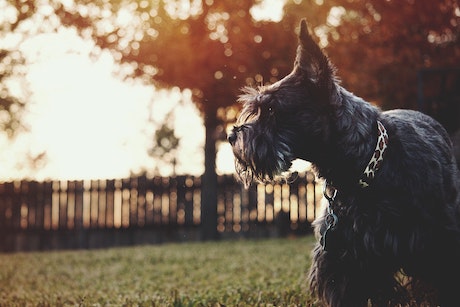
Brutis was a large standard Schnauzer. Luckily he was well behaved, but when I reached to touch the ear, I could hear a low-pitched growl coming from deep in his throat. I knew that was a specific warning given by large dogs. It was a severe warning, and if it went unheeded, they were always ready to back up their threats.
“It sounds like Brutis has is a little tired of the problem also,” I said.
“Most of the time now, they have to sedate him to work on that ear,” Dorothy said. “He is such a good dog, but he is tired of places like this. He lets me put medicine into his ear, but I doubt that he is going to let you do anything to it.”
“When was the last treated for this chronic ear infection?” I asked.
“A veterinarian in Salem looked at him about three months ago and gave me another tube of medicine,” Dorothy said. “He said if that medicine didn’t solve his problem, that no medicine was going to solve it. He said that Brutis needs to have surgery to remove part or all of his ear canal. That sounded pretty drastic to me, and I didn’t go back. But this ear is as bad as it has ever been. What do you think about that surgery?”
“Sometimes, that surgery is about all that we have that will solve the problem,” I said. “I have done both a lateral ear canal resection, where we just remove the lateral half of the ear canal to all better drainage for the dead canal. The total ear canal ablation occurs when the entire ear canal is removed, and the middle ear is opened for drainage. Both are drastic, with the total ablation being the worse.”
“Do you think that is what needs to be done?” Dorothy asked.
“Maybe we should try a little magic first,” I said.
“I have heard it all now,” Dorothy said. “None of these other vets claimed they had any magic.”
“Let me explain myself,” I said. “I have a recipe for an ear flush that an old veterinarian gave me. I said it works like magic, and I have found it too close to that description. Since I have been using it, I have only had to resort to surgery once, and that was in a Cocker Spaniel. They probably have the worse ears of all the dogs. The thing about trying a new medicine, it only takes a week to two to know if there is a chance of curing this problem and a month or two to know if it is really cured. We can always resort to surgery if things don’t work. The thing about these surgeries is once it is done, there is no going back. For a dog like Burtis, with cropped ears, it will significantly change his appearance.”
“Tell me a little about the so-called magic you have,” Dorothy asked.
“Everything in it is legal,” I said. “It is just a combination of a bunch of medications. I will be honest with you. The experts will consider it unacceptable. There is at least one antibiotic that has the potential for toxicity to the inner ear. Still, I have not had a problem with it. Using it on this ear, after all the medication you have used, if it works, you will indeed think it is magic.”
“So what is in this flush?” Dorothy asked.
“The base of this flush is Massengill Vaginal Douche,” I said. “Then there are several things added to it. Gentamicin, a strong antibiotic with some ototoxicity potential, is added. Synotic is an ear solution with a strong steroid and some DMSO in it. Dexamethasone is another strong steroid that is in this flush. And lastly, I add some nitrofurazone solution, an antibiotic with a small molecule and a broad spectrum of activity. This recipe comes from an older veterinarian. I doubt there are any published accounts of its use and no trials to attest to its success. But I have used it often and with almost universal success. And I only use it on problem ears.”
“It sounds like it has everything except the kitchen sink in it,” Dorothy said.
“You are just about right,” I said. “That is why it will never be considered an acceptable medication by any of the big doctors in the veterinary colleges. The old guy that gave me this recipe said that he thought that it was the douche that did most of the work. I don’t know. I have never used the douche alone.”
“Okay, I am willing to give it a try,” Dorothy said. “And I appreciate your honesty.”
“I think we should leave Brutis with me for a couple of hours so I can sedate him and clean this ear and get a good look down in that ear canal,” I said. “He has a lot of hair, and if we get that all pulled out of there, the medication will have a better chance of getting into the deep portions of the ear canal. If there as been as many hands in that ear as you report, there is a possibility something was left behind. Be it a piece of cotton or something like that. We just need to get a good look.”
I sedated Brutis with some pentothal and pulled all the hair from his ear canal. A good otoscopic exam was difficult due to the swelling in the deep ear canal. I could not visualize the eardrum, but with the long list of medication given in the past, I would assume the risk that it was intact.
I flushed the ear canal and instilled the first dose of the magic flush. Burtis was up a few minutes after I was done, and he was anxious to go home.
“I want you to place a couple of droppers into this ear twice a day,” I said. “Massage the canal if he allows you to do that. This ear might be sore of a day or two from the work we did. Then let me look at it in a week.”
“So, if you check him every week for a couple of months, I will probably own part of this business,” Dorothy said.
“No, I am a small-town veterinarian,’ I said. “My opinion on such rechecks goes back to the summer I graduated from high school. I started paying my own medical bills that summer, I had a good job working in the cheese factory. I think I was making about two dollars and thirty cents an hour. I had a wart frozen off of one hand, and the doctor said he wanted to look at it next week. The following week, I go in. He is sitting at his desk. He looks up from his paperwork, takes my hand and glances at it, and says, let me look at it next week. I check out at the front desk, and the gal says, that will be six dollars. That was the last time I went to that doctor. I don’t charge for a brief recheck. I never have. I want people to let me see how things are progressing.”
***
The following week, I entered the exam room, and Dorothy was all smiles.
“I have to tell, Doctor Larsen, this is best I have seen this ear in years,” Dorothy said. “And Brutis acts like a puppy. He feels so much better.”
“That is good,” I said. “But we have a couple of months to go before we can start to think the battle is over.”
With Brutis on the floor, I held his mouth and pulled his ear flap back to look at his ear. There was no response from him this time. I picked up my otoscope and looked at the ear. Again, there was no response from Brutis. This ear canal seemed almost normal. I could easily visualize the eardrum, and it looked fine.
“Things look perfect, Dorothy,” I said. “I want you to continue this flush twice a day for another week. If things look good next week, we go once a day for two weeks and then sit the flush on the shelf. I think we are going see this ear back to normal.”
“I am ecstatic,” Dorothy said. “And to think, I almost had this ear butchered. I like your magic.”
***
The next few rechecks continued to be favorable, and Brutis had a normal ear at the two months.
“I think you can put the remainder of that flush in your medicine box,” I said. “Only use it if this ear starts to get bad again. I let me look at him early on if it becomes a problem. I think you can think of this ear as a normal ear.”
I was able to follow Brutis for the remainder of his life, and he never had a recurrence of an ear infection.
Over the years, the ear flush became a seldom-used product. Not because it didn’t work, but because the commercial products became better at addressing these chronic ear problems.
Photo by Tim Arterbury on Unsplash

 Memoirs of a Country Vet