D. E. Larsen, DVM
The old cow groaned a little as I plunged my arm deeper into her rectum. Dixie pushed a little harder on the squeeze handle. I always hated pregnancy exams on old fat cows. Their uterus was often difficult to reach, and any pregnancy over three months was out of reach until six or seven months.
Finally, I grasped the cervix and retracted it enough to feel fetal membranes in the body of the uterus. Based on cotyledon size, this cow was about five months pregnant.
“Tom, this cow is about five months pregnant,” I said. “That is a pretty rough estimate, and it could be a couple of weeks either way.”
“Doc, I called you out to look at this eye, not to do a prep check,” Tom said.
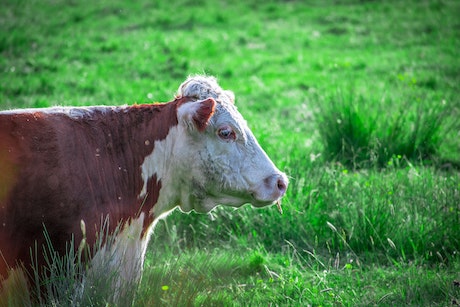
This was an older Hereford, and her left eye was gruesome. There was a bulge of tissue the size of a large egg, bulging from the inner corner of her eye. The entire left side of her face was soiled from the chronic drainage. This was probably the worse case that I had seen since returning to Oregon.
“I know, Tom, but I needed to know her pregnancy status so I could recommend the right course of action for this eye,” I said. “This is a pretty ugly-looking eye. How long has it been a problem?”
“I noticed it sometime last year,” Tom said. “I guess I can’t be sure just when it was that I first noticed it. But by the end of August, I put a couple of puffs of pinkeye power in it, and I figured it was just pinkeye. But I have never seen a case of pinkeye look like this.”
“This is cancer eye, Tom,” I said. “We don’t see many cases of cancer eye around here. When I was in school in Colorado, we would see a lot of cows with cancer eye. Colorado has a lot more elevation and more sunshine. Just like this cow, Herefords account for most of the cases. That white face doesn’t reduce the glare from the sun.”
“What do you do for it?” Tom asked.
“We need to take the eye out,” I said. “That is why I needed to know her pregnancy status. If she is five months pregnant, we can take the eye out and expect her to live long enough to raise the calf to weaning. Many cows will live for several years after we remove the eye. It just depends on how far the cancer has spread.”
“She is a registered cow, and she was artificially inseminated, but I am not sure she is worth the expense of the surgery,” Tom said. “Can I send her to slaughter?”
“If she goes to an inspected slaughter outfit, they will condemn the head,” I said. “And if they find that the cancer has spread beyond the head, they will tank the whole carcass.”
“You’re saying that there is a possibility that she might not be worth anything,” Tom said.
“If she goes through a sale ring, those cattle buyers will probably not want to bid on her,” I said. “They know there is a possibility that she might be tanked. Selling her to an inspected slaughterhouse on condition that she passes inspection, and you might get something out of her. But you assume the risk of her not passing the inspection.”
“I think I will go that route,” Tom said. “She is nothing special, hardly more than a commercial cow. By the time I pay for the eye removal and treatment and then lose everything at the sale. The profit margin on the calf is not worth the trouble.”
“You’re the one making the financial decisions,” I said. “Often, the best medical decision is not the best financial decision.”
Dixie and I cleaned up and repacked the truck.
“Tom, you give me a call if you change your mind or if you have any questions,” I said through the open window as we started out of the barnyard.
Dixie was deep in thought. She usually was full of questions, especially when we had treated an unusual case.
“Do you think it would be a mistake for me to make an offer to Tom for that cow?” Dixie asked.
“I thought you were trying to figure something out,” I said. “You want to buy the cow for a song, remove the eye and get a registered calf to start your herd.”
“What do you think of the idea?” Dixie asked.
“For Tom, that might be his best option,” I said. “With that eye looking like it does, he is not going to get much for her. And if they buy her on condition of her passing the inspection, and she doesn’t, that is going cost him the slaughter fee plus the transport fee.”
“So I shouldn’t make a big offer?” Dixie asked.
“For you, I would guess the cow will live long enough to wean the calf,” I said. “And she might live several more years. If you can get her for a hundred bucks or so, you just about can’t go wrong. We could take the eye out without much of a problem.”
“I am going to talk with Blain about this deal,” Dixie said. “I have been wanting to get some cows on our place, and this will allow me to get a start with some registered stock.”
***
The following week, Dixie wanted to schedule surgery for her new cow.
“I know we have been busy,” Dixie said. “But this cancer eye on Della is really getting to be a mess, and I was hoping we could come up with some time to get it taken care of this week.”
“Have Sandy look at the appointment book,” I said. “If nothing else, we could do it right after lunch on Thursday. That would just mean I would get a little late start on the golf course.”
“I have already looked,” Dixie said. “I was hoping you would volunteer Thursday afternoon. I don’t have a chute. Do you think you can do it without one?”
“Della seemed like a mild-mannered cow,” I said. “We can probably get it done with her tied to a post.”
***
On Thursday afternoon, I pulled the truck into the middle of Dixie’s pasture. Della seemed unconcerned, even a little interested. Probably, thinking there was something good to eat.
She never flinched when I threw a rope over her head.
“The plan is to tie her to my bumper, and then I will get my other rope and throw her,” I said as Dixie watched. “Should be a piece of cake if I can get her to fall on her right side.”
I tied the rope to the bumper of my truck with enough slack to allow her to fall away from the truck. That proved to be an error.
I went to the back of the truck to get my second rope. Della discovered that she was tied and immediately started fighting the rope. She pulled back and shook her head. Then she swung around like a pendulum and crashed into the passenger side door on the pickup. This made a massive dent in the door.
I came back to settle her down, and Dixie was talking to Della in a stern voice.
“I think you have just earned a dose of Rompun,” I said to Della as I drew up a dose of Rompun.
Rompun was a horse tranquilizer. It had a profound, almost anesthetic, action in cows.
In less than a minute, Della settled to the ground. We blocked her up, so she stayed on her sternum. I removed the rope from her neck and pulled her head to the right with my nose tongs. This gave us good access to her left eye.
We clipped the hair from the left side of her face and around the eye. The chronic drainage from the eye had soiled and matted the hair on the side of Della’s face. Under all the matted hair was a lot of inflamed skin.
There was nothing pretty about removing the eye. There was so much cancer that the eye was almost hidden in the mass of tissue.
I removed the eye and dissected all the cancerous tissue from the socket. I had to make a sliding flap of skin on the lower side of the eye to adequately close the wound.
We rinsed the area well, sprayed for flies, and gave Della a dose of long-acting penicillin.
“Well, she looks like she came through this better than the truck,” I said.
“I am so sorry about that,” Dixie said. “Do you think the insurance will cover it?”
“I think so,” I said. “And I think I learned a lesson or two today. We can schedule us to get back out here in about three weeks to get the sutures out. You need to check every evening, just to make sure there is no drainage from the incision.”
***
Della healed well and gave Dixie several calves before she was done. Jack Wright fixed the truck, and the insurance covered the expense. And I made it to Pineway golf course in time for the evening game.
Photo by Khamkhor on Unsplash


