D. E. Larsen, DVM
Jake lifted his young son out of the pickup and handed him off to Sue as he opened the tailgate and let Bruiser jump out of the pickup bed.
They could already feel the cooling breeze coming from the river and providing some welcome relief from the Mid Willamette Valley’s August heat.
Bruiser was excited, he had been here before, and he strained against Jake’s hold on his collar while Jake struggled to attach a leash.
Sue was double-checking everything in her bag. She didn’t want to make a trip up the bank to the pickup for some forgotten item. Finally, she was ready.
“Ok, let’s get to the water,” Sue said as she jostled Benny on her hip.
Bruiser strained at the end of the leash, trying to reach the trail leading down to the river. Jake had to lean back against the pull to keep from being pulled off his feet.
“Why don’t you just let him go?” Sue asked.
“We don’t know who is down there. I don’t want to end the day with a dog fight.”
They threaded their way down the trail to the river from the highway. The far shoreline was filled with people, kids, and dogs. This side was a little more challenging to get up and down from the road, but it was much less crowded for that very reason.
“I wish that the Cascadia State Park side was not so crowded,” Sue said. “It is so much easier to get down to the river.”
“We will enjoy the day so much more on this side,” Jake said. “Bruiser can run off-leash, and we won’t have to worry about all the dogs on the far bank.”
There was a small beach with soft, warm sand on this side of the river. Everywhere else was just smooth bedrock that the river flowed over. Several large holes of deepwater offered prime swimming areas. They were connected with short rapids as the water cascaded over the shale.
The breeze coming up the river was most refreshing, and Sue spread the large beach towel out on the soft sand and sat down with Benny. The little beach was shaded by the large maple trees the lined the river, so she didn’t have to worry about smearing sunblock on Benny.
“This feels so nice here. I wished we lived closer, so it wasn’t such a chore to get here,” Sue said.
“It would be nice,” Jake said as he released Bruiser from the leash and started to wade into the water. “When I was young, and we lived Sweet Home, it was an easy trip. But from Albany, it just seems like it takes forever.”
Jake dove into the deep pool. He popped up and looked back at Sue and Benny on the little beach. The cold water was a refreshing contrast to the valley heat.
Sue tried to get Benny to look at his father, and Bruiser was standing in the river with the water touching his chest. Being a Pit Bull, he was not a good swimmer and did not like the deep water.
Jake thought he would do a deep dive and then take Bruiser up the shallow water in the rapids above this hole. Jake dove to the bottom of the hole.
This was a hole carved into the smooth bedrock of the river. The hole’s bottom was littered with large river gravel—rocks worn smooth from being tumbled down the river during the rainy season. As Jake turned to head for the surface, he noticed several trout feeding in the area where the water spilled into the deep hole. They seemed oblivious to his presence.
Jake returned to the bleach and grabbed Benny from his toys on the beach towel. He tossed him a few inches in the air. Jake would have thrown him high, but Sue would not allow that. Then he took Benny to the water’s edge, put his feet in the water, and splashed some water on his bare belly.
“Would you play with Benny in the water while I take Bruiser up to the shallow water?” Jake asked Sue.
Sue set her book down and jumped up to take Benny. Jake motioned to Bruiser and headed up the stream toward the shallow water.
Bruiser plowed into the shallow water above the rapids. He splashed and ran, piling up a wake in front of his broad chest. Jake watched him and smiled. He liked this place so much as it reminded him of his days as a child. Few people knew of the little sandy beach. It was always like their little private spot.
Jake stood and surveyed the scene in front of him. The cool breeze coming up the river was in his face. Sue and Benny were playing in the water at the beach and the mass of people frolicking on the rocks at the deep holes down the river by the park. It was just about a perfect day, an ideal place.
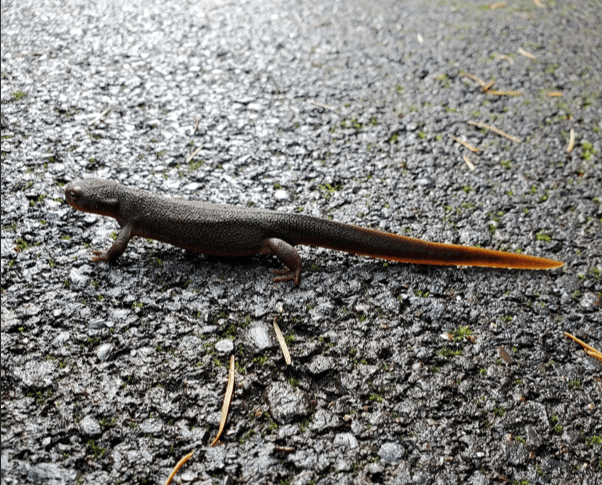
Jake turned around and looked at Bruiser. Bruiser was standing in a shallow pool and had a yellow-bellied newt hanging from his mouth by its tail.
“Put that thing down!” Jake yelled at Bruiser.
Bruiser looked at him, then slurped the salamander into his mouth, chomped a time or two, and swallowed it.
“I hope that tasted good, you dumb dog,” Jake said. “Come on, let’s go back to the beach.”
Jake turned and started back down the stream to where Sue had just started drying Benny off with a large beach towel.
He looked to make sure Bruiser was following. Bruiser was foaming at the mouth a little and shaking his head, scattering foam into the water on both sides of him.
“I told you to put that thing down, now look at you. Come on, let’s go get you cleaned up.”
Bruiser started to follow Jake down the stream, staggering a bit as he ran across the rocks.
“What in the world happened to Bruiser?” Sue asked as they approached the beach.
“He ate one of those salamanders that are all over here this time of the year. I think they call them newts.”
“I seem to think that they might be poisonous. Just look at Bruiser now. He can hardly walk.”
Jake turned to look at Bruiser. He was stumbling and staggering to keep up with him. His chest was covered with the thick white foam that he continued to shake out of his mouth.
“I will wash out his mouth. That should make it a little better.”
“I don’t think so. I think this is serious,” Sue said. “I think we should take him to the vet. There is probably one in Sweet Home.”
“Maybe you are right. Let’s load up and run down there and have him checked.”
Sue hastily packed her things into her bag and grabbed Benny, and started up the trail. Jake put the leash on Bruiser and gave it a tug. Bruiser did not respond.
Jake looked closely at Bruiser. Bruiser’s eyes seemed to not focus on anything. He pulled on the leash again. Bruiser tried to take a step but fell face-first into the sand. Jake was anxious now.
He gathered Bruiser up in his arms and clambered up the trail to the pickup.
“He is getting worse by the minute,” Jake said to Sue as he lowered the tailgate and slid Bruiser into the bed of the pickup. Bruiser looked up but did not try to stand. The pupils of his eyes were widely dilated, and he seemed to look without focus.
“Let’s hurry. We can stop at the store and get directions and have them call for us,” Sue said.
They loaded everything into the cab and sped off down the road to the store.
Sue ran into the little store. Joyce was behind the counter.
“Our dog swallowed a salamander, and he was foaming at the mouth and staggering by the time he got out of the water. I don’t think he can stand now. Can you call the vet for us in Sweet Home and let them know that we are on our way.”
Joyce gave Sue directions to the clinic and said she would call.
“You guys drive safe going down that road out there. The traffic is pretty heavy today.”
Sue looked at Bruiser as she walked around the pickup to get in on the passenger side.
“He looks worse by the minute,” Sue said. “She is going to call, so they will be waiting for us.”
Jake pulled out onto the highway and turned on his emergency flashers. Then he pushed the gas pedal to the floor. It was going to be a challenging 13 miles.
Sandy took the call from Joyce.
“It must be bad,” Joyce said. “She was really frantic. They should be there shortly if they don’t crash on the way.”
Sandy relayed the information to Terri and me.
“What do you for that?” Terri asked.
“Those newts are highly toxic. This is probably going to be a dead dog. There is nothing to be done. A young guy in Coos County swallowed one on a dare when they were partying on the river bank a few years ago. He died.”
“So, these folks are going expect us to do something.”
“Let’s set up the endoscope. Maybe we can retrieve the thing from his stomach and reduce the dose. It will look like we are trying, but it is going to end with a dead dog.
When I was in school at Oregon State studying under Dr. Storm in the Zoology Department, he talked about one of his graduate students’ studies on these newts in Western Oregon. They are called the Rough-Skinned Newt. They are very toxic around here, less so in some areas. I didn’t know at the time, but the student was from Myrtle Point. Older than me by a few years, but he was in high school with my brother. We called him Butch. He is pretty much the expert on the newt.”
We were all set up for Jake and Sue’s arrival with Bruiser. They came through the door in a rush. Bruiser was limp in Jake’s arms, Sue was carrying Benny on her hip. We guided them to the treatment table, where Jake laid him out on the table.
“I think he is dead,” Jake said.
I checked, he was dead.
“We should have been faster,” Jake said.
“I am sorry, Jake. This is a hard way to lose a friend, but being faster would have made no difference. Bruiser signed his death certificate when he ate the salamander. There is nothing to be done to treat this toxicity.”
“Do we owe you anything?” Sue asked.
“No, not at this point. Do you want us to take care of him for you?” I asked.
Jake gathered Bruiser up in his arms, “No, we will take him home. We have a place to bury him.”
With that, they were gone, almost as fast as they came.
“That was sad,” Terri said.
“So many people have no idea those little things are so deadly. As a kid, we played with them all the time. I never heard of a problem with them until I was in school at Oregon State.”
Photo by Dyann McCollum
Information Link:
https://en.wikipedia.org/wiki/Rough-skinned_newt?fbclid=IwAR0czquFGih0kn0vgTXLlog0mplGLaeReWU7Dh8Lsfnw5GiIUkV88NJDHhU

 Memoirs of a Country Vet