D. E. Larsen, DVM
I came through the back door of the clinic in Enumclaw, I liked to get into the clinic early. Jack was just cleaning up from an early morning call.
“You are here a little early,” Jack said as I squeezed past him at the utility tub.
“I have been coming a little early to organize the morning a little different,” I replied.
“A little different,” Jack said, “Things have run the same way around here for the last 30 years. I am not sure we need things to be a little different.”
“We have the surgery patients coming in during the late morning, and we don’t get to them until the afternoon after all the farm calls are done,” I said. “If we brought them in early in the morning, we could get the surgeries done before noon on most days. That way we could send them home in the evening. That would save a lot of cage cleaning for the girls in the morning. It would also be better than having them here overnight, unattended, following surgery.”
“Well, you might have something there,” Jack said. “I will have to give it some thought.”
“I have Mrs. Nielsen coming in this morning with a couple of cat spays,” I said. “If there are no urgent farm calls, I thought I would do the surgeries first thing this morning and send them home at 4:00 this afternoon.”
“Well, hopefully, I took care of our emergency for the day,” Jack said. “I had a calf to deliver at about 5:00 this morning. It was an easy pull. Tiny calf, one of those that you have to hold in there for a few minutes, so the farmer thinks he gets his monies worth. Then I hooked an OB strap on the legs and pulled it with one hand.”
“That sounds easy,” I said.
“But there is more to the lesson,” Jack said, anxious for me to listen. “One thing you want to do when you pull a calf is to go back in and check for another calf. Sure enough, I did that this morning, and there was another calf. It was backward, hind feet sticking into the birth canal, it was as small as the first one. Came out without any problems.”
“That is something that they always stressed in school,” I said.
“You don’t see twins very often, and it is easy to get used to thinking that there is no reason to check,” Jack said. “I seem to forget to check some of the time, just a good idea to do it every time.”
“Thanks for the update,” I said. “I will be sure to make it a habit. I have to hurry upfront so I can speak with Mrs. Nielsen when she drops off her two cats this morning.”
The girls had just completed getting Mrs. Nielsen’s cats into kennels when I got to the front desk.
“I am glad I caught you before you got out the door,” I said.
Smiling, Mrs. Nielsen said, “I am glad too, Ole wanted me to make sure I met you today. He is impressed with you, young man.”
“I just wanted to make sure that you were going to pick up these cats this afternoon,” I said, ignoring her husband’s compliment.
“That is different,” She said. “Always in the past, they were kept overnight. But Ole said, “Anything Dr. Larsen says is fine with us,”
“We are just changing the schedule a little, I will do the surgeries this morning, and they will be ready to go home anytime after 4:00. They will do better at home than down here overnight with nobody watching them.”
“And we close at 5:30,” Mary said, speaking over my shoulder.
“I will be here at 4:00,” Mrs. Nielsen says as she starts out the door.
The girls were used to a slow morning at the office. All three of us veterinarians would depart and do farm calls, usually not getting back into the office until the afternoon. Today I had two cat surgeries to do before starting on my farm calls.
“Let’s get the exams done on these cats and get set up for surgery,” I said. “I have been assuming that they were both females, but we better check.”
The first cat on the exam table was probably approaching a year old, and I didn’t have to look for testicles to know he was a young tomcat. His neck and cheeks were already growing thick, probably the life around the barn required these guys mature early if they are going to survive.
“This morning schedule just got a whole lot easier,” I said.
We finished an exam, did his vaccines, and gave him a dose of atropine to start getting him ready for anesthesia.
The second cat must have been a brother as they looked like two peas out of the same pod.
“I am sure she was talking about spaying these cats,” Mary said.
“People are often confused about the term, spay,” I said. “I can’t say that I know where the term came from. It makes no sense to me.”
With the first cat on the surgery table, I gave him a dose of Ketamine by IV injection. I gave 0.4 cc IV. This was a dose that would provide excellent anesthesia and immobilization for about 20 minutes and would allow a smooth recovery within 30 or 40 minutes. Some residual pain control lasted for several hours with Ketamine.
With the cat under anesthesia and on his right side, I plucked the hair from his scrotum. Mary prepped the scrotum as I pulled on a pair of surgical gloves. Jack had graduated in the 1940s. His method of castration in the cat was to incise the scrotum over each testicle, grasp the end of a testicle with a forceps and apply slow, steady traction, pulling the testicle out until the cords stretched and broke off.
I had been told of this procedure in school and instructed to never use it as it was outdated. There were few complications with this old procedure, but time marches on. I used one of several methods. All involved incisions over each testicle.
I would pull the testicle out until I could feel the cremaster muscle tear, clamp the cord with a hemostat, and place a ligature on the cord before removing the testicle. This procedure consumed a package of suture material and took a little more time.
The other procedure and the one I used most often was to pull the testicle out of the scrotum, incise the tunic and separate the tunic from the testicle, then open the tunic with scissors down the length of the exposed cord. Then I would tie the testicular vessels and the tunic in several throws of square knots before removing the testicle and residual tunic.
With any procedure, it was over in minutes. We would clean the surgery area and return the cat to the kennel to recover. With Ketamine anesthesia, the blink reflex is absent until the patient is fully recovered. The surface of the cornea must be protected with the application of an ointment.
This morning, I had the two cat neuters completed, and the record work completed by a little after 8:30. I would be able to get through my farm calls almost on their regular schedule.
Then the phone rang. Both Jack and Don had already left on their calls. Mary answered the phone.
“No, Jack has already left the office. Dr. Larsen is still here, would you like to talk with him?”
Mary hands me the phone. “This is Harold, you know him, I think. He lives out on that little knoll. This is about the twins that Jack delivered this morning.”
I take the phone from Mary, “Hello, Harold,” I say. “What do you have going on?”
“Jack was here about 5:00 this morning,” Harold says. “He delivered a set of twins. Those two are doing well, but the old cow doesn’t seem right to me. She is uncomfortable, not really straining, but sort of doing little pushes.”
Harold was one of our younger dairy clients. He had a herd of 50 or 60 cows. He probably wasn’t the sharpest tack in the box, but he was generally pretty observant, and if he didn’t think things were quite right, it probably meant that I should check the cow.
“Harold, it sounds like I should run out and check the cow,” I said. “If you have her in where we can get to her, I can come right now.”
“I still have her in the calving pen,” Harold said. “I will go get a halter on her and have her tied up and waiting for you.”
Harold’s place was only a mile down the road. I checked to make sure I had water in the truck, pulled on a pair of coveralls and boots, and started down the road.
Harold’s place was laid out a little different for the area. His house, barn, and all the outbuildings were perched on top of a knoll. All his pastures were on the level valley floor, leaving quite a little hill for the cows to climb to the milking parlor and barn twice a day.
I filled a bucket of warm water from the truck, grabbed a bottle of scrub and one of lube and headed for the barn with a couple of OB sleeves in my back pocket.
Harold was waiting in the calving pen with the cow tied in the corner. The twin calves were running around, nursing on mom and then on Harold’s knees.
“They look like they are doing okay,” I said to Harold as I squeezed through the gate, blocking the way, so the calves didn’t escape.
“They are doing great, but I am not sure about this old gal,” Harold said as he rubbed the cow on her back.
She was standing okay, but her tail was raised. That would suggest some continuing contractions. With the calves out of there, that shouldn’t be happening. The calves were small enough, there should not have been any injury to the birth canal.
“Will, let me get her cleaned up, and do a quick check on her,” I said as I tied a piece of twine to the switch on her tail. I tied the other end of the twine in a loop around her neck, pulling her tail along her side and out of the way.
“You must feel pretty good, getting two heifers out of such a good milker,” I said to Harold as I was scrubbing the vulva on the cow.
“Yes, it is nice. I don’t think I have had twins before,” Harold said. “In fact, I don’t think I have seen twins before.”
“They happen, but not very often,” I said as I pulled on an OB sleeve and applied a handful of lube.
I ran my left arm into the vagina. Everything was normal in the vagina. The cervix was still open, and there were still membranes present. Retained fetal membranes were not uncommon in difficult deliveries and in multiple births.
I extended my reach into the uterus. There was the problem. All of a sudden, I was holding the tail of another calf. Reaching a little further, this third calf was in full breech presentation. It was maybe a little bigger than the other two but still small. I inserted a finger into the rectum, it tightened. The calf was still alive.
Then came the bad news. There was no vulva, and reaching a little further, there were the testicles. Harold’s twin heifers suddenly became triplets with a bull calf. This meant the heifers were likely freemartins.
Freemartins are female cattle born twins to a male calf. In cattle, and occasionally, sheep, goats, pigs, deer, and camels, there is a fusion of fetal membranes, and the male calf shares some cells with the female. Those cells produce enough male hormones that the development of the female reproductive structures are affected, and the female calf is sterile. The male calf is only slightly affected, but there is some reduction in his fertility.
“There is good news and bad news Harold,” I said. “The good news is there is another calf in there, and he is alive. Getting him out will solve the immediate problem. He is in a full breech position, but I should be able to correct that with no problem.”
“And the bad news?” Harold asked.
“The bad news is the calf is a male,” I said. “That means that there is over a 90% chance that these little heifer calves are freemartins.”
“What is a freemartin?” Harold asked, “I have never heard that term before.”
“Heifer calves born a twin (or in this case a triplet) to a bull calf are affected by the male hormones, and their reproductive tract doesn’t develop correctly,” I explained.
“I guess the thing to do is just to sell them,” Harold said. “The market of heifer calves is pretty good.”
“We see that done, for sure,” I said, “but that is not very ethical. Then somebody spends a lot of time and money and ends up with a heifer who will not get pregnant. That is pretty unfair to the buyer.”
“Now you make me feel like I am cheating somebody,” Harold said.
“Just be honest,” I said. “Tell the buyer what the problem is, so they know what they are getting. Just don’t do anything that your mother would not approve of, that is the best test.”
“Now, let me get this calf out of her.”
I reached deeper into the uterus and could only touch the hock of the calf as the hind legs were both extended forward along the body on the calf. I could use a crutch now, a device to push the rump up and forward and making it easier to reach the hocks. We didn’t have that available in this practice.
I turned my arm so I could elevate the rump with my elbow. That allowed just enough elevation to allow me to grab a hock and pull the right hind leg back to the rear of the calf. Then I grabbed the cannon bone, midway between the hock and the hoof. By pushing the cannon bone up, then pushing the hock forward, I brought the foot to the brim of the pelvis where I could pop it into the birth canal.
Attaching an OB strap to this hoof, I could apply enough traction that I could reach the other leg with ease. I repeated the maneuver with the cannon bone. Once both legs were in the birth canal, I was able to pull this small calf with simple traction.
He hit the ground and I picked him up and swung him by his heels to drain a lot of fluid from his airways. Another couple of hours and we would have lost this guy.
“Will I guess having three calves for sale is almost as good as one to raise,” Harold said.
“This is probably the only set of triplets I will ever deliver or help to deliver,” I told Harold. “I will have to tell Jack to check for another after each calf.”
“Maybe you should check to make sure there is not another calf, Doc,” Harold said.
“Good point, Harold,” I said. “I am going to put some antibiotics into her uterus anyway. There has been a lot of in and out of there today. And she has a big bunch of membranes to pass. I opened a package of 5 grams of Tetracycline Powder on two sides and carried it into the uterus. I unfolded the pouch and dispersed the powder into the uterine fluids.
“You need to watch her close,” I said. “If she has not passed those membranes by tomorrow afternoon, we should recheck her.”
I cleaned up and headed back to the clinic. The afternoon discussions will be interesting today.
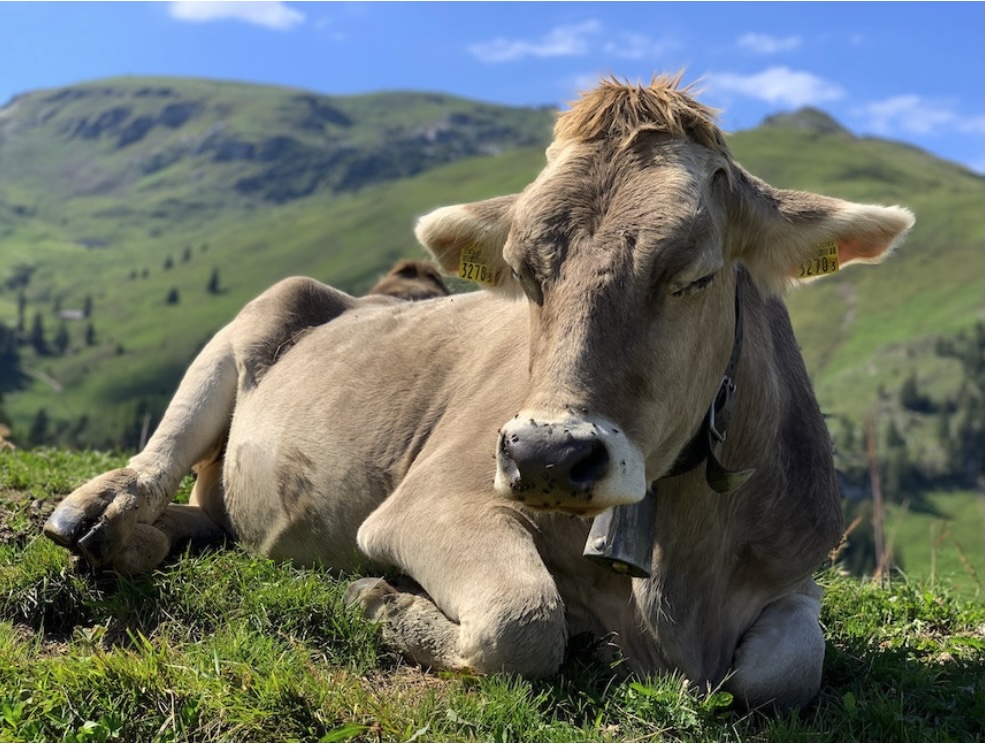
Photo by Corinna Widmer from Pexels.