On the Wheel with a Broken Wheel

D. E. Larsen, DVM

Pat was standing at the counter, clutching a shoebox in her hands.

“I know we impose on your generosity, Dr. Larsen,” she said. “But the class is heartbroken over Blossom. Can you get a look at her?”

“Don’t feel like you’re imposing, Pat,” I said. “I see all the classroom pets in Sweet Home at no charge.”

“I think this is a major injury,” Pat said. “You are maybe not going to be able to fix it.”

“Let’s get a look at Blossom,” I said as I led Pat into the exam room.

I opened the shoebox, and Blossom was huddled in the corner of the box. She was almost in a ball, and her fur was fluffed up. This was definitely a hamster who was not feeling well.

I started to reach into the box to pick Blossom up, so I could get a better look at her.

“Oh, be careful, Dr. Larsen,” Pat said, reaching out for my forearm. “She bites at times, especially if she is unhappy.”

I put my hand over her body, securing her head between my thumb and index finger. I carefully lifted her from the box. As I turned her over, her injury was visible. She had a fracture of her right tibia.

“Is it bad?” Pat asked. She had probably not been able to bring herself to look at the injury.

“Blossom has a fracture of her tibia on her right hind leg,” I said. “I am not sure that it is fixable. There is a lot of displacement.”

“We knew it was bad,” Pat said. “The class is very upset. It was that way when we came to school this morning. If there is anything that can be done for her, you would be their hero.”

“I think I am hearing that replacing her might not be an option,” I said. “Or at least, not if there is any chance of fixing her.”

“I told the class that I was sure you would do everything in your power to fix her, but we might have to talk about what to do if she can’t be fixed,” Pat said.

I looked at Blossom closely and mulled over repair options in my mind. I could possibly fashion a Thomas Splint that would work. That would be difficult to manage in a classroom pet. It would be easy to amputate the lower leg. She might do surprisingly well on three legs, but the classroom would have some difficulty with the decision. Just maybe, I could get an intramedullary pin into this bone. I could attempt to pin it, and if unsuccessful, I could go ahead and amputate the lower leg at the fracture site.

“Okay, Pat, here is my plan,” I said. “I don’t think that trying to splint this leg is a good option. There is a chance that I could repair this fracture with a pin on the inside of the bone. I am not sure about that, my experience base for repairing hamster fractures is zero. But I think I should try to pin this fracture. If I cannot get that done, I will amputate the leg at the fracture site. Blossom needs to stay overnight. That means you will need to bring her cage down, so we are not tearing the clinic apart tomorrow, looking for a fugitive hamster. You also need to prepare your class for the possibility of Blossom losing her leg, She will do well with 3 legs. It is just that some kids might be upset with that option.”

“Okay, I can bring the cage down after school,” Pat said. “We have a cage that the kids take her home in on the weekends.”

“That will be good,” I said. “I have some time this afternoon. We will do this then. I may well be done by the time you get back here with the cage.”  

I put Blossom entirely into a large dog facemask to induce anesthesia. When she was asleep, we secured her head in the smallest cat facemask. This allowed for reasonable control of anesthesia and access to the fracture site.

After prepping the leg, I covered the foot with a sterile gauze. Securing it with a couple of purse-string like sutures around the top and bottom of the foot.

I made a short incision over the fracture site on the inside of the leg. Bending the leg, I could expose both ends of the fractured tibia. Looking at the size of the medullary cavity, I selected a 20 gauge needle to use as an intramedullary pin.

I snipped off the sharp point on the aluminum needle. Then I inserted the blunt needle into the bone of the distal fracture fragment. This needle fits perfectly. And without any pressure applied, I measured the depth of insertion to be 3 mm. My plan was to bury this IM pin. This was something I had done in repairing fractures of the radius in tiny dogs.

I snipped the needle hub off and inserted the needle shaft into the proximal fracture segment. When it was fully seated in the upper bone fragment, I measured and snipped the needle to leave just over 2 mm of the exposed needle shaft.

Now it was a simple task to toggle this exposed needle shaft into the distal fragment. It required a little stretch, but it popped into the distal fragment quickly. The bone ends slid together better than expected. This proved to be an excellent repair. I closed the incision with a couple of sutures of 5-0 Dexon in the subcutaneous tissues and then closed the skin a couple of subcuticular stitches with the same material.

Blossom was placed in her shoebox with a warm towel for her to recover. By the time Pat had returned with the cage, Blossom was up and running around like nothing was wrong with her leg.

“Oh my, she acts like nothing is wrong,” Pat said as we moved Blossom into her larger cage.

“So, I think Blossom is doing well enough that you can take her home tonight,” I said. “You need to drop her by tomorrow just so I can check her over really quick. I want to make sure she is still using the leg and that the incision is okay.”

“Do I need to do anything for her?” Pat asked.

“I would bed her down with a fluffy towel for the night,” I said. “Other than that, I don’t think we need to do anything. I think we are home free.”

“I want to thank you, Dr. Larsen, from the bottom of my heart,” Pat said. “And I am sure the class will be thankful also.

The following week Blossom was in for her checkup with the entire class. We went into the surgery room, where there was room for the group. Blossom was the star of the show, and her broken wheel was healing well.

“She is back to running on her hamster wheel, and she doesn’t even limp when she runs,” one of the little girls said.

Photo by Frances Goldberg on Unsplash

The Upgrade

D. E. Larsen, DVM

“You need to hurry, your flight is boarding now,” the airline attendant said as he took our bags. “If your bags don’t make your flight, they will be on the next flight. You have a full plane, there is a Ducks game in Berkley Saturday.”

We hurried down the concourse to the plane. Just what I wanted, to ride to San Francisco with a planeload of Duck fans.

We squeezed down the aisle and found our seats. Now we could relax for a few minutes before the plane takes off. This was going to be our first long weekend off for nearly 2 years. A continuing education trip on paper, but a mini-vacation if we could make it such.

“I think we would have been better off to take the extra time and drive to Portland,” Sandy said. “Then we could have got a direct flight to Reno. I hate changing planes, and especially in San Francisco.”

“It won’t be too bad, we should have plenty of time,” I said.

About then, we were rudely made aware that our flight was going to be anything but pleasant. Sitting behind us, and on top of our seats at times, was a most unruly four-year-old and his mother, who had no concept of discipline.

We are making the final approach to landing on the runway that extends out into the bay. 

“I hate landing at this airport,” I say. “The first time I flew on a commercial airline was when I joined the Army. They loaded us on a plane in Portland and flew us to San Francisco. I had a window seat, and when we were landing, all I saw under the plane was water. We were getting closer and closer to the water. I was lifting my feet before the ground, and a runway came into my view. I repeat that episode in my mind every time I land there.”

We deplane and rush down the concourse looking for the gate for the flight to Reno. We ask an agent at the end of the hall. 

“That is a separate terminal. You catch a shuttle bus down those stairs,” the agent says, pointing to a stairwell at the end of the concourse. 

We hurry down the stairs and catch a bus to the detached terminal. Then we load into a puddle jumper, not my idea of a fun flight. I am white-knuckled all the way to Reno. We arrive, and Sandy’s bag makes the flight, my bag is nowhere in sight. We leave our information and hail a cab to the hotel.

“We have your reservation right here,” the hotel clerk says to Sandy. “It is a nice room, I hope you enjoy your stay.”

Sandy looks over the paperwork while I twiddle my thumbs.

“Is this a non-smoking room?” Sandy asks.

“No, Ma’am,” The clerk responds. “This is a smoking room.”

“We requested a non-smoking room on our reservation,” Sandy says.

The clerk looks at his computer screen closely. “I see that you are correct, it says a non-smoking room right here,” the clerk says. “We don’t have a non-smoking room available in this room class.”

It looks like another planeload of people has arrived, there is quite a line behind us now.

“I have to have a non-smoking room,” Sandy says.

“Let me go talk with my supervisor,” the clerk says as he leaves his station.

The people behind us let out an audible moan. Sandy is unwavering.

Finally, after close to 5 minutes, the clerk returns. He is all smiles.

“I have an upgraded room for you,” he says, winking at me. “You guys are really going to enjoy this room! It is one of our best suites.”

The Bellhop leads us away. The room is high in the hotel, on the 35th floor.

“You are going to really enjoy this room,” he said as he pushed open the door.

He set the bags down and went to the drapes and pulled them open. The entire wall is floor to ceiling windows, and the view of the city is incredible. I feel a little embarrassed as I hand him a $5.00 tip.

“Can you believe this room,” I said to Sandy. “And all because you would not accept a smoking room.”

The main room of the suite is three times the size of any hotel room we have ever seen. The bathroom is enormous. It has a large shower with two showerheads. There is a large jacuzzi tub, massive mirror with double sinks and a separate water closet.

“This sort of reminds me of Ma and Pa Kettle,” I said.” We are just a couple of old country bumpkins in a high-class hotel.”

Sandy laughs as she investigates the kitchenette/bar area. There is a large sectional, a loveseat and a couple of chairs. And then the bed takes up the far end of the room. 

The bed is more substantial than a king-size bed and round, on a raised platform.  There is a 30 inch high wrought iron railing around half of the platform. And a massive round mirror is on the ceiling above the bed. 

“I am not sure how this is going to work out for us,” I said. 

I’m a stomach sleeper, and I hang my feet over the end of the bed. Or I sleep on my side, in touch with the edge of the bed. I am not sure I am going to be able to find either in this bed.

“I think we are maybe past the mirror stage in our relationship,” Sandy said. “This could be an interesting evening.”

We were just ready to leave to get a bite to eat when there was a knock at the door. It was the Bellhop with my bag from the airport.

“They delivered your bag, but it looks like it has been broken into, you might want to check it carefully and make sure you file a report with the airline,” he said.

“Thanks,” I said. “Before you go, can you tell me something about this room? What does a night in this room usually cost?”

“This is our special suite,” he said. “We generally use it to comp the high rollers. We don’t rent it out very often, but when we do, it goes for $1200 a night.”

“I would guess you generally get more than $5.00 tips up here,” I said.

“I have got some tremendous tips in this room, but it is not a big deal, $5.00 is a pretty standard tip in most rooms.”

“I would have to have a whole lot of expendable cash before I could bring myself to pay $1200 for a room,” I say as I hand him a $20 bill.

It was sort of like adding the final insult to the plane trip. The bag was a mess, but the only thing missing is my sports coat. This gives me an excellent excuse for dressing casually. That fits my style just fine.

When the evening was over, and we are ready to go to sleep, Sandy spends a lot of time closing the drapes. It is no small task. I can not convince her that there is nobody who can peek into a room on the 35th floor, especially if the lights are out. But she does not listen.

The bed is comfortable, but, like many hotel beds, the sheets and blankets are excessive. I go around and untuck all the sheets on my side of the bed. Then I discard the comforter and half the blankets. I crawl into bed.

I am instantly miserable. I can’t find the edge of the bed, and when I reach a point where I can hang my feet over the end of the bed, my nose is at Sandy’s knees. I toss and turn and get tangled up in the top sheet. I get up and pull the top sheet off the bed. Since Sandy was sleeping soundly, I open the drapes and enjoy the view until I drift off to a fitful sleep. 

About 3:00 in the morning, I get up to go to the bathroom. I roll out of bed and start in the direction of the bathroom. I follow the edge of the bed until I reach the point where the round was turning toward Sandy’s side of the bed. I strike out toward the bathroom. 

I forgot about the railing. Just as my left foot takes a step down, the end of the railing hits me in the groin. My right leg impacts the railing, I lose my balance and fall, left side first, the two steps to the floor.

I roll onto my back. I feel like I have just been struck with a Klingon pain stick. I look around, the view out the windows is just as good from the floor. Then I look up, there I am, in full view, in the mirror. 

Morning comes, Sandy is well-rested. I look like I have been wrestling steers all night. We shower together and get dressed so we can get breakfast before classes started.

As we leave the room, Sandy stops and looks at the bed. What a mess, there are piles of sheets on each side of the bed. The blankets are knotted in a heap in the middle of the bed. Even the bottom sheet is untucked, and only half covered the mattress.

“The housekeeping girls are going to tell stories about what went on in that bed last night,” she said.

Photo by Manny Becerra on Unsplash

A Cat’s Breakfast

D. E. Larsen, DVM

I could see Bill and the hired man bringing the cow down from the upper pasture as I pulled up to the squeeze chute. This cow had a dead calf this morning. Bill was unsure what went on, but he was just starting into the calving season and wanted to make sure he didn’t have a problem.

“She looks like she is in good shape,” I said, as they ran the cow down to the squeeze chute. “Do you have any idea when she was due.”

“I told May Jane that you were going to chew me out for not have had the herd preg checked this year,” Bill said. “The calf looks pretty good size, I would guess she was near full term.”

“I am going to take the tractor back up there and get the calf,” the hired man said as he started up the tractor.

“We just want to make sure we don’t have a problem that is going to go through the herd,” Bill said.

“I will draw some blood for this cow and from her dead calf if I can. And I will get a sample of her afterbirth from a cotyledon and samples from the calf. The lab will be able to give us a pretty accurate diagnosis is it is something important. But, a lot of the time, maybe I should say most of the time, they won’t have an answer.”

“Mary Jane wants you to get us on your schedule to do some pregnancy exams this fall,” Bill said as I was finishing up with the sample collection from the cow.

“That will be good, I have a sheet of recommendations on breeding times and when we should do the exams,” I say. “It is good to try to get your calving season down to 40 days or less. It takes a few years to get there for most herds, but you will enjoy life better once we make it.”

“I wonder what is taking Don so long to get that calf?” Bill said. “It is only halfway up the field, he should have been back here a long time ago.”

Bill had no more than uttered the words when the tractor came into view. He had the calf in the front end loader.

“I got up there, and the calf was gone,” Don said. “I looked all over and finally found it up at the top of the field, on the other side of the fence. And you need to take a look at this.”

Don pulled the calf out of the loader and stretched it out on its back. This calf had a half dozen large chomps along the margin of the rib cage that opened the abdomen. The entire liver was gone.

“What the heck do you suppose did that to this calf?” Bill said.

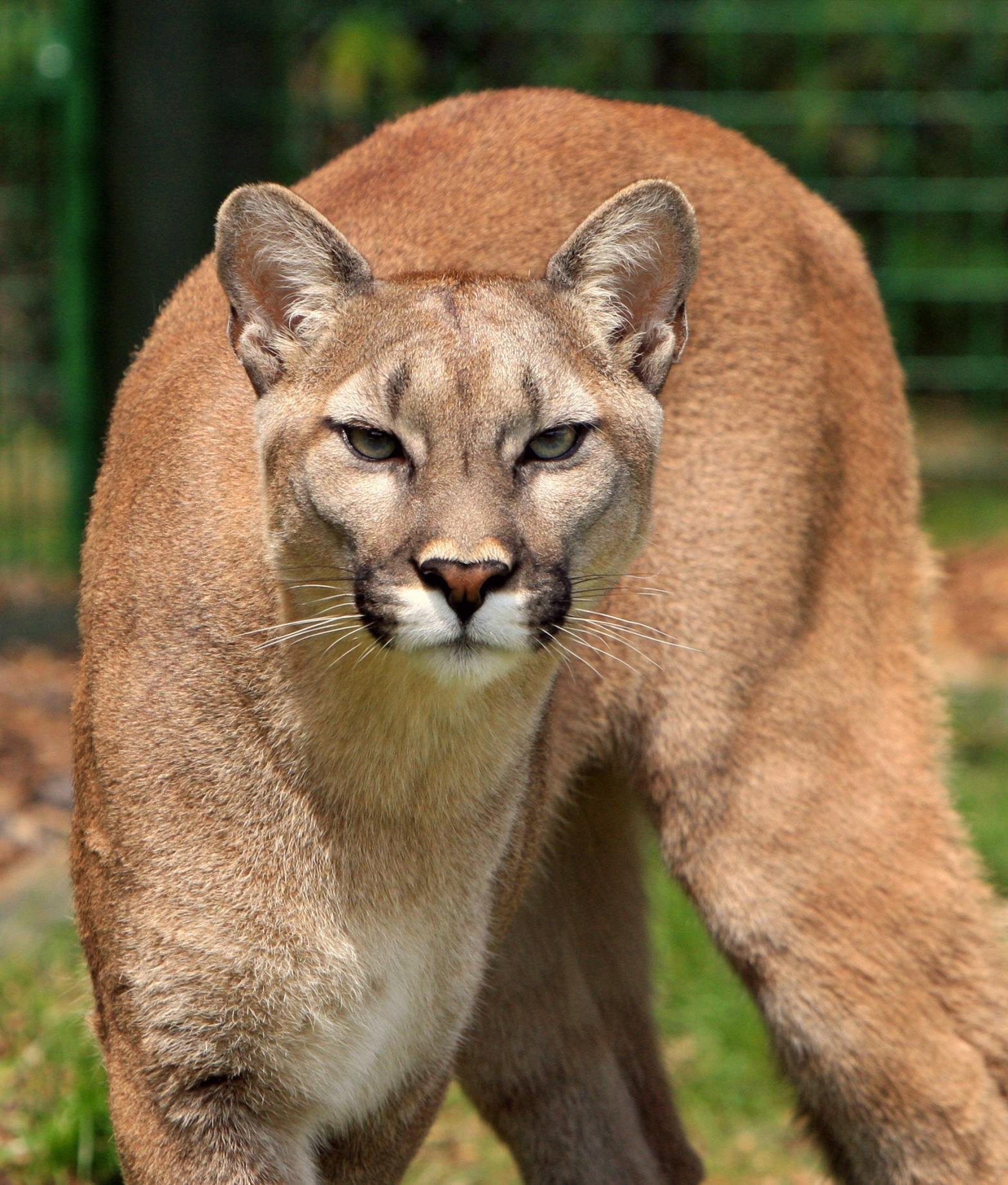
“A cougar did this,” I said. “Look at the size of these chomps along the ribs.” I placed my fingertips along the width of the bite marks, spreading them wide enough to cover each bite mark. “This was a large cat, look at the size of these bites.”

“Yes, large enough to pick this calf up and haul it over 100 yards up the hill and carry it across the fence,” Don said.

“It is 11:00 in the morning, and that field is right beside the county road,” Bill said. “This cat situation is getting a little scary.”

“When I first came to Sweet Home, I seldom heard a story of a cougar,” I said. “Now I hear stories almost every week. When they stopped hunting them with dogs, it changed the cat’s behavior. Even the hound guys tell me that their behavior has changed. Their dogs get tore up by cougars if they corner them. When they were hunting them, they would run to a tree. The cats have lost any fear of man and most of their fear of dogs.

“They see cougars downtown all the time nowadays,” Don said.

“Several things have happened,” I said. “The environments will say we are invading the cat’s territory, but with all the land use laws, things have not expanded around most towns in Western Oregon. What has happened, is the National Forest has stopped most timber harvest. So now there are few clear cuts in the high country. Clear cuts are were all the production happens. All the logging has moved to private lands, most of those lands are located closer to towns. The deer and elk need a lot of browse, and they don’t get in the timber, so they move to where the clear cuts are located. The cats follow their primary food sources. With not much hunting, the cat population expands, and they tend to end up in town once in a while. They find hunting cats and dogs pretty easy living. Encounters are only going to get more frequent as time goes on.”

“What can a person do to change things?” Bill asked.

“Probably not much, a lot of people are champions for the cat,” I said. “Hunting without dogs does very little to control their population. They can be right beside you in the brush and you will never see them. Don was probably lucky this cat didn’t want to argue over who owned this calf.”

“I never thought about that,” Don said. “He probably was not far away when I took it.”

“I had a client tell me a story not long ago,” I said. “His dog was very mean. One of those dogs that I see only to get a rabies shot into every 3 years. This dog is so mean that he bites the owner more than once in a while. This guy was telling me he was walking along a cat road through some small timber with his dog on a leash. The dog started throwing a fit, enough that the guy thought he was going to get bit. He turned the dog loose, it jumps in the brush, right beside them, and kicks out a cougar.”

“The state is quick to use dogs if there is a problem cat somewhere,” Don said.

“Nothing will change until a cat drags some kid out of a schoolyard someday,” Bill said.

“I better get some samples from this calf. The liver is a pretty important sample that the lab asks for, they probably won’t believe me when I tell them that a cat beat me to it.”

Photo by Pixabay from Pexels