My First Sick Cow

D. E. Larsen, DVM

My early memories from childhood are still vivid in my mind and go back to my third year, and maybe earlier. My older brother, who never seems to recall much of those days, will often disagree with my memory once I mention something. That said, this is my memory and my blog.

I stood at the window and watched the chicken coop up the hill from the house. Dad and the Uncles were in the coop, treating our cow. She was sick this morning. Of course, at four years of age, I knew nothing of the particulars. 

Dad picked up the earpiece on the wooden wall phone and cranked the hand crank several times. Then he told the woman on the phone who he was calling. I was never allowed to use this phone. You had to know our ring before you could answer the phone. Otherwise, I would be just like Mary down the road, listening to other people’s conversations.

“The cow was staggering this morning,” Dad had said into the wooden phone that hung on the wall. “I was able to run her into the chicken coop. She went down, and I can’t get her up. It looks like Milk Fever to me.”

We lived on a small acreage on Catching Creek at the time. It was not really a farm, but this cow was our family milk cow. There was a big concern about the cow in the house that morning. This was our sole source of milk.

It was not long after the phone call that Grandpa and Uncle Dutch arrived at the house. Mom poured them coffee as they waited for Uncle Duke and Rodney. Rodney was next to come.

“Duke is never on time,” Albert said.

They were waiting on Duke because he was the “cow doctor” for the group. Duke had been to college and was respected for his expertise. There was a lot of chatter at the table, about the cow, and about Duke.

When he arrived, everyone was up and out of the house. They all headed for the chicken coop.

I have no real recollection as to how long they were in the chicken coop. Mom was busy in the kitchen, dishing up some pie to go with the coffee. The men would be back when their work was done.

Finally, the first to exit the chicken coop was the cow. She must be well. Everyone in the house was happy. Then in a few minutes, the men filed out the door.

Mom served the pie with thick cream and coffee. All the men relaxed and talked about the treatment and the coming chores or the day. Rodney kidded my brothers and me. It was a happy event.

The mood around the table was almost jovial. It was more than the fact that the cow was well. It was the fact that it had been so easy and so fast. 

There was no way for me to know at the time, and I can only speculate today, but this could have been the first time that this group of men had treated a cow with milk fever with an injection of IV Calcium. 

Before the mid to late 1940s, milk fever was treated by inflating the udder with air to bring milk production for an immediate and temporary halt. Udder inflation was the first successful treatment for milk fever. It was used initially without a clear understanding as to why it worked.

In the mid-1930s, low blood calcium was found to be the cause. Routine treatment, on the farm, with IV calcium, was slow to replace udder inflation. But by the late 1940s, IV calcium had become the standard treatment.  

In the late 1940s, veterinarians were in short supply in Western Oregon, especially in Coos County. Duke’s skills were heavily relied upon in those years before Myrtle Point had a veterinarian.

This event provided me with an early awareness that we treated sick cows. And, perhaps, most importantly, the elation when everything was successful.

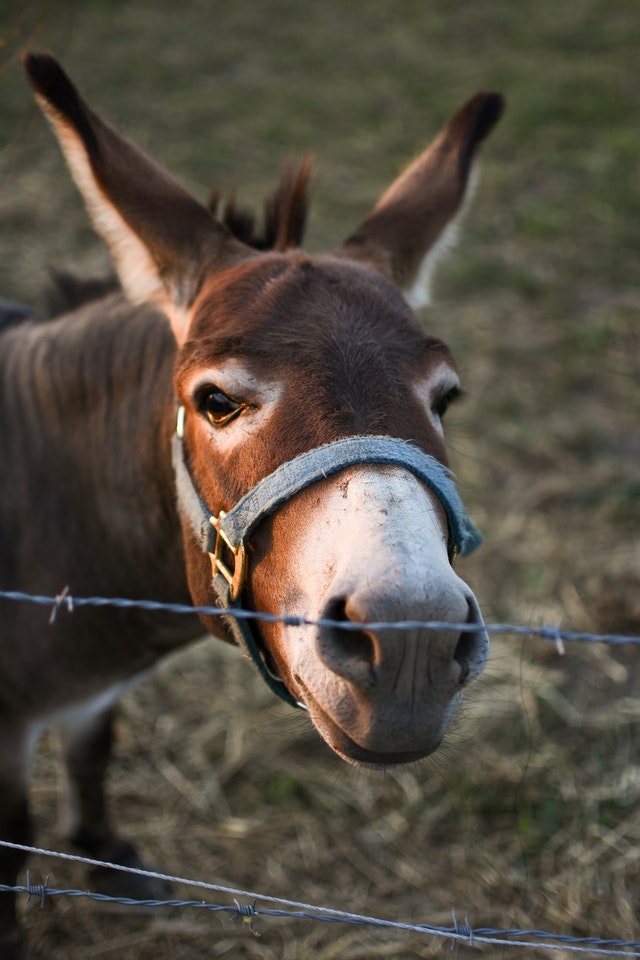
Photo by carboxaldehyde from Pexels

One Twist Deserves Another

D. E. Larsen, DVM

I ran my hand into Rosie’s vagina a second time. It still ran into a blind pouch. Rosie was a prized Jersey cow that supplied milk to a lot of neighbors.

“What the heck is going on?” I asked myself. “I had never had a dystocia in a Jersey before unless it was associated with milk fever.”

I explored the pouch with my fingertips. Then the light finally flashed on. This was a full uterine torsion. Partial torsions were common. In fact, I sort of prided myself at being able to untwist a uterus that was half rotated. 

I used my left arm’s strength, I would rock the calf a little, and then, with a strong flip, I would turn it upright. The narrowed twisted vagina would open completely, and delivery would be a snap after the correction. This was a full 360-degree torsion. The vagina was twisted closed like the top of a plastic bag. I tried to advance my hand through the twisted vagina, to no avail.

My thought was to get my hand into the uterus with a detorsion rod and hook the feet to the rod. Then with a bar through the other end of the detorsion rod, I could untwist the uterus with a strong crank. But that wasn’t going to happen. I could not begin to advance my hand through the twisted vagina.

“Carol, there is full 360-degree uterine torsion,” I said. “I can’t get my hand through it. That means we are probably going to have to do a C-Section.”

There was a gathering crowd in this small backyard barn lot. It seemed that half of Crawfordsville was watching.

“Is that the only option,” John asked.

I started to reply, but the question had started the wheels turning in my memory bank.

“I am sort of short on tricks,” I said. “But there is one that we could try. I have never done it. In fact, I have never seen it done. It might be worth a try. I will need 2 by 12 plank, about 12 feet long.”

“We just happen to have one of those,” Carol said. “Over in that lumber pile.”

A couple of guys pulled the plank out of the lumber pile and had it beside Rosie in no time. I had everyone’s full attention now. Nobody had any idea what I was up to.

“This is the plan,” I explained. “We lay Rosie on her side, lay this plank across her belly, with the plank’s midpoint on her belly. Then we roll Rosie to her other side while some brave soul stands on the plank. The plank holds the calf while the Rosie turns, thus undoing the uterine torsion. The only trick is to make sure you roll her the right way.”

“And just how are you going to lay her down on her side?” Bill asked. “I suppose you just ask her.”

“That’s another trick that I use all the time,” I said. “It’s called the Flying W. If you haven’t seen it, you will be impressed.”

I got my large cotton rope and placed the middle of the rope over Rosie’s neck. I crossed the rope between her front legs and brought it up each side, crossing again in the middle of her back. Then I bring both ends out between her hind legs, on each side of her udder, the application was complete. A slight pull, and Rosie fell to her right side.

“I’ll be darned,” Bill said.

I positioned the plank across Rosie’s belly. With the midpoint in the middle of Rosie’s belly. This would be enough plank to make a full turn for Rosie. The plank was at about a 45-degree angle with the ground. It might take an agile person to ride it for the entire arc.

I looked around at the crowd.

“I can stand on the plank,” Carol said. “She is my cow, and there was a day that I was somewhat of a gymnast.”

I positioned Carol on the plank, about four feet up the plank from the ground. I had a couple of guys on each rope tied to both the front and hind feet.

“Now, we are going to go very slow,” I said. “I need to have my hand in her vagina to make sure we are turning the correct way. I tend to be a little dyslexic, and I have trouble figuring this out.”

With my hand in the vagina, I had the guys start lifting on the feet. Sure enough, the twist was tightening.

“Okay, all stop,” I said. “We are going the wrong way. We have to start all over with Rosie on her left side.”

It only took a couple of minutes to untie Rosie’s feet and remove the plank. I didn’t have to do much. The whole crew knew what was up and what needed to be done.

With Rosie on her feet, Bill quickly grabbed the ends of the ropes on the Flying W. He wanted to feel just how easy it worked.

“Now, we want her to fall on the left side,” I said. “So when you pull, you want to lean left and put all the pressure in that direction.”

Bill pulled, leaned left, and Rosie flopped to her left side. Bill had a big smile on his face.

“That was so easy, I can’t believe it,” Bill said.

“If you are throwing a big bull, or an ornery steer, it might take a couple of guys on each rope,” I said. “But I have never seen it fail.”

The rest of the crew had Rosie’s feet tied and the plank in place in no time. Carol jumped on the plank, and we rolled Rosie.

After standing Rosie up, I washed her up one more time. I ran my hand it into a normal birth canal. I didn’t let on, but I was almost as amazed as was the crowd watching. I grabbed both front feet of the calf and pulled them into the birth canal. As I turned to my bucket for my OB straps, Rosie strained, and out popped the head. One more strain, and both John and I caught the calf before it fell to the ground.

“That was easy,” John said.

“Jersey cows have the easiest deliveries of all the breeds,” I said.

We turned Rosie loose, and she turned her attentions to the little heifer calf, utterly oblivious to the crowd watching.

Photo by Tom Swinnen from Pexels

Ageless Ida and Kitty

D. E. Larsen, DVM

Ida was sitting beside her daughter, waiting patiently, with Kitty nestled in her lap. Ida was my oldest client, a tiny, frail old lady with snow-white hair. She lived by herself, but her daughter, Lila, was close at hand. Lila was no spring chicken herself.

Ida drove until a couple of years ago. She had expressed her disappointment to me when they took her driver’s license away. She was fiercely independent, and she hated to have to impose herself on her daughter.

Kitty was an old tabby cat with a white blaze and a white chest. The record did not have a birth date for Kitty. That meant the girls probably disagreed with Ida’s guess. Maybe I should resolve that issue today.

Ida slapped at her daughter when Lila tried to help her stand up with Kitty. She also refused the helping hand offered by the girl showing her to the exam room. She ambled toward the exam room with measured steps and cradled Kitty in her arms.

“Kitty’s has not been feeling well for several days,” Ida said as she carefully positioned her on the exam table. “I had to crawl under my bed to get her this morning.”

I had to take a moment to process that statement. I am not sure I could crawl under a bed to retrieve a cat, and I am a young man. Imagining this frail little lady crawling under her bed was difficult to conjure up in my mind.

“Ida, you shouldn’t be doing that at your age,” I said. “You should get one of your grandsons to help.”

“They are always busy, and Lila is in worse shape than I am,” Ida said. “Besides, if you quit doing things for yourself, pretty soon, they stick you in one of those prisons that they call all sorts of fancy names today.”

“That’s pretty good advice,” I said. “Let’s look and see if I can find out what is wrong with Kitty.”

“Kitty is very old, she is 26 years old now,” Ida said.

“That is pretty old for a cat, are you sure of the date?” I asked.

“David, I got her as a kitten for my 70th birthday,” Ida said. “I should know her age. I named her Kitty because cats never pay attention to a name but always come when you call kitty.”

“I had no idea she was that old,” I said. “I don’t think I have seen another cat near that age. I did have a client who moved here from California with a 17-year-old cat. That cat aged 2 years every 3 months, according to the owner. It was 25 when he died a year later.”

“I have a picture of Kitty and myself at my birthday party,” Ida said. “That was the last birthday party I allowed Lila to give for me. They are sort of silly for old folks. They just use them as an excuse to take their picture with you. Just because you might not be around next year.”

Kitty was lying on the exam table, unmoving through all this discussion. I petted her head and then ran my hand down the length of her body. There was a bump when I cross her abdomen. I felt closer. It was a tumor, the size of an orange.

I looked at Ida, and she had a tear on her cheek.

“I felt it last week,” she said. “I prayed it would go away, but that didn’t help.”

“Sometimes, we can remove these with surgery,” I said. “That might be difficult at Kitty’s age.”

“No, I told her I wouldn’t let you do any of that to her,” Ida said, tears streaming down her cheeks now. “I don’t know what I am going to do without her, Doctor. She is all I have to talk with now, all my friends are long gone.”

Ida was purposely avoiding the discussion of euthanasia. I knew it had to be discussed, but I wanted her to bring it up. Maybe that wasn’t going to happen.

“You should get a new cat,” I said. “We could find you a kitten.”

“That wouldn’t be fair to the kitten, David,” Ida said. “I am not going to be around forever, you know.”

“You could have your Granddaughter help pick her out,” I said. “She could know that it would be her responsibility when the time came.”

“That might be a thought,” Ida said. “But what are we going to do with Kitty? I don’t want her to suffer.”

“Is she eating at all?” I asked.

“She has been under my bed for 3 days,” Ida said. “That is why I had to crawl under there to get her.”

“I think she waiting to die,” I said. “Maybe it is time we talk about making that an easy process for her.”

“Yes, I think that is what I thought when I called Lila this morning,” Ida said. “Then, I can take her home and bury her beside her favorite place in the back yard.”

“You should get one of your grandsons to help you with that chore,” I said.

“The ground is still soft, David,” Ida said. “I am not helpless. That is something I would like to do privately.”

“It will only take a moment for me to put her to sleep,” I said. “You can wait out front if you like, and we can bring her out in a small box.”

“I think she will like to be looking into my eyes when she goes, I will wait right here,” Ida said. “And I will take her home wrapped in her blanket. She would like it that way.”

And that is precisely how it was done. Ida carefully wrapped Kitty in her blanket and wiped a tear from her eye before gathering her into her arms.

“Thank you, David,” Ida said. “I will think about that kitten.”

I watched as Lila helped her mother out the door. Ida slapping at her as she tried to hold Kitty.

That was the last time I saw Ida. Her obituary was in the paper a few months later.

Photo by Belén Rubio from Pexels