Several Days in February

D. E. Larsen, DVM

I looked for a spot in the trunk for my bag. There were six of us stuffed into the sedan for our trip to Nebraska. My bet was, I was the only one who had been in the military. You didn’t need to bring your entire wardrobe for a one week trip. 

We were going out to spend a week helping a progeny test herd of 600 heifers during the calving season. The herd belonged to Diamond Labs. They were collecting ease of calving data on their bulls to be used for their semen marketing. Six of us would drive out on this Sunday morning, and the 6 guys out there would take the car and drive home. Diamond Labs had a house on the place for us, and we took meals in a restaurant/bar in the small village near the ranch.

The drive out of Fort Collins was away from the mountains and out across the prairie. It was a four-hour drive across some for the flattest land in this country. I settled into a corner of the back seat and tried to catch a couple of hours of sleep.

“Larsen, how can you sleep when we are driving through some scenic country?” Mike said.

“One thing you learn in the Army is to sleep anywhere,” I said. “You go up on the mountains out of Fort Collins, Mike, and you can watch the riverboats on the Mississippi River.”

“That can’t be right,” Mike said. “That can’t be right, can it, Jim?”

“He is toying with you, Mike,” Jim said. “He doesn’t have much to say about this flat country.”

It was going to be a cold week. Daily high temperatures were 20 below zero. Overnight lows were pushing 40 below. This will be a great learning experience, but we will pay for it by enduring some harsh temperatures.

The group that was going home was glad to see us pull up to the little house. The housekeeper was just finishing up getting the place ready for the new crew. We discussed instructions as briefly as possible, and they were off. The ranch foreman came over to make sure we were settled into the house.

“Here are the directions to the restaurant where you take your meals,” the Foreman said. “It is time for you all to go get lunch. You can take the old crew cab pickup. When you get back, you need to decide on your groups of two. The herd needs to be checked every 2 hours. You pull any heifer who was in labor on your last drive trough. Bring them into the barn, diagnose the problem, and take care of it. That means you pull the calf, do a C-Section, or do a fetotomy, Whatever is indicated.” I will be around in the morning. You go for breakfast at 7:00, Shift change is at 8:00 AM, 4:00 PM, and Midnight.”

Using my military experience again, my first priority was picking out my bunk. When the others realized what I was doing, there was a mad rush to stake their claims.

The restaurant was in what one would have to stretch to call it a town. It was more like a congested area with maybe a dozen buildings. But the food was good, and they appreciated the business that the ranch was giving them.

“Look at that picture on the wall,” I said to Jim as we were setting down. It was a poster of W. C. Fields with one of his quotes.

“During one of my treks through Afghanistan, we lost our corkscrew. We were compelled to live on food and water for several days,” W. C. Fields.

“Bob and I are going to take the first shift,” Mike said. That will mean we will have a short shift today.”

“A short shift today, but also a short shift next Sunday before we leave,” I said. “It all catches up with you sooner or later.”

“Dave and I will take the midnight shift,” Jim said. “That will be the coldest, but also probably the quietest.”

“I guess that leaves the 4:00 to midnight shift to Bill and me,” John said as we finished lunch. “I guess we better get back so Mike can go to work.”

Midnight came sooner than I thought. John was up waking us up about 11:30.

“You guys get dressed, and we will have time to go over our notes,” John said. “Make sure you put on your long johns, it is just damn cold out there tonight, and that little heater in the pasture truck doesn’t keep up.”

“Make sure you check the corners of the pastures,” John said. “There is a heifer in labor in the corner by the creek. If she doesn’t have a calf, you should bring her in for help. We didn’t have any deliveries to help. Maybe you will get lucky.”

The pasture truck we had to check the herd with was an old Army ¾ ton. It had a canvas top and probably no insulation anywhere. With a light wind blowing, the 30 below temperature was brutal. The heater in the truck seemed to take forever to warm up and then blowing full blast, it failed to keep the ice from forming on the inside of the canvas top.

“There is the heifer John was talking about,” Jim said as he turned the truck so the headlights would fall on her. “We get lucky on this trip. She already has a calf.”

“How do these calves survive in these temperatures?” I asked, thinking that Jim would have some experience with this cold since he was from Wyoming.

“Some don’t, and a lot of them lose the tips of their ears,” Jim said. “I guess it takes a good momma cow to get them dried off and up nursing.”

Most of the herd was in a hollow in the middle of this ten-acre pasture. Grouping up kept everyone a little warmer, and the hollow provided some protection from the wind.

“Looks like we get to drink some coffee,” I said. “Not seeing any heifer in labor on this trip means we don’t have any work to do on the next trip.”

“I think you spoke too soon,” Jim said as the headlights caught the eyes of a heifer in the far corner of the pasture. He pulled the truck closer.

“It looks like we should watch her a few minutes,” I said.

The heifer was straining hard, and just the tips of the toes were visible at her vulva. Her straining did not let up as we watched, and there was no progress in the fetus’s position.

“What do you think?” I said. “I don’t think we want to leave her for another two hours with that straining.”

“I agree,” said Jim. “She would have to be in the farthest corner from the barn.”

We both got out and got her on her feet and headed for the barn. She seemed to know that it would be warmer there.

“You keep her going,” Jim said. “I will go and make sure we are set up in the barn, then I will come back and follow you with some lights.”

It was a long slow walk to the barn, and while I was expecting some warmth when we got there, I was disappointed.

“Why do suppose people would settle in this part of the country?” I asked Jim. 

“This is great cattle country,” Jim said.

“My bet is, they had a broken wheel on their wagon and couldn’ go any further,” I said.

We got the heifer in the chute and started the propane heater. The heater was going full blast, and you could hardly feel it.

I tied the tail out of the way, and Jim washed her up and did a vaginal exam.

“I think we can pull this one with no problem,” Jim said. “It might be a tight fit, but I think it will come. You might want to check her.”

I washed up, the water was warm, but my wet hands and arm were instantly freezing. The only warmth was inside the heifer. 

We hooked up the calf puller and haltered the heifer so we could release her head from the chute in case she went down during the delivery. It was a hard pull, but the calf was fine when it hit the ground. We move them into a holding pen for the night.

“This guy is a lucky one,” I said. “He gets to spend the night in a warm barn.”

We set up the chute so it would be ready for the next cow. I noticed the water on the ground from where we worked on the heifer was frozen solid.

The thermometer continued to dive as the night grew long. On our third trip through the herd, it was 40 below. One quit trying to stay warm, you just tried to keep from getting frostbite.

Jim noticed the heifer in the corner by the creek.

“We better check that one,” Jim said.

Blowing in my hands and reflecting my breath onto my face, trying to keep some feeling in my cheeks, I looked up and noticed this was the heifer that had calved earlier.

“No, she has been there for several days,” I said.

“Several days!” Jim remarked. “This is our first night.”

This is going to be a long week.

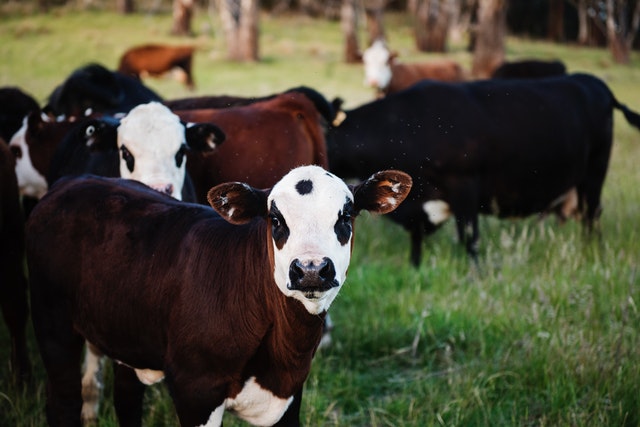
Photo by Chris F from Pexels

Note on My Brother, Larry Larsen

D. E. Larsen, DVM

I started writing bits and pieces in the 1990s. Those writings were brief, maybe all my papers are brief, but those were 200 to 400 words. They helped preserve some of those moments, and I still refer to those notes when pondering a topic.

About this same time, my oldest brother started writing a weekly column in The Myrtle Point Herald, the local weekly newspaper. His column was short stories of his early years in the woods (or the logging industry for those unfamiliar with the vernacular). His column chronicled his life in the woods, and as a small gyppo logging company owner, and then later as a log scaler.

He enjoyed a high level of local notoriety. To think, he didn’t even know how to type, let alone run a computer.

He would write those stories in longhand, and the paper would type them out and publish them. With some encouragement, he compiled them into a small paperback book. He printed several hundred copies, at considerable expense for him. He managed to sell them all for $22.00 a copy.

When they were sold, he was reluctant to go through the printing expense again. I convinced him to put it on Amazon as an ebook.

If anyone wants a different perspective of life in a small West Coast logging town and the work that goes on in the woods. That book is still available on Amazon. 

My brother passed away in 2017 from lung cancer. The events leading up to his death were a story fit for a novel.

Larry had one set of numbers that he played in the Oregon Lottery. He played those numbers every drawing, and he won a lot. Winning 4 numbers several hundred times and 5 numbers a half dozen times. He absolutely knew he was going to win the big pot sooner or later.

After he was sick and waiting for some diagnostics the following week, he had trouble finding the shower Thursday night. His wife would not let him go to town to buy his lottery ticket on Friday morning. He managed to sneak out of the house and drove the 8 miles to town. He made it into the store and purchased his ticket. Then he collapsed. The store called his daughter and daughter-in-law, the ambulance, and the police. Of course, there was a lot of commotion. 

Larry managed to recover enough to get back on his feet and get back into his pickup. He was going home. The police were reluctant to allow him to drive. The daughters tried to talk him into the ambulance. 

With much hesitation on his part, he finally consented to an ambulance ride. He died in the early morning hours of the following day.

What about that final lottery ticket? Would that not be the final irony of a man’s life, if that ticket was the winner.

As it turned out, it was not the big winner, but what an ending to a novel or a life, if it had been.

Link to Larry’s book,

Back in the Day, by Larry Larsen

The Wicked Witch of the West

D. E. Larsen, DVM

Sandy went with me on this late afternoon call to Lacomb. With the kids visiting our parents, we had planned to stop for dinner on the way home.

I leaned against the rail of the log corral. On the far side of the corral stood this evening’s patient, a Scottish Highlander cow, with a long set of horns. She was eyeing me as carefully as I was her.

Then she charged, and she covered the ground across the corral with surprising speed. I stepped back from the rail just before she struck the fence and swept her horns through the slates, side to side.

“I told you she was mean,” Jean said. “We are hoping that dehorning her will help to calm her down.”

“I see what you mean,” I said. “Dehorning her will remove those weapons, but she might still be dangerous to have around. Sometimes you are better off to send these cows down the road.”

“She gives us a nice calf every year,” Jean said. “These cows are small and really are not profitable beef animals. They are mostly just pets.”

“If you keep a cow with this kind of behavior, 5 years from now, you are going to have four of them to deal with,” I said. “Behavior is pretty heritable, like mother, like daughter.”

“Will, to start with, let’s get those horns off,” Jean said. “Is that something you can do?”

“It would be a lot easier, and cheaper, if you had a squeeze chute,” I said. “But I can probably get it done. I will have to get a couple of ropes on her and cross tie her to get close enough to restrain her head. If I can do that, the rest is easy.”

The cow stayed against the far fence in the corral now. I walked around to her side of the corral. I jumped as she again butted the rails and slashed at me with her horns. When she backed up a couple of steps, I dropped a lariat loop over her head and took a quick dally on the nearest post. Her first reaction was to run. I held tight when she hit the end of the rope. Then she gave me enough slack so I could get the dally tied on the post. I moved around the corner and tried to get her to come up to the fence. No way, she stood at the end of the rope, as distant from me as she could get.

I moved back to my original position with Jean and Sandy. The cow moved back to her place near the post where the rope was tied.

“I guess if I’m going to get another rope on her, I am going to have to crawl over the fence,” I said.

“You be careful,” Sandy said. “I don’t like the way she is acting.”

“Yes, I wouldn’t trust her at all,” Jean said.

I crawled up to the top of the fence, hoping to entice her to move closer to me. I threw a loop at her from this position, but it fell short. After recoiling me lariat, I crawled down into the corral.

She watched me closely as if measuring me up or measuring how much rope she had to play with. I took a couple of steps toward her. She bellowed and charged.

The charge took me by surprise. I thought I knew cows pretty well, and I was expecting her to move away once I was on the ground in the corral. But here she came, at full speed.

I knew I didn’t have time to turn and run, so I backed up quickly. My back hit the fence. Both Sandy and Jean were too excited to scream. Her charge was almost to me, but then she hit the end of her rope. She slashed her horns back and forth, the tips coming only inches from my chest. I waited for a second to allow my breathing to quiet, then I dropped the loop over her head.

With both ropes her now, I could cross tie her in the far corner of the corral. Once I had her cross-tied, I grabbed her with my nose tongs and tied her short.

The dehorning was almost a pleasure at this point. I gave some thought to doing it without anesthesia, but that would be taking advantage of my position to get back at her. I clipped the hair away from the base of her horns and scrubbed the area with Betadine. Then I did nerve blocks on each horn. 

After removing both horns with a wire saw, she looked almost like a nice cow. I sprayed the wounds well with antibiotic spray and fly spray, even though we were probably too early for flies. Now all I had to do was to turn her loose. 

I had quick-release hondas on both lariats, so they were quickly removed. Now she was only secured by the nose tongs, and she was pulling against them.

Standing on the fence’s bottom rail, I made a quick, coordinated motion to untie the nose tongs and shake them loose from her nose. She took a step back and then charged the fence, knocking me to the ground when she struck the rails, swinging her head, not yet aware that her wicked horns were gone.

Both Sandy and Jean rushed over to help me to my feet.

“Are you okay?” Jean asked. “I told you she was a mean one.”

“I am fine,” I said. “She is not just mean, she is a wicked witch, that is what she is. At least, pretty soon she will learn that her horns are gone. Most of her herd mates have probably been hoping for this day.”

My nerves were almost back to normal as they seated us by a window in the restaurant at Pineway Golf Course.

“I think I deserve a beer before dinner tonight,” I said.

Photo by Trina from Pexels