Grandpa’s Hog Snare

D. E. Larsen, DVM

   The first large boar I castrated was quite an event for me. I had been told of a good anesthesia technique that sounded pretty simple. “Inject 5 grams of Surital (Thiamylal) into one testicle. When the boar falls over, open the scrotum and clamp the cord of the injected testicle. Every time the boar shows some movement, remove the clamp on the cord until he is asleep again. Then when everything else is done, remove the injected testicle and let him wake up.” 

   Sounds simple, but try sticking an eighteen gauge needle into the testicle of a 700-pound boar who is not happy about meeting you in the first place and who is in a pen that may or may not hold him. 

First, I had to mix the Surital in a manageable concentration. Five grams are usually combined with 100 ml of sterile water. I needed to mix it so it would all fit in a 60 ml syringe. It proved a little challenging to get all the powder to dissolve in a smaller amount of water. I put 45 ml of water into the vial first and mixed it at that concentration. Then I drew it into the syringe and added enough water to bring the volume to 60 ml. Attaching an 18 gauge, 1 ½ inch needle to the syringe, I was ready for the injection.

   With all my equipment laid out by the pile of fresh straw where the boar was hopefully going to fall, I headed to the pen, syringe in hand. This pen was too large, and the boar could quickly turn around. Every time I positioned myself behind him, he would twirl around and charge me, ramming the panels with his snout. He was becoming more agitated by the minute.

   Old man Morris watched the spectacle for a few minutes. I think he was trying to not laugh. 

  “I think we need to get a hold of him,” Mr. Morris said.

  “And just how do you think that is going to happen?” I asked.

  “We should be able to get a snare on his snout,” he replied. “He wants to face you head-on, none of that sneaking up on his nuts.”

   “I will grab my snare, If I can find it,” Mr. Morris said. He disappeared into the old barn. 

This boar was a new project for Mr. Morris. He picked him at a bargain price at the sale barn and planned to make sausage out of him. They say if you put boar meat in a frying pan, it will run you out of the house. It smells as bad as the old boar. But if you castrate these guys and give them 6 months of rest and relaxation, they make pretty good sausage. I would think you would get tired of the stuff after 400 pounds. 

   Mr. Morris was a quiet man, his wife had died several years ago, and he lived alone now. I would guess the barn was older him. He had to be in his eighties, short, gray-haired, and walking with a little stooped over posture. His knees bothered him as he walked across the uneven ground in the barnyard.

   He came back with a hog snare that looked much older than him. “This was my grandfather’s hog snare,” he said as he held it up for my inspection. The smile on his face told of the memories going through his mind right now.

   This snare had a rusty cable loop that was attached to a wood handle. There was an old rope on the other end of the wooden handle. If you got the cable loop around the snout, you could anchor the whole thing to a post to maintain control of the captive. This was definitely homemade but looked like it might work.

   “If we catch his snout with this snare and tie it to the corner post, he will stand here and squeal as he pulls back on the snare. That should give you enough time to do your thing behind him,” Mr. Morris explained. “I don’t know if it will hold him for the entire thing.”

   “If it holds him at all,” I said. “All I need is a moment to get this injection into one of his testicles.”

   “How does that work?” Mr. Morris asked, clearly confused.

   “This injection will put him to sleep, and the rest of the procedure will be a piece of cake,” I explained.

   I retrieved a jug of mineral oil from the truck and lubed the old snare the best I could. I was afraid to ask how old it was and when it was last used. I kept telling myself, “I only needed a minute.”

   It took several tries to get the snare on his snout. When I finally managed to catch him, I leaned back and pulled on the handle as hard as possible. The whole time, hoping this old snare held together.  

   To say the boar squealed would be a tremendous understatement. The squeal was a harsh roar, a bellowing screech. It was the loudest thing I had heard from a pig. The boar was pulling back with such a force I didn’t know who would be tied to the post, him or me. It actually worked out almost perfectly. He pulled back till his rear end hit the far corner of the small pen. I pulled hard and took two wraps around the post with the rope, and handed the end of the old rope to Mr. Morris. Mr. Morris had a big smile on his face, knowing that his grandfather would be proud. 

The boar was pulling back, and his testicles were sticking through the slats of the pen. The injection was a snap. I popped the needle into his left testicle, and there was no noticeable response, no change in the intensity of his screech. 

   Once the injection was complete, I motioned to Mr. Morris he could let go of the rope. The boar immediately quieted, shaking his head to remove the snare. He returned to his usual grunts and grumbles.

   “As soon as he starts to wobble, we need to open this pen and try to direct him over to that pile of straw,” I said.

Things moved pretty fast, another minute, and he was wobbling. We swung open the pen, and he stumbled out, made it to the edge of the straw, and fell to his right side. I watched him briefly, making sure he wasn’t going to jump up again. There was nystagmus in his eyes, so I started with a quick prep of his scrotum and then sprayed it with Betadine.

   I washed quickly and dried my hands on a surgery towel. After putting on a pair of sterile surgery gloves, I grabbed the scalpel and incised over the left testicle and through the tunic. I pulled the testicle free and clamped the cord with a large Oschner forceps. Then I relaxed a little, did a better prep on the scrotum’s right side, and flushed the area again with Betadine. I incised the scrotum over the right testicle and through the tunic. I pulled the right testicle out and applied a clamp on the cord, just for insurance. I applied the emasculator to the cord, saying to myself, “nut to nut,” to make sure the emasculator’s crushing side was in the proper position. One good squeeze and the testicle fell free.

   “You don’t want these, do you?” I asked Mr. Morris.

   “There ain’t nothing about this guy that is going to be worth eating for another 6 months,” he replied.

After making sure the crush on the cord was adequate, I applied some antibiotic powder to the cord and released the clamp. Then I powdered the inside of the wound. I went up to the boar’s head and checked to make sure there were no injuries from the snare, then turned to the last testicle. The boar was flecking his ears now, so I released the clamp for a moment. He quieted quickly. I clamped the cord and removed the testicle with the emasculator, again, saying to myself, “nut to nut.” I powdered the cord and the scrotal incision and sprayed the entire rear end for flies. Not wanting to catch him again, I gave him an injection of long-acting penicillin.

  “Is he going to be okay?” Mr. Morris asked.

   “He will be fine. He will be back on his feet before I get my stuff put away,” I replied. “I am going to take these testicles and throw them away at the clinic. If your dog got ahold of the one I injected, it might kill him.”

   I was doing the final wash on my hands and arms when the old boar rolled up on his sternum. He stood up just as I closed the rear door on the vet box.

   “Couldn’t have done it without your grandfather’s snare,” I said to Mr. Morris.

   He just smiled and nodded his head as he put a couple of wraps of the rope around the handle.

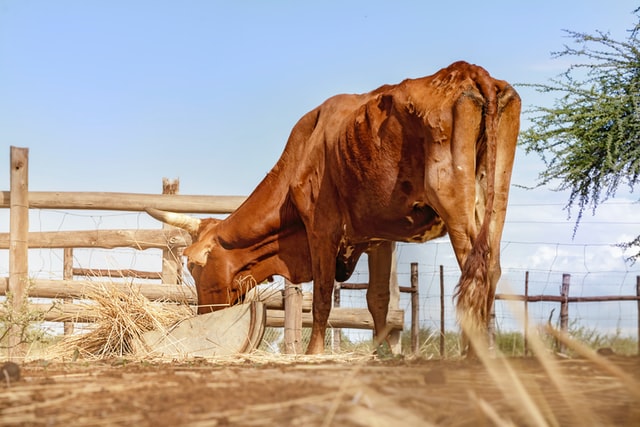
Photo by Clint Patterson on Unsplash

The Dreaded Pox

D. E. Larsen, DVM

“Gary, let me look at that sore again,” Mom said to my brother as he was getting ready for school one Spring morning.

Gary had a blister-like sore that had developed on the back of his hand. After a couple of days, it had scabbed over and was not bothering him much. 

“I don’t know how you can stand it,” I said to Gary as Mom was looking at the sore. “I would pick that scab.”

“This looks just like this sore that has popped up between my fingers,” Mom said.

Gary was 4 years older than me. He and Mom did most of the morning milking when Dad was working, as I had not started school yet. We milked a small herd of cows, but it was enough to pay most of the bills in the early 1950s.

“I think this is a cowpox sore,” Mom said. “Grandpa said he had seen these before.”

Cowpox is a viral disease of cattle caused by a virus that closely resembles the smallpox virus. In 1796, Edward Jenner noticed that milkmaids who had contracted cowpox never had smallpox lesions. After some experimentation, he published his findings in 1801. Cowpox virus was used to vaccinate people against smallpox for many years in the 1800s. The vaccine was changed to another virus sometime in the 1800s, but that date is not known.

“I will call Dr. Whitaker and have him look at the cows,” Mom said.

The next morning the cows were left in their stanchions after milking. Mom and I waited at the barn for Dr. Whitaker to arrive. I was excited because our farm’s rare visits by veterinarians were always filled with mystic and intrigue. 

Doctor Whitaker was a tall, thin, young veterinarian who had just moved to Myrtle Point. He moved from cow to cow until he found a sore on the teat of the 4th cow. 

“Yes, this looks like cowpox to me,” Dr. Whitaker said to Mom. “I will go ahead and vaccinate the entire herd.”

“David can stay and watch, and he can show you where everything is located if you need anything. I have chores to do at the house. You can stop there when you are done,” Mom said as she left the barn.

“Will David, let me show you how we vaccinate cows for cowpox,” Dr. Whitaker said as if he was conducting a lecture.

Dr. Whitaker returned to the cow with a large scab on one teat. He carefully picked the scab off the teat and placed it into a small tin container that looked like a lid off a jar. Then he added a little sand to the container and some water. 

With a knife, he cut the scab into tiny pieces. Then he placed it all in a mortar and pestle and ground it into a fine suspension.

“There, that should be good enough,” he said as he showed me the finished product. “Now we just have to scratch some of this into each cow. We will do this on the edge of their tail. That way, the sore that develops won’t be a problem for them.”

We moved from cow to cow, working down the milking string. Dr. Whitaker treated each cow the same. Lifting the tail, he would grab the web of skin on the side of the tail. Then he would scratch the skin with a knife blade until it bled. He had a small stiff brush in the solution he had made from the scab. He dipped the little brush and then rubbed it into the bleeding scratch he had made on the tail.

Each cow took a few minutes to complete the process. It must have taken close to an hour to finish the entire herd. 

“Do you guys have any heifers that are going to calve soon that are not in this bunch,” Dr. Whitaker asked?

“No,” I said with confidence. Although, I doubt if I had any real awareness of that status.

“Okay then, let’s clean up, and I can get out of here,” Dr. Whitaker said.

“I better turn the cows out first.”

“No, you come with me to the milk house, and we will wash up first,” Dr. Whitaker said. “Then you can turn the cows out.”

“But I didn’t touch anything.”

“It is better to be safe than sorry,” Dr. Whitaker said.

Dr. Whitaker washed my hands like they had not been washed before. I would have complained had it been Mom doing the washing, but I sensed that it was time to show how tuff I was.

“Okay, you can go turn those cows out. They will be ready to get out to the pastures.”

I opened the large door on the side of the barn. All the stanchions were connected with a set of boards along the top of the stanchion. I pulled the wooden pin that was holding them closed and pulled hard on the first stanchion. That pull, plus all the cows pulling back with their heads, and the stanchions came open. The cows backed out, and with some degree of order, turned and headed out the open door. 

Just as Dr. Whitaker had said. As soon as they were clear of the barn door, they would buck and kick their legs as they ran toward the pasture.

“This barn is a big mess. Those extra couple of hours with the cows in here makes it a big job to clean,” Dr. Whitaker. “I suppose your mother does that job.”

“I do some of it,” I said. “I can scrape and sweep the floor into the gutter. When the gutter is this full, I have difficulty pushing it out to the manure pile. When my brothers get home from school, we will clean it then. My sister never has to work at the barn.”

“I hear that a lot,” Dr. Whitaker said as he put everything back into his truck. “Sisters seem to get out of a lot of barn work. But most of the time, they do plenty of work around the house.”

Dr. Whitaker stopped and talked with Mom.  

“You should notice a scab on the right side of their tail,” he said. “And you shouldn’t have any more problems. You might want to have a doctor look at your sores if they get worse. Most of the time, they are no problem, but once in a while, they make people sick.”

“Thanks for coming so soon,” Mom said.

“Thanks for the call, and thanks for the help David,” Dr. Whitaker said as he departed.

Photo by Michael Gane from Pexels

Note to My Readers, #4

D. E. Larsen, DVM


I almost missed it entirely. My first blog post was on Dec 14, 2019.

Yesterday was the first anniversary of DocsMemiors.com.


In that time, I have posted around 160 stories, a few notes, and a couple of Guest Author stories (more are welcome, by the way).


I have my first book compiled from that bunch and several more planned. There seems to be no end in sight for new stories, at least at this point, so the blog will continue.


I am open to any suggestions and/or criticisms, as long as it is constructive.


I am also open to any suggestions, tips, or cautions on my first book’s publication.


Christmas falls on Friday this year, so my blog post will publish on Thursday. It was about an eleven PM farm call on Christmas eve when I was in school. Sort of welcome to the profession. Then, on Christmas morning, I will post a kind of summary of the four Christmases I experienced while I was in the Army for those who need a little to read.


Thanks for reading my blog this past year, and I hope to keep you entertained for another couple of years.


Merry Christmas and Happy New Year. Maybe next year will prove better.

Dave Larsen