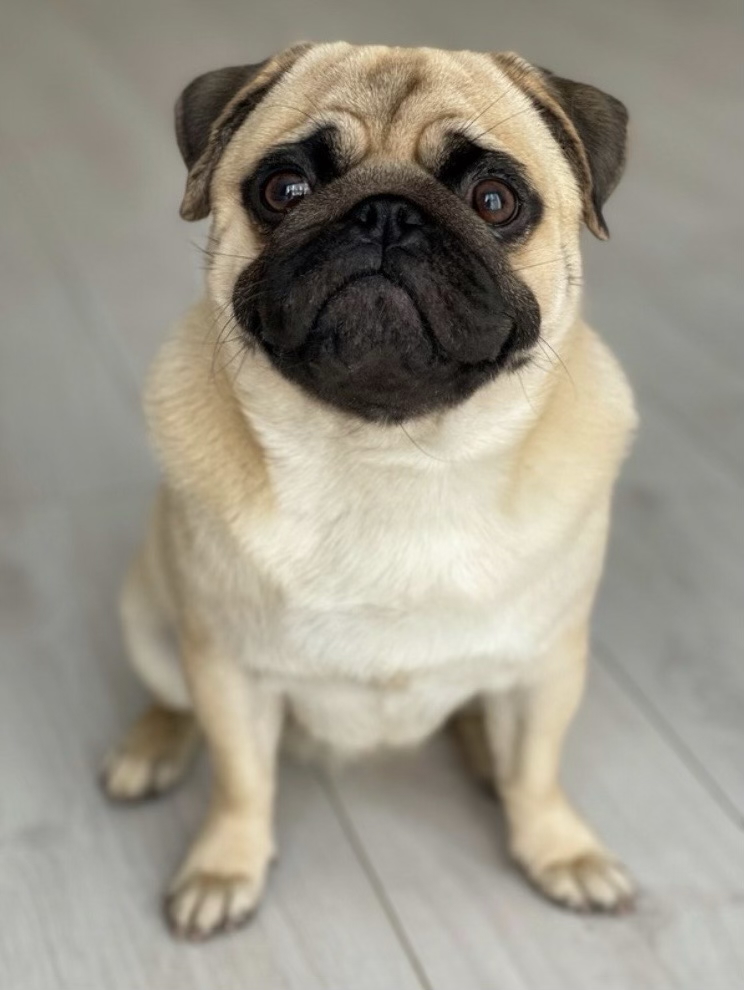
Our first ceramic dog for the clinic was given to us by a client as a housewarming gift when we moved into our new clinic.
It was placed on the floor at the corner of the reception counter with the thought of it being a greeter for our canine patients.
It was a very well-done ceramic and looked almost real. Life-sized and with eyes that seemed to look directly at any approaching.
I was anxious to see the reaction of our patients. I didn’t have to wait long. The first patient through the door was Duke, with Taylor leaning back on the other end of the leash.
Duke was a large Rottweiler who easily tipped the scales at a hundred and twenty pounds. He was well disciplined and well behaved when George was around. But when he was with Taylor, he acted like he was the one giving the commands.
George was a local policeman. He wasn’t a large man, under 6 feet, but well built. Duke followed him in a precise heel position. There was never tension on the leash. With George in the room, Duke was the perfect patient.
Taylor was usually the one to bring Duke to the clinic. Taylor was petite; if her clothes were wet, she might weigh a hundred and ten pounds. She had as much control over Duke as he was willing to allow. And she was scared to death of the dog.
Duke spotted the statue pug the moment he was through the door. With the hair on the back of his neck raised, he made a beeline for the statue dog. In the process, he jerked Taylor the rest of the way through the almost-open door, almost pulling her off her feet and jamming one shoulder against the half-open door.
Duke stopped in front of the statue and, showing his teeth, let out a deep growl. When the statue didn’t respond and just continued to gaze into Duke’s eyes, Duke lunged and bit it on the side of its face.
Duke realized that he had been had. He stepped back and sniffed the statue, then, to show his disgust, he turned, hoisted his leg, and proceeded to anoint the statue with a long stream of strong-smelling urine.
Taylor stood at the reception counter, unable to intervene in Duke’s excursion. She was holding on to her shoulder and profusely apologizing for the attack and the urine. Duke returned to her side and sat down, satisfied that he had neutralized any threat from the statue.
Sam was quick to assure Taylor that there was nothing to apologize for.
“This is nothing, we are used to some real messes to clean up,” Sam said as she headed to the back for a wet towel.
“Yes, he left his mark, and now the other dogs will be a little confused when they encounter our statue,” I said.
Duke had left a deep scratch over the statue’s right ear, and the urine had soaked into the exposed unpainted ceramic. Any dog sniffing this statue will be wondering how tough this thing really is.
It was interesting to watch the response of the various patients to our little pug statue. A few, maybe ten or fifteen percent, had a similar reaction to that which Duke had. Our statue became quite scarred as time went on.
The majority had no response at all. They obviously saw the statue but didn’t recognize it as a dog.
A final ten or fifteen percent would approach the statue with caution, take a sniff or two, just to satisfy their curiosity, and move on. Duke’s initial anointing lingered for many years.
At one point, there was an aggressive scuffle, and our little pug suffered a fracture of one of his front legs. It was easily repaired with the magic of superglue. Maybe one day, real bones will be repaired that way.
With the years of scratches and now the leg injury, we decided to purchase a helper for our little pug. We purchased a small ceramic cocker spaniel. Not as a replacement, just as an assistant.
The cocker never seemed to attract as much attention as the pug. Maybe most of the patients were aware of our trickery, but I think the difference was in the eyes. The new statue just didn’t have the gaze like the little pug.
When we retired, the statues were placed in new homes with incredible ease.
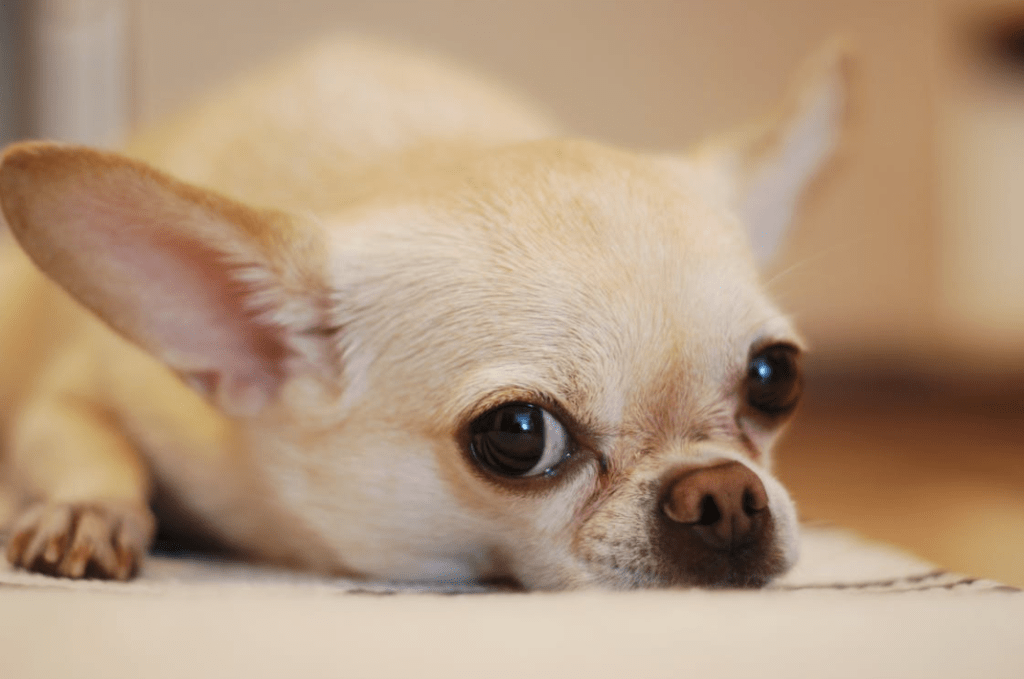
Chico had been one of my first small animal patients when I arrived in Enumclaw to start working.
The practice was primarily a dairy practice, and I was a cow doctor at heart. The dogs and cats were almost a sideline for us. And Chico was about as far removed from a cow as you could get.
Chico was a frequent visitor to the clinic. I think his master used his visits as a social outing. And as I would often observe over the years, these little ankle biters held a special attraction to older large men. George fit that description to a tee.
George was all of six and a half feet and carried a little extra weight that was most obvious in his belly. Chico would arrive at the clinic nestled in the crook of George’s arm and somewhat resting on the top of that belly. Perched there, ready to attack anyone or anything he perceived to be a threat.
On Chico’s first visit, George had stood at the exam table, and after an introduction and some small talk, I reached over to take Chico from his perch. I was lucky George had good reflexes and was able to turn Chico away before I lost a finger or two.
“He will be okay, Doc,” George said. But I have to give him to you. He is pretty protective of my space.”
George placed Chico on the table and pushed him in my direction.
“He’s okay,” George said to Chico.
I wasn’t so sure, and Chico kept a close eye on me and my fingers. I reached out and stroked his head.
After that encounter, everything was fine between Chico and me. As long as I didn’t try to take him from George’s arm.
This afternoon, George came into the clinic just as I was returning from my morning farm calls. Over the last year, he had learned my schedule pretty well, but I thought he must have been watching for me. Unlike most of his visits, there was concern on his face and in his voice.
George had walked to the back of the clinic, where I was washing up.
“Doc, I’m sorry I don’t have an appointment, but I noticed a growth on Chico this morning, and I was hoping you could just get a quick look at it for me,” George said.
There goes my lunch hour, I thought.
“Sure, George,” I replied. “Just give me a few minutes to clean up. I don’t have any appointments until later this afternoon.”
George and Chico were waiting for me in the exam room. George pushed Chico over onto his left side and spun him around to show me a small raised tumor on the right side of his chest.
“I swear, Doc, this thing wasn’t there yesterday,” George said. “There is no way I would not have seen it.”
This was a small tumor, less than half a centimeter across, round, and raised several millimeters. The surface was intact and deep red in color.
“I think I better stick in needle in this and see if I can tell you what it is,” I said.
“What do you think, Doc?” George asked as he picked Chico up and returned him to his perch.
“Let me get a couple of slides, and I will get a look at things under the microscope,” I said. “Then we can get an idea if this is a tumor or maybe an oddball infection or something. It will only take a few minutes.”
“You’re not going to just run up a big bill on me, Doc?” George asked.
“This isn’t going to be much,” I said. “I’m just going to look at it here. I’m no pathologist. So, if we have to send it to the lab, it might cost a little. But we can talk about that if need be.”
Doing a fine needle aspirate on a skin tumor was a pretty simple procedure. You just needed to slide the needle into the lesion, move it around a bit, and withdraw. There was no need for any aspiration, you are just trying to collect a small sample of cells in the needle that you can transfer to a slide and make a smear.
Big dogs seldom flinched during the process. That usually wasn’t the case with small dogs. But Chico was not an ordinary small dog. He was confident that he was in control of his environment, and as long as George was there, I think I could do almost anything to him.
After collecting the aspirate, I squeezed it onto a microscope slide and made a thin smear. After a quick stain, I put it on the microscope stage and focused on the cells.
The slide was covered by a sheet of plump, round cells filled with deep purple granules. Under my breath, I said, ” Mast cells.”
“George, this is a mast cell tumor,” I said.
“So, what does that mean for Chico?” George asked as he rubbed Chico on the head.
“Most mast cell tumors this size are not a major problem,” I said. “We remove them, usually put the dog on some Prednisone for a short time, and that’s the end of it. Rarely, and I have never seen one, they can be a very aggressive tumor. And that means with some chemotherapy and radiation, the patient is not going to make it very long.”
“What do we need to do now?” George asked.
“The first step is to get the thing off of Chico,” I said.
“When can you do that, Doc?” George asked.
“Yesterday would be time,” I said with a smile.
George didn’t smile. “What do you mean, Doc?”
“This is a veterinary clinic, George. You don’t have to wait 6 weeks for an important surgery,” I said. “If you can leave Chico, I can do the surgery tonight or tomorrow morning.”
“I can’t leave Chico, Doc,” George said. “What else can you do?”
I should have known that George wouldn’t leave Chico. That was probably a good thing. I’m not sure we would be able to get him out of the kennel without a major battle. I stepped out and glanced at the afternoon schedule.
“George, if you can wait a bit, when Don gets back to the clinic from his farm calls, he can handle the appointments, and I can get Chico under anesthesia,” I said. “That way we can get him awake and ready to go home by this evening.”
“I would think you could take that little thing off with a local,” George said.
I had to think about that a bit. With a large dog, that would have been an option. But most of the time, it was almost impossible on a small dog. But Chico was different. We might be able to get away with a local.
“I hadn’t thought about that,” I said. “But we might be able to do that with Chico. The problem is that this is a small tumor, but we have to make a wide cut around it. In veterinary medicine, surgery is often our only option, so the old saying goes, cut early, cut wide, and cut deep. That ends up meaning this is a little tumor, but it will be a big incision.”
“If I’m here, I think you could cut his leg off, and he wouldn’t say a word,” George said.
“You’re probably right, George,” I said. “Chico is sort of a special case.”
George and Chico had to wait out front for only a short time. Don arrived from his farm calls and helped me set up for surgery before appointments started.
George brought Chico into the surgery room where we clipped his chest and did an initial scrub.
“This stuff stings a little at first,” I cautioned George as I approached with a syringe of Lidocaine. Chico never budged as I blocked a wide area around the tumor.
The surgery was anticlimactic. I removed the tumor with a wide elliptical incision that extended deep to the fascia of the Latissimus Dorsi muscle.
After removing the block of tissue, I placed it in a jar of formalin so we could send it to the lab. I turned around and took a deep breath. There was a big hole to close on this little dog.
Chico followed my every move with his eye, but George’s hand on his head kept him quiet.
“How are you holding up, George?” I asked as I started closing the deep tissues.
“I’m doing fine,” George said. “But I’m glad you told me you were going to take a big chunk out this little guy, Otherwise, I would be worried.”
“Chico has a lot of loose skin on his chest,” I said. “You are going to be amazed at how well this wound closes up. And we are going to be done in just a few minutes.”
I closed the deep tissues with a continuous suture of Dexon. This brought the skin edges together nicely, and allowed me to close the skin with individual nylon sutures with no tension on the wound. The closure looked perfect, if I say so myself.
“I am amazed, Doc,” George said. “I never thought it would be almost new.”
I removed the small drape, and Mary cleaned the wound and motioned to George that he could pick up Chico.
“I’m not going to hurt him, am I?” George asked.
“That wound will be numb for a couple of hours,” I said. “I will send you home with some Prednisone tablets that he will need to take for a few weeks. And a few pain pills, just in case he needs them for a day or two. As far as the wound goes, just keep it clean and dry and let me look at it if you notice discharge, swelling, or discoloration. Otherwise, let me see Chico in three weeks. I go a little longer for the sutures with him being on Prednisone.”
“I noticed that you saved that tumor,” George said. “What do you plan to do with it?”
“I’ll send it to the lab,” I said. “They will look at it under a microscope and let me know if it is a bad tumor or not.”
“Doc, if it is a bad tumor, I am not going to be able to do any more than we have already done,” George said. “It is sort of a sad fact of life for Chico. So, I think we would just rather not know. I will spend that money on some steaks, and Chico and I will live high on the hog for a while. We probably should be doing that anyway.”
“George, I’m okay with that. In reality, if this is a bad tumor, Chico probably doesn’t have much of a chance, even if he had a full wallet,” I said. “Time will tell the same thing as the lab.”
As George was leaving with Chico in his spot in the crook of his arm, he stopped at the door and turned around.
“Thanks, Doc,” He said. “I think we are going to visit my sister down in Oregon. We’ll be back in time to get these sutures out. See you then.”
Chico healed well, and when his course of Prednisone was done, I deemed him cancer-free. Probably a little early for that, but George had come to grips with his mortality and that of Chico’s.
“We eat steak more often than we used to!” George said as he headed out the door after we considered Chico cancer-free. “Thanks for everything, Doc.”
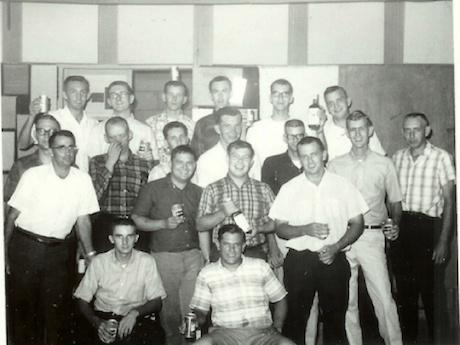
By the summer of nineteen sixty-seven, I had been elevated to Quality Control NCO in our maintenance shop for the 177th USASA Operations Company located at Camp Humphreys, South Korea.
The year I was there is often called the second Korean War. We were besieged by many infiltrators from North Korea that year. Firefights on the DMZ were regular events. In that year, we lost over six hundred UN soldiers. Over one hundred of those were Americans.
The 177th was the hub of the low-frequency radio intercept and direction finding operations in the country. We had a lot of equipment to maintain, both installed in our operations and mobile vans.
This position removed me from the rotating trick maintenance position and gave me a day job. That was a blessing, but the position also gave me a couple of headaches, namely, in Dumb and Dumber. The two trick workers could also be called Mutt and Jeff. They seemed to do everything together, and their work often had to be redone by someone more competent.
Promotions were given out almost automatically in Korea. Nearly everyone in the shop was promoted to Specialist Five when they had two years in the Army. I wondered why these were still Spec Fours, and they were close to rotating to their next duty station.
“Dumber, I have a job for you,” I said as I assigned Dumber to fix a mobile jamming transmitter located down at the motor pool.
“Great,” Dumber said, “I will take Dumb with me. We can go to lunch when we are done. That will get us out of the shop for a few hours.”
I had a strange foreboding as the two left the operations building, carrying an armload of equipment each. They still managed to laugh and butt shoulders as they went through the exit door.
Starting at ten-thirty in the morning, most of the guys in the shop would have had the job done well before lunch. But actually, having the pair out of the shop for a few hours was a good thing, so I let them work at their own pace.
When Dumb and Dumber returned to the shop, it was nearly two o’clock.
“I thought you two would be back right after lunch,” I said.
“We got the transmitter fixed and checked out its operation,” Dumb said. “Then, after lunch, we had to go back to the motor pool and get all our equipment. We got back as soon as we could.”
Their explanation was marginal, but there was no sense in questioning their time frame. They settled into the afternoon work schedule, and everything was going along fine.
That is, going fine until Chief Warrant Officer Neal, the officer in charge of the shop, stormed across the hall from his office.
“I have the old man on the phone, and he is really pissed,” Mr. Neal said. “It seems we have been jamming a local radio station for the last several hours. Do you know anything about this?”
I looked at Dumb and Dumber; no words were needed. They immediately fessed up.
“We fixed that transmitter and rolled it up on this Korean radio station, just to check it out,” Dumber said. “I guess we must have forgotten to turn it off when we went to lunch.”
Mr. Neal fumed. Steam was coming from his ears.
“You get your ass down there and turn the thing off,” he yelled to Dumber.
Then he turned to me. “You should know better than to send that pair to do anything without direct supervision,” he said. “That means they don’t do anything out of this shop.”
So Dumb and Dumber were sent to visit with the commanding officer. They were given an article fifteen for lack of detail in the performance of their duties. Article fifteen, a company-level punishment, just about confirmed that they wouldn’t be promoted before leaving Korea.
***
It was a sweltering hot August afternoon when the Swing trick took over for the trick on days. Everyone wanted to be in the operations building. It was about the only place with air conditioning in this section of Korea.
I was just leaving the shop when I heard the trick chief handing out assignments for his crew. They had to run the emergency generators today. I cringed when I heard him give the job to Dumb and Dumber.
“You know the situation,” I said to the trick chief. “Those two are not to be doing anything outside of the shop without direct supervision.”
“The generators are inside the compound,” the trick chief said. “They have done this every time we have the assignment.”
We had two massive diesel generators for emergency power that were manually started, stabilized. Then they were switched over to run the operations building. The Comm Center had its own generator that would automatically switch on in the event of a power failure.
We ran the operations building on emergency power for a half-hour every month. Just to make sure the generators were operational and that the maintenance crew was familiar with the operation and switch over protocol.
That protocol required the generator to be started and stabilized before switching the site over to emergency power. Although the switch would only cause a blink in power, we would always have the equipment turned off before switching over to the generator.
I left with the rest of the day crew, and we went down the hill to mess hall for dinner. We were through the chow line and had just started to eat when one of the swing trick guys came running into the mess hall.
“You guys are needed back at the shop, stat,” the guy said.
“Can we finish dinner?” I asked. The mess hall had Korean servers and cooks, and the was no shop talk allowed at any time.
“No, we need all hands on deck immediately,” the runner said.
Climbing the hill back to the operations building in the afternoon heat was not the most pleasant exercise method. But the gem at the end was an air-conditioned building, so that made the task bearable.
When we checked in through the security gate, the guard said, “You guys had better hurry.”
We walked into a completely dark operations building. The smell of burnt power supplies was overwhelming.
“What happened?” I asked the trick chief.
Mr. Neal almost ran over me as he rushed through the door of the operations building.
“What happened?” Mr. Neal asked.
“Every light bulb in the building is burned out,” the trick chief said. “Even the light bulbs in the comm center. Apparently, their lights are not hooked into their emergency power supply. And almost every piece of equipment has a blown power supply.”
“That doesn’t answer the question,” Mr. Neal said. “I want to know what happened.”
“Apparently, when Dumb and Dumber switched the site to emergency power, they hadn’t stabilized the generator. It dieseled on them, and it must have put three or four hundred volts of power into the building. They hadn’t told anybody they were making the switch, so all the equipment was still turned on and operating. Most of the power supplies are toast, as you can smell.”
“I want those two out of operations,” Mr. Neal said to the trick chief. “They can pull weeds for the old man until they rotate out of here. And you knew they were not to do anything out of the shop. You are going to have some explaining to do.”
“They only have a couple of weeks before they rotate out of here,” the trick chief said.
“God, I hope they aren’t getting sent to Vietnam,” Mr. Neal said. “They will get a lot of guys killed down there if they pull a stunt like this. It is bad enough here. How long until we can get things back online, Larsen?”
“If we get some lightbulbs working, we can get some stations working in a couple of hours,” I said. “We are going to be limited on the supply end.”
“You let the operations officer select the stations he wants up first,” Mr. Neal said. “I will start working on the supply issues. We are probably going to have to bend a few of those Army rules.”
And so it began, nearly forty-eight hours of work before the operations were fully functional again. Then a few hours of sleep and a big party to celebrate the fix.
Dumb and Dumber were just gone. I have no idea what became of them, but they were shipped out to Seoul, I would guess.