Sandy

Sandy at Seaside 2

D. E. Larsen, DVM

Some people actually thought that I was the boss. They seldom experienced the quiet, yet solid, push from the front desk regarding the clinic’s functions. Unless they had a collection account. Her domain encompassed all things not related to medicine. And most of the time, things ran like a well-oiled machine.

I had completed an exam on a cat with a bite wound that was brought in by new clients. The young couple was at the counter settling the bill with Sandy.

“We just moved to town,” Steve said. “I’m with the Forest Service. We will be looking for a house, just in case you know of anything available.”

“I don’t know of anything right now, but there are several good real estate offices between here and the Forest Service building,” Sandy said.

“Oh, and what about the app?” Steve asked as he looked at Ruth.

“Yes, I was going to pick up a job application if you have anything available,” Ruth said.

“I’m not sure what the Doctor is thinking right now,” Sandy said. “But we have been swamped. At the very least, we can keep the application on hand. Just a moment, and I will grab one.”

Sandy retrieved the application from the file cabinet in my office and chatted with Ruth a bit as she handed it to her.

“I will get it filled out and drop it off in the morning,” Ruth said as they made their way out the door.

Sandy stood, watching the young couple load the cat carrier into their car and pull out of the parking lot.

“I think we should hire her,” Sandy said as she sat back down. 

“You don’t know anything about her,” I said.

“They just moved to town, with a couple of young kids, and he works for the Forest Service,” Sandy said. “I would guess they will be here for a long time.”

“How do you gather all of that in a couple of minutes?” I asked. “You know, they are probably from California.”

“I don’t know, maybe it’s a girl thing,” Sandy said. “I just have a good feeling about her. I think you should hire her. You’re a good teacher. You can teach her everything she needs to do the job. And you worry too much about people from California.”

The following morning, Ruth dropped off her completed employment application. She spent ten or fifteen minutes talking with Sandy before leaving after Sandy told her we would give her a call after I had a chance to review the application.

When I had a brief break, Sandy handed me Ruth’s application

“You might want to review this,” Sandy said as she handed me the application.

“Is there anything in it that might change your mind?” I asked.

“No, it looks fine to me,” Sandy said. “I think we should hire her.”

“Why do you want me to review it then?” I asked. “You don’t think I would be able to overrule you, do you?”

“Then it is okay for me to call her and offer her a job?” Sandy asked.

“I thought you had already made that decision,” I said.

Ruth started work at the beginning of the following week. Initially, Sandy had her working on the front desk. We were in a period of transition in our record-keeping, and things were new to everyone.

Office computers were becoming practical for small offices. However, veterinary software was still out of reach for small-town practices. At the recommendation of a practice management advisor, I had added a computerized cash register, and we had a new Macintosh computer to keep track of client and patient numbers.

“I guess this new stuff is okay,” Sandy said. “But if we are going to have all this stuff in the cash register and on the computer, I want to make sure we keep a paper copy of everything.”

“Do you realize how much extra work that will require?” I asked.

“I don’t care, that is the way it is going to be done,” Sandy said as she turned and walked out of my office.

Of course, for the next thirty years, that is how it was done. There were a couple of times when it proved to be a good practice.

When she started work, Ruth confessed that she had never worked with a computer before.

“Don’t worry,” I said. “The Mac is very intuitive. By the end of the day, you will be an old pro.”

One morning, a few weeks later, I noticed Ruth frantically searching through the computer desktop screen.

“Are you having a problem?” I asked.

“I don’t know what I did,” Ruth said with some tension in her voice. “I can’t find the client list.” 

I looked through the computer’s desktop. The client list was gone. 

“It’s gone,” I said. “You must have deleted it, somehow.”

“Oh no!” Ruth said. “What are we going to do now?”

“No problem,” I said as I retrieved the backup floppy disc from the drawer. “I back this computer up every night. I will restore the file, then you have to reenter the new files from this morning by using Sandy’s paper copies.”

That proved to be a good lesson for Ruth and for me. I hated to admit that Sandy’s paper backups served a useful role, and I never skipped an evening backup on the computer. Ruth learned to be more careful before clicking random buttons.

“Jim just called from Foster,” Ruth said to Sandy. “He is on his way with his cat. He says she has an abscess that just broke open.”

“Let’s check that file,” Sandy said. “I think Jim is a collection account from when we just started business. In fact, he might have been our first collection.”

Sandy had to go into the back to the old files, but she returned with Jim’s file. It had numerous red ink markings.

About that time, Jim came through the door. He had the cat wrapped in a towel. The towel was smeared with pus and blood.

“This cat needs some help, right away,” Jim said with tears welling up in his eyes.

“We have a little problem to settle first,” Sandy said with little emotion in her voice. “You have an unpaid balance from back in 1976. That has to be paid before services are available for you at this clinic.”

“That’s almost ten years ago,” Jim said. “I thought you were supposed to purge your records after seven years.”

“That might happen in some clinics, but it doesn’t happen here,” Sandy said as she sat down and busied herself straightening up the old file.

“How much do I owe?” Jim asked.

“With the collection fees, the total is one hundred and thirty dollars,” Sandy said. “And that doesn’t include any interest charges. If you pay it today, I’ll waive the interest charges. Otherwise, I will update the file, and you will also owe for the interest.”

“Okay, I have enough to pay the old bill,” Jim said. “Then I can charge today’s bill.

“It doesn’t work that way, Jim,” Sandy said. “The doctor trusted you with a handshake, and you have made no effort to pay this old bill. If you had paid five dollars a month, this would have been resolved years ago. Now, if you want the doctor to take care of your cat’s problem, you have to pay the old bill and the estimate for today in advance.”

“That’s hardly fair,” Jim said, his tears wiped away with the back of his bloodied hand. “All you guys worry about is the money.”

“The next clinic is fifteen miles down the road,” Sandy said. “I would suggest you call before you arrive. We have to pay wages, rent, medication costs, and make enough profit to feed the kids. If we don’t do that, we won’t be able to stay in business to help people who pay their bills. When you don’t pay, you are stealing from every one of our clients, not just from us.”

“I can’t go down the road,” Jim said. “I owe them money, too.

“That is not a surprise,” Sandy said, her voice now tiring of the conversation. “In that case, you had better hurry, Albany is over thirty miles.”

“Okay, I’ll go talk with my wife,” Jim said. “How much do you think I will need? And can I leave the cat here while I talk to her?”

“No, you are not trustworthy enough to leave a sick cat here,” Sandy said. “I can’t say for sure until the doctor writes an estimate, but I would guess you will need two hundred and fifty dollars, at least.”

Jim took his cat and went to speak with his wife. 

“What is going to happen to his cat if he doesn’t have the money?” Ruth asked.

“Most abscesses will heal on their own,” Sandy said. “It just takes a lot longer and puts the cat through a lot more pain. He probably can’t go to Albany either. In the last ten years, he has probably had a collection account with every veterinarian in the county. It’s the family names you will learn. Our collection accounts are filled with a dozen family groups. It is a lifestyle, they don’t pay for anything until their back is against the wall. Jim is going to be back in a few minutes with three hundred dollar bills, you watch.”

Sure enough, Sandy and Ruth had no more than finished the conversation when Jim came back through the door.

“Okay, my wife had three hundred dollar bills,” Jim said as he handed Sandy the bills. “If I can leave the cat, I assume he will be ready in the morning, and we can do the receipts when I pick him up.”

“Let’s have the doctor get a look at him first,” Sandy said.

I examined Jim’s cat, Tom. He had an open abscess that just needed to be cleaned up and some antibiotics. His main problem was his set of testicles. 

“I can take care of this abscess and send you home with some antibiotics for Tom and some change in your pocket,” I said. “If I do that, you will be back with another abscess before summer comes. Since you are clearing up an old bill, I can make you a deal. I will throw in some brain surgery and vaccinations, and keep the total under the three hundred you put on account. There won’t be much change, but you might be able to buy a beer or two.”

“What do you mean by brain surgery, Doc?” Jim asked. 

“If we neuter Tom, it will change the way he looks at the world,” I said. “He is still a young tomcat, so his fighting days will probably be behind him. If we leave those testicles, he is going to continue to be out there fighting with the boys. Tomcats tend to have a lot of infections, and in the end, they don’t live very long.”

“You will do that for me, after I didn’t pay my bill years ago?” Jim asked.

“See how good things happen when you become a responsible pet owner,” I said. “Your neighbors are probably going to be happy when Tom is neutered and quits beating up their cats.”

“Okay, do what you need to do, and I will be back in the morning to pick him up,” Jim said. “And you might want to apologize to the lady out front for me. I gave her a bit of a hard time, trying to get something for nothing.”

“Sandy is a pretty tough girl,” I said. “My bet she gave it right back to you.”

“Yes, she did a good job at that, alright,” Jim said. “I will speak to her when I leave. Thanks, Doc!”

Jim stopped at the front counter as he was leaving.

“Sandy, I’m sorry I was so ornery earlier,” Jim said. “You and the Doc are okay. I’ll be back in the morning.”

Ruth smiled as Jim went out the door.

“My, what a change of character,” Ruth said. “I wonder what brought that on?”

So, Tom went home in the morning with his wound cleaned and an entirely new man. A few days of antibiotics and he was as good as new. Many would say better.

As our computer use in the practice progressed, we continued to maintain a paper backup of all our work. It seemed unnecessary to me, but it was not worth the battle with Sandy. We did shorten the time we maintained the paper backup to about three months.

Ruth remained a valuable employee for many years. She progressed to a licensed veterinary technician before moving to Eugene.

Photo Credit: D. E. Larsen, DVM

Bob

D. E. Larsen, DVM

I tried to be impartial with my patients. But Bob was definitely special, and to be honest, one of my favorites.

Bob wasn’t much to look at. He was a true mutt. Looked like a cross between a spaniel and a corgi, with maybe a little coyote thrown in for good measure. His short legs looked out of place on his body. A gnarled right ear and a left ear that stood up gave him a lopsided appearance. His right eye was present, but the lids were so scarred that you had to look closely for the eyeball.  His legs and shoulders were also marred with scars, telling of a rough early life.

To Howard, Bob had become his reason for existence since his wife, Dorothy, had passed away a few years ago. I never saw Howard without Bob by his side. It didn’t matter where, in the clinic or around town.

Today, Bob was sitting between Howard’s legs when I entered the exam room.

“What’s up with Bob today?” I asked as I reached down and scratched Bob’s gnarled right ear. This was my regular greeting for Bob. He would press his head against my hand to acknowledge the greeting.

“He is getting so arthritic anymore, he can hardly get around,” Howard said. “I have to lift him into and out of my pickup, and he can’t do stairs at home. If you need to look at him today, Doc, I was hoping you could do it on the floor. I don’t think he can get comfortable on that table.”

“How old do you figure Bob is getting to be?” I asked. “Looking at his record, we just have a guess for a birthdate. It says late 1960s.”

“I don’t know that I can get closer than that,” Howard said. “He was full-grown when he staggered up to our old house on the river. And I think we moved out of that house before the son graduated from high school. And that was 1968. He was a real mess then, Doc. I always figured he must have been in a fight with a coyote, but who knows. That was before you came to town. I couldn’t get anyone to look at him, so I just did the best I could. He lived, but all the scars and his ear just added character to him.”

“So it is possible that he was born in 1965,” I said. “That means he could be pushing twenty.”

“I know, Doc,” Howard said, looking down at Bob. “He can’t last forever. However, I’ve heard that you have a new medicine that helps these old dogs. If we can help him, I want to do that. If not, I don’t want him to suffer like he is doing now.”

“The problem is these old dogs just don’t live long enough,” I said. “And their bodies give out before their heart most of the time. I have an injection that is used in horses for pain and inflammation. It’s not approved for dogs, but many veterinarians are using it in special cases. It might be something we could try on Bob.”

“Do you think it is safe, Doc?” Howard asked.

“It is safe for horses,” I said. “And works wonders in many cases. It is called Banamine. It is a class of drugs we haven’t had access to before. There are risks involved. It is hard on the kidneys and can cause some gut problems. I haven’t used it on a dog, but if we are talking about making Bob feel better or putting him to sleep, it might be something to try.”

“Kidneys and gut are two pretty important things, Doc,” Howard said. “I don’t know, Bob doesn’t need to be a guinea pig in his last days. Maybe we will go home and spend some special time while I come to grips with what needs to be done.”

“The choice is a hard one, Howard,” I said. “I see all sorts of things, some good and some not so good. The best advice I can give is it is better to be a day too soon rather than a day too late.”

“When I make the decision, Doc, I’m not going to be able to do it,” Howard said. “Can I send my son?”

“Howard, we will do anything you want,” I said. “I could come out to the house if you want.”

“No, Bob enjoys coming here and getting his ear rubbed,” Howard said.  “I will just send him with my son, and he can stay with him. That will work the best.”

Howard scooped Bob up and carried him out the door, too upset to worry about the bill at this point. He carefully put him on the passenger seat. 

***

It was three days later when Howard’s son brought Bob into the clinic for euthanasia. After he had finished the paperwork, Sandy ushered him and Bob into the exam room.

Harold was holding Bob in his arms when I stepped into the exam room.

“Dad wanted me to stay with Bob for this thing we are doing today,” Harold said. “But Doc, I can’t do it. Can you tell Dad that I stayed?”

“That’s fine, Harold,” I said. Bob and I are old friends, he will be fine with me today. We just won’t say anything. You can just hand him to me and leave.”

“Dad is pretty broken up,” Harold said. “Bob has been his whole life since Mom passed. Do you think I should get him another pup?”

“Some dogs can’t be replaced,” I said. “I think you just let your Dad make that decision.”

Harold left, and with Ruth’s help, and with me scratching his ear, Bob peacefully drifted off.

***

It was less than two weeks later when I noticed Howard in the reception area. He was holding a small Cocker Spaniel who looked like she had missed a few meals. I stepped out front to see how he was doing.

“Howard, I am not surprised to see you, but this pup is a little bit of a surprise,” I said.

“I just dropped by to make an appointment for next week,” Howard said. “I will have my check by then so I can give you some money.”

“Who do you have here?” I asked as I reached out and scratched the pup’s right ear. She leaned against my hand as I rubbed.

“This little gal just walked up our lane and made herself at home,” Howard said. “Not unlike what Bob did so many years ago. She looked like she hadn’t eaten in a week or two. I just couldn’t send her away.”

“That’s great, Howard,” I said. “It is probably just what you need since Bob is gone.”

“Yes, she definitely fills a big void,” Howard said. “Actually, I think Dorothy sent her.”

“What are you going to name her?” Sandy asked.

“I have been calling her Dot,” Howard said. “That’s what I always called Dorothy, when it was just the two of us.”

Photo Credit: Photo by freestocks on Unsplash.

Queenie, The Scramble Calf, Part Two

D. E. Larsen, DVM

A little history on the Calf Scramble at the Coos County Fair, first, then Queenie’s story.

The Coos County Fair and Rodeo in Myrtle Point, Oregon, started in 1912. The Calf Scramble was added to the Rodeo program in 1949. In the initial years, steer calves were used in the calf scramble. I have been unable to determine the year when the switch to heifer calves was made.   

But heifers were used in 1959.

As near as I can determine, the 

last Calf Scramble was conducted

In 1987. 

David Larsen,                     1959

I had several family members who

won scramble calves.

Bill Davenport, cousin, 1950

Larry Larsen, brother,         1951  

Aaron Larsen, Nephew      1976

Debra & Laura Larsen, 

Chicken Scramble 1974
 Chickens in the gurney sacks.

Now, on to Queenie’s story.

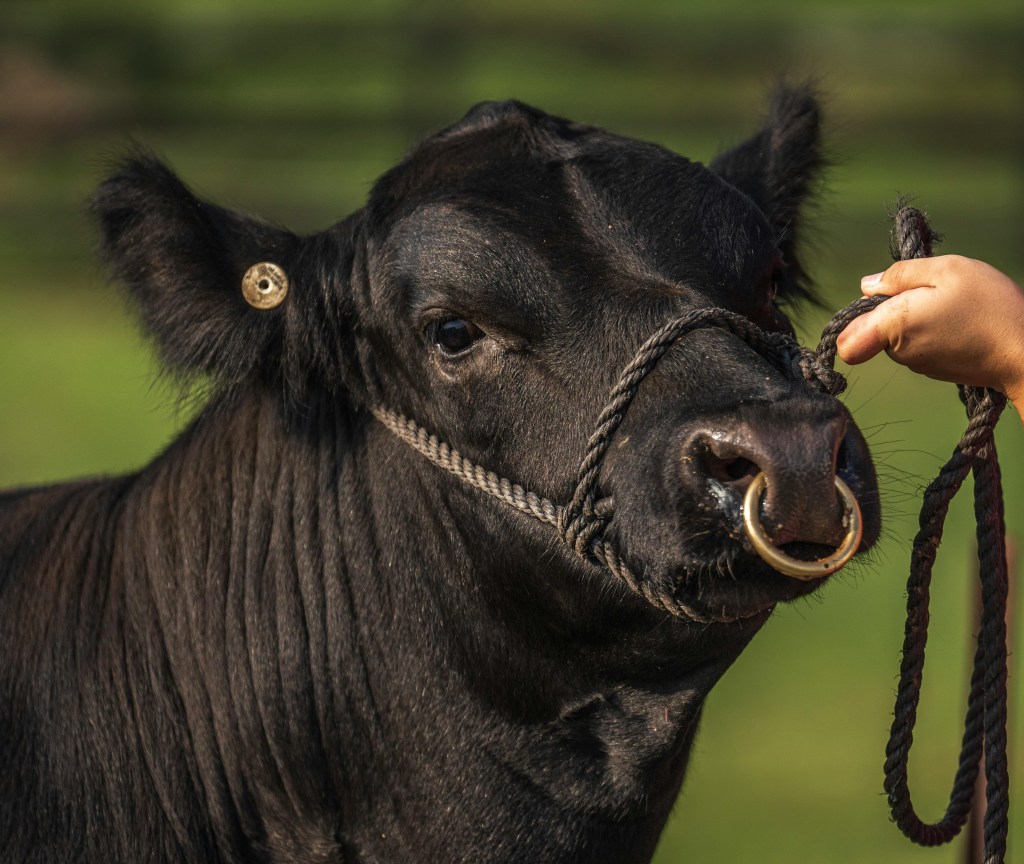
By the beginning of summer in 1960, Queenie was settled into the routine of following the dairy cows to the barn every morning and late afternoon. The trails were worn deep in the pasture as the cows joined the single-file line to the barn with only the slightest encouragement.

Queenie was a well-conditioned Hereford heifer, after a winter of corn silage and grain. With a bit of sleuthing, unknown to my father, I increased her grain ration as the summer progressed.

The summer was filled with preparing Queenie for the show ring at the County Fair in the middle of August. That meant hours of training her to lead and to stand correctly. Trips to the bathing rack. And curling her hair coat. 

After my years in 4-H, I was well-versed in showmanship. But my experience was with dairy animals. The beef folks used different methods for positioning an animal’s feet by using a show stick. 

After several attempts with the show stick, Queenie learned the kinder dairy methods of a nudge here or there. But when the fair came, Queenie was ready.

The fair was busy as always. The scramble calves were weighed and assigned to a special set of stalls, separate from the rest of the cattle, located right on the main entrance path. 

Queenie weighed in at just under eleven hundred pounds. Second place, by less than ten pounds, to another calf raised with a dairy herd over on Coos River. I should have increased her grain ration earlier. Things were geared toward an auction for the scramble calves, but this year, that was not on the schedule. These calves were ours to keep.

When it was our turn in the show ring, Queenie placed second behind the Coos River calf, both a notch or two ahead of the rest of the group. Both myself and the Coos River kid were scolded for showing these calves like we would show a dairy animal. We had to stand at the head of the group and listen to how we should use a show stick, not just carry it. 

All that meant nothing. We both got blue ribbons, and I had fulfilled my obligations to the fair board. Queenie was now mine. The trip back to the farm was an enjoyable one, especially for Queenie. She kicked up her heels when she was unloaded and turned back into the pasture with cows she knew.

She was a little disappointed when her grain ration was reduced. 

“You need to cut back on her feed,” Dad instructed. “She doesn’t need to carry that extra weight. She will be coming into heat pretty soon, and we need to get her into shape for calving.”

I knew Dad was right, but Queenie did a double-take when I scooped a couple of handfuls of grain into the manger in front of her, rather than the two large coffee cans full of grain that she had been getting.

It was only a couple of weeks later when Dad met me at the barn door when I was coming to help with the evening milking.

“Queenie is heat today,” Dad said. “You need to go call to make sure we can get her bred tomorrow with an AI bull.”

Just a bit of excitement, but nothing major. 

“Do you want a fancy bull?” Dr. Haug asked when I called.

“She is a scramble calf,” I said. “They said she was registered, but I don’t have any papers. Just a good Hereford bull will do.”

“Okay, I pick out a bull with a record for easy calving,” Dr. Haug said. “Can you get her in a stanchion?”

“Sure, she thinks she’s a dairy cow,” I said. “She has been coming to the barn twice a day for most of the year.”

“Great, just leave her in the barn and I will take care of her tomorrow,” Dr. Haug said.

That was simple. Queenie was bred and pregnant. She slipped into her routine with the herd of cows. School started, and football, along with other activities, became a part of an active teenager’s life. 

It was almost a surprise when Mom came into the house one morning, all excited.

“Queenie had her calf last night,” Mom exclaimed. “It looks good from the front porch. Maybe you should run out and get a look at it before you leave this morning.”

I hurried through breakfast and pulled on a pair of boots. Queenie was in the far field, but Mom knew I was in shape enough to run out there and back and still have time to make it to school.

When I got to Queenie, she was just as gentle as she was at the fair. Her calf, already up and running about with a dry umbilical cord hanging from her navel, was not about to be caught. But I could tell it was a heifer calf.

“What was it?” Mom asked the minute I came through the door.

“It’s a heifer and everything looks good,” I said. “Queenie has passed her afterbirth, and the calf’s navel is dry. She must have been born last night.”

“That’s great,” Mom said. “That’s the way it is supposed to happen. Now you have two females in your herd.”

The following day, when I arrived from school, I looked toward the far field. I could see Queenie, but the calf was not to be seen. A little odd, I thought.

“I don’t see Queenie’s calf this afternoon,” I said when I hurried into the house to change clothes.

“It’s probably lying down somewhere,” Mom said. “That would be hard to see from here.”

“I will run out there before starting my chores,” I said. “Just to make sure it’s okay.”

I knew this field like the back of my hand. Catching Creek ran along one corner of the field, and the road ran along one side before turning left and running beside the creek to the upper reaches of the little valley.

The grass was not tall, and I made a quick circle of the field. Then I walked along the creek, through the brush, and watched for any sign of tracks. There was nothing. The calf was just gone. I stopped and scratched Queenie on her back as I headed back toward the barn. She didn’t seem to show any concern.

I repeated the process the following afternoon. There was no sign of the calf. I spent enough time to cover every inch of the field and the creek bank. I even went downstream looking for any sign of the calf, hoping that she didn’t fall into the creek.

“The calf is just gone,” I said at the dinner table that night.

“You don’t think someone stole that calf out of the pasture, do you, Frank?” Mom asked.

“I think they would have to be pretty fast to be able to catch it,” Dad said. “I think Queenie must have tucked away somewhere.”

The following evening marked three days since the calf had been seen. I searched along all the fence rows and into the adjoining fields. I stayed with Queenie until dark. She showed no signs of distress or concern. 

I was sick. Mom warmed my dinner, and I sat at the dinner table alone.

“I guess she is just gone,” I finally said as I started upstairs to bed.

The following morning, I stood and watched Queenie from the porch before heading off to school. She was still by herself in the field.

I was miserable all day at school. I ran through my mind everywhere I had looked. There was one spot, a grove of large maple trees, where the creek and road parted ways. I had looked there, but I had not scoured the spot. Mainly, because it was just bare ground under those trees. But I resolved that tonight I would search that area. That provided me some comfort for the rest of the school day. 

When the final bell rang, I bolted for the door. I was the first one on the bus and could hardly contain my excitement. I was convinced that tonight, I would find that little heifer calf.

My resolve to find the calf tonight was stronger than ever as I got off the bus and ran to the house. I was running the layout of the maple grove through my mind, trying to visualize just where that calf was hiding. 

I reached the porch, and just before entering the house, I turned to look for Queenie in the far field. There she was, grazing on the lush pasture. And, running circles around her, there was her calf.

“The calf is back in the pasture,” I said to Mom when I came through the door.

She stepped out on the porch to look.

“I wonder where she has been all this time,” Mom said.

Before going to the barn, I ran out to the pasture to check the calf. She was fine, didn’t look like she had missed a meal. Her umbilical cord was gone. She came up and sniffed my pants leg as I scratched Queenie on her back.

“The calf is back in the pasture,” I said to Dad when I entered the barn.

“You’d better name her before she disappears again,” Dad said. “Have you thought of a name yet?”

“I think, Princess,” I said. “After all, her mother is a queen.”

“That fits,” Dad said. “By the way, I stopped by the cheese factory this afternoon and spoke with Art. He said you can start to work there this weekend. Check into the office at eight on Saturday morning to do their paperwork.

Life got busy for me at that point. The cheese factory was the best job in town, outside of working in the woods. Dad had worked as a logger for many years. He was anxious for me to get a job that was not in the woods. At the cheese factory, I could work after school and on weekends. I would have enough money for a car and the first year of college by the time I was out of high school. Then, working summers, I could pretty much work a summer and pay for a year of school.

Queenie and Princess stayed with the cow herd. Only Dad quit bringing her into the barn. When Queenie was ready, we bred her to the same AI bull that had given us Princess.

In the spring, I graduated from high school, and Queenie had another heifer calf. 

There was no drama this time. We woke up one morning, and Queenie was out in the pasture with Princess and another calf. I ran out to check it, to make sure it was a heifer.

AS fall approached, I began thinking about going away to school. Don, a coworker at the cheese factory, asked me what I was going to do with my cow herd.

“You know, if you leave them there for you Dad to take care of and do all the work, he will start thinking they are his,” Don said during one break.

“Yes, I know,” I said. “He has to take the trouble of cutting them out of the herd at every milking now. That is sort of pain for him.”

“My herd is doing well and growing all the time,” Don said. “I could use a few good cows. If you are interested, I would like to buy them from you. That would give you a good cushion for school.”

I gave his words some thought. Queenie’s life would be good at Don’s place. The money would make my coming year comfortable. 

Don and I reached a price and shook hands.

“I can come Saturday evening, probably after your milking time would be best,” Don said.

When I broke the news to Dad, he was not happy. Not about the sale, he had been thinking the same thing. But he thought the price was too low.

“This is a super group of young females,” Dad said. “You need to ask for more money.”

“We shook hands, Dad,” I said.

Dad shook his head. He had taught me well. And a handshake was stronger than any document a lawyer could write.

It was a little bit of a sad time when we loaded the Queenie, Princess, and Duchess into Don’s trailer. Mom put her hand on my shoulder, and there was a single tear on her cheek.

“Beef cows are happier on an open range,” Mom said. “They just get too fat when they are raised with dairy cows.”

Photo Credit: Mohan Nannapaneni on Pexels.