D. E. Larsen, DVM
The Coos County Fair has existed for my entire memory. The fact is, it started in 1912. Every summer in my early memory, the Larsen kids worked to have money for the fair.
Our main effort was peeling chitum (cascara) trees. We would dry the bark on the roof of the machine shed. Once dried, we crushed the bark into small pieces and sold it to the local feed store. I was the youngest, and I am sure I got the short end of the stick when it came to dividing the funds. It was calculated on the fact that my needs were fewer. I would guess that my contribution to the workload was probably less as well.
I became aware of the calf scramble in 1952, when my oldest brother caught a calf. In those years, the calves were steers. They were sold at an auction at the end of the following year’s fair.
When I was fifteen, I filled out an application for the calf scramble. I have no idea what the selection process was or how many applications there were. But there were ten scramble calves and twenty guys giving chase. The fact that my uncle was chairman of the fair board couldn’t have had any bearing on my application.
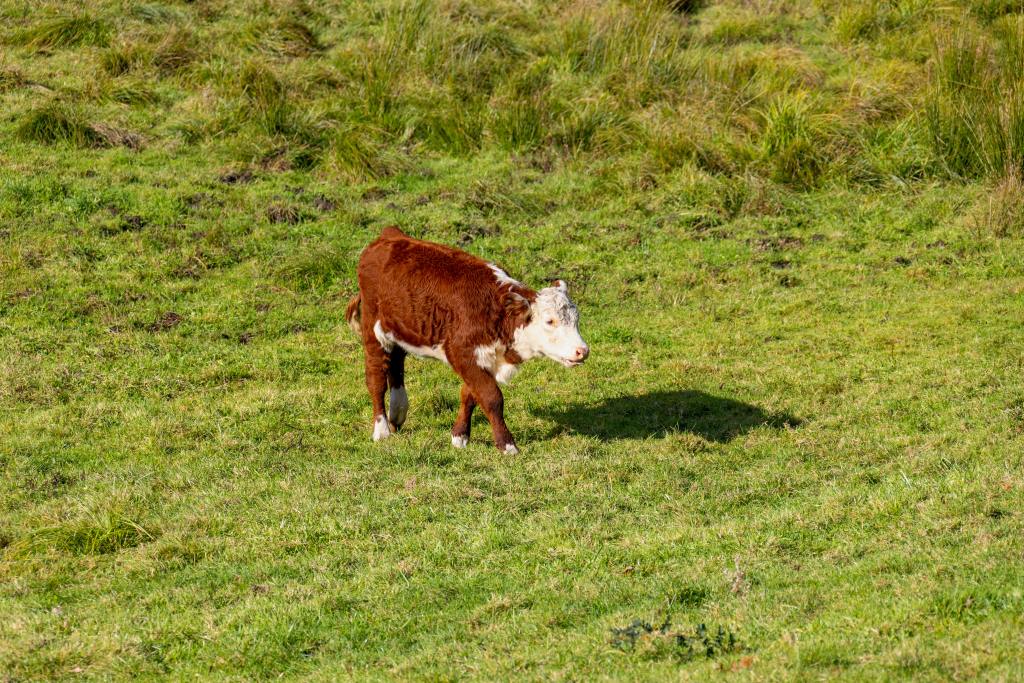
The calf scramble had become a significant event during the Saturday night rodeo. They ran all the calves into the arena, and they stood in a group at the far end, wondering what was going on. These were not baby calves. As a group, they averaged close to four hundred pounds.
The calves were heifers this year. We had to show them at the fair the following year, but there would be no auction. They became the property of the successful scrambler.
They lined us guys up in front of the rodeo chutes. We were all given a rope halter and then a brief reading of the rules. This was an individual sport. You were not to expect help from your competitors, and you were to not offer any help.
You had to catch the calf, put the halter on the calf, and lead her out of the arena. Once you had her out of the arena on the halter, she was yours.
They blew the whistle, and the race was on. There was some initial cooperation in the group of guys, with everyone helping to corner calves. But once the first couple of calves were seemingly caught, it became every man for himself.
I was in a small group, chasing a couple of calves toward the corner of the arena when suddenly, there was a calf running beside me on the left side.
I threw my left arm around her neck and locked hands. I tried to plant my heels in the soft arena dirt. The calf had no problem pulling me off my feet and dragging me across the arena. My arm maintained a solid grip around her neck.
It was not long before she was tired enough to come to a stop. With my left arm still firmly around her neck, I grabbed her by the nostrils with my right hand and pulled her head across my chest. At the same time, I stood and leaned with all my weight, pushing her to the left. She resisted for a moment, then flopped onto her left side.
I rested a moment, keeping all my weight on her neck. While I was trying to figure out how I was going to get a halter on this calf, I noticed a small group of guys gathered around me. They were not there to help. They were hoping the calf would escape my grip.
I pulled the coiled rope halter from my belt and shook it to straighten it out. Then, with my right hand, I slipped it over her nose first and pulled the upper part of the halter over her left ear. Finally, I struggled to get the halter over her right ear and tightened it to make sure it was a secure fit.
I started getting myself up, keeping one knee on the calf’s neck while I wrapped the end of the halter lead around my butt. With a deep breath, I sprang to my feet and braced myself.
The heifer righted herself to her sternum, looked around for a moment, then scrambled to her feet and started in the direction of the far end of the arena. I planted my feet, she hit the end of the rope and spun around, standing there, pulling against the lead rope.
I swung around her in a wide circle, not giving any slack in the rope. Finally, I had her pulling against the lead rope with her butt pointed toward the exit gate. I took a step, and she backed up with a constant pull against the lead rope.
The circle of guys thinned out a little when they realized I was in complete control of the situation. They were looking for other potential escapees. I made slow progress, backing the heifer toward the gate.
As I approached the exit gate, Uncle Duke and another guy came out and helped me with the last few yards. Once through the gate, the other guy took the lead rope and tied it to a fence post.
“I’ve been working these scrambles for quite a few years,” the other guy said. “I don’t think I have seen anyone walk a calf out of the arena backwards before.”
“He has trained calves to lead for the last 10 years,” Duke said. “It was a little inventive, but he knows that a will pull against the lead rope for two or three days.”
“I think we should see more of that sort of stuff,” the other guy said. “The crowd really loved it. Did you hear them?”
‘No, I didn’t hear a thing,” I said. “I was just trying to get to the gate. I thought it worked pretty well. Sort of the path of least resistance.”
There was plenty of help to lead the calf to her stall in the beef barn.
“She has to stay here tonight,” Uncle Duke said. “She can go home tomorrow afternoon when the other animals are released to go home.”
Sunday evening, we loaded her into the truck with the rest of the fair animals with no problems. She went home, and we kept her in the barn for several weeks to help tame her down. She was no longer a range animal. Rather than turning her out with other calves, we let her run with the cow herd. That way, she would come to the barn twice a day and learn that good things, grain and silage, happened in the barn.
“What are you going to name her?” Dad asked one evening.
“I have been calling her Queenie,” I said.
Queenie wintered with a herd of Jersey cows, and when spring came, I started working with her for her return trip to the Coos County fair.
Please read the rest of her story next week.
Photo Credit: Mohan Nannapaneni on Pexels.
 Memoirs of a Country Vet
Impressive technique, Doc.
LikeLike
Good writing, Doc. I can picture the whole event from your words. Looking forward to the second part of her story.
LikeLike
County fairs I find are not just fun, they inspire!
LikeLike
I’m in love with her. Can’t wait until next week. Great story!
LikeLiked by 1 person
Even back then as a teenager you were already of the creative kind. It proved to be helpful in your work as a vet (if I am to judge from your own stories) and it certainly is helpful now
LikeLike